- 382 pages
- English
- ePUB (mobile friendly)
- Available on iOS & Android
eBook - ePub
About this book
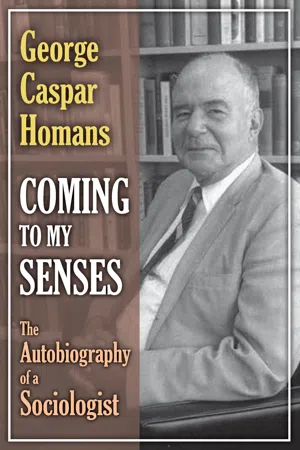
Those interested in the development of scientific theory and in the nature of academic life will appreciate this intellectual autobiography written by one of America's leading sociologists. Following his family tradition (The Education of Henry Adams was written by his great-uncle), George Caspar Homans describes how his ideas about the proper nature of theory in social science, both in form and content, have developed over time. The chief interest of the book lies in the description of this process.Homans' career has spanned many of the key periods of development in social research, and his own work has been central to the process. He was the first major sociologist to outline the sociological implications of psychologists' work on learning or behavior theory. His contributions to modern sociology have had a major impact on the study of small groups, the problem of theory and methods of theory construction, and the study of basic characteristics of social behavior. He is regarded as the father of social exchange theory.Homans considers academic and intellectual as well as nonacademic influences on his development: personalities of highly idiosyncratic individuals against whose views of culturalism, functionalism, and structuralism he reacted, discussions with colleagues, reading, as well as his ancestry, his childhood in Boston, his literary education and later social-life in Boston, and his experiences as a sea captain in the Navy in World War II. This is an absorbing book, both an autobiography and a history of the development of the social sciences in the post World War II era.
Trusted by 375,005 students
Access to over 1.5 million titles for a fair monthly price.
Study more efficiently using our study tools.
Information
1
ANCESTORS
Let me waste no time getting myself into the world and placed in it. I was born on 11 August 1910, the eldest child of Robert and Abigail (Adams) Homans, at 164 Beacon Street—the better and “water” side of the street because it looked out over the Charles River Basin—in the Back Bay district of Boston. The house belonged to my paternal grandmother, Helen Amory (Perkins) Homans, and still contained the surgery of her husband, Dr. John Homans, who had died a few years earlier.
My mother, who had just introduced me physically, must introduce me intellectually too. She was one of the nieces of Henry Adams, for whose benefit he liked to pretend he had written Mont-Saint-Michel and Chartres.1 She had written him to announce my arrival; he replied suitably, and she answered his letter with the first description of me and my possible future:
164 Beacon Street
August 27, 1910
August 27, 1910
Dear Uncle Henry:
It gratified me very much to receive your note—not only as a tribute to my own efforts, but as showing a very proper tendency on your part to recognize the advent of a future Chief Justice into the family. If you could but once see my infant you would appreciate instantly the correctness of my prognostications!! A more hard-featured mite it would be hard to find! His nose has already assumed alarming proportions, while his head is a mass of lumps which will make him look very distinguished when, as a bald old gentleman of eighty odd, he sits upon the bench dispensing justice!!
He is to be named George Caspar for my brother, as the Homans family did not consider that I was the sort of person to produce a good doctor, and so reserved the name [John] for my brother-in-law Jack’s benefit. . . .2
The Homanses were a locally famous medical family and were well aware of it. The first John Homans in this country had come from Ramsgate, Kent, England. He served for many years in the early eighteenth century as master of a vessel plying between London and Boston. When he had made enough money, he retired from seafaring, bought a farm in Dorchester, now part of Boston, and married a Yankee girl. Their son, the first Dr. John Homans, graduated from Harvard in 1772, tended the wounded on the evening of the battle of Bunker Hill, and then went on to serve through the Revolution as surgeon and adjutant of a dragoon regiment of the Massachusetts Continental Line. Since then the Homanses had produced three successive generations of surgeons, all called John, at least two of them distinguished, if being Professor of Surgery at the Harvard Medical School be a mark of distinction. The Harvard professor was my Uncle Jack, to whom my mother’s letter refers. He was the discoverer of “Homans’ sign,” the author of a famous textbook of surgery, and the wittiest of physicians, even at tense moments in the operating room. In due course he did marry and produce a son, also called John, the name reserved for him, who in turn became a physician, but an internist, not a surgeon. Though the eldest of his generation, the family did not allow my father to become a physician, since his name was Robert, not John. He became a lawyer instead.
The Homanses were right. Whether or not my mother could have given birth to a surgeon, it certainly would not have been me. I am sure I have not the proper temperament for the job. I suspect she resented the Homanses making the assumption for her. But then the Homanses would yield the wall to nobody, not even to an Adams.
The father of my Homans grandmother was William Perkins, the son of another William Perkins, who like the first Dr. John Homans had served at Bunker Hill and in the Revolutionary War, but as an artilleryman and not a surgeon. William Perkins II was an India merchant, like so many of the leading Bostonians of his time, that is, someone who owned and operated sailing ships, especially in the Far Eastern trades, and bought and sold their cargoes. His bark Beverly holds the record (eighty-five days) for the passage under sail from Boston to Calcutta (the Sand Heads).3 The flavor of the blue-water trades lingered in my youth in my grandmother’s house in the form of an exquisitely carved set of ivory chessmen from India, which we children were sometimes allowed to take out of their box and handle, and in a painting by one of the Roux family, greatest of painters of ship-portraits, of the Perkins ship Tarquin entering Havre.
My father used to say that William Perkins stuck to sailing shipping too long, that is, until after the Civil War, when steam, the Suez Canal, and the British superiority in building iron ships made the wooden sailing ships of New England increasingly less profitable. He ought to have shifted his capital, as the wise money had long since done, into cotton mills, railroads, and other products of the Industrial Revolution. He failed to do so, and lost most of it. Yet William Perkins may simply have been interested in other things. He was active in good works in Boston, particularly as president of the Provident Institution for Savings, Boston’s oldest savings bank. The early savings banks were not meant to be merely commercial enterprises, but to encourage the deserving poor by providing them with a safe depository for, and a fair return on, their savings however small. His successor at the Provident wrote of William Perkins: “In fact, I have often felt that our friend was too prodigal of his unpaid time. Time is money, and who can compute the fortune he would have accumulated and enjoyed, had he devoted to his own affairs, the time spent in the service of others?”41 have inherited little of this trait of my Perkins great-grandfather.
Both of my grandfathers died before I was born, and my Adams grandmother when I was only a year old, so that the only grandparent I can remember is my Homans grandmother, who did not die until I was fourteen. Yet I hold no vivid recollection of her. It was not that I did not visit her often in her second-floor parlor at 164 Beacon Street, looking out over the Charles River, trimmed in golden oak, and dominated by a steel engraving of Rosa Bonheur’s The Horse Fair. I also stayed with her in her beautiful and spacious country house in Ponkapoag. But all that remains is the impression of a small, plump, rather silent woman dressed in black or grey silk, happy to have me just sitting on her lap.
If I were not to be called John, since I was not of surgical material, why did I receive the rather outlandish name of George Caspar? Since Caspar was one of the three kings that followed the star to the Christ Child at Bethlehem, the name should have been perfectly respectable. Yet throughout my youth I suffered from it because a then famous comic strip had as its nonhero a spineless character called Caspar Milquetoast. As my mother’s letter records, she named me after her eldest brother, George Caspar Adams, who died shortly before I was born. She had two other older brothers, Charles Francis and Arthur, but no sister.
Everyone, including my mother, loved George, but he became an alcoholic and drink finally killed him. He himself was named after my mother’s grandfather, George Caspar Crowninshield. The Crownin-shields include my most romantic, eccentric, and wicked ancestors.5
In 1684 there landed in Boston a man calling himself Johannes Kaspar Richter von Kronenscheldt. He claimed to be descended from a long-ennobled family of the kingdom of Saxony; hence his use of the particle von. He had come from Germany to Boston by way of England and further affirmed that he was a trained physician. That was all he ever said about himself. My mother always believed that he had fled from Leipzig because he had killed a man in a duel. But when in the nineteenth century his descendants employed genealogists to trace him in the German records, they could find no hint even of his existence. There must have been something profoundly bogus about him. Here was a rare bird to be admitted to the sober Puritan dovecote.
But admitted he was. He settled in Salem, Massachusetts, married a Salem girl, and even made a living practicing medicine. The Yankees, who were never good at pronouncing foreign names, called him “Groun-cell.” Later it was Anglicized as Crowninshield. What is more surprising, he became a friend of the most prominent Puritan minister of the time, Cotton Mather, even though Mather admitted he was “a little atheisticall.” One may well wonder why Mather was willing to make a friend of anyone who was “atheisticall” at all.
Johannes Kaspar left several sons, who followed the sea. There was nothing much else for Salem boys to do in those days. I am particularly interested in one of his grandsons, George Crowninshield. He too followed the sea, serving among other things as shipmaster for Elias Hasket ("King") Derby. Derby made a great fortune as an operator of privateers during the American Revolution and as a merchant-ship owner before and afterward: he was the first American millionaire. Remember that, according to the international law of the time, it was quite within the rights of a government at war with another to issue to private armed vessels papers entitled “letters of marque and reprisal” authorizing the vessels to capture enemy ships and to sell both the ships and their cargoes—if, of course, they could reach a friendly port. Hence such privateers were often called “letters of marque.” While the Homanses, Perkinses, and Adamses were serving their country during the Revolution in the Continental Army or in Congress for modest salaries, the Crowninshields were doing so at sea—for the capture or destruction of British shipping certainly served the American cause—and making a great deal of money at it. Lest we sneer at the legalized piracy that was privateering, remember that it entailed great risks: a privateersman stood in greater danger of death by gunshot or drowning than did the ordinary soldier of the Continental Army.
George Crowninshield married his boss’s sister; his own sister married the boss himself. No sooner had he thus allied himself with the Derbys than he fought with them. He came to hate his brother-in-law, and he was a good hater. An historian of the family says of him: “George Crowninshield was like the badger of proverb: he never bit but what he made his teeth meet.”6 Their fellow townsmen spoke of the Crowninshields as possessing “fair faces but black hearts.” Perhaps George hated the Derbys because he would be second to none. At any rate, he and his sons set up on their own as the firm of George Crowninshield and Sons.
The company’s first coup was to come close to cornering the pepper trade to the United States and Europe from the wild west coast of Sumatra. The Dutch in theory, the native rajahs in fact, controlled the island, and the Crowninshields dealt with the rajahs. The difficulty was that the rajahs would not sell pepper except for coin, and coin was always in short supply in the young United States. Therefore the Crowninshield ships had to make a series of preliminary voyages and trades before they could accumulate enough coin to pay for the pepper. Then they had to get it back to Europe or Salem. It was a trade that took seamanship, diplomacy, hard but fair bargaining, guts, and luck. The company also did well in Arabian (mocha) coffee. For a time the Indian Ocean was its pond.
Pepper and coffee founded the fortune of George Crowninshield and Sons. Privateering in the next war against Great Britain, the War of 1812, consolidated it. The Crowninshields sent to sea the largest single fleet of American privateers to prey on British shipping. Not only was theirs the largest fleet but also—which does not necessarily follow—the most successful. The company made some twenty million dollars in today’s money out of British prizes. That may not seem a huge sum now, but it was proportionately greater then. The Crowninshields owned more ships and employed more seamen than the United States Navy itself.
As soon as they could afford to do so, the Crowninshields took political as well as economic supremacy away from the old families of Salem, particularly the Derbys. The merchants of the New England ports were Federalists almost to a man, and Federalists who followed the policies of Hamilton rather than those of President John Adams. Accordingly the Crowninshields practically had to be anti-Federalist, which made them Jeffersonian Democrats in fact if not in name. After several defeats, Jacob, George’s second son, finally crushed the Federalists by beating their candidate in the congressional elections of 1803. The contenders on both sides fought dirtily and savagely, but the Crowninshield savagery was the stronger. In 1814 President Madison appointed another son, Benjamin William, as secretary (naturally) of the Navy. Ben later represented Essex County in Congress. I am a descendant of Ben’s.
When the War of 1812 ended, George Crowninshield, Jr., the eldest of the brothers, had built for himself an hermaphrodite brig, elegantly fitted out and painted in herringbone pattern on one side of the hull, in stripes on the other. He christened her Cleopatra’s Barge, and she is famous as “the first American yacht.” Since one hates someone one has injured, George hated the British, and therefore admired Napoleon. He sailed in the Barge on a voyage to the Mediterranean in a feckless search for Napoleonic relics. Shortly after returning to Salem he died, leaving no legitimate children, and the Barge was later lost while serving as the Hawaiian royal yacht.
The Crowninshields were sometimes just plain wicked. If Johannes Kaspar may perhaps have been a murderer, a descendant of his, Richard Crowninshield, Jr., certainly murdered, and not for the relative honest motive of passion but for just plain pay. His father had been one of the famous group of brothers, but they did not take him into the company, apparently because, though like the others he was a sea captain, he was not a successful one. There lived in Salem a certain Joseph White, eighty-two years old, who had made money, like the Crowninshields themselves, as a master mariner and a merchant. His favorite niece had vowed to marry a man named Knapp, of whom White disapproved so much that he prepared to disinherit her. By 6 April 1830, it looked as if the contending parties might be reconciled. All the same, on the next morning Captain White was found dead in his bed, his skull broken by the proverbial blunt instrument and no less than thirteen stab wounds near his heart—a case of overkill. Within a few days an informer for the police declared George Crowninshield had told him that two Knapp brothers had offered George and his brother, Richard, Jr., one thousand dollars to kill White, perhaps to forestall his changing his will. The Knapps and the Crowninshields were thrown into jail, where on 5 June 1830 Richard managed to hang himself, thus in effect confessing that he had a part in committing the crime. No less a man than Daniel Webster prosecuted the remaining prisoners as accomplices. Generations of American schoolchildren had to read and even memorize his eloquent speech describing the midnight murder. The Knapp brothers were convicted and hanged. No one doubted that George Crowninshield was one of the gang, but the evidence against him was weak, and his case was dropped. He lived to an advanced age, childless, and still protesting his innocence.
When in my youth a number of Crowninshield descendants gathered together at some festive occasion like a wedding, we would take a perverse pleasure in raising the cry “Crowninshields this way!” and then drinking two toasts, first, “To the hired murderer!” and then, “To the worst blood in New England!” We were giving ourselves too much credit, for the hired murderer was only a collateral ancestor of ours.
By 1830 the great days of Salem and the seafaring Crowninshields were over. In the opening of The Scarlet Letter, Nathaniel Hawthorne, himself a Salem man, describes the stagnation at the old Customs House. My great-grandfather George Caspar Crowninshield left Salem for the Boston suburb of Longwood. He did not go to sea but stayed at home and managed his not inconsiderable capital. Indeed he increased it by marriage. Just as Charles Francis Adams the first married the daughter of Peter Chardon Brooks, reputed the richest man in New England in his time, so George Caspar married the daughter of David Sears, the richest in his. The Searses set themselves up to be, as we used to say, “some punkins,” being descended from a prominent Pilgrim Father. My own father would scornfully allege that David Sears came from a livery stable on Cape Cod. That is, he was a nouveau riche in the Boston of the midnineteenth century. These concentrations of wealth, though large for the time, did not last many generations. The families were prolific, and though I believe fathers might legally leave all their money by will to their eldest sons, they usually in fact divided it equally among their children.
One of the offspring of the Crowninshield-Sears marriage was my grandmother, Fanny Cadwallader Crowninshield, named after a Philadelphia friend of her mother’s. As a young woman she must have been exceptionally beautiful, for she was chosen as one of the local belles to dance with the Prince of Wales at a ball given for him when he visited Boston in 1860. She married my grandfather Adams in 1861. Otherwise Fanny sounds a bit stuffy, and whatever else may be said of the Crowninshields, stuffiness was not one of their usual traits. My mother claimed, for instance, that Fanny refused to recognize the social existence of Mrs. “Jack” Gardner, because she held that Mrs. Jack was “no better than she should be,” that is, a good deal worse morally than she ought to be. No one but my grandmother was the loser by taking this line of high respectability. She did no harm to Mrs. Jack, who was a woman of the greatest charm and distinction, a friend of all the ablest artists, writers, and musicians of her time, and the creator of the famous Isabella Stewart Gardner Museum ("Fenway Court") in Boston.
Of my four grandparental families, I leave the Adamses to the last, for far too much has already been written about them. My grandfather, John Quincy Adams II, was the eldest of the four sons of Charles Francis Adams, minister to the Court of St. James during the Civil War, and the only one of the four who was not a writer. Charles II (who was also a railroad magnate), Henry, and Brooks all wrote like mad, but my grandfather not a word more than he could help. But if the others were famous, my grandfather was more charming. My mother adored him, and my father declared that he was the most popular man in Massachusetts, in spite of his adopting the ...
Table of contents
- Cover Page
- Title Page
- Copyright Page
- Dedication
- Acknowledgements
- Preface
- 1 Ancestors
- 2 The Back Bay
- 3 Parents
- 4 School
- 5 Harvard College
- 6 DeVoto, Henderson, Zinsser
- 7 Curtis and Pareto
- 8 The Society of Fellows
- 9 Mayo I: Psychology
- 10 Mayo II: Social Anthropology
- 11 Medieval England
- 12 Sailing with Uncle Charlie
- 13 Dining with Ba
- 14 The Navy I: Hazel, Accentor, and YMS 59
- 15 The Navy II: Aruba-Curaçao
- 16 The Navy III: Trinidad-Recife
- 17 The Navy IV: The Pacific
- 18 Harvard after World War II
- 19 The Human Group
- 20 Theory and Explanation
- 21 Social Behavior
- 22 Summary: Medfield
- Index
Frequently asked questions
Yes, you can cancel anytime from the Subscription tab in your account settings on the Perlego website. Your subscription will stay active until the end of your current billing period. Learn how to cancel your subscription
No, books cannot be downloaded as external files, such as PDFs, for use outside of Perlego. However, you can download books within the Perlego app for offline reading on mobile or tablet. Learn how to download books offline
Perlego offers two plans: Essential and Complete
- Essential is ideal for learners and professionals who enjoy exploring a wide range of subjects. Access the Essential Library with 800,000+ trusted titles and best-sellers across business, personal growth, and the humanities. Includes unlimited reading time and Standard Read Aloud voice.
- Complete: Perfect for advanced learners and researchers needing full, unrestricted access. Unlock 1.5M+ books across hundreds of subjects, including academic and specialized titles. The Complete Plan also includes advanced features like Premium Read Aloud and Research Assistant.
We are an online textbook subscription service, where you can get access to an entire online library for less than the price of a single book per month. With over 1.5 million books across 990+ topics, we’ve got you covered! Learn about our mission
Look out for the read-aloud symbol on your next book to see if you can listen to it. The read-aloud tool reads text aloud for you, highlighting the text as it is being read. You can pause it, speed it up and slow it down. Learn more about Read Aloud
Yes! You can use the Perlego app on both iOS and Android devices to read anytime, anywhere — even offline. Perfect for commutes or when you’re on the go.
Please note we cannot support devices running on iOS 13 and Android 7 or earlier. Learn more about using the app
Please note we cannot support devices running on iOS 13 and Android 7 or earlier. Learn more about using the app
Yes, you can access Coming to My Senses by George Caspar Homans in PDF and/or ePUB format, as well as other popular books in Social Sciences & Social Science Biographies. We have over 1.5 million books available in our catalogue for you to explore.