- 316 pages
- English
- ePUB (mobile friendly)
- Available on iOS & Android
eBook - ePub
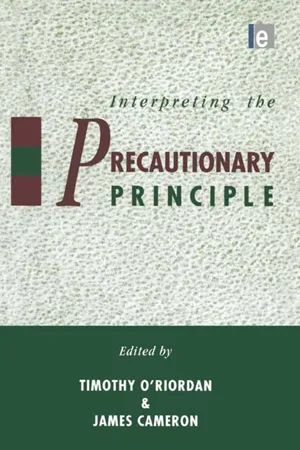
Interpreting the Precautionary Principle
About this book
Viewed from the perspective of environmental management, this study describes the implications and applications of the precautionary principle - a theory of avoiding risk even when its likelihood seems remote. This principle has been employed in the United Nations Framework Convention on Climate Change and the North Atlantic Convention, yet it is not widely understood. This study examines the history and context of the principle, and its applications to law, governmental policies, business and investment, scientific research and international relations.
INTERPRETING THE PRECAUTIONARY PRINCIPLE
Part I
History and Context of the Precautionary Principle
Chapter 1
The History and Contemporary Significance of the Precautionary Principle
The precautionary principle is a culturally framed concept that takes its cue from changing social conceptions about the appropriate roles of science, economics, ethics, politics and the law in pro-active environmental protection and management. As this book will reveal, it is a rather shambolic concept, muddled in policy advice and subject to whims of international diplomacy and the unpredictable public mood over the true cost of sustainable living. Because of the insistence and persistence of the sustainability debate, largely as a result of the much analysed UN Conference on Environment and Development held in Rio de Janeiro in June 1992, precaution thrives in the flux of values and new organisational arrangements generated by the Rio meeting.
Above all, however, precaution continues to evolve because of the peculiar requirements of adjusting to global environmental stresses and strains. Humanity is in trouble: up to 10000 people die daily because of avoidable environmental foreclosure in their wretched lives. The earth itself is showing signs of wear and tear in terms of soil erosion, savage loss of land cover, potentially massive species loss, destruction of stratospheric ozone, and a huge gamble with future climate, to say little of ubiquitous toxification of ecosystems, excessive demands on water resources and mounting piles of waste materials. All these points are well covered in regular reports by the World Resources Institute (1993), Worldwatch Institute (1993), the UN Environment Progamme (1993), the World Bank (1992) and the Organisation for Economic Cooperation and Development (1991) together with thoughtful anthologies by Simmons (1989), Turner et al. (1991) and Myers (1993). Global environmental change stimulates the precautionary principle in three ways:
The requirement of collective action
The global “commons” is a life support system of intricate complexity. We are only just beginning to realise how unique and precious it is in the cosmos as a whole. More to the point we are slowly recognising how utterly vital it is for our survival as a civilised and wealth generating species. It is still incalculable how much it would cost us to replace by artificial means all of the services that natural systems provide in assimilating, buffering, cleansing and absorbing, to say nothing of their primary role, namely redistributing chemical and physical energy to renew life in every nook and cranny of the globe. Jim Lovelock in Chapter 5 makes a stab at the air conditioning value of tropical forests – one small point of a myriad of functions supplied by these mysterious ecosystems. He concludes they are at least worth the total value of annual wealth generated by humanity itself. He may be far out, who knows: but his analysis points to the crucial issue that we have for far too long taken these functions as not only free and accessible, but also indestructable.
To safeguard these critical life support processes requires collective action by every nation state and every global citizen. We do not know how far they are being stressed, though the consensus is that this stress is fairly massive. Nor do we know how close to breakdown any or all of these functions may be. Because everyone has to play their part, and because we must allow the earth room to breathe, so precaution adopts the mantle of earth protector and earth shop steward.
The requirement of burden sharing
Not all countries are equally in a position to play their part as protector or steward. So precaution has to enter the realm of broker and facilitator in devices to help the strong to assist the weak in the common cause of survival. The Rio Conference essentially failed to extract any commitment from the rich to the poor. But in its declaration 15 it did accept that the application of precaution should be handled by each country according to its capabilities. This opens up the scope for burden sharing by recognising that those whose greater wealth has in part been won at the expense of the poor and of environmental life support systems have a greater moral and public responsibility to help those unable in themselves to follow a precautionary and sustainable growth right now.
The rise of global citizenship
Global change naturally is time driven. Then full effects of current disruption will only be felt by the next two generations, and all of the second remain to be born. Global citizenship means taking care across both space and time, recognising that every individual act has implications not only for the household undertaking it, but for all households on the earth today, and the billion or so of new households that will be formed within 25 years. Each additional molecule of CO2 or chlorofluorocarbons or methane remains active for at least 25 years, and usually over 50 years. An unknown number of our actions have incipient global and generational implications. Precaution captures this mood of a new self interest in collective “sacrifice”, namely that good citizenship is both a life saver and a recognition of solidarity with creation. Only by anticipating possible catastrophe and by taking care over every daily practice can we imbue a precautionary sensitivity in ourselves and our offspring.
There are reasons enough for introducing a precautionary line of thinking into all human cultures. As the text that follows suggests, and as the editorial introductions to each of the three main sections of the book elaborate, three additional factors are shaping the evolution of the precautionary principle in modern environmentalism:
Extending science
Natural processes appear to operate in ways that are not fully understood by conventional scientific methods. Indeed much of the life support functions already described may act in an indeterminate, and hence act in a thoroughly unpredictable manner. The usual scientific approaches, dependent on observation, verification, falsification and replication coupled to prediction by reference to statistical inference, hypothesis testing and modelling may not be sufficient to instil confidence. Of crucial significance is that elusive zone where phase changes in such systems might occur. These would result in possible catastrophic convulsions in human use of the earth and huge costs of remediation or substitution. Society is terribly ambivalent about this matter. Catastrophe is truly too awesome to contemplate so is sidestepped. But natural resilience, though always profoundly impressive and humbling to contemplate, cannot be relied upon forever. This dilemma is well described by Simmons (1989).
Anticipatory action
International agreements covering global or regional environmental protection are increasingly based on proactive or preventative measures which encompass collective action and burden sharing. As a result signatories to major agreements have to give to significant changes in their economies and lifestyles ahead of scientific proof of the likely gains of making such sacrifices. This is one of the most awkward aspects of applying the precautionary principle in a democracy. Citizens like to be assured of the justification of pain and forebearance. When the cost benefit analysis look alarmingly loaded in favour of high initial expenditures for uncertain and distant gains, occurring well beyond present lifetimes of voting and taxpaying families, proaction in a self serving democracy becomes sorely tested.
Shifting the burden of proof
As evidence of life-threatening environmentl transformation accumulates, wealthy societies at least, and impoverished cultures if given the option, are becoming more risk averse. They expect better guarantees of zero discharges or strictly limited damage before allowing change to proceed. This is inevitably shifting the burden of proof onto those who propose to alter the status quo, rather than simply to expect victims subsequently to seek compensation. This is having a major effect on the common and statute law of liability with far greater emphasis on self insurance or shared compensation pools. Inevitably the protection of adequate statutory regulation backed by national and international cash safeguards will be required, but that is a little way off. It is of interest to note that bilateral and multilateral aid agencies are increasingly being required to ensure proactive safeguards to ensure that local inhabitants are not defenceless in any case of environmental liability (see Costanza and Cowell, 1992).
Definitions of the precautionary principle
As Sonja Boehmer Christiansen points out in the chapter that follows, the prcautionary principle evolved out of the German socio-legal tradition, created in the heyday of democratic socialism in the 1930s, centering on the concept of good household management. This was regarded as a constructive partnership between the individual, the economy and the state to manage change so as to improve the lot of both society and the natural world upon which it depended for survival. This invested the precautionary principle with a managerial or programmable quality, a purposeful role in guiding future political and regulatory action.
As Boehmer Christiansen argues, the German concept of Vörsorgeprinzip means much more than the rough English translation of foresight planning. It absorbs notions of risk prevention, cost effectiveness but in a looser economic framework, ethical responsibilities towards maintaining the integrity of natural systems, and the fallibility of human understanding. The right of nature means, in part, giving it room to accommodate to human interference, so precaution presumes that mistakes can be made. For the Germans, therefore, precaution is an interventionist measure, a justification of state involvement in the day to day lives of its lander and its citizenry in the name of good government. Social planning in the economy, in technology, in morality and in social initiatives all can be justified by a loose and open ended interpretation of precaution. As we shall see, it is precisely the unravellability that makes precaution both feared and welcomed.
Throughout the late 1970s and early 1980s these notions of care and wise practice have been extended to six basic concepts now enshrined in the precautionary principle.
(i) preventative anticipation: a willingness to take action in advance of scientific proof of evidence of the need for the proposed action on the grounds that further delay will prove ultimately most costly to society and nature, and, in the longer term, selfish and unfair to future generations.(ii) safeguarding of ecological space or environmental room for manoeuvre as a recognition that margins of tolerance should not even be approached, let alone breached. This is sometimes known as widening the assimilative capacity of natural systems by deliberately holding back from possible but undesirable resource use.(iii) proportionality of response or cost-effectiveness of mar gins of error to show that the selected degree of restraint is not unduly costly. This introduces a bias to conventional cost benefit analysis to include a weighting function of ignorance, and for the likely greater dangers for future generations if life support capacities are undermined when such risks could consciously be avoided.(iv) duty of care, or onus of proof on those who propose change: this raises profound questions over the degree of freedom to take calculated risks, thereby to innovate, and to compensate for possible losses by building in ameliorative measures. Formal duties of environmental care, coupled to an extension of strict liability for any damage, no matter how unanticipated, could throttle invention, imagination and growth. Alternatively, when creatively deployed such strictures could encourage imagination and creativity in technology, economic valuation, technological advance and unusual forms of ameliorative compensation. Hence the concept of proportionality can be regarded either as a deadweight or a touchstone for the visionary.(v) promoting the cause of intrinsic natural rights: the legal notion of ecological harm is being widened to include the need to allow natural processes to function in such a manner as to maintain the essential support for all life on earth. The application of ecological buffers in future management gives a practical emphasis to the thorny ethical concept of intrinsic natural rights.(vi) paying for past ecological debt: precaution is essentially forward looking but there are those who recognise that in the application of care, burden sharing, ecologically buffered cost effectiveness and shifting the burden of proof, there ought to be a penalty for not being cautious or caring in the past. This suggests that those who have created a large ecological burden already should be more “precautious” than those whose ecological footprints have to date been lighter. In a sense this is precaution put into reverse: compensating for past errors of judgement based on ignorance or an unwillingness to shoulder an unclearly stated sense of responsibility for the future. This element of the principle is still embryonic in law and practice, but the notion of “common but differentiated responsibility” enshrined in the UN Framework Convention on Climate Change, and the concept of conducting precaution “according to capabilities” as laid down in principle 15 of the Rio Declaration reflect to some extent these ideas.
By no means all of these interpretations are formally approved in international law and common practice. At present the line is to act prudently when there is sufficient scientific evidence and where action can be justified on reasonable judgements of cost effectiveness and where inaction could lead to potential...
Table of contents
- Cover
- Half Title
- Title Page
- Copyright Page
- Table of Contents
- Foreword
- Part I – History and Context of the Precautionary Principle
- Part II – Implications for Science
- Part III – Implications for Management
- Part IV – The International Dimension
- Part V – The Future
- Index
Trusted by 375,005 students
Access to over 1.5 million titles for a fair monthly price.
Study more efficiently using our study tools.
Frequently asked questions
Yes, you can cancel anytime from the Subscription tab in your account settings on the Perlego website. Your subscription will stay active until the end of your current billing period. Learn how to cancel your subscription
No, books cannot be downloaded as external files, such as PDFs, for use outside of Perlego. However, you can download books within the Perlego app for offline reading on mobile or tablet. Learn how to download books offline
Perlego offers two plans: Essential and Complete
- Essential is ideal for learners and professionals who enjoy exploring a wide range of subjects. Access the Essential Library with 800,000+ trusted titles and best-sellers across business, personal growth, and the humanities. Includes unlimited reading time and Standard Read Aloud voice.
- Complete: Perfect for advanced learners and researchers needing full, unrestricted access. Unlock 1.5M+ books across hundreds of subjects, including academic and specialized titles. The Complete Plan also includes advanced features like Premium Read Aloud and Research Assistant.
We are an online textbook subscription service, where you can get access to an entire online library for less than the price of a single book per month. With over 1.5 million books across 990+ topics, we’ve got you covered! Learn about our mission
Look out for the read-aloud symbol on your next book to see if you can listen to it. The read-aloud tool reads text aloud for you, highlighting the text as it is being read. You can pause it, speed it up and slow it down. Learn more about Read Aloud
Yes! You can use the Perlego app on both iOS and Android devices to read anytime, anywhere — even offline. Perfect for commutes or when you’re on the go.
Please note we cannot support devices running on iOS 13 and Android 7 or earlier. Learn more about using the app
Please note we cannot support devices running on iOS 13 and Android 7 or earlier. Learn more about using the app
Yes, you can access Interpreting the Precautionary Principle by Timothy O'Riordan, James Cameron in PDF and/or ePUB format, as well as other popular books in Business & Insurance. We have over 1.5 million books available in our catalogue for you to explore.