- 240 pages
- English
- ePUB (mobile friendly)
- Available on iOS & Android
eBook - ePub
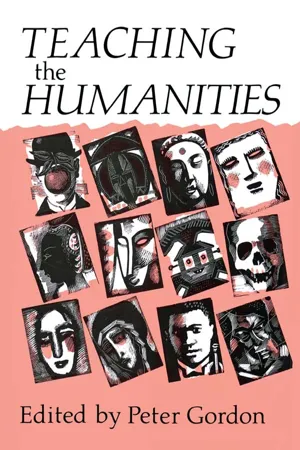
Teaching the Humanities
About this book
First Published in 1991. The contributors to this book share the belief that the teaching of humanities should form an essential part of the school curriculum. It includes the areas of the scope of humanities, the cultural dimension of classroom language learnings and cross-curricular subjects of Geography, Reglues Education, Art and History as well as looking at computer assisted learning, how to handle controversial issues and case studies.
Information
1
Approaching the Humanities
The contributors to this book share the belief that the teaching of humanities should form an essential part of the school curriculum. As Kenneth Baker, then Secretary of State for Education, told the British Academy in July 1988:
It is my conviction that in this country, as nowhere else, the tradition of humanities teaching has continuing vitality and relevance. I am quite clear that every civilised society, to remain civilised, needs to develop in its citizens the aptitudes and intuitions which flow from engagement with the humanities. The humanities are an inter-related effort to give intellectual expression to the significance of what it is to be human. (DES, 1988)
Given the general consensus that some understanding of the nature of humanities and the insights which this affords is of value to all, the history of the teaching of humanities in school has been remarkably neglected. By tracing its origins and subsequent history, we can perceive the forces which have been responsible for shaping its development.
Although the curricula of the grammar and public schools were traditionally based on the humanities, with science being introduced at a late stage, this tradition was not carried over into the elementary school curriculum after the 1870 Education Act. In the first instance, attention was directed to those who had left school and required continuous and systematic encouragement in instruction for ‘the steady improvement of public opinion’. Arthur Acland, later to be Vice-President of the Committee of Council on Education in Gladstone’s final ministry, advised in his book The Education of Citizens (1883) that the social aspects of citizenship could be best taught under three headings: through social and economic subjects, which dealt with education, health, and local and central government; through literature, as a means of affording insights into the meaning and moral purpose of many of the characters; and history, seen as a study of decisive moments which have helped to shape our society and institutions. Education should lead to self-restraint and self-reliance, and to individuals becoming more tolerant of other people’s opinions (Acland, 1883, p.8).
A few years later, this movement was paralleled at school level by the formation in 1897 of a Moral Instruction League, consisting of educationists and philosophers, whose stated aim was ‘to substitute systematic non-theological moral instruction for the present religious teaching in all State schools, and to make character the chief aim of school life’. In its early years, the League was able to exert much influence. The Board of Education’s Suggestions for the Consideration of Teachers and Others concerned in the Work of Public Elementary Schools (later retitled Handbook of Suggestions), published in 1905 clearly stated that
The good Moral Training which a school should give cannot be left to chance; on this side, no less than on the intellectual side, the purpose of the teacher must be clearly conceived and intelligently carried out.
Within three years, almost a third of the 327 LEAs in England and Wales were making provision for moral instruction. For many reasons, not the least the advent of the First World War and an undue emphasis on the production of manuals of moral ‘teaching’, the League’s influence declined, and its title was changed to the Civic Education League (Hilliard, 1961, p.61).
The post-war climate was amenable to rethinking the place of humanities. For one thing, the war had produced an awareness of the need for harmony within society; progressive educational theories placed the individual pupil in the centre of the learning process: and there were growing demands that education should be more directly related to the realities of modern living.
Nowhere was this more clearly demonstrated than in the plans made for the curriculum of the continuation schools set up under the 1918 Education Act. These part-time schools were intended to cater for the entire adolescent population of the country, with the exception of those students who were already receiving full-time instruction in secondary schools. The school-leaving age had been raised to 14 by the Act and its supporters were enthusiastic to provide a bridge between school and work with a curriculum which would be of value to those attending these new institutions.
A very interesting pamphlet was issued by the Board of Education in 1921 entitled Humanism in the Continuation School in which the place of the humanities in an industrial society was discussed. A bold challenge was made in the Introduction:
It is not technical instruction we stand in need of so much as an informed humanism, which welcomes and understands the results of technical achievement, faces them boldly, and declares that the works of man’s hand, even in these grimy days, deserve the blessing which, up to the advent of materialism, poetry, art and culture have always rejoiced to bestow upon them. For the first time in history a fatal schism has arisen between culture and the crafts, with the result that modern culture tends to be trivial, esoteric, dilettante, while the crafts, from which poet and artist turn away in disgust, are left mean, ugly and formless. In the continuation schools of the future we have an opportunity of doing something to bring these natural allies together once more, and so to lend our assistance, however feeble, to the re-establishment of our civilisation upon a sound basis. (Board of Education, 1921, p.6)
For the author of the pamphlet, J. Dover Wilson, then one of His Majesty’s Inspectors, humanities in education meant
the awakening and liberation of the spirit in the individual child by cleansing the channels and increasing the flow of his self-expression, by making him conscious of his heritage and of his true function in society, and lastly by teaching him to take flight upon the wings of imagination. It embraces, in other words, all those subjects which deal with man as man: man, as an individual soul dedicated to the pursuit of Beauty, Truth and Goodness; man, as a social being with obligations to his immediate society, his nation and the whole human race; man, as the lord of creation, weighing the stars in his balances, dividing infinitesimal from infinitesimal, peering into ‘the dark backward and abysm of time’. (ibid, pp.8–9)
The essential subjects were those that began with man, especially art, literature, music, history, geography and economics.
This ambitious scheme was given little chance to flourish, falling foul of the twin factors of the post-war economic depression and the opposition of employers to the new type of school. Official reports paid some lip-service to the need for a humanities dimension in the curriculum. The Hadow Report, entitled The Education of the Adolescent (1926), which dealt only with the elementary sector, recommended the study of society, but for less able pupils. Similarly, the Spens Report on Grammar and Technical High Schools (1938) encouraged the teaching of economics, though claiming that it was more suitable for sixth-formers than for a younger age group. An insight into the attitude of the largest education authority in the country, the London County Council, is afforded in a document circulated by its Chief Inspector, F. H. Spencer, in 1933. Looking into the possibilities of teaching civics in schools, Spencer wrote:
In the teaching of History and Geography, especially, but also in Literature, Music and Arithmetic, opportunities occur for promoting interest in or some training for citizenship and legitimate national and local patriotism. It is undesirable to prescribe or even to encourage the teaching of civics as a separate subject in elementary schools … The subject, in exceptional cases, need not, however be proscribed. (LCC, 1933)
After the 1944 Education Act had established secondary education for all, the question arose of the most appropriate curriculum for the new secondary modern school, which catered for the majority of pupils. The revival of education for citizenship was officially encouraged in a Ministry of Education pamphlet Citizens Growing Up (1949). New teaching techniques were needed for pupils to achieve an independent outlook and the ability to form judgments based on evidence. The pamphlet suggested that artificial barriers should be broken down between subjects. The study of man in society should permeate the matter of all organised studies.’ History and geography, taught in a way which made them ‘socially relevant’, would make a good basis for such a study. The Social Studies movement, which was popular in secondary modern schools during the 1950s, failed for a number of reasons (Lawton and Dufour, 1973, pp.8–9), not least because the more able were on the whole excluded from such work. A revival of interest in Social Studies from the 1960s, which adopted a social science approach, was more successful.
A new surge of interest in the humanities was the prelude to further action on the school curriculum. The public imagination was caught by a book entitled Crisis in the Humanities, published in 1964, edited by the historian J.H. Plumb. It consisted of contributions from a number of academics in the humanities field and demonstrated the lack of confidence in disciplines such as classics, history, philosophy, divinity, literature and the fine arts since the Second World War. With the growth of a technological society, the humanities had attempted to become more ‘scientific’, in the process of which they had become less intelligible to their audiences. A new look at the nature and purpose of the humanities was essential (Plumb, 1964, p.30).
At the same time, changes were taking place within the education system itself. The Robbins Report on Higher Education (1963) recommended the establishment of more universities for the growing population of suitably qualified candidates: several of the new institutions had strong humanities faculties. In another official document, the Newsom Report (1963), the Central Advisory Council for Education made its recommendations for the education of pupils aged 13 to 16 of average and less than average ability. Entitled Half Our Future, the Report surveyed the whole field of secondary education and made several recommendations which had important implications for all secondary pupils, both in terms of organisation and curriculum. The philosophy propounded in the Newsom Report impressed ministerial thinking and was to lead to swift action. Chapter 19, headed ‘The Humanities’, considered the nature, content and purpose of this large area of the curriculum. A section entitled ‘The Proper Study of Humanities’ begins:
The importance of history and geography, or the social studies in which they are sometimes merged, seems obvious. A man who is ignorant of the society in which he lives, who knows nothing of its place in the world and who has not thought about his place in it, is not a free man even though he has a vote. He is easy game for ‘the hidden persuaders’. (Ministry of Education, 1963, para. 499)
Unlike earlier reports, however, it takes a wider and more systematic view of the range of possible contributions to humanities programmes. The main aim of teaching was the personal development and social competence of the pupil. History should enable pupils to enter imaginatively into other men’s minds, and cultivate intuitive awareness rather than rational fact-finding. In geography, the cultural, psychological and economic problems needed to be studied as well as land masses. The approaches of a historian and a geographer are often required together, though the Report is firm in denying that these subjects alone can provide adequate answers. ‘Most of the illustrations we used lead on into the field of moral judgements. No review of the world situation can fail to show boys and girls how strong and how various are the faiths by which men live’ (para 514). Close association with religious education teaching was thus recommended for humanities.
The Newsom Report appeared at a time when the existing secondary school system was changing. With the return to office of a Labour government in 1964, comprehensive school reorganisation was speeded up; by the late 1960s, 104 of the 131 LEAs had plans to abolish allocation procedures (NFER, 1969, p.19). Differences between types of secondary schools lessened with the merging of grammar and modern schools. One of the recommendations of the Newsom Report was that the school-leaving age should be raised to 16, echoing the earlier Crowther Report on Early Leaving (1959). The arguments contained in Newsom for this move were crucial in persuading the Secretary of State for Education, Sir Edward Boyle, in 1964 to approve the raising of the leaving age (ROSLA) in 1970–71, subsequently delayed a year (Boyle and Crosland, 1971, p.138).
Preparations for dealing with the demands which would be made on the secondary curriculum, especially in the fourth and fifth years, by ROSLA, were now seen as a priority. In 1964, the Schools Council for Curricula and Examinations, a body consisting of teachers’ representatives, LEAs and the DES, was established. One of its major tasks was to find ways of organising means of reviewing and reforming the school curriculum in England and Wales. Resources were made available for developing curriculum projects which would assist teachers. One of the first priorities was given to proposals concerned with ROSLA.
An important statement of how progress could be achieved was set out in Schools Council Working Paper No. 2, Raising the School Leaving Age. A Co-operative programme of research and development (1965). The Working Paper laid great stress on the part to be played by the humanities in presenting a more acceptable curriculum to the older age group. A feasibility study in the humanities was jointly financed and organised by the Council and the Nuffield Foundation; it addressed the problem of helping a typical comprehensive school in presenting a scheme for English, religious education, history and geography for pupils of average and below average ability. Up to a third of the weekly timetable would be available for the new course.
The targetting of the ‘young school leaver’, and the Council’s assumption that humanities courses should be designed only for this group identified by the Newsom Report, were unfortunate for the development of humanities. As was pointed out in Working Paper No. 11, Society and the Young School Leaver (1967) which reported on the feasibility study, it was not possible
to separate the educational needs of the ‘young school leaver’ from those of ‘the GCE pupil’. There are not two distinct types of curriculum for these two categories, and, of course, in terms of school organization the categories are themselves becoming even less distinct. Much of what is in this report is relevant to the pupil who leaves school at 18. (p.iv)
In addition, the report dismissed artificial limitation of the term ‘humanities’ to a water-tight section of the curriculum: teachers of art, music, languages and science, for instance, could contribute to the broad educational purpose of the programme.
Nevertheless, the majority of Schools Council curriculum research and development projects in the humanities area for secondary pupils were aimed at the average and below average. They were criticised on the grounds that they reflected the status quo rather than attempting to change it (Gordon, 1989, p.66). An outstanding exception, referred to later by other contributors to this book, was the Humanities Curriculum Project (HCP) directed by Lawrence Stenhouse, an approach to areas of inquiry involving a synthesis of social sciences, arts and religion. Seminar discussion was based on evidence and chaired by a ‘neutral’ teacher, not concerned with teaching neutrality but with teaching the nature of commitment (Schools Council, 1971, p.39). One other valuable feature of the Schools Council programme was that, after the initial concentration on ROSLA, lower school humanities courses were eventually recognized in, for example, the Integrated Studies Project based at Keele University for 11–15-year-olds and History, Geography and Social Science 8–13, based at Liverpool University.
From the mid-1970s, there was a growing awareness of a need for a more systematic approach to the curriculum. The Schools Council Working Paper 53, The Whole Curriculum 13–16 (1975), looked at the nature of, amongst other things, a humanities programme which would account for a third of the weekly timetable. An integrated approach was recommended, though it was stressed that ‘the issue of whether to teach through subjects or by means of integration becomes less a matter for ideological debate and more one calling for sensitive political judgement’ (p.46). The growing popularity of humanities programmes in the early secondary years was partly due to the availability of Schools Council and LEA-produced materials, but also to the realisation of the value of such programmes in acting as a continuation of the primary mode of working, a factor highlighted by the emergence of the middle schools from 1965.
Further encouragement was provided by HMI in their discussion document Curriculum 11–16 (1977), where a common curriculum was advocated, based on eight kinds of experience, including Social and Political, Aesthetic and Creative. Three years later, in a further HMI discussion document, A View of the Curriculum (1980), the point was raised that
Schools do quite commonly now offer pupils a choice from hist...
Table of contents
- Cover
- Half Title
- Title Page
- Copyright Page
- Table of Contents
- Acknowledgments
- Notes on Contributors
- Plates between pages 113 and 120
- 1. Approaching the Humanities
- 2. The Scope of the Humanities
- 3. A Tale of Three Learners: The Cultural Dimension of Classroom Language Learning
- 4. Geography and the Humanities
- 5. Religious Education and the Humanities
- 6. History and the Humanities
- 7. The History of Art and its Uses in the School Curriculum
- 8. Controversial Issues in the Humanities: Helping Pupils to Handle Bias
- 9. Simulation and Computer Assisted Learning in the Humanities
- 10. Lower School Humanities Courses: Three Case Studies
- Index
Trusted by 375,005 students
Access to over 1.5 million titles for a fair monthly price.
Study more efficiently using our study tools.
Frequently asked questions
Yes, you can cancel anytime from the Subscription tab in your account settings on the Perlego website. Your subscription will stay active until the end of your current billing period. Learn how to cancel your subscription
No, books cannot be downloaded as external files, such as PDFs, for use outside of Perlego. However, you can download books within the Perlego app for offline reading on mobile or tablet. Learn how to download books offline
Perlego offers two plans: Essential and Complete
- Essential is ideal for learners and professionals who enjoy exploring a wide range of subjects. Access the Essential Library with 800,000+ trusted titles and best-sellers across business, personal growth, and the humanities. Includes unlimited reading time and Standard Read Aloud voice.
- Complete: Perfect for advanced learners and researchers needing full, unrestricted access. Unlock 1.5M+ books across hundreds of subjects, including academic and specialized titles. The Complete Plan also includes advanced features like Premium Read Aloud and Research Assistant.
We are an online textbook subscription service, where you can get access to an entire online library for less than the price of a single book per month. With over 1.5 million books across 990+ topics, we’ve got you covered! Learn about our mission
Look out for the read-aloud symbol on your next book to see if you can listen to it. The read-aloud tool reads text aloud for you, highlighting the text as it is being read. You can pause it, speed it up and slow it down. Learn more about Read Aloud
Yes! You can use the Perlego app on both iOS and Android devices to read anytime, anywhere — even offline. Perfect for commutes or when you’re on the go.
Please note we cannot support devices running on iOS 13 and Android 7 or earlier. Learn more about using the app
Please note we cannot support devices running on iOS 13 and Android 7 or earlier. Learn more about using the app
Yes, you can access Teaching the Humanities by Peter Gordon in PDF and/or ePUB format, as well as other popular books in Education & Education General. We have over 1.5 million books available in our catalogue for you to explore.