- 319 pages
- English
- ePUB (mobile friendly)
- Available on iOS & Android
eBook - ePub
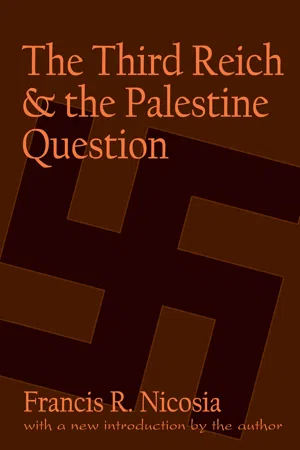
The Third Reich and the Palestine Question
About this book
In order to ensure its racial, ideological, and strategic interests, the Hitler regime actively supported the status quo in Palestine and the Middle East during the interwar period. This included the perpetuation of British imperial power in Palestine, the Jewish National Home (not an independent Jewish state) promised by the Balfour Declaration, and the rejection of Arab self-determination and independence.The Third Reich and the Palestine Questionis the first comprehensive study of German Palestine policy during the 1930s. Francis R. Nicosia places that policy within the context of historical German interests and aims in Palestine, the Middle East, and Europe from the Wilhelminian era through the Weimar period and the Third Reich. He also provides insight into the broader foreign policy aims and calculations of the Nazi regime throughout the Arab Middle East before World War II.In a new introduction, Nicosia places his ground-breaking research in its proper historical perspective. He reviews some of the recent literature on the history of Nazi Germany and the Holocaust. He also discusses some of the archival materials that have recently become available in the former German Democratic Republic and Soviet Union.
1. Imperial and Weimar Precedents
Germany’s relationship to the Palestine question can be traced to its developing political and economic ties to the Ottoman Empire during the approximately thirty years before World War I and to the emergence of Berlin as an important center of a fledgling international Zionist movement late in the nineteenth century. Although the idea of Drang nach Osten (eastward expansion) was not new in Germany in 1890, it was not until Wilhelm II dismissed Bismarck as chancellor that a pro-Ottoman orientation became a fundamental element in German foreign policy.1 It was mainly within the context of German strategic aims in the Middle East that the Zionist movement sought to become a willing instrument in the formulation and pursuit of German foreign policy.
Zionist leaders had realistically accepted the necessity of securing the sponsorship of at least one of the European Great Powers for the establishment of a Jewish homeland in Palestine. The Ottoman government was never inclined to foster the national identity or autonomy of any of its subject peoples, least of all one that was to be imported for the most part from Europe. Moreover, Zionists were Europeans, and their movement a European national movement, inclining its leadership to look to the European powers for support and protection. At the turn of the century, Zionist leaders had placed much of their hope on the sponsorship and support of Germany. Throughout the nineteenth century, Germany had been a haven for persecuted Jews from eastern Europe, as well as a cultural and spiritual beacon for the masses of Jews in the ghettos of eastern Europe. Mainly east European in origin and leadership, the Zionist movement was based in central Europe. Its leadership was almost entirely German or German-educated Jews from eastern Europe, despite the overwhelmingly liberal/assimilationist, anti-Zionist inclinations of German Jews.2
The interests and aims of the Zionist movement and the German government appear to have coincided at the end of the nineteenth century. This resulted in an informal alliance that, in spite of occasional difficulties, was to last through World War I and the Weimar period. Theodor Herzl sought to enlist the support of Kaiser Wilhelm II in an effort to obtain from the sultan a charter for the establishment of an autonomous Jewish commonwealth in Palestine.3 Herzl’s strategy, and that of his successors, was to persuade the government of a Great Power that Jewish settlement in and development of Palestine would be an invaluable asset in the pursuit of its policy in the Middle East. In this instance, Herzl asserted that a Jewish Palestine would be the financial salvation of the bankrupt Ottoman Empire, suggesting that the expected influx of Jewish capital into Palestine as well as the assumption of the entire Ottoman debt by the Jewish world community would greatly strengthen Germany’s weak eastern ally, and thus strengthen Germany’s strategic position in the international balance of power.
The German government had indeed been mindful of the various signs of weakness of its Ottoman protégé since the late 1880s and the resulting opportunities this had created for other powers, notably Britain and France, in the eastern Mediterranean.4 There was also an awareness of the potential benefits that Germany might reap in the Middle East through close links with the Zionist movement. Count zu Eulenburg, the kaiser’s close friend and adviser, outlined the threefold advantages of a German-Zionist link to Wilhelm II on several occasions. These included not only Herzl’s idea of strengthening the Ottoman Empire, but also hopes of gaining a firmer foothold for Germany in the Middle East and, at the same time, contributing to the resolution of the Jewish question in Germany. This last possibility held considerable appeal for Wilhelm II, as well as for many influential leaders, both Jewish and non-Jewish, in late nineteenth century Germany. The prospect of halting the flow of east European Jewish refugees into Germany, and redirecting it to Palestine, was greeted with enthusiasm by some German Jews and anti-Semites alike.5
By the time of Wilhelm’s state visit to the Ottoman Empire in the autumn of 1898, a pro-Zionist component had already become evident in Germany’s Middle East policy. In 1893, Germany had been the only power to advocate the cancellation of an Ottoman decree that prohibited Jews from further land purchases in Palestine.6 It briefly appeared that Germany might be on the verge of a public declaration of support and sponsorship for Zionist efforts in Palestine. The kaiser’s Ottoman visit included several days in Palestine, where he met briefly with Herzl and appeared favorably disposed toward Zionist activities. During his talks with the sultan, Wilhelm spoke favorably of Zionism, its quest for a Jewish homeland in Palestine and the potential economic benefits of Jewish settlement in Palestine for the Ottoman Empire. Opposed, however, to any form of autonomy for subject nationalities, the Ottoman government rejected the kaiser’s bidding on behalf of the Zionist movement. Wilhelm immediately lost his initial enthusiasm for Zionist endeavors, and the German Foreign Office concluded that the matter should be officially dropped so as not to alienate the Ottoman government.7 The importance of Germany’s developing political, economic and military relationship with the Ottoman Empire appeared to require public support for its internal status quo, leading Berlin to the conclusion that the avoidance of policies to which the sultan might object would ensure the continued success of Germany’s ambitious economic projects in the Ottoman Empire.8
Between 1898 and 1917, the Zionist movement was unable to budge the Ottoman and German gpvernments from their respective positions of outright opposition to\and sympathetic aloofness from Zionist aims in Palestine. The Zionist argument that Germany’s overall strategic interests in the Middle East were best served by the realization of Zionist aims in Palestine was reluctantly ignored by Berlin until late 1917, when the British government assumed sponsorship of the Zionist cause through the Balfour Declaration. Indeed, as early as December, 1898, Herzl had indicated in a letter to his friend the grand duke of Baden that the Zionist movement might seek the support and protection of Great Britain.9 Moreover, the German Zionist Executive in Berlin warned the German Foreign Office as late as the summer of 1917 that the western powers would soon come out publicly in favor of a Jewish homeland in Palestine, and thereby enhance Allied prestige among the Jewish masses of central and eastern Europe and North America.10 They pressed in vain for an official declaration of support from the German government to head off the anticipated western initiative.
Britain, on the other hand, was beginning to realize that much might be gained by a declaration of support for Jewish efforts in Palestine.11 It was hoped that Jewish opinion in central and eastern Europe as well as in America might be turned away from its traditional sympathy for Germany, and antipathy for Russia, and encouraged to rally to the Allied cause. Moreover, by the summer of 1917, the British offensive from Egypt under Allenby had moved into Palestine, and the German-Turkish position in the Middle East theatre was beginning to collapse. The new military and political realities in the Middle East, coupled with Britain’s apparent willingness to cooperate with the Zionist movement, inclined many Zionists somewhat reluctantly to begin looking to Great Britain and away from Germany for the fulfillment of their hopes. The German Zionist Richard Lichtheim observed:
We owed Germany very much, but the course of events in the war compelled Zionism to seek a connection with and help from the Anglo-Saxon Powers. . . . In 1917 the center of gravity of Zionist policy was moving more and more toward London and Washington. This was the necessary result of military and political developments, as well as the evident readiness of the British and American governments to support Zionist wishes.12
On October 4, 1917, Lord Balfour spoke to the War Cabinet in London, arguing that Germany was seeking to enlist the support of the Zionist movement. He urged haste in preparing an official British declaration of support for the Zionist cause. Balfour’s information on German intentions was erroneous. Official German attitudes toward the Zionist movement, always sympathetic if somewhat aloof, had cooled by mid-1917 with America’s entry into the war.13 Years of German propaganda aimed at American Jewry with hopes of strengthening American neutrality had failed. The Balfour Declaration was approved by the War Cabinet in London on October 31 and made public in Balfour’s famous letter to Lionel Walter Rothschild (the second Baron Rothschild and honorary president of the Zionist Federation of Great Britain and Ireland) on November 2, 1917. It seems to have had the desired impact on Jewish public opinion and to have enhanced Allied prestige among the Jews of central and eastern Europe.14 Much of Palestine had already been overrun by Allenby’s army and his Arab allies, and Jerusalem was to fall a month later. The British Foreign Office set up a special branch for Jewish propaganda within the Department of Information, under the direction of an active Zionist, Albert Hyamson.15 Propaganda materials were distributed to Jewish communities around the world through local Zionist organizations and other intermediaries, while leaflets containing the text of the Balfour Declaration were dropped over German and Austrian territory.16 After the capture of Jerusalem in December, 1917, pamphlets were circulated among Jewish troops in the German and Austrian armies, which read:
Jerusalem has fallen! The hour of Jewish redemption has arrived. . . . Palestine must be the national home of the Jewish people once more. . . . The Allies are giving the land of Israel to the people of Israel. Every loyal Jewish heart is now filled with joy for this great victory. Will you join them and help to build a Jewish homeland in Palestine? . . . Stop fighting the Allies, who are fighting for you, for all Jews, for the freedom of all small nations. Remember! An Allied victory means the Jewish people’s return to Zion.17
The impact of the Balfour Declaration on world Jewish opinion, although difficult to measure, abruptly ended Germany’s previous aloofness from the Zionist movement. The press and public opinion in Germany, both Jewish and non-Jewish, began calling for German action to counter what was perceived to be an English propaganda victory; the lament suddenly arose that Germany had failed to use traditional Jewish sympathy for Germany.18 After some debate in the German Foreign Office, the government decided to press its Ottoman ally to issue a declaration in favor of Zionist aims in Palestine, which the Ottoman government reluctantly did on December 12.19 A similar statement had been issued by the Austro-Hungarian government on November 21, and Berlin followed with its own declaration on January 5, 1918:
We deem worthy the wishes of the Jewish minority to develop their own culture and individuality in those lands in which the Jews have a strongly developed, distinct way of life. We extend to them our full understanding, and are prepared to extend our benevolent support for their efforts in this direction.
With regard to Jewish efforts in Palestine, especially those of the Zionists, we support the declaration recently made by the Grand Vizier, Talaat Pasha, and in particular the intention of the Imperial Ottoman government, in keeping with their proven friendly disposition toward the Jews, to promote the flourishing Jewish settlements in Palestine by granting free immigration and settlement limited only by the absorptive capacity of the land, the establishment of local self-government in keeping with the laws of the land and the free development of their cultural individuality.20
The belated attempts of the Central Powers to neutralize whatever advantages the Allies gained from the Balfour Declaration were to no avail. It was primarily military necessity and imperial ambition in the Middle East that had prompted Britain to support Zionist aims in Palestine; Germany’s political obligations to its Ottoman ally had precluded similar initiatives from Berlin before 1917, despite its natural inclination. The result was a shift in the center of gravity of the Zionist movement from central Europe to London and the United States, or from its former German orientation to an Anglo-American one. The war and the Balfour Declaration made political Zionism more popular among Jews around the world. Although the majority remained non-Zionist, many Jews developed a sense of protective responsibility for and loyalty to the National Home once it became a reality. If Germany retained the goodwill of Jews around the world, it nevertheless forfeited its special relationship with European Jewry, and with the Zionist movement, to the western powers. The Zionist movement had become an instrument for the promotion of British, not German, imperial interests.
The German government tried to regain some of the advantage lost to Britain with measures that paralleled those carried out in London after the Balfour Declaration. Early in 1918, the German Foreign Office created a special department for Jewish affairs under Professor Moritz Sobernheim. The government also encouraged German Zionists and their supporters in their efforts to set up a German equivalent to the British Palestine Committee, a group of prominent Jews and gentiles within and outside the government, designed to mobilize public support for the Zionist cause. In May, 1918, with the full support of the German government, the Deutsches Komitee zur Förderung der jüdischen Palästinasiedlung (German Committee for the Promotion of Jewish Settlement in Palestine), also known as the Deutsches Pro-Palästina Komitee (German Pro-Palestine Committee), was established in Berlin. It attracted prominent Jewish and non-Jewish Germans of all political and ideological shades, brought together by the common conviction that Germany’s political, economic and strategic interests were best served by promoting the Zionist cause in Palestine.21 The Pro-Palästina Komitee described its convictions and task “to promote Zionist efforts to create a national Jewish Commonwealth in Palestine. . . . that the Jewish settlement of Palestine is a phenomenon of great historical significance that must be of extraordinary interest for German policy.”22
The Pro-Palästina Komitee used the arguments with which German Zionists for years had tried to enlist the support of the imperial German government. It stressed the political, economic and cultural advantages that Germany would reap in the strategically important Middle East and the importance of strengthening Jewish sympathy for Germany around the world. Like Britain, Germany sought to use the Zionist movement as a weapon against the other side, not merely for war advantage, but, as Zechlin observes, even more for the postwar world in which Germany would be involved in a continuing political and economic struggle.23
With the end of the war, Germany’s defeat, the disintegration of the Ottoman Empire and the establishment of British power in Palestine, the brief formal alliance between the German government and German Zionism ended as abruptly as it had begun a year earlier. The Pro-Palästina Komitee quickly disbanded, as the common interest in a German victory and Germany’s imperial advantage in the Middle East, which held its members together for a year, was no longer applicable. The temporary unity and cooperation among Zionists, non-Zionists and even some anti-Zionists within the German Jewish community lapsed as the old ideological cleavages, which had divided the German Jewish community in the past, reemerged. However, the reasons that had prompted the German government to identify its interests with the Zionist movement, in varying degrees both before and during the war, were not lost on subsequent governments during the Weimar period.
Germany’s defeat in 1918 neutralized the political and economic advantages it had accumulated in the Ottoman Empire prior to World War I. Yet German prestige and popularity, well established in Syria and Palestine before 1914, remained high after the war. The numerous German schools, hospitals, insti...
Table of contents
- Cover Page
- Title Page
- Copyright Page
- Contents
- Introduction to the Transaction Edition
- Preface
- 1. Imperial and Weimar Precedents
- 2. Early National Socialist Attitudes toward Zionism
- 3. The Development of the Haavara Transfer Agreement
- 4. The Zionist Connection, 1933-1937
- 5. The Role of England in Hitler's Foreign Policy Plans
- 6. The Rejection of an Arab Connection, 1933-1937
- 7. The Peel Partition Plan and the Question of a Jewish State
- 8. Continuation of the Zionist Option
- 9. Germany, Palestine and the Middle East, 1938-1939
- 10. Conclusions
- Appendixes
- Notes
- Bibliography
- Index
Trusted by 375,005 students
Access to over 1.5 million titles for a fair monthly price.
Study more efficiently using our study tools.
Frequently asked questions
Yes, you can cancel anytime from the Subscription tab in your account settings on the Perlego website. Your subscription will stay active until the end of your current billing period. Learn how to cancel your subscription
No, books cannot be downloaded as external files, such as PDFs, for use outside of Perlego. However, you can download books within the Perlego app for offline reading on mobile or tablet. Learn how to download books offline
Perlego offers two plans: Essential and Complete
- Essential is ideal for learners and professionals who enjoy exploring a wide range of subjects. Access the Essential Library with 800,000+ trusted titles and best-sellers across business, personal growth, and the humanities. Includes unlimited reading time and Standard Read Aloud voice.
- Complete: Perfect for advanced learners and researchers needing full, unrestricted access. Unlock 1.5M+ books across hundreds of subjects, including academic and specialized titles. The Complete Plan also includes advanced features like Premium Read Aloud and Research Assistant.
We are an online textbook subscription service, where you can get access to an entire online library for less than the price of a single book per month. With over 1.5 million books across 990+ topics, we’ve got you covered! Learn about our mission
Look out for the read-aloud symbol on your next book to see if you can listen to it. The read-aloud tool reads text aloud for you, highlighting the text as it is being read. You can pause it, speed it up and slow it down. Learn more about Read Aloud
Yes! You can use the Perlego app on both iOS and Android devices to read anytime, anywhere — even offline. Perfect for commutes or when you’re on the go.
Please note we cannot support devices running on iOS 13 and Android 7 or earlier. Learn more about using the app
Please note we cannot support devices running on iOS 13 and Android 7 or earlier. Learn more about using the app
Yes, you can access The Third Reich and the Palestine Question by Francis R. Nicosia in PDF and/or ePUB format, as well as other popular books in History & European History. We have over 1.5 million books available in our catalogue for you to explore.