- 248 pages
- English
- ePUB (mobile friendly)
- Available on iOS & Android
eBook - ePub
About this book
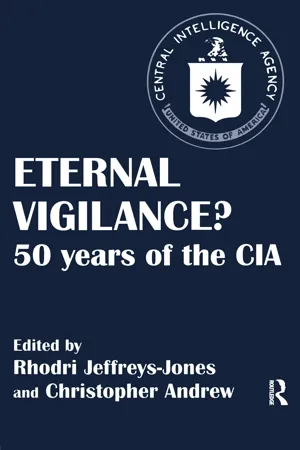
Eternal Vigilance? seeks to offer reinterpretations of some of the major established themes in CIA history such as its origins, foundations, its treatment of the Soviet threat, the Iranian revolution and the accountability of the agency. The book also opens new areas of research such as foreign liaison, relations with the scientific community, use of scientific and technical research and economic intelligence. The articles are both by well-known scholars in the field and young researchers at the beginning of their academic careers. Contributors come almost equally from both sides of the Atlantic. All draw, to varying degrees, on recently declassified documents and newly-available archives and, as the final chapter seeks to show, all point the way to future research.
1
The American Road to Central Intelligence
Intelligence changes rained down upon the United States in a great torrent during the 1940s and early 1950s, culminating in the creation of the Central Intelligence Agency in 1947 and the National Security Agency in 1952. This occurred in part because World War II intelligence developments such as those within the US Army (Military Intelligence Division), the US Navy (Office of Naval Intelligence) and in William Donovan’s Coordinator of Information and Office of Strategic Services (OSS) organizations, provided the US government with the experienced and skilled personnel to make such postwar intelligence innovation possible.
In addition, unsettled conditions in the postwar era played a part by requiring innovative new political-military arrangements in every corner of the globe. But probably most important, there came the threatening forward pressure of the USSR which manifested itself in the late 1940s. When this ‘Soviet threat’ was combined with the residual shock and sense of vulnerability that had been engendered by Hitler’s Blitzkrieg surprises, and especially the Japanese attack on Pearl Harbor, the American public and its leaders were given a new sense of vulnerability and a belief that new and more assertive methods needed to be employed to protect national security.
However, it is important to remember that neither the American intelligence organizations which had been created during World War II such as OSS, nor the CIA and the National Security Agency (NSA) which followed them, arose from a historical vacuum. Men such as Franklin Roosevelt (born 1882) and William Donovan (born 1883), had lived not only through periods in which American intelligence had been weak and backward, but also eras in which the US intelligence system was strong and nearly the equal of those of other great powers.
Therefore to form a realistic picture of how and why OSS/CIA and its intelligence modernizing companions were created in the period 1941–52, one must acknowledge the great changes and challenges which took place in those 11 years. But it is also useful to examine the main phases of American intelligence history from the Civil War era to 1942, in order to gauge whether or not the creations of the 1940s and 1950s were radical departures in American history or were simply new superstructures built on earlier eras in which the US had quite effective intelligence organizations.
It is a reasonable truism that extensive and bitterly fought conflicts tend to produce innovation in all things military, including intelligence. Such developments definitely occurred in the great revolutionary struggles which began with the American Revolution and stretched on through the wars of the French Revolution to the Vienna settlement of 1815. This 40-year period saw warfare energized by new organizations, tactics and strategies, made possible by the ideological enthusiasm which made individuals willing to fight and die, if necessary, to further one cause or another. The spirit of ideological commitment also penetrated into the intelligence realm, and some individuals, including perhaps even General Benedict Arnold, pursued the trade of espionage and treachery out of some idealism as well as greed and resentment.
However, following the Vienna Congress of 1815, the revolutionary fires were dampened and the ‘old order’ continued to hold on to power for at least half a century. Wars were few and limited in scope and time, so the European governments were primarily concerned to pursue real or imaginary security and subversive dangers at home and abroad. Intelligence modernization was consequently muted in Europe as well as the USA in an era in which 20 per cent of the British Foreign Service budget was spent on secret service activities aimed more at subversive than at foreign military activities.1
The two decades following 1850, however, witnessed a series of major wars – the Seven Weeks War (Austro-Prussian), the Franco-Prussian War, and, most important for the USA of course, the American Civil War in which technological change and military innovation determined in large measure who would win and who would lose. The US armed forces on the two sides of the American Civil War did not produce any startling intelligence innovations during that conflict (despite the employment of observation balloons), but they did make a series of important innovations in weaponry, including submarine and torpedo technology, the development of high quality artillery, and a leap ahead regarding military signals. In consequence, throughout the 1860s and 1870s, foreign governments, led by the British, spent considerable time and effort studying US Army and Navy equipment and combat methodology. Most such examinations, including that done by the British Navy, were carried out openly by visiting officers and the British Naval Attaché who made the intelligence rounds between the principal naval powers. The British also used some Secret Service money in America during the 1860s and 1870s, but virtually all of it was to finance secret information on the Fenian Irish.2
Much of the detail on weaponry of the Powers was at that time made freely available to foreign governments. After developing new defences on the Potomac river in 1866, Washington promptly revealed the details to the British authorities, even though the only country which had previously launched an attack up the Potomac was Britain (in the War of 1812).3
But the dispatch of the first US Naval Attaché to his new post in London in 1882 showed that America was now prepared to play the game, and make use of the prevailing openness to increase the inward flow of information on the armed forces of other countries. In the same era, the US Army, while engaged in the great Indian Wars on the Western Plains, showed itself equally willing to cooperate with British authorities regarding information on the most formidable of Indian challenges, a British intelligence report on Sitting Bull being supplied to the Americans in the late 1870s.4
The 1880s was an era of increased tension in Europe with the Austro-German Dual Alliance converted to the Triple Alliance by the adhesion of Italy in 1882. This initiated the struggle of alliance blocs which led to World War I 35 years later. During the 1880s, at a time when the British government began to complain that other countries were becoming secretive, American military and naval intelligence threw off most of the shackles of innocence and timidity, and introduced many of the same organizational innovations being carried out by the other major powers. In 1885, the United States established an Intelligence Group in the War Department and three years later the first US Military Attaché took up his post abroad.5
The US Navy, which launched a major modernization and building program in 1885/86, also carried through extensive intelligence reforms. The navy’s Office of Naval Intelligence (ONI) was created in 1884, well ahead of the Royal Navy’s replacement of its old-fashioned Naval Intelligence Committee by a new Naval Intelligence Division (NID).6 Most importantly, the US Navy enthusiastically shared in the use of the most important technical intelligence innovation of the age, the application of still photography to the identification and detailing of foreign naval vessels. Although the Royal Navy was collecting photographs of foreign ports and warships at least as early as 1878, the US Navy began to shift from artists’ renderings to photographs for ship identification by 1885, the same period in which the Royal Navy introduced its first foreign naval vessel identification-volumes using photographs (1886).
The only aspect of intelligence in which the United States seriously lagged behind the other powers during the mid-1880s was in the realm of secret information in respect to security suspects. In 1880, the British Army’s share of the secret budget was £65,000, but most of the secret vote was still not expended on any form of intelligence related to military operations. The bulk of it went to the Home Office and the British authorities in Ireland.7
The US remained a wide open country, dependent on local police authorities committed to crime prevention and criminal punishment, with little or no idea of anti-subversive operations. There was also only a rudimentary respect for the application of technology to police work and the identification of suspects. When, for example, in November 1884 the London police requested that the State of Nebraska supply a photograph of a man from that State who was held in London for murder, the Nebraska authorities replied that they had no photograph of the man in question, but they were happily forwarding a photograph of his brother!8
Such naiveté, and blindness to the minimal requirements of fair play and internal security, underscores that in the 1880s the United States was still a very decentralized country trying to play the international game with widely diffused authority at home. But it is also true that in regard to intelligence on foreign military and naval matters, the US government was in the same league as the major European powers, with ONI in existence, army and navy attachés abroad, and naval cameras recording details of foreign navy units.
The subsequent decade, the last of the nineteenth century, faced American intelligence with a new series of challenges. Again, the stakes were raised, and the game made harsher and faster, by the formation of another alliance bloc. The Franco-Russian Alliance of 1894 left this pair of countries confronting the three members of the Triple Alliance (Germany, Austria-Hungary and Italy), and only three powers remained free agents, Britain, Japan, and the USA. Inevitably, Britain then tried to snuggle closer to both the United States and Japan. Even before the Spanish-American War dramatically raised the US profile in international relations, Britain had elevated its Mission in Washington to the Embassy level in 1893 (over the objections of Queen Victoria), and soon thereafter the two countries were exchanging samples of their basic infantry weapons, and British officers were permitted to make detailed studies of American coastal fortifications.9
The Spanish-American War of 1898 revealed the United States for the first time as an assertive military power within, and beyond, the Western Hemisphere. Some intelligence fiascos occurred, such as the discovery after the war began that one major War Department secret report on the Philippines had actually just been copied from the Encyclopaedia Britannica, but over all American intelligence, based largely on the work of such secret emissaries as Lieutenant Whitney in Puerto Rico and extensive questioning of merchant ship captains, was adequate to get forces ashore, and improvized combat intelligence operations then helped take the American ground forces on to victory.10
Throughout the campaign, American intelligence gathering was greatly aided by US Navy and Army attachés stationed in both Europe and Asia, who provided valuable information (in some cases through running espionage agents) regarding Spanish armament, dispositions and intentions.11
But no sooner did the United States complete the leap into something approximating full membership in the modern intelligence club through participation in the Spanish-American War, than great power international relations sharply increased in the ominous complexity and modernity of its weaponry. Although the Americans and the British managed in 1899 to squeeze the Germans out of Samoa, and Britain also strengthened its position in Asia by an alliance with Japan in 1902, Britain was soon absorbed into the system of alliance blocs. The Entente Cordiale was signed by Britain and France in 1904, and when supplemented by the Anglo-Russian agreement of 1907, Europe was divided into hostile camps, with Britain, Japan, France and Russia on one side, and Germany, Austria-Hungary and Italy on the other. The USA was therefore the only nation of consequence left out of the alliance bloc system.12
Running parallel to the march toward confrontational blocs of great powers in the early twentieth century, there occurred a new, and more deadly arms race. The armies and navies of the European powers and Japan underwent modernization, and the main features of maritime power were transformed, The Royal Navy launched HMS Dreadnought in 1906 and ceased attending German Navy maneuvers in order to prevent reciprocal German visits in hopes of slowing the pace of German dreadnought development. But the Germans nonetheless launched a comparable super battleship in 1907, maintaining the balance and raising the risks involved in European conflict.13
In the same era lo...
Table of contents
- Cover
- Half Title
- Title Page
- Copyright Page
- Table of Contents
- Editor’s Preface
- 1. The American Road to Central Intelligence
- 2. Why Was the CIA Established in 1947?
- 3. Intelligence and the Cold War Behind the Dikes: The Relationship between the American and Dutch Intelligence Communities, 1946-1994
- 4. Science, Scientists, and the CIA: Balancing International Ideals, National Needs, and Professional Opportunities
- 5. The Wizards of Langley: The CIA’s Directorate of Science and Technology
- 6. The Committee of Correspondence-CIA Funding of Women’s Groups, 1952-1967
- 7. The CIA and the Soviet Threat: The Politicization of Estimates, 1966-1977
- 8. National Intelligence and the Iranian Revolution
- 9. American Economic Intelligence: Past Practice and Future Principles
- 10. The CIA and the Question of Accountability
- 11. The CIA’s Own Effort to Understand and Document its Past: A Brief History of the CIA History Program, 1950-1995
- 12. Conclusion: An Agenda for Future Research
- About the Contributors
- Index
Trusted by 375,005 students
Access to over 1.5 million titles for a fair monthly price.
Study more efficiently using our study tools.
Frequently asked questions
Yes, you can cancel anytime from the Subscription tab in your account settings on the Perlego website. Your subscription will stay active until the end of your current billing period. Learn how to cancel your subscription
No, books cannot be downloaded as external files, such as PDFs, for use outside of Perlego. However, you can download books within the Perlego app for offline reading on mobile or tablet. Learn how to download books offline
Perlego offers two plans: Essential and Complete
- Essential is ideal for learners and professionals who enjoy exploring a wide range of subjects. Access the Essential Library with 800,000+ trusted titles and best-sellers across business, personal growth, and the humanities. Includes unlimited reading time and Standard Read Aloud voice.
- Complete: Perfect for advanced learners and researchers needing full, unrestricted access. Unlock 1.5M+ books across hundreds of subjects, including academic and specialized titles. The Complete Plan also includes advanced features like Premium Read Aloud and Research Assistant.
We are an online textbook subscription service, where you can get access to an entire online library for less than the price of a single book per month. With over 1.5 million books across 990+ topics, we’ve got you covered! Learn about our mission
Look out for the read-aloud symbol on your next book to see if you can listen to it. The read-aloud tool reads text aloud for you, highlighting the text as it is being read. You can pause it, speed it up and slow it down. Learn more about Read Aloud
Yes! You can use the Perlego app on both iOS and Android devices to read anytime, anywhere — even offline. Perfect for commutes or when you’re on the go.
Please note we cannot support devices running on iOS 13 and Android 7 or earlier. Learn more about using the app
Please note we cannot support devices running on iOS 13 and Android 7 or earlier. Learn more about using the app
Yes, you can access Eternal Vigilance? by Christopher Andrew,Rhodri Jeffreys-Jones in PDF and/or ePUB format, as well as other popular books in History & Military & Maritime History. We have over 1.5 million books available in our catalogue for you to explore.