eBook - ePub
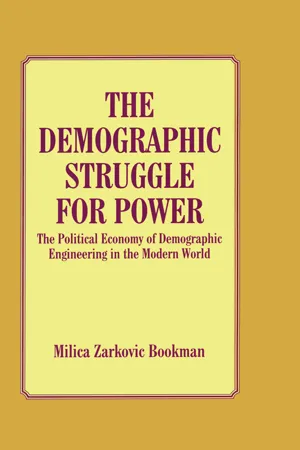
The Demographic Struggle for Power
The Political Economy of Demographic Engineering in the Modern World
- 284 pages
- English
- ePUB (mobile friendly)
- Available on iOS & Android
eBook - ePub
The Demographic Struggle for Power
The Political Economy of Demographic Engineering in the Modern World
About this book
The 20th-century demographic struggle for power translates itself into an inter-ethnic war of numbers. This book offers suggestions for structural alterations within states to sever the link between ethnic size and power, and thus eliminate the rationale for the demographic struggle for power.
1
Introduction
THE QUOTES OPPOSITE were published over the course of a few months in 1993-94. While it may seem that the events and locations described are unrelated, there is in fact a common link between them that this book strives to identify and analyze. The quotes portray cultural oppression, diversion of natural resources, discrimination in health care, eviction of individuals, and destruction of property. They describe direct and indirect sources of change in the composition of a region’s population. Since each of the victims described in the quotes is of a distinct ethnic or religious group, the articles are thus indications of inter-ethnic struggles for space and the control of that space.
Throughout history there have been struggles for territory and control of its resources. Only sometimes have these struggles been based on ethnicity. Such struggles for power and resources among ethnic groups manifest themselves in various ways: on one level, violent wars are being waged as populations, usually of varying ethnic or religious orientations, attempt to militarily achieve supremacy and power (in the 1990s most ongoing struggles in the Balkans, as well as the former Soviet Union, Asia and Africa, are based on ethnicity. Indeed, of the world’s 82 conflicts that took place during 1989-92,79 took place within borders and among different ethnic or religious groups1). At another level, an ‘inter-ethnic war of numbers’ is taking place. While this expression of inter-ethnic animosity may be non-military and subtle, it has far-reaching ramifications. The goal of this war of numbers is to increase the economic and political power of an ethnic group relative to other groups, and the method by which this is achieved entails the increase in size of one population relative to others. Most ethnic groups in multinational states across the globe are engaged in this activity in varying degrees, thus clearly manipulating population numbers in their struggle for power. They have similar goals, but only differ in the form and intensity of the struggle. The war of numbers may precede, accompany or follow the war of militias.
This inter-ethnic struggle may be called the ‘demographic struggle for power’. In describing this struggle, two questions will be answered. First, what is it that ethnic groups think they can achieve by augmenting their numbers? To answer this, the link between the size of an ethnic group and its economic and political power is to be identified. The conditions under which this link exists and the conditions under which it can be prevented from developing are analyzed. Moreover, this link is observed across levels of development, degrees of ethnic heterogeneity and systems of political organization (in other words, a comparison is made between the demographic struggles in less developed Turkey and more developed Canada, as well as those within federal India, unitary Romania and ethnically homogeneous Slovenia and heterogeneous Lebanon). Second, by what methods do leaders of ethnic groups actually manipulate demographic characteristics in their struggle for power? Do they just wage wars to exterminate their opponents, or are there in fact more subtle components to their efforts? This study analyzes such demographic alterations as caused by pronatalist policies, population resettlements, religious and linguistic conversions, immigration policies, etc. This book then places phenomena like ethnic cleansing, mass rapes and genocide into an economic and political framework, according to which the guiding motivation is to alter the ratio of an ethnic population to territory in an effort to increase economic and political power.
Thus, this book is a study of comparative ethnic demography and its political and economic significance. The emphasis lies in the analysis of the various dimensions of demographic policies that have been used by governments in multinational states. An index of demographic engineering policies is constructed to enable the assessment of demographic policies under varying structural conditions. Moreover, parameters are established which set limits on the analysis of the demographic struggle and thus enable the delineation of states in which such struggles occur and can be studied. The establishment of these parameters enables, for example, a comparison between policies of demographic engineering in ethnically more or less homogeneous states.
The literature on ethnicity and nationalism, inter-ethnic conflict resolution, and nation-building already abounds and is growing precipitously to keep up with the intensification of inter-ethnic conflicts in the post-cold war period. However, there seems to be a void in the literature pertaining to organized efforts (by legitimate governments and/or non-elected ethnic leaders) aimed at altering relative population sizes of ethnic groups in the quest for political and economic dominance. This book strives to fill this gap by (i) providing a framework for the analysis of demographic engineering that is embedded in the existing literature on economic and political dimensions of inter-ethnic relations in multinational states, (ii) by providing a methodical discussion and analysis of various population policies that have been adopted across states with different levels of ethnic homogeneity, levels of economic development and political systems, and (iii) by offering an alternative structure for inter-ethnic accommodation aimed at diffusing the need (perceived and actual) to engage in the demographic struggle for power.
This book is arranged as follows. Chapter 2 contains a description of the link between ethnic size and political and economic power, as well as the conditions under which this link is positive. A classification of demographic engineering policies is presented and their implementation in some 35 regions across the globe is described (Appendix I provides a background to the ethnic composition of the states, the inter-ethnic conflict that preceded or followed policies of demographic engineering, and the particular characteristics of the demographic policies). Chapter 3 conveys the problems and realities associated with the measurement and definition of demographic data, and it contains an analysis of the politicization of the population censuses. Chapters 3 through 7 contain descriptions of methods by which ethnic leaders alter the demographic composition of populations including: pronatalist policies (chapter 4), assimilation (chapter 5), forced population movements (chapter 6) and boundary alterations (chapter 7). In the realization of the above policies, one feature (other than direct force) has been consistently present, and that is the exertion of economic pressure on targeted groups with the aim of altering the demographic composition. This pressure takes the form of ethnic discrimination in employment, property rights (especially with respect to land), real estate taxes, etc. Because of the prevalence, simultaneity and subtlety of economic pressures, an entire chapter is dedicated to the exploration of this method of achieving a desired inter-ethnic redistribution (chapter 8). Finally, chapter 9 contains a suggestion for institutional changes at the state and sub-state levels that are aimed at easing inter-ethnic conflict by reducing the necessity for a demographic struggle for power. This suggestion follows from the literature on nation-building, consocionational democracy, and nationalism.
While this book is broad in its geographical scope, it is narrow in its temporal dimension. Its limitation to the contemporary period (post- World War II) is not due to a lack of examples of demographic engineering in past centuries. Indeed, demographic engineering policies that caused the resettlement and ethnic cleansing of targeted populations have characterized Emperor Justinian’s quests in North Africa; the Spanish expulsion of Jews and Moors from Spanish territory; European conquests of North and South American indigenous populations and the forcible removal of Africans for sale into slavery. Moreover, economic pressures were used as a tool of conversion across the Ottoman Empire, India and South America in the 19th century. However, not only is information pertaining to the demographic struggle for power more extensive in the contemporary period, but also the international norms of acceptable inter-ethnic behavior are more clearly defined and more clearly articulated, providing a common denominator for policy comparisons. Indeed, the examples from ancient history and the age of colonialism are embedded in vastly different political systems and different norms for acceptable behavior (certainly, ethnic cleansing of Native Americans was generally acceptable in the 1800s, but not acceptable in the Balkans in the 1990s). Thus, with several exceptions, it is contemporary examples from across Asia, Europe, Africa and the former Soviet Union that provide the illustrations in this book and the cases for analysis. Chapter 2 contains an assessment of the forms of demographic struggle for power that prevail under specific structural conditions in all 35 regions. Moreover, some territories are discussed in detail with respect to a single method of demographic engineering that has been particularly notable in that setting (for example, in Nigeria, the politicization of the census; in Croatia, the assimilation efforts of the central authorities, etc), and one, Bosnia-Herzegovina, is analyzed in detail using all the categories of demographic engineering set out in chapter 2.
To the extent that there is a disproportional emphasis on the Balkans, Eastern Europe and the former Soviet Union, it is because, at the time of writing, these regions seem a microcosm in which the struggle for power among ethnic groups has focused global attention in part because so many aspects of demographic engineering are present. Indeed, the current war in the former Yugoslavia is but the culmination of a comprehensive ongoing demographic struggle for power that has characterized that region throughout this century. The view that this region lends itself to a study of inter-ethnic relations and conflicts was also expressed by Paul Brass, who remarked that ‘the whole range of government policies towards ethnic groups has found expression at different times in Eastern Europe.’2
Some Definitions and Concepts
There are numerous terms and concepts used throughout this book that warrant explanation. They are terms whose definition is not agreed upon in a literature that is characterized, according to Connor, by ‘terminological chaos’.3 The introduction of these terms serves merely to describe how they are used in the text, rather than to offer a definitive explanation or resolve some outstanding contradictions in the literature. Moreover, in defining concepts such as ethnicity and nationalism, an overview of the literature is conspicuously absent, as that is beyond the scope of this study. The works of Anthony Smith, Walker Connor, Paul Brass, James Kellas, Donald Horowitz, Milton Esman, Ted Robert Gurr, and others have contributed so greatly to the field that there is little added here byway of definitions, and attempts are made in subsequent chapters to embed the discussion of demographic policies in their rich contributions. Despite this abundant literature, the question of how to classify and define peoples remains unresolved and continues to dominate debates on ethnicity and nationalism: indeed, while scholars have made great strides in the study of peoples from the time when the Pope proclaimed, in the 1530s, that the American Indians were indeed human, there is still disagreement pertaining to the definition of people by ethnicity, race and nation.
The term ethnic group warrants explanation. Since Pareto said that the term ‘ethnic’ is one of the vaguest known to sociology,4 research has attempted to clarify the term. According to Paul Brass, an ethnic group may be defined in three ways: in terms of objective attributes, with reference to subjective feelings and in relation to its behavior.5 All the definitions that follow focus on at least one of those categories. An ethnic group, according to Narroll, is defined as a biologically self-perpetuating group that shares fundamental cultural values and differentiates itself from other groups.6 These cultural values maybe embodied in language, religion or myth of origin. Which of these predominates is pointed out by Uri Ra’anan: in ‘eastern regions’, ancestral language seems to be the dividing factor, while in ‘southern regions’ religion is the primary differentiating aspect of ethnicity.7 Barth has focused his definition of ethnicity on the boundary that defines an ethnic group, rather than its cultural components.8 According to Anthony Smith, an ethnic group is composed of a people that share a cultural bond and that perceive themselves to share a common origin.9 Glazer and Moynihan describe an ethnic group as ‘any group of distinct cultural tradition and origin’.10 Ted Robert Gurr focuses on another angle: ethnic groups, which he refers to as communal groups, ‘are psychological communities’, underscoring the perception of collective identity that membership in a group connotes.11 Finally, in today’s climate, George Brock’s definition of an ethnic group is perhaps the most a propos: he defines an ethnic group as a people united by a common dislike of their neighbors and a common myth of their origin.12 In these and other definitions of ethnicity, a crucial question has arisen that has divided scholars into two categories: are characteristics that place individuals in a given ethnic category primordial or instrumental (’modernist’, according to Anthony Smith) in nature? In other words, are ethnic communities natural, primordial and given, or are they created by the interests of leaders, elites or the particular political system? The debate, stimulated by Shils and Geertz as proponents of the primordial view and Wallerstein, Hechter, and Gellner as modernists, is ongoing.13 For the purposes of this study, ethnic aff...
Table of contents
- Cover
- Title
- Copyright
- Dedication
- Contents
- List of Tables and Figures
- 1 Introduction
- 2 The Demographic Struggle for Power
- 3 Demographic Statistics: What They Reveal, What They Conceal
- 4 Pronatalist Policies
- 5 Involuntary and Induced Assimilation
- 6 Forced Population Movements: Ethnic Dilution, Ethnic Consolidation and Ethnic Cleansing
- 7 Demographic Change Through Boundary Alterations: Secession and Irredentism
- 8 Economic Pressures and Incentives Underlying Demographic Change
- 9 The Political Economy of Engineered Demographic Change
- Appendix Brief Description of Ethnicity and Inter-ethnic Conflict in Selected Regions
- Select Bibliography
- Index
Trusted by 375,005 students
Access to over 1.5 million titles for a fair monthly price.
Study more efficiently using our study tools.
Frequently asked questions
Yes, you can cancel anytime from the Subscription tab in your account settings on the Perlego website. Your subscription will stay active until the end of your current billing period. Learn how to cancel your subscription
No, books cannot be downloaded as external files, such as PDFs, for use outside of Perlego. However, you can download books within the Perlego app for offline reading on mobile or tablet. Learn how to download books offline
Perlego offers two plans: Essential and Complete
- Essential is ideal for learners and professionals who enjoy exploring a wide range of subjects. Access the Essential Library with 800,000+ trusted titles and best-sellers across business, personal growth, and the humanities. Includes unlimited reading time and Standard Read Aloud voice.
- Complete: Perfect for advanced learners and researchers needing full, unrestricted access. Unlock 1.5M+ books across hundreds of subjects, including academic and specialized titles. The Complete Plan also includes advanced features like Premium Read Aloud and Research Assistant.
We are an online textbook subscription service, where you can get access to an entire online library for less than the price of a single book per month. With over 1.5 million books across 990+ topics, we’ve got you covered! Learn about our mission
Look out for the read-aloud symbol on your next book to see if you can listen to it. The read-aloud tool reads text aloud for you, highlighting the text as it is being read. You can pause it, speed it up and slow it down. Learn more about Read Aloud
Yes! You can use the Perlego app on both iOS and Android devices to read anytime, anywhere — even offline. Perfect for commutes or when you’re on the go.
Please note we cannot support devices running on iOS 13 and Android 7 or earlier. Learn more about using the app
Please note we cannot support devices running on iOS 13 and Android 7 or earlier. Learn more about using the app
Yes, you can access The Demographic Struggle for Power by Milica Zarkovic Bookman in PDF and/or ePUB format, as well as other popular books in Economics & Political Economy. We have over 1.5 million books available in our catalogue for you to explore.