eBook - ePub
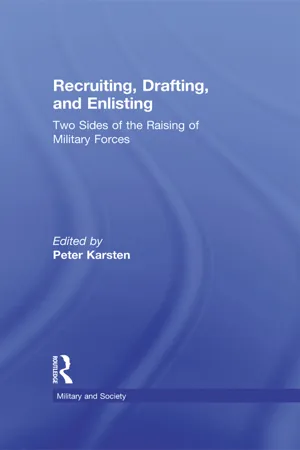
Recruiting, Drafting, and Enlisting
Two Sides of the Raising of Military Forces
- 344 pages
- English
- ePUB (mobile friendly)
- Available on iOS & Android
eBook - ePub
About this book
These five volumes concern one of the most important institutions in human history, the military, and the interactions of that institution with the greater society. Military systems serve nations; they may also reflect them. Soldiers are enlisted; they may also be said to self-select. Military units have missions; they also have interests. In an older, more traditional military history, while the second reflects a newer approach. Although each statement in the pairs may be said to be true, the former speak from the framework of the military sciences; the latter, from the framework of the social and behavioral sciences. The military systems of our past differ from one another over time, in political origins, size, missions, and technological and tactical fashions, but to a great extent their historical experiences have been more noticeably similar than they were different. When we ask questions about the recruiting, training, or motivating of military systems, or of those systems' interactions with civilian governments and with the greater society, as do the essays in these five volumes of reading on The Military and Society we are struck by the almost timeless patterns of continuity and similarity of experience. In each of these volumes approximately half of the essays selected deal with the experience in the United States; the other half, with the experiences of other states and times, enabling the reader to engage in comparative analysis.
Trusted by 375,005 students
Access to over 1.5 million titles for a fair monthly price.
Study more efficiently using our study tools.
HESSIAN PEASANT WOMEN, THEIR FAMILIES, AND THE DRAFT: A SOCIAL-HISTORICAL INTERPRETATION OF FOUR TALES FROM THE GRIMM COLLECTION
In folklore they are called “the blind Hessians,” and as with peoples who were visible but not of central importance in history, their homelands are invariably described as a crossroads. The picturesque but poorly endowed fields and mountainous woodlands that stretch north from Frankfort-on-the-Main were indeed a historical crossroads of a particular sort. Trajan’s limes traversed the southern reaches of this region to mark the borders of the secured Empire; the Chatti had stopped the Romans at the confluence of rivers around present-day Cassel. “If their native state sinks into the sloth of peace and quiet,” Cornelius Tacitus reported, “many noble youths seek those tribes which are waging some war …” (Church and Broadribb, 1868). Here was Charlemagne’s recruiting ground and staging area for his war against the Saxons. During the Middle Ages, Hessians were involved in the warfare of a succession of German emperors whose armies and opponents marched and counter-marched through these territories. The Saxon emperors’ incursions into southern Germany, Henry III’s war against the Bohemians, Henry IV’s Saxon war, Barbarossa’s crusades, the local wars concerning Rhenish tolls, and the 1504 succession to the Palatinate all involved Hessian armies. After the Peace of Westphalia ended the further drain of military men and resources occasioned by the religious and territorial wars of the sixteenth and early seventeenth centuries, Hessian princes almost immediately furnished more men and funds for the Rhenish League to prevent Habsburg and Bourbon armies from clashing in their principalities.
One result of the Rhenish states’ struggles against Louis XIV was that the Hessian rulers, in particular Charles I of Hesse-Cassel, initiated fundamental military and fiscal reforms and took recruitment out of the hands of private and semi-private military entrepreneurs. They organized their state apparatus around standing armies, initially of mercenaries and increasingly of draftees. These armies became, in turn, “auxiliaries” for sale to other states.1
Unlike the rulers of Prussia whose state supported a large military, the eighteenth-century rulers of Hesse made the inspired decision to let their army support the state. Beginning in the 1680s Hesse-Cassel’s chief export consisted of trained and equipped regiments of foot-soldiers. Long before the English “subsidy” contract of 1776 which sent a total of 17,000 draftees to America, Hessians had fought in Denmark, in the eastern Mediterranean, along the Rhine, in Bavaria, Scotland, and the Netherlands. They saw their last service in the wars against the revolutionary forces of France; the Hessian system was finally discontinued by Napoleon.
Eighteenth-century Hesse-Cassel was a unique state, a model, and to some extent a proto-type of those small but relatively well-organized states of our day which also lease draftees to their “allies.” It comes as some surprise that no one has so far looked at Hesse in order to discover what kind of society a state financed by the leasing of drafted mercenaries can produce. In recent years there have been a number of sophisticated demographic, economic, and social investigations into various aspects of early modern Hessian history which touch on the possible significance of the draft (Fox, 1976; Imhof, 1975). But there has been no study, for example, to compare with Otto Büsch’s investigation into and interpretation of the Prussian military state and its almost complete absorption of the rural labor economy (Büsch, 1962). To uncover the complicated inter-relationships between the Hessian state’s military entrepreneurship on one hand, and the rural society which fed men and resources into the system on the other, is a task we can not take on here. What this essay does attempt instead is to approach the problem “from below” to discover how the popular culture, the peasant mentalité, perceived and understood the impact of the draft system on rural social life. If nothing else, this kind of investigation should provide important clues to other related questions and subjects for a more comprehensive study of the Hessian social system.
The existing descriptions and explanations for the popular reception of the eighteenth-century Hessian draft are not satisfying, because they simply discuss whether the people were for or against their princes’ military entrepreneurship. For example, one finds that the popular mood was generally one of acceptance or even indifference born of centuries of obedience (von Both and Vogel, 1973: 102). Moreover, there is evidence from popular verses that refer to the 1776 “subsidy contract” to suggest that the people of Hesse welcomed the opportunity to fight overseas (von Ditfurth, 1871–72: 5, 7, 9):
Wer will mit nach Amerika?
Die Hannoveraner sind schon da,
Die Hessen Werben mit Gewalt,
Kommen die Braunschweiger auch alsbald.
Wer will mit nach Amerika?
Alles was man wunschet ja,
Find’t man in Amerika!
Kommt ihr dann nach Engeland
Allda sind wir wohlbekannt,
Sollt ihr sehen was es giebt,
Braten und gebackene Fisch;
Auch der allerbeste Wein
Soll zu euren Diensten Seyn;
Trinkt und lasst uns lustig seyn!2
or this:
Frisch auf, ihr Brüder, ins Gewehr,
‘S geht nach Amerika!
Versammelt ist schon unser Heer,
Vivat, Viktoria!
Das rothe Gold, das rothe Gold,
Das kommt man nur so hergerollt,
Da giebt’s auch, da giebt’s auch, da
giebt’s auch bessern Sold!3
Recent research reveals that there was some truth to these songs; the pay was relatively good and the draftees could expect to send considerable sums home to their families (Fischer, 1979). While there were popular anti-war songs from the period (von Ditfurth, 1871–72:4), none expressing popular hatred for the Hessian system in particular seems to have survived. Instead, opposition came from more elevated social circles. “Enlightened” opinion and foreign policy interests brought together such strange bedfellows as Mirabeau, Frederick II of Prussia, and the former army surgeon Friedrich Schiller to condemn the system. They even joined in debate with those bureaucrats and moral economists who made careers defending the Hessian system in rudimentary cost/benefit terms which would be familiar to defense analysts of our own day (von Both and Vogel, 1973:102–4; Lowell, 1884: 21–26).
But there is little to be learned about the assimilation of the Hessian draft system into popular life by the study of expressions of passive acceptance or eager participation. Such enquiry does not help us understand how the system’s effects on the rural population’s daily experience were perceived. More specifically, it does not tell us in what terms or how deeply the peoples of Hesse thought about their state and its draft system in relation to fundamental aspects of popular social life, such as the relations between the sexes and family members, the devolution of rights and properties, social success and failure, and the like.
Happily, one available source allows us insight into popular intelligence on these matters. The countryside around Cassel at the turn of the nineteenth century was not only the annual gathering ground for military exercises and maneuvers; it was also where two young brothers barely out of law school began what would become the best known collection of German fairy tales. Jacob and Wilhelm Grimm’s Kinder and Hausmärchen (1819) have produced an enormous outpouring of interpretive writings of a literary-critical, pedagogical, or psychological nature. Unfortunately, most of these writings treat the tales in falsely universalistic terms that see in them solutions to problems which afflict people, and especially the young, everywhere and at all times. One might even speak of a fairy tale industry which debases the tales for modern popular consumption. But even when the scholarly discussion of the tales turns historical, it is still only to invoke them as evidence for general phenomena from the past, such as the historical German character, rural social violence, feudal or patriarchal norms, rural poverty, and popular superstitions (Röhrich, 1976:21, 28). As an alternative approach, this essay proposes to treat four tales from the Grimm collection as historical sources whose applicability is limited to late eighteenth-century Hesse-Cassel, whose largely feminine origins make them especially relevant to the history of Hessian peasant women, and most importantly, whose contents reveal a relatively sophisticated social intelligence capable of identifying the connections among the state system, the draft, the private family, and the larger society. They even analyze some of the difficulties and conflicts arising from these inter-connections.
Mentalité, Fairy Tales, and Historical Change
Recently there has been renewed interest in the value of recorded oral tradition for social historical purposes. For example, James Obelkevich’s Religion and Rural Society (1976) includes much material collected by English folklorists. Similarly, there is the recent study by Stephen P. Dunn (1978) of the various Russian sources of folk literature for evidence of family relations and practices; his comparison of this evidence to what the Grimm brothers’ tales reveal about similar relationships is useful. On the whole, however, historians so far have confined themselves to a straightforward cataloging of folk beliefs and have not attempted a careful treatment of the symbolic materials contained in folk and fairy tales, especially in relation to specific historical situations. What is needed is a treatment of this material in the manner of an intellectual historian but with more specific social and political historical objectives. The inquiry should not be directed toward making statements about, for example, general attitudes concerning “community” or “the family” (Dunn, 1978:170). Historians need to investigate instead how and to what extent these expressions of the popular mind were related to specific changing institutions.
The first difficulty arising in such an enterprise is that modern historians of popular culture do not characterize a popular mentality that is useful for the analysis of mass institutions such as the family as it is presented in recorded folk literature. If one turns to the best recent survey, Peter Burke’s Popular Culture in Early Modern Europe (1978), he quickly sees that it is not actually a study of the world found in folk culture, but a taxonomy of folk expression and its relation to culture generally. Taking as his point of departure Robert Redfield’s classic “great tradition/little tradition” distinction, Professor Burke argues an asymmetrical relationship between the two cultures: “the elite participated in the little tradition, but the common people did not participate in the great tradition” (Burke, 1978:28). The great tradition required a formally taught language to which the great majority of the people had no access. In this view the little tradition is perceived as easily accessible, because it required no special learning and presented itself to everyone in public places.
Burke does not entirely share Redfield’s distinction between the “reflective few” and “the unreflective many” (Redfield, 1960:31). Moreover, he shifts attention away from the content toward type differentiation, source taxonomy, social function, and occupational stratification. Although he does not deny reflectivity to popular culture, Burke studies it only in terms of popular culture’s concern with images of various universal social and psychological types; he explicitly denies popular culture’s capacity for self-reflectivity and considers it incapable of conceiving “alternative social worlds” (Burke, 1978:176). Condemned to their limited vision of society as a war of all against all, the people restricted to the little tradition of popular culture found outlets for their social frustrations only in mythologized relations with elites and in those festivals of ritualized reversals of fortune known as “the world upside down.” Professor Burke concludes that the fortunate participants in high culture, for whom popular culture had at best been a form of play and at worst an increasingly dangerous irritation, finally and inevitably distanced themselves from such a limiting popular culture. This culture was doomed to extinction by the commercial and industrial revolution which nevertheless gave it its last golden age.
Although Professor Burke has greatly broadened historical interest in early modern European popular culture, his point of view is of limited use to social historical analysis of the period’s mentalité. For the present purposes it would be more fruitful to see the Grimms as mediators between high and low culture at that crucial juncture when traditional popular culture gave way to a more secular and politicized mass culture. An intellectual elite made its contributions by recording and even “modernizing” key elements of these older popular cultural forms and messages that were disappearing. But this perspective is not enough. For one thing, to take this approach is to avoid delving into the less obvious content of oral and printed folk literature and to restrict oneself to taxonomies of conspicuous motifs which give the tales’ contents a static and universal character. This in turn leads to functional interpretations of popular narratives, viz., that folk tales served to pacify the lower orders and taught them social conformity and acceptable norms of behavior (Mandrou, 1964:45–47, 149; Burke, 1978:72). That in turn places popular culture in the service of social stability and the ideological interests of elites. In the final analysis, this approach fails to account for the folk’s participation in popular culture and ignores those more subtle and complicated elements of popular culture which do not appear to serve “interests” (Geertz, 1973: 201–203). Such a path of investigation leads historians away from the evidence and the social relations they are trying to understand. For example, in his discussion of the social content of Russian fairy tales, Professor Dunn considers one of the institutions of interest to social historians, the peasant family, only to claim that families and family relationships in fairy tales say nothing about them. Rather, these accounts for Dunn are but metaphors expressing a timeless universal need for communal and social integration (Dunn, 1978:161–162).
Implicit in this ahistorical view of popular oral narratives are modern psychological and therapeutic theories. Although he attributed the psychoanalytic interpretation of popular fairy tales and myths to other therapists, Freud later interpreted popular hero mythology and fairy tales as the creations of an individual psyche on its way to ego formation and as part of the super-ego (Freud, 1967:35–36; 1965: 86–89; 1977:30–31; 1962:88–89). Similarly, for Jung fairy tales performed the vital historical function of complementing the human conquest of nature with a conquest of the spirit. For Jungian therapists, this has come to mean that materials from fairy tales express an individual psyche’s struggles with animus and anima (Jung, 1954; von Franz, 1972:126–128). Most recently, Bruno Bettelheim has followed with a general theory concerning the psychological function of fairy tales which universalizes and makes them indispensable to the existential and social education of children. Thus, one of the Grimm brothers’ tales discussed below, “Brother and Sister,” appears here with “protagonists [who] represent the nature of id, ego and superego,” so that “the main message is that these must be integrated for human happiness.” But Bettelheim’s primary concern with therapy does not blind him to the other dimensions of fairy tales, for example, that they communicate a cultural heritage to children. Again using a tale discussed below, “The Seven Ravens,” Bettelheim turns it into a moral tale about Western civilization in which seven brothers, representing banished paganism, are redeemed by their sister’s Christian self-sacrifice (Bettelheim, 1977:78, 12–13). Consequently, not only does he together with Mandrou and Burke see oral narratives in popular culture as a tool to integrate the young (and the poor) peacefully into the traditions and norms of a culture, but along with Dunn he also denies that these tales explicitly about families have anything to do with historical family life.
A more fruitful approach to fairy tales is to see them in connection with actual social life and social institutions, as a popular (and not elite) ideological product focused on the inherently imperfect and conflicting workings of a given social order. This approach has its pitfalls as well, however, for it too can lead back to a functional view of fairy tales as a means of overcoming conflict to achieve popular social integration. While it may be correct to consider fairy tales as expressions of genuine discontent with poverty, oppression, inequality, and social failure, care must be taken not to see them as merely ineffectual social critiques whose impotence is revealed in pervasive world-upsidedown motifs—and whose evolution may still coincide with a growing elite interest in shaping and controlling an emergent mass culture (Mandrou, 1964:163; Röhrich, 1976:22–28; cf. Davis, 1975:120–123, 131). Fairy tales are indeed ideological creations emerging from the folk and often do address themselves to the psychosocial strains in an historically evolving social system; the crucial difference in approach is not to see the tales and their contents as expressions of strain but as objective linguistic and conceptual materials—”symbolic templates”—by which members of a population fashioned for themselves analyses that continually interpreted, and reinvented their social politics (Geertz, 1973: 213–218, 313).
In this way...
Table of contents
- Cover
- Title Page
- Copyright Page
- Table of Contents
- Series Introduction
- Volume Introduction
- The Institution of Conscription
- Hessian Peasant Women, Their Families, and the Draft: A Social-Historical Interpretation of Four Tales from the Grimm Collection
- Purchase and Promotion in the British Army in the Eighteenth Century
- The Afro-Argentine Officers of Buenos Aires Province, 1800–1860
- “Martial Races”: Ethnicity and Security in Colonial India, 1858–1939
- Chums in Arms: Comradeship Among Canada’s South African War Soldiers
- The Creation of the Imperial Military Reserve Association in Japan
- The Untouchable Soldier: Caste, Politics, and the Indian Army
- Ethnic Conflict in the Military of Developing Nations: A Comparative Analysis of India and Nigeria
- The Blue Water Soviet Naval Officer
- Consent and the American Soldier: Theory versus Reality
- General Smallwood’s Recruits: The Peacetime Career of the Revolutionary War Private
- Commutation: Democratic or Undemocratic?
- Guerrilla War in Western Missouri, 1862–1865: Historical Extensions of the Relative Deprivation Hypothesis
- Draft Evasion in the North during the Civil War, 1863–1865
- Making the Military American: Advertising, Reform, and the Demise of an Antistanding Military Tradition, 1945–1955
- Was Vietnam a Class War?
- The Army’s “Be All You Can Be” Campaign
- Acknowledgments
Frequently asked questions
Yes, you can cancel anytime from the Subscription tab in your account settings on the Perlego website. Your subscription will stay active until the end of your current billing period. Learn how to cancel your subscription
No, books cannot be downloaded as external files, such as PDFs, for use outside of Perlego. However, you can download books within the Perlego app for offline reading on mobile or tablet. Learn how to download books offline
Perlego offers two plans: Essential and Complete
- Essential is ideal for learners and professionals who enjoy exploring a wide range of subjects. Access the Essential Library with 800,000+ trusted titles and best-sellers across business, personal growth, and the humanities. Includes unlimited reading time and Standard Read Aloud voice.
- Complete: Perfect for advanced learners and researchers needing full, unrestricted access. Unlock 1.5M+ books across hundreds of subjects, including academic and specialized titles. The Complete Plan also includes advanced features like Premium Read Aloud and Research Assistant.
We are an online textbook subscription service, where you can get access to an entire online library for less than the price of a single book per month. With over 1.5 million books across 990+ topics, we’ve got you covered! Learn about our mission
Look out for the read-aloud symbol on your next book to see if you can listen to it. The read-aloud tool reads text aloud for you, highlighting the text as it is being read. You can pause it, speed it up and slow it down. Learn more about Read Aloud
Yes! You can use the Perlego app on both iOS and Android devices to read anytime, anywhere — even offline. Perfect for commutes or when you’re on the go.
Please note we cannot support devices running on iOS 13 and Android 7 or earlier. Learn more about using the app
Please note we cannot support devices running on iOS 13 and Android 7 or earlier. Learn more about using the app
Yes, you can access Recruiting, Drafting, and Enlisting by Peter Karsten in PDF and/or ePUB format, as well as other popular books in History & Military & Maritime History. We have over 1.5 million books available in our catalogue for you to explore.