eBook - ePub
Reading
A Special Issue of Exceptionality
- 64 pages
- English
- ePUB (mobile friendly)
- Available on iOS & Android
eBook - ePub
Reading
A Special Issue of Exceptionality
About this book
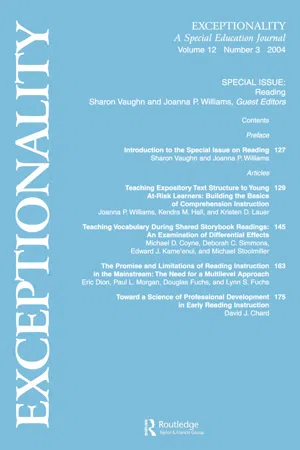
First Published in 2004. The No Child Left Behind legislation signed into law in January 2002 provides guidelines for educational reform and accountability for all student learning. This legislation includes students with disabilities in all of its mandates including Reading First, state-wide assessments, and annual progress reports. Based on the belief that research from the special education community provides an excellent resource of scientifically based reading research that can influence instruction for students with disabilities as well as other students at risk for reading difficulties. This special issue features the work of four researchers and their teams who have contributed to the excellent research base on reading practices for students with disabilities and those at risk for reading difficulties.
Information

Articles
Teaching Expository Text Structure to Young At-Risk Learners: Building the Basics of Comprehension Instruction
Joanna P. Williams
Department of Human Development Teachers College, Columbia University
Kendra M. Hall
Department of Teacher Education Brigham Young University
Kristen D. Lauer
Office of Special Education Programs U.S. Department of Education
Expository text is often neglected in the elementary school curriculum even though most of the reading that children do in school is of that type. Most of the research that demonstrates the importance of text structure in reading comprehension and the benefits that accrue from instruction in text structure deals with children at or above the 4th grade. This research literature, reviewed briefly, provides the basis for the work that is described in this article, which involves younger children. First, a study is presented that demonstrates that children are sensitive to text structure, and therefore would benefit from instruction, as early as 2nd grade. Second, a new instructional program is described that focuses intensively on one specific expository structure, compare and contrast. Finally, the results of a study that evaluates the effects of the program are described.
When we think about the information that is contained in a text, we think primarily about information that relates to content. Indeed, most textual information is content information. Readers use that information to construct a meaningful mental representation of the text and thereby comprehend it. However, some textual information concerns structure, not content. This structural information is important because it helps readers organize the content and thus aids in the process of constructing the mental representation, that is, the meaning of the text.
Text structure is inherent in a text’s organizational pattern, which reflects the logical connections among the ideas in the text (Meyer, Brandt, & Bluth, 1980). These patterns are not limited to text; they represent general rhetorical structures (Dickson, Simmons, & Kame’enui, 1998; Weaver & Kintsch, 1991). There may be explicit markers in the surface text that guide the reader. Sometimes there are signal words such as first or as a result, which identify the particular genre of the text (narrative or expository) and the particular type of structure within a genre. There may also be titles or headings that cue the overall organization of the text. Sometimes there are no surface cues to the text’s structure. However, proficient readers have a sense of the structures that exist. They can recognize them even in text that is not organized effectively. This knowledge helps them organize the information presented in text into a well-structured mental representation.
Many children, some who are just learning to read as well as some who are older, do not easily understand what they read. There may be many reasons for such difficulties, from inadequate decoding or fluency to a lack of task persistence. It is likely, however, that these problems are specifically a matter of poor comprehension, which often involves a lack of knowledge about text structure (Oakhill & Yuill, 1996).
In this article we first review briefly some of the research that demonstrates the importance of text structure in reading comprehension and the benefits that accrue from instruction. We focus on expository text and on studies relevant to children who are at risk for academic failure. Most of this work involves children at the fourth-grade level and above.
We then describe some of the work that we have done with younger children, second graders. We ask two questions. First, are students this young sensitive to text structure? Second, if they are, can we capitalize on this sensitivity and develop instruction in text structure that will improve their reading comprehension? We present a study that answers the first question in the affirmative. Then we describe a new instructional program that focuses intensively on one specific expository structure, compare and contrast, and we present the results of a study that evaluates the effects of this program. (It is intended that this short program might later be expanded to include a variety of expository text types.)
Expository Text and Poor Readers, Including Readers with Learning Disabilities
Although many children start school with an awareness of narrative text structure, few have an awareness of expository text structure. This is in part because most of the reading that parents do with their preschool children is from storybooks. This in turn is probably because expository text is more difficult; the relation between ideas that are presented in expository text is not the simple sequence of familiar events that are depicted in many narratives. Rather, they depict abstract logical relations (Stein & Trabasso, 1981).
Another reason why expository text is difficult to comprehend is that it appears in a variety of different organizational structures. Anderson and Armbruster (1984) listed six such structures: description, temporal sequence of events, explanation of concepts, definition and example, compare and contrast, and problem–solution–effect. Other authors (e.g., Meyer et al., 1980; Meyer et al., 2002) have similar lists. Moreover, most texts do not represent a single structure—they mix two or more of them (Meyer & Poon, 2001). Historical sequences exemplify a particularly common type of mixed structure, incorporating problem–solution–effect, description, and narrative (Perfetti, Britt, & Georgi, 1995).
Poor readers, including students with learning disabilities, find expository text structure particularly difficult. The earliest studies addressed the question of how well students were able to comprehend main ideas. Hansen (1978) found that students with learning disabilities did not recall as much main idea information as did normally achieving students, although both groups of students recalled comparable amounts of detail information. Wong’s (1980) results were similar, but she also found that if prompting questions were provided, the two groups did equally well. Wong concluded that students with learning disabilities have particular difficulty organizing information on their own. However, it is not only poor readers and children with learning disabilities who have difficulties with expository text. In a study of children randomly drawn from suburban classrooms, Williams, Taylor, and deCani (1984) found that even the oldest students (seventh graders) were not sensitive to how the presence of anomalous information might modify a text’s main idea.
Following these early studies, attention was soon drawn to a consideration of the several organizing structures that we have already described. Englert and Thomas (1987) compared normally developing students, students with learning disabilities, and students who were low achievers but who did not have learning disabilities. They looked at four types of expository text: description, enumeration, sequence, and compare and contrast. On a task that required the students to differentiate sentences that either related to the text topic or presented intrusive information, students demonstrated differential sensitivity to the four structures. There was greater sensitivity to the sequence structure than to the enumeration and description structures, which in turn showed greater sensitivity than the compare and contrast structure.
Englert and Thomas (1987) compared third and fourth graders with sixth and seventh graders, and they found that older students in all three student groups exhibited more sensitivity to structure, suggesting that awareness of text structure is developmental. When asked to identify inconsistencies in expository text content, the normally achieving students identified more inconsistencies than did the low-achieving students, who identified more than did the students with learning disabilities. Englert and Thomas concluded that poor readers could not use the interrelations in text to guide their comprehension. In addition, these students were not sensitive to their comprehension failures; they did not demonstrate any self-monitoring of their comprehension, for example, by going back to reread the text.
Several investigators have focused on problem–solution text, defined by Meyer et al. (1980) as including a description of a problem and the specification of a number of possible solutions that might solve the problem. This problem–solution structure fits a good portion of the content found in upper elementary history and social studies textbooks. It resembles narrative structure in that causal relations, which link actions in sequences, and motivational relations are found in both narratives and history textbooks (Black, 1985).
However, when Beck, McKeown, Sinatra, and Loxterman (1991) analyzed the structure of authentic history texts found in classrooms, they found that their causal event sequences are not presented in the same pattern as most narratives. Narratives typically follow a sequence that first presents the problem to be solved, then the action that solves the problem, and finally, an effect that occurs as a result of the action. Textbooks, on the other hand, often follow an action–effect–problem sequence. Beck et al. modified passages from authentic textbooks, reordering the content so that the passages followed a narrative sequence (problem–action–effect). They found that fourth- and fifth-grade students who read the revised texts recalled significantly more idea units and answered more questions correctly than did those who read the original textbook passages. These findings are often cited as clear evidence that text structure influences comprehension.
One outcome of such research findings is to provide motivation for writers to modify the organization of textbooks so that they conform to what we know about good (i.e., easy to understand) structure (Gersten, Fuchs, Williams, & Baker, 2001). However, that approach goes just so far. Students must be prepared for the many less-than-adequately structured texts that they will encounter both in and out of school.
A review by Dickson et al. (1998) describes 17 studies focused on the relation between text organization and comprehension; they concluded that knowledge of text organization affects comprehension especially in terms of the identification and recall of the most important information in a text. Good readers appear to be able to use this type of knowledge more effectively than poor readers.
Instruction
It might be expected that, given the documentation of students’ difficulties with reading comprehension in general and with text structure in particular, there would be great efforts to provide suitable instruction. However, there have not been. There were a few research studies in the 1980s that focused on how best to teach text structure, but interest in the topic waned after a few years without having sparked any large-scale movement to apply the findings of the studies in the classroom.
Until 2 or 3 years ago there was almost a complete dearth of instruction focused on expository text in the early grades. In fact, there is little exposure to expository text in these grades. Hoffman et al. (1994) pointed out that basal readers typically include a very small proportion of expository text. Duke (2000), who examined 20 first-grade classrooms across 10 different school districts, found a scarcity of informational texts in all of them; she suggested that perhaps this lack of experience with expository text contributes to the fourth-grade slump in reading achievement noted by Chall, Jacobs, and Baldwin (1990). Without proper attention to expository text in the early grades, students remain unprepared for the comprehension demands that await them (Bernhardt, Destino, Kamil, & Rodriguez-Munoz, 1995; Jitendra, Edwards, Choutka, & Treadway, 2002).
There have been some research studies within the context of strategy instruction. Among the many strategies that have been recommended is one that teaches students about how text is structured, with the expectation that if they apply this knowledge as they read, their comprehension will improve (Gersten et al., 2001). However, on what basis would one decide which structure to teach? It seems reasonable to argue that students would profit from having instruction focused on a structure if they were at all sensitive to that structure, that is, if they responded differently to the same text content presented in well-structured form or in poorly structured form. Such sensitivity is often called awareness, but there is no implication that students are in any way conscious of their responses.
Richgels, McGee, Lomax, and Sheard (1987) found that sixth graders were indeed sensitive to and aware of text structure and also that their awareness varied as a function of structure type. Across five awareness and recall tasks, students were more consistently aware of a compare and contrast structure than a causation structure. Thus upper elementary school students are promising candidates for instruction in text structure.
Armbruster, Anderson, and Ostertag (1987) conducted an instructional study that dealt with a single structure, problem–solution. In their study, middle school students who were given explicit instruction in this structure recalled more information on an essay test than students who received more traditional instruction that included general comprehension questions and summarization. In addition, the structure-trained students identified more main ideas than did the other students, indicating that explicit instruction in structure facilitates the development of a well-structured mental representation.
Overall, the few instructional studies that exist, although far from conclusive, suggest that instruction, especially if geared to a single text structure, is effective in improving students’ ability to comprehend expository text. Dickson (1999), for example, found that the compare and contrast structure could be taught successfully in middle school general education classrooms. Much more work in this area needs to be done. Very few instructional programs have been developed, and there is almost no work that focuses on the sustainability of effects over time or of generalization to structures different from the ones used in training.
In this review, we have cited several studies in which participants were children with learning disabilities. This is because much of this work was done by researchers in special education. More recently, researchers in general education have found that many of the difficulties exhibited by children with learning disabilities are also seen in poor readers who do not have learning disabilities. It also turns out that most of the instructional techniques first explored with students with learning disabilities can b...
Table of contents
- Cover
- Preface
- Introduction
- Articles
Trusted by 375,005 students
Access to over 1.5 million titles for a fair monthly price.
Study more efficiently using our study tools.
Frequently asked questions
Yes, you can cancel anytime from the Subscription tab in your account settings on the Perlego website. Your subscription will stay active until the end of your current billing period. Learn how to cancel your subscription
No, books cannot be downloaded as external files, such as PDFs, for use outside of Perlego. However, you can download books within the Perlego app for offline reading on mobile or tablet. Learn how to download books offline
Perlego offers two plans: Essential and Complete
- Essential is ideal for learners and professionals who enjoy exploring a wide range of subjects. Access the Essential Library with 800,000+ trusted titles and best-sellers across business, personal growth, and the humanities. Includes unlimited reading time and Standard Read Aloud voice.
- Complete: Perfect for advanced learners and researchers needing full, unrestricted access. Unlock 1.5M+ books across hundreds of subjects, including academic and specialized titles. The Complete Plan also includes advanced features like Premium Read Aloud and Research Assistant.
We are an online textbook subscription service, where you can get access to an entire online library for less than the price of a single book per month. With over 1.5 million books across 990+ topics, we’ve got you covered! Learn about our mission
Look out for the read-aloud symbol on your next book to see if you can listen to it. The read-aloud tool reads text aloud for you, highlighting the text as it is being read. You can pause it, speed it up and slow it down. Learn more about Read Aloud
Yes! You can use the Perlego app on both iOS and Android devices to read anytime, anywhere — even offline. Perfect for commutes or when you’re on the go.
Please note we cannot support devices running on iOS 13 and Android 7 or earlier. Learn more about using the app
Please note we cannot support devices running on iOS 13 and Android 7 or earlier. Learn more about using the app
Yes, you can access Reading by Sharon R. Vaughn, Joanna P. Williams, Sharon R. Vaughn,Joanna P. Williams in PDF and/or ePUB format, as well as other popular books in Éducation & Éducation générale. We have over 1.5 million books available in our catalogue for you to explore.