- 112 pages
- English
- ePUB (mobile friendly)
- Available on iOS & Android
eBook - ePub
Primary History Curriculum Guide
About this book
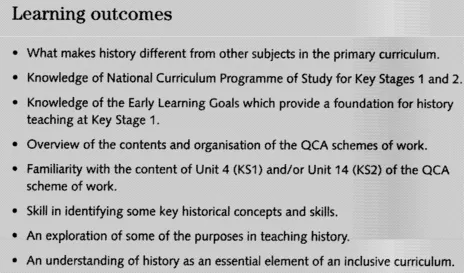
First Published in 2001. This guide sets out to prepare primary teacher training students to teach history well -whatever the topic or aspect of the Programme of Study. It also provides opportunities and encouragement for students to develop their own personal subject knowledge of history. The course content is covered in nine chapters. Each chapter begins with a statement of its learning outcomes and lists the materials that are needed to complete the work of the chapter and achieve these objectives.
Information
Topic
EducationSubtopic
Education GeneralChapter 1
What is History?
You will need
National Curriculum for History (Task 2); Newspaper (Task 4); National Curriculum for History 1999 (Task 5); QCA Scheme of Work - Unit 4 for KS1 and Unit 14 for KS2 access to non-fiction books on Florence Nightingale (KS1) and Ancient Greece (KS2) (Task 6).
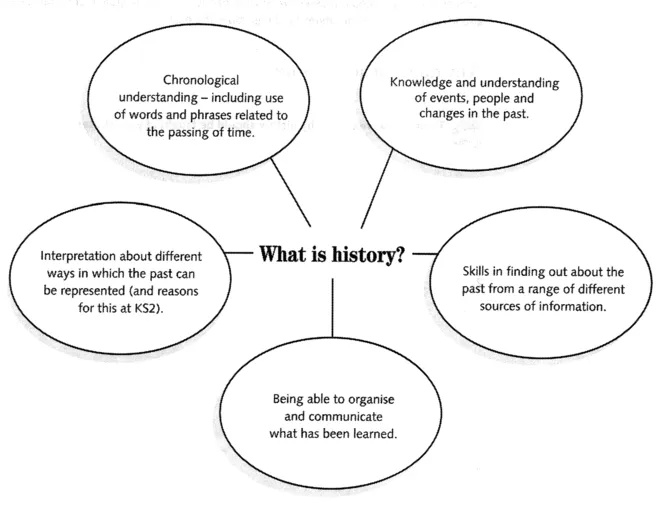
What is history?
Since 1991, the National Curriculum has required that history be taught to all children throughout the five to 11 age-range. Prior to that, history had appeared on primary timetables in a variety of forms. Sometimes it was simply history as a distinctive timetabled subject, but often it appeared in guises such as social studies, humanities and topic work. The gradual move towards a more subject-specific curriculum is well documented in a number of texts about educational change in the last three decades of the 20th century. In the late 1980s, subject-specific working parties were set up to examine all the different curriculum areas, and their initial findings were used to inform the content of the first National Curriculum document. The Working Party's document for history makes useful reading for history specialists (DES 1990). It identifies the purposes of history teaching and uses this rationale for recommending subject content. It is interesting to compare the latest statutory requirements for history teaching in the 21st century with the initial recommendations of the working party.


The Foundation Stage
Knowledge and understanding of the world is an area of learning for the under fives. One of the early learning goals for the end of the Foundation Stage is that pupils should be able to find out about the past and present events in their own lives and in those of their families and other people they know. Several of the goals for language and literacy will also involve language and understandings about the past.
Why do we teach history?
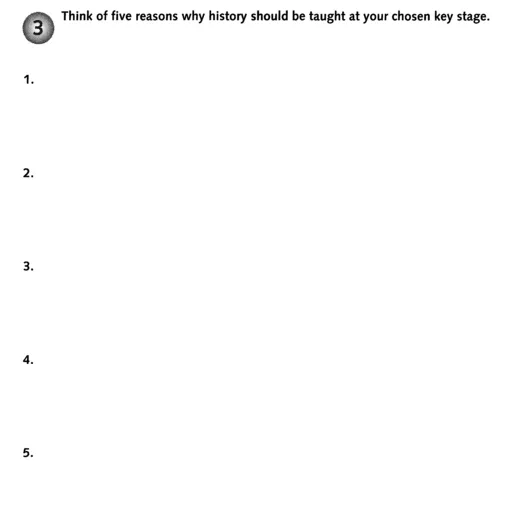
Compare your list with someone else's before looking at the suggestions made by the National Curriculum History Working Group (following).
The National Curriculum History Working Group suggests that the purposes of school history are:
- to help understand the present in the context of the past
- to arouse interest in the past
- to help give pupils a sense of identity
- to help give pupils an understanding of their own cultural roots and shared inheritances
- to contribute to pupils' knowledge and understanding of other countries and other cultures in the modern world
- to train the mind by means of disciplined study. History relies heavily upon disciplined enquiry, systematic analysis and evaluation, argument, logical rigour and a search for truth
- to introduce pupils to the distinctive methodology of historians
- to enrich other areas of the curriculum
- to prepare pupils for adult life.
Hilary Cooper, in the third edition of her book The Teaching of History in Primary Schools (Cooper 2000), extends this in her two chapters on historical thinking.
You may find that you disagree with some of these purposes or that you have found additional reasons for the study of history in the primary school. However, whether we enjoyed or hated the subject when we were at school, we cannot escape from it. It is the most dangerous subject in the world because it kills!
Historical skills
HMI identified seven objectives tor pupil progress in historical skills in a document published in 1985 (History in the Primary and Secondary Years). These still remain a good guide to identifying specific historical skills when planning a lesson. The document is well worth seeking out because it provides a linear progression for each skill.
- Reference and information-finding skills such as those outlined in the NLS for nonfiction texts.
- Skills in chronology - such as the use of basic vocabulary and understanding chronology.
- Language and historical ideas - we would probably identify these today as historical concepts such as hero, heroine, nobleman.
- Use and analysis of evidence,
- Empathetic understanding.
- Asking historical questions.
- Synthesis and communication using basic ideas.
Thinking skills and attitudes
The writers of this guide believe that history has a key role to play in encouraging children and adults to know how to think. We would be very foolish to claim that such thinking skills will create world peace, but extending the mind beyond the obvious and developing creative solutions to problems should be one outcome of good education. It is certainly a crucial element in children's social, moral, spiritual and cultural education.
Here are some pointers for creating a thinking atmosphere:
- Examine your own thinking about thinking! Academic skills, such as knowing how to read and memorise number facts, are not the same as thinking skills. Historical skills cover various levels of thinking - knowledge, comprehension, application, analysis, synthesis and evaluation.
- Start early. Under fives can be challenged to think and image. History asks them to think about the time when they were little.
- Give children something to think about. All historical sources provide this - museum exhibits, artefacts, portraits, photographs and so on. Challenge them to think about what they've seen and heard.
- Teach them to look at all sides to a question/problem. The obvious answer is not always the best one.
- Encourage them to find threads, patterns and make connections. How does this relate to what we did in history last week?
- Show how history can be seen as a dynamic force where accepted ideas are overturned.
- Ask good and varied questions. Knowledge-level for recalling information, unconventional questions to elicit thought 'How do you know that?'; prepare questions in advance but be prepared to follow up on the comments and understandings children have; ask questions which can be answered silently or in writing; sometimes ask pupils to repeat the question and give a good response time (3 to 5 seconds after asking the question); ask children to clarify their answers.
- Teach children to define terms. What is meant by the word 'old', for example? Defining terms is a tough mental discipline,
- Encourage them to consider other points of view. Historical fiction provides some ideas doing this.
- Write it down. Thoughts can be fuzzy, until clarified on paper. History can be particularly useful in clarifying formats for different types of writing - reports, recounts and explanations.
- Encourage creativity. Role-playing; pose 'what if?' type questions; practise divergent thinking; solve open-ended problems 'How can you make a model Tudor town house?'
- Nurture imagination. What would happen if a Tudor child came to visit us in school today?
People
History is about people.
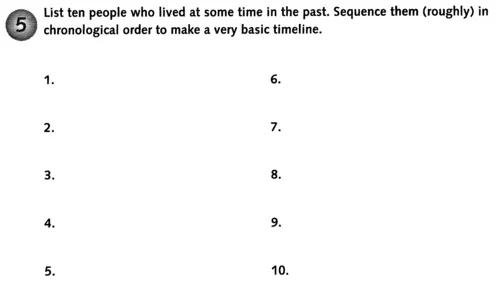
Now ask yourself these questions:
- What type of people are they?
- Why are they remembered?
- What aspects of human endeavour do they represent?
- Are there any women on your list?
- Do any represent different cultures?
- Have you included any members of your family? If not, do so.
Add yourself to the timeline.
Add the name of one of the children you have taught.
School history has been criticised as being exclusive because the subject matter concentrates on Eurocentric, wealthy males. In Reclaiming Our Pasts, Claire (1996) argues strongly for a more inclusive history curriculum for the primary school:
- children need to contextualise the information they are getting through the media in order to understand it better
- they are interested anyway
- a Eurocentric and male-centred curriculum fails to prepare children adequately for life
- a Eurocentric and male-centred curriculum is basically unjust and biased about the contributions and history of women and non-European people
- this limited curriculum continues to support sexism, racism and class misunderstanding by perpetuating out-dated attitudes.
She points out that this is not just about trendy 'political correctness' but is central to a number of subject related issues. These include:
- The relationship between British history and world history - this is a crucial part of historical interpretation. The National Curriculum at KS extends the need to identify different ways in which the past is represented and interpreted to giving reasons for this.
- The need to avoid teaching pupils a version of history which sees history as a 'march of progress', where political, social and economic aspects of life get progressively better. The great 19th century historians spent little time on the failures and the experience of the marginalised or less fortunate groups such as the colonised or poor. Today, politicians speak of their own great changes and frequently forget particular aspects of the recent past which may have been more supportive to the majority of people.
- The need to encourage children to find out about the histories of their own communities and draw on this to avoid an imperialist, Eurocentric and male-centred view of the world. The movements of people is a fascinating subject in itself. Nursery children may have moved themselves or know people who have moved. The local community may include a number of communities with varied heritages and languages. All of the studies at KS2 involve movements of peoples - the Romans, Anglo-Saxons and Vikings; Tudor exploration; movements of peoples into the cities in Victorian times and immigration and emigration in Britain since 1930.
Primary school history has to take account of 'race' and ethnicity, gender and class. Local publications are often very good at doing this and the history channel on the television often reflects this broader a...
Table of contents
- Cover
- Original Title
- Title
- Copyright
- Contents
- Introduction
- Chapter 1 What is History?
- Chapter 2 Planning, Teaching and Assessing Historical Knowledge, Skills and Understanding
- Chapter 3 Evidence
- Chapter 4 Using Artefacts in the Classroom
- Chapter 5 Visual Sources: Photographs and Portraits
- Chapter 6 Written Sources
- Chapter 7 TV, Film, Radio, ICT and Drama
- Chapter 8 Music
- Chapter 9 Local History, Buildings and Sites, Oral History
- Bibliography and References
- Further Sources of Information
- Index
Trusted by 375,005 students
Access to over 1.5 million titles for a fair monthly price.
Study more efficiently using our study tools.
Frequently asked questions
Yes, you can cancel anytime from the Subscription tab in your account settings on the Perlego website. Your subscription will stay active until the end of your current billing period. Learn how to cancel your subscription
No, books cannot be downloaded as external files, such as PDFs, for use outside of Perlego. However, you can download books within the Perlego app for offline reading on mobile or tablet. Learn how to download books offline
Perlego offers two plans: Essential and Complete
- Essential is ideal for learners and professionals who enjoy exploring a wide range of subjects. Access the Essential Library with 800,000+ trusted titles and best-sellers across business, personal growth, and the humanities. Includes unlimited reading time and Standard Read Aloud voice.
- Complete: Perfect for advanced learners and researchers needing full, unrestricted access. Unlock 1.5M+ books across hundreds of subjects, including academic and specialized titles. The Complete Plan also includes advanced features like Premium Read Aloud and Research Assistant.
We are an online textbook subscription service, where you can get access to an entire online library for less than the price of a single book per month. With over 1.5 million books across 990+ topics, we’ve got you covered! Learn about our mission
Look out for the read-aloud symbol on your next book to see if you can listen to it. The read-aloud tool reads text aloud for you, highlighting the text as it is being read. You can pause it, speed it up and slow it down. Learn more about Read Aloud
Yes! You can use the Perlego app on both iOS and Android devices to read anytime, anywhere — even offline. Perfect for commutes or when you’re on the go.
Please note we cannot support devices running on iOS 13 and Android 7 or earlier. Learn more about using the app
Please note we cannot support devices running on iOS 13 and Android 7 or earlier. Learn more about using the app
Yes, you can access Primary History Curriculum Guide by Pat Hughes,Kath Cox,Gillian Godard in PDF and/or ePUB format, as well as other popular books in Education & Education General. We have over 1.5 million books available in our catalogue for you to explore.