- 192 pages
- English
- ePUB (mobile friendly)
- Available on iOS & Android
eBook - ePub
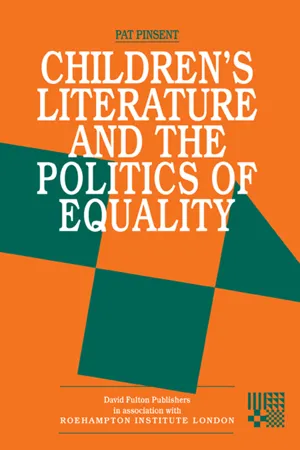
Childrens Literature and the Politics of Equality
About this book
First published in 1997. In this book the author intends to explore some of the many questions which arise as a result of increasing awareness in our society about equality issues. Can the attempt to make books for children consistent with contemporary views about equality go too far? In any case, are children really as much influenced by books and other material as some educationalists would claim? What can or should we do about the 'classics' Of the past? And are today's children's writers so much better at avoiding giving offence to minorities? How much are children affected by the kind of prejudices and preconceptions that we all grow up with but don't always succeed in acknowledging in later life?
Information
Chapter 1
Prejudice in Children’s Books
There is no such thing as an unbiased book (Gillian Klein, 1985, p. 1)
It was not until the 1970s that many people began to be powerfully aware of the extent to which those members of Western society who were not able-bodied middle-class white males were disadvantaged. In 1971 the Institute of Race Relations published Books for Children: The Homelands of Immigrants in Britain, edited by Janet Hill, who voiced her disquiet that so many of these books were poor in quality and ‘blatantly biased’, and her concern about African children growing up in England meeting ‘patronizing, insensitive, and outmoded tales of the noble white man and the natives’ (p. 7). The Children’s Rights Workshop also gave some attention to sexism, race and class in children’s books, but probably the most influential document of the period, in England and Wales, was the Bullock Report, A Language for Life (1975), which devoted a chapter to ‘Children from Families of Overseas Origin’; a slightly unfortunate message was conveyed by this being located in the section of the Report concerned with ‘Reading and Language Difficulties’.
During this period, it was gradually becoming apparent that women, black people and the disabled had too little autonomy in their lives, especially in the area of employment. As a consequence, legislation was enacted to enforce the rights of minorities and in Britain, the Equal Opportunities Commission (1974) and the Commission for Racial Equality (1976) were set up. On both sides of the Atlantic, people’s consciousness began to be raised about the way in which reading matter provided for children was not always in line with the changes in society. There has always been argument about whether literature should simply reflect the social situation or seek to improve it; children’s authors in particular have frequently sought to teach their readers the values which society wants to encourage, even to the extent of seeking to indoctrinate them. Many writers have assumed that literature does influence children, so it was quite natural that in this period more attention began to be given to the suitability or otherwise of much of what young people were being given to read.
It is not surprising that as soon as concerned groups started to present guidelines about particular areas of possible prejudice, especially gender and race, controversy erupted. Books which are loved in childhood naturally generate strong emotions, and frequently the reader has a special sense of possession about them. The immediate reaction of many otherwise logical readers to criticisms of writers such as Bannerman and Blyton was, ‘They never did me any harm’. Even if that were true, however, it in no way legitimates a book which is presented to children who live in a totally different kind of society and whose responses are inevitably various and quite unpredictable. Those who argued the case for Little Black Sambo and Noddy seldom bothered to search out the books and re-examine them in the light of contemporary conditions, but rather relied upon their own childhood memories. They deemed therefore that people who wrote against prejudice were going to extremes and indeed, those who criticize books can all too easily appear to rate all the negative aspects as equally important.
Thus, a female reader may reject a book because of its ‘he-man’ language, rather than looking at deeper issues like the characterization and the way in which girls are treated in the plot. Nevertheless, it is easy for people who have never themselves found language offensive to ridicule those who do. Some readers’ reactions may seem excessive to those less concerned about language, and this probably accounts for the fears which many people have about censorship, although not even the most emphatic of those who sought out prejudice recommended anything so drastic. The idea that there were ‘thought police’ going around burning Blyton and Biggles often prevented some critics from even investigating whether perhaps there was really something wrong with these books.
Guidelines
Since it is clearly impossible to look closely at all the collections of guidelines about avoiding discrimination in literature, I will concentrate on a very influential set which came out in the mid-1970s and have been reproduced in a variety of forms since then. (See notes at the end of this chapter for details of the documents examined.) These were produced by the American Council on Interracial Books for Children, and were adapted by the World Council of Churches (1978) with the addition of specific points about religion (see Preiswerk, 1980) and also by Stinton (1979) and Hicks (1981). British guidelines against racism, such as those produced by the Inner London Education Authority (ILEA) in conjunction with the Centre for Urban Education (CUES) in 1980, and against sexism, like those of Rosemary Stones in 1983, were also inevitably influenced by the American ones. It should be noted that the Council was not recommending that books displaying sexist or racist characteristics should be burnt, or even necessarily removed from shelves. Rather the intention was to alert teachers and librarians to aspects of prejudice of which they may have been unaware, so that they could:
- look for better books, where possible, and not spend scarce resources on unsatisfactory books; and
- show children ‘how to detect racism and sexism in a book [so that] the child can proceed to transfer the perception to wider areas.’
(Spare Rib, December 1980).
Gillian Klein, who was associated with the Guidelines produced by the Inner London Education Authority, emphasizes that these too were in no sense intended to be rigid (1985, p. 17).
If the Guidelines had always been read in the spirit in which they were put forward, it would have defused much of the controversy, but some teachers and librarians were perhaps over-zealous, and isolated cases which seemed to display uncritical adherence to the ‘letter of the law’ were inevitably seized upon by the media.
Rather than quoting the whole document, I am taking each of the points made and, where relevant, also citing the kind of objections which have been made, commenting on some of the reasons why people have been worried about them. The recommendations are as follows.
1. Illustrations
These should avoid stereotypes, such as the Native American ‘brave’ and his ‘squaw’, or the ‘completely domesticated mother, the demure doll-loving little girl or the wicked stepmother; tokenism, like for example the depiction of racial minorities as looking just like whites except for their colour; and passive or subservient roles for ethnic minorities and females.
Objections which were made to this recommendation include:
- the anxiety that women would never be permitted to choose domestic roles, or little girls be allowed dolls – a result which was not intended;
- the fear that traditional tales, which abound in heroines waiting for deliverance and in wicked stepmothers, would be banned.
Counter to such objections is the movement, during the 1980s and 1990s, for presenting children with alternative tales, both traditional and newly written. The feeling articulated in the Guidelines also began to lead to an increase in the number of illustrators from ethnic minority groups, who have increased considerably since Errol Lloyd’s My Brother Sean was published in 1973; additionally, several publishing companies, such as Tamarind and Mantra, devoted to the production of minority groups texts, were founded (See Dragons Teeth, No. 27, Summer 1987 and No. 32, Winter 1989 respectively for details of these companies).
2. Story line
The behaviour of white males should not be taken as the only standard for success, nor should females and members of other ethnic groups always be seen to rely on them for deliverance, or be encouraged to accept inequalities passively.
Objections could be made that in some societies, women are expected to act passively, and that to portray them in literature as doing otherwise is unrealistic. However, while it is difficult to combine proper respect for the traditions of other societies with resistance to women being put into a subservient role, I think many people are unhappy about such a situation being seen as an inbuilt, rather than a societal, norm.
3. Lifestyles
The manners, food and clothing of the white middle classes should not always be seen as a norm.
Objections to this tend to be made by those who have never tried to see their own culture objectively; since some of its customs are implanted in infancy, it is very difficult not to regard them as superior to alternative modes. An historical perspective can be very helpful here.
4. Relationships
Again, care should be taken that white males are not always portrayed as dominant, in society and the family. Due weight needs to be given to the effect of social conditions on family relations. Objections to this tend to be made by those who feel that in realistic terms, white males are dominant; here again, it can be claimed that writers of literature have a responsibility not to perpetuate unjust social systems.
5. Heroes and heroines
Not only should there be strong female characters and people from minority groups, but they also need to be shown opposing some of the power structures which Western society may take for granted.
Those people who object to this requirement imply that it would mean that individuals, such as revolutionaries, who oppose some social or religious institutions, might be depicted as models for children. One person’s revolutionary, however, is another person’s freedom fighter, and there is a good deal of relativism in the standards which are applied.
6. Effects on a child’s self-image
There should be ample provision of characters with whom girls and ethnic minority children can identify.
This is a difficult area, particularly in relation to the literature of the past. It is also noteworthy that the child reader does not always identify, or fail to identify, with the characters anticipated; many girls have seen themselves as Jim Hawkins in Treasure Island or Mowgli in The Jungle Books, though both of these are boys and the latter is presumably Indian in origin.
7. Author’s and illustrator’s backgrounds
The creators of a book about a particular theme or culture should have some qualifications to portray it, either by background or acquired knowledge.
This recommendation has been particularly controversial, as it could be taken to exclude authors from writing or illustrating books about countries and peoples other than their own. It should instead be seen as a plea that writers and illustrators be accurate.
8. Author’s perspective
Since all of us have our own sets of unexamined assumptions, it is worth trying to find out those which have influenced the creator of a book. People who query this suggestion have probably an unexamined but invalid assumption that they themselves are completely without prejudice of any kind!
9. Language
Sexist and racist language, and that which excludes females by using only the male pronoun, needs to be examined.
This is also an extremely contentious area. On the one hand, some writers, especially those of the past, have used terms to describe black people which are completely unacceptable today, so that their critics have sometimes asserted that their works should not be read by young children. On the other, some writers who are extremely anti-racist in their own attitudes have felt the necessity to portray racist characters in their books, which has led to them using offensive language, although it may be contextualized (but never sanitized) by being spoken by an objectionable person. Equally, such language might be spoken by a character, such as a child, who has not yet realized that it could give offence. Provided the book portrays such characters learning or being rebuked, where appropriate, some people would argue that the offence is mitigated.
10. Date
A recent date is not a guarantee of being informed about new perspectives; delays in publication mean that a book may transmit outdated attitudes.
This has been particularly criticized; Hoggart (The Observer, 22 January 1984) assumes that it means: ‘If a book is even two years out of date, sweep it from the shelves.’ While it is not impossible that excess of zeal could lead to such behaviour, it seems clear from the context that this recommendation applies more to information books than to fiction, and in any case, the recommendations are really directing adults to be careful and where appropriate to provide an historical context, rather than getting rid of specific books as such.
The relevance of the guidelines to children’s books
All of these areas have remained controversial in the period since the guidelines were first published. One of the most important aspects is that although there is ample evidence of guidelines such as these being borne in mind by many teachers, librarians, authors, publishers and booksellers, they are less likely to be taken into consideration by parents and other people who buy books for children. There are also still in existence innumerable copies of books which do not adhere to any guidelines, and these are likely to be read by children without the guidance of a teacher. Children must be educated about such issues, and I would suggest that in many instances, books which preceded or have ignored such guidelines are themselves the most effective resources for such education. Insulating children from anything likely to mislead or to give offence would be as dangerous as failing to vaccinate them against, for instance, tetanus.
I shall be looking at many of these aspects in more detail in the next chapter, since some of the fundamental assumptions about the effect of literature on children need to be examined in more depth before the discussion in subsequent chapters of some books which have appeared since the mid-1970s.
One of the main limitations of guidelines like these is that by their nature they disregard literary quality and the appeal of books to children. Books which are on the right lines about racism and sexism need to be just as good and as readable as any others; they need to be enjoyed both by children and by adults. Only then will they have any chance of becoming part of the school culture, or being recommended by a child’s peer group or by teachers and librarians; only then will they be bought for schools or by parents. If books lack interesting plots and attractive characters, or if the language, however non-racist and non-sexist it is, does not appeal to the child reader, then no adherence to sets of guidelines will cause the book to have a good effect.
It is important at this stage to establish that on the one hand, political commitment does not make a book inferior, and on the other that there are poor books whose adherence to the guidelines does not redeem them. An example of a strongly committed book, written out of a deep involvement with the socially deprived and racially oppressed black families of the Southern States in the 1930s, is Mildred Taylor’s Roll of Thunder, Hear My Cry (1976), based on her father’s s...
Table of contents
- Cover
- Title Page
- Copyright Page
- Table of Contents
- Acknowledgments
- Introduction
- 1. Prejudice in Children’s Books
- 2. Children and Literature
- 3. Have the ‘Classics’ Had Their Day?
- 4. Prejuduce and Children’s Popular Fiction
- 5. Anti-Sexist and Emancipatory Books
- 6. ‘Race’ and Ethnic Identity
- 7. Literature, Language and Culture
- 8. Literature and Society: Age and Disability
- 9. Equality and Information Books
- 10. Literature, Equality, and the Classroom
- Bibliography
- Index of Auhtor
- Index of Subject
Trusted by 375,005 students
Access to over 1.5 million titles for a fair monthly price.
Study more efficiently using our study tools.
Frequently asked questions
Yes, you can cancel anytime from the Subscription tab in your account settings on the Perlego website. Your subscription will stay active until the end of your current billing period. Learn how to cancel your subscription
No, books cannot be downloaded as external files, such as PDFs, for use outside of Perlego. However, you can download books within the Perlego app for offline reading on mobile or tablet. Learn how to download books offline
Perlego offers two plans: Essential and Complete
- Essential is ideal for learners and professionals who enjoy exploring a wide range of subjects. Access the Essential Library with 800,000+ trusted titles and best-sellers across business, personal growth, and the humanities. Includes unlimited reading time and Standard Read Aloud voice.
- Complete: Perfect for advanced learners and researchers needing full, unrestricted access. Unlock 1.5M+ books across hundreds of subjects, including academic and specialized titles. The Complete Plan also includes advanced features like Premium Read Aloud and Research Assistant.
We are an online textbook subscription service, where you can get access to an entire online library for less than the price of a single book per month. With over 1.5 million books across 990+ topics, we’ve got you covered! Learn about our mission
Look out for the read-aloud symbol on your next book to see if you can listen to it. The read-aloud tool reads text aloud for you, highlighting the text as it is being read. You can pause it, speed it up and slow it down. Learn more about Read Aloud
Yes! You can use the Perlego app on both iOS and Android devices to read anytime, anywhere — even offline. Perfect for commutes or when you’re on the go.
Please note we cannot support devices running on iOS 13 and Android 7 or earlier. Learn more about using the app
Please note we cannot support devices running on iOS 13 and Android 7 or earlier. Learn more about using the app
Yes, you can access Childrens Literature and the Politics of Equality by Pat Pinsent in PDF and/or ePUB format, as well as other popular books in Letteratura & Didattica generale. We have over 1.5 million books available in our catalogue for you to explore.