eBook - ePub
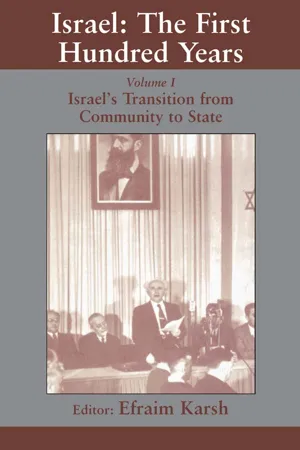
Israel: the First Hundred Years
Volume I: Israel’s Transition from Community to State
- 264 pages
- English
- ePUB (mobile friendly)
- Available on iOS & Android
eBook - ePub
About this book
The Zionist Movement was born in the wake of Jewish emancipation in Western Europe, and at a time of increased persecution in Eastern Europe. This volume addresses the intellectual, social and political ramifications of Jewish settlement in Eretz Israel before the creation of the State of Israel.
Trusted by 375,005 students
Access to over 1.5 million titles for a fair monthly price.
Study more efficiently using our study tools.
Information
Subtopic
20th Century HistoryIndex
HistoryTHE MAKING OF THE YISHUV
The Jews in Eretz-Israel/Palestine: From Traditional Peripherality to Modern Centrality
Until about three decades ago, most of the research on the Jews in Eretz-Israel during the nineteenth and the first half of the twentieth centuries was characterized by a ‘Judeo-Palestino-centrist’ orientation. Conducted mainly by historians of the Jewish people, economic historians, sociologists, political scientists and geographers, it focused only on the Jewish sector of the population, and dealt mostly with the changing ideological trends, ties with Diaspora Jewry and local Ashkenazi community frameworks, interactions and conflicts. Even when choosing the Jewish community in Palestine (Yishuv) as the unit of analysis, topics such as the traits and role of Sephardi and Oriental communities, the status and contribution of women in the different communities, urban and rural planning and architecture, were barely touched upon.
The traditional schools of thought did not consider the Jewish Yishuv in Palestine within a more general and comparative context as part of the region in the period under discussion; nor did they attempt to interface their studies with general theories, models and paradigms. Themes and processes such as the influence of external political systems, the comprehensive policy of the rulers (being in our case the Ottoman Empire and the British Mandate), westernization, colonialism and colonization, world and regional economic and technological change, environmental, spatial and physical change, and general processes of demographic, social and cultural change were considered only in a very narrow context.
By way of filling this research lacuna, this essay seeks to attain several objectives:
• To present a longitudinal narrative overview of the Jews of Eretz-Israel/Palestine (the Yishuv) during the late Ottoman and the Mandate periods.
• To consider the Jews of Palestine within the context of external political systems and the Jewish Diaspora on one hand, and the local non-Jewish society on the other.
• To provide a generalized dynamic typology of the demographic, political, social, cultural, spatial, and economic components over time.
• To refine the existing categorization of ‘Old’ and ‘New’ Yishuv.
• To further examine the contribution of Sephardi and Oriental versus Ashkenazi Jews to the growth and development of the Yishuv, which in our opinion has been underestimated.
Certain aspects such as the status and role of women, and characteristics of several ethnic groups in the Yishuv require more in-depth attention than can be attempted in this framework.
GOVERNMENT AND ADMINISTRATIVE DIVISION
Under Ottoman rule (1517–1917) there was no political entity actually known as Palestine but a term preserved by the Christian world referring to the ‘Holy Land’ or ‘Judea’. The name Palestine was taken from the Hebrew word Pleshet and used by Emperor Hadrian in an attempt to eradicate any trace of Judaism in the land. By 425 AD, the Byzantine heirs to the eastern part of the Roman Empire had delineated three provinces: Palaestina Prima, which included the coastal towns, the Judean Hills and the Jewish section of the Jordan Rift; Palaestina Secunda, which comprised the Jezreel Valley, the Galilee and the Golan; and Palaestina Tertia, which consisted of the Negev, Ammon, Moab and Edom. After the Arab conquest in 638, Palaestina Prima was named Jund Filistin. Under the Mamluke (1267–1517) and Ottoman rule, the use of the term Filistin was not resumed. Instead, Ottoman jurisdiction divided the territory between the provinces (vilayets) of Sidon (later Beirut) and Damascus. The latter controlled the northern sections of the area east of the Jordan River. Under the 1864 Law of Vilayets the districts (sanjaks) of Jerusalem, Nablus and Gaza became a separate administrative unit, called the mutasariflik of Jerusalem. In 1873 its rule was transferred directly to Istanbul. In 1906 an administrative boundary was drawn between Sinai and the Ottoman Empire along the Rafah-Taba line. In 1908 the Negev was placed under the Governor of the Damascus province.
The British gained control of Palestine during 1917 and 1918. On 24 April 1920, the Supreme Council of the Peace Conference at San Remo conferred the Mandate over Palestine on Great Britain. The British opted for the name Palestine in line with the European Christian tradition. As a concession to Jews who wanted the historic name Eretz-Israel (i.e., the Land of Israel), the initials aleph and yud were added in parentheses to the Hebrew form of the name of Palestine. The territory east of the Jordan and Arava Valleys was separated and the protectorate of Transjordan was created in 1923 with Emir Abdallah Ibn Hussein as its sovereign. The northern boundary of the area west of the Jordan River was finally determined in the spring of 1923. The area of Mandatory Western Palestine was 27,009 square kilometres (10,429 square miles) including 704 square kilometres (272 square miles) of inland water. The 1948 War led to the partition of Western Palestine, with the newly established State of Israel occupying 20,700 square kilometres (7,993 square miles). The Hashemite Kingdom of Jordan annexed the territory which came to be known as the West Bank, including East Jerusalem, and the Kingdom of Egypt occupied the Gaza Strip.
The territory consists of three major longitudinal strips. East of the Mediterranean Sea is the coastal plain which narrows from 40 kilometres in the latitude of Gaza in the south to 4–5 kilometres in the north near Rosh Hanikra. Sparsely populated in the early nineteenth century, it became the focus of twentieth century Jewish settlement activity. Inland the territory consists of a chain of mountains interrupted by latitudinal valleys. In the south are the Negev Hills. The Beersheba Depression separates them from the central mountain district (Judaean and Samarian Mountains). The Judaean Mountains peak at an elevation of just over 1,000 metres above sea level in the areas of Hebron and Ramallah. In the north is the Galilee, another mountain area separated from the chain by the Jezreel and Beit Shean Valleys. The northern boundary of this geographic region is Lebanon's Litani River. The highest peak is Mount Meron (1,208 metres). The central and northern mountain zones were the most densely populated areas in the nineteenth century, with towns and traditional villages. The third strip is part of the Great Rift Valley. The northern section is defined by the Jordan River Valley including the Sea of Galilee and the Dead Sea. The elevation drops to 400 metres below sea level. The southern section, the Arava Valley extends to the Gulf of Eilat (or Aqaba), an extension of the Red Sea.
The climate of most of the area is Mediterranean, characterized by winter rains and summer drought. This is typical of regions on or near the west coasts of continents approximately between the latitudes of 25 to 35. Precipitation reaches a maximum annual average of 1,100 millimetres in the Upper Galilee with averages of 625 millimetres for Haifa, 550 for Tel Aviv, and 500 for Jerusalem. An arid zone is found in the southern section of the country and is part of the global desert belt which includes the Sahara and Arabian Deserts. In addition, the southern part of the Jordan Valley is arid resulting from the rainshadow effect of the adjacent hills. The climate greatly affected human usage. The 300–400 millimetre isohyets was the approximate boundary of human settlement except where groundwater was available or run-off was collected. Beersheba receives annual average of 200 millimetres of rainfall and Eilat only 30 millimetres. The arid and semi-arid areas were traditionally inhabited by a nomadic population – the Bedouins. A few permanent settlements were located adjacent to secure water sources.
CHANGE OF RULE
Our starting point will be 1799. It was then that Napoleon's army invaded Palestine. What ensued was a new era in the country's history. From a forsaken province, it became the focal point of a tug-of-war between the European powers and later Zionist efforts for the establishment of a homeland for the Jews. From a political and administrative perspective, the history of Palestine could be differentiated between Ottoman rule (1799–1917) and British rule (1917–1948).
The era of Ottsoman rule could in turn be divided into four political sub-periods: (1) the period of the Pashas – strong local rulers (1799–1831), i.e. a continuation of the eighteenth century and the forms of government common then; (2) the conquest of Syria and Palestine by Egyptian ruler Muhammed Ali via his son, Ibrahim Pasha (1831–40), which, in many respects, was a turning point, for despite the brevity of this period, the changes in government and other spheres were many; (3) the period of reforms (1841–76), when the Ottomans, who had regained control of the country, tried to institute new patterns of government throughout their empire; and (4) the end of the Ottoman period (1877–1917). The first and larger half of this period was marked by the centralized rule of Sultan Abdul Hamid II; then came the rise of the Young Turks, who staged a revolution in 1908 and remained in power until the British occupation of Palestine in 1917–18. Some modest expressions of Palestinian nationalist sentiments could be detected during the years preceding the war.
This overall periodization is meaningful in terms of improvement in the status and security of Jews, Christians and foreign subjects. The rights of foreign nationals, which were mostly Jews, to own land throughout the Empire were revised in 1858 and 1867. However, in the last sub-period, laws and orders restricting Jewish immigration and land purchase in Palestine were issued. They were more strictly enforced from 1897 – the founding of the Zionist movement – to the First World War.
The era of British rule has been sub-divided by researchers mainly according to criteria connected to the history of the Jewish population, namely aliya (waves of immigration), Jewish economic activity or British activities vis-à-vis Jewish immigration and settlement, the Arab revolt and conflict with the Jews. The periodization from the perspective of the non-Jewish society opened with the early years after the war (1918–21) which saw the rise of Arab nationalism. Palestine was seen as part of ‘Southern Syria’ and its incorporation into a large Arab state was demanded. The second period (1922–28) was that of appeasement. The Churchill White Paper calmed Arab fears of a Jewish state. This was followed by renewed nationalism (1929–39) and the demands for a continued Arab majority. It peaked in 1936–39 with the Arab Revolt which was expressed through general strikes and armed struggle against British authority and the Jewish population. The final period was that of conflict (1940-48) with attempts at Arab appeasement during the Second World War to prevent their alliance with Germany. The exiled Mufti of Jerusalem, Haj Amin al-Husseini, set the tone and allied himself with Adolf Hitler. Also, Jewish pressure mounted for increased immigration and territorial control during and following the war. It ended with the establishment of the State of Israel and the occupation of remaining sections of Palestine by Egypt and Transjordan.
THE COMMUNITIES OF PALESTINE
Palestine was populated by a mix of different peoples, divided along religious and/or ethnic lines. However, until 1922 when the first comprehensive census of the country's population was conducted, information is based on incomplete data and conflicting estimates which are not always objective. In 1800, the population stood at an estimated 250,000–300,000 (including about 5,500 Jews). Y...
Table of contents
- Cover
- Half Title
- Israeli History Politics and Society
- Title Page
- Copyright Page
- Table of Contents
- Introduction
- Nations, Nationalism and State-Building
- The Making of the Yishuv
- The Struggle for Independence
- Abstracts
- Index
Frequently asked questions
Yes, you can cancel anytime from the Subscription tab in your account settings on the Perlego website. Your subscription will stay active until the end of your current billing period. Learn how to cancel your subscription
No, books cannot be downloaded as external files, such as PDFs, for use outside of Perlego. However, you can download books within the Perlego app for offline reading on mobile or tablet. Learn how to download books offline
Perlego offers two plans: Essential and Complete
- Essential is ideal for learners and professionals who enjoy exploring a wide range of subjects. Access the Essential Library with 800,000+ trusted titles and best-sellers across business, personal growth, and the humanities. Includes unlimited reading time and Standard Read Aloud voice.
- Complete: Perfect for advanced learners and researchers needing full, unrestricted access. Unlock 1.5M+ books across hundreds of subjects, including academic and specialized titles. The Complete Plan also includes advanced features like Premium Read Aloud and Research Assistant.
We are an online textbook subscription service, where you can get access to an entire online library for less than the price of a single book per month. With over 1.5 million books across 990+ topics, we’ve got you covered! Learn about our mission
Look out for the read-aloud symbol on your next book to see if you can listen to it. The read-aloud tool reads text aloud for you, highlighting the text as it is being read. You can pause it, speed it up and slow it down. Learn more about Read Aloud
Yes! You can use the Perlego app on both iOS and Android devices to read anytime, anywhere — even offline. Perfect for commutes or when you’re on the go.
Please note we cannot support devices running on iOS 13 and Android 7 or earlier. Learn more about using the app
Please note we cannot support devices running on iOS 13 and Android 7 or earlier. Learn more about using the app
Yes, you can access Israel: the First Hundred Years by Efraim Karsh in PDF and/or ePUB format, as well as other popular books in History & 20th Century History. We have over 1.5 million books available in our catalogue for you to explore.