- 392 pages
- English
- ePUB (mobile friendly)
- Available on iOS & Android
eBook - ePub
About this book
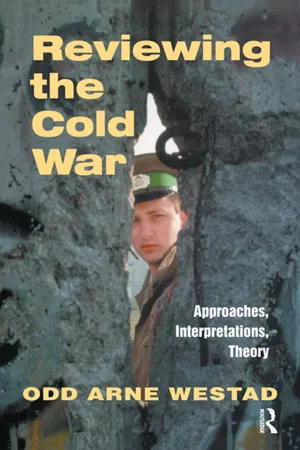
Since the cold war ended, it has become an international field of study, with new material from China, the former Soviet Union and Europe. This volume takes stock of where these new materials have taken us in our understanding of what the cold war was about and how we should study it.
Information
PART I:
STUDYING THE COLD WAR
1
On Starting All Over Again:
A Naïve Approach to the Study of the Cold War
‘Outside of a dog, a book is a man's best friend. Inside of a dog, it's too dark to read.’ (Groucho Marx)
I like this quotation from the ‘other’ Marx because it suggests how limited our view of the Cold War, until quite recently, has actually been. In contrast to the way most history is written, Cold War historians through the end of the 1980s were working within, rather than after, the event they were trying to describe. We had no way of knowing the final outcome, and we could determine the motivations of only some – but by no means all –of the major actors. We were in something like the position of those puzzled poseurs, Rosencrantz and Guildenstern, in Shakespeare's Hamlet, wondering what in the world was going on and how it was all going to come out.1
We now know, to coin a phrase. Or, at least, we know a good deal more than we once did. We will never have the full story: we do not have that for any historical event, no matter how far back in the past. Historians can no more reconstruct what really happened than maps can replicate what is really there.2 We are all in the business of representation, and because representations invariably reflect the nature and purposes of those doing the representing, there can never be definitive histories of anything.3 Historians, hence, are by their nature revisionists. Their task is as much to subvert as to confirm prevailing views – even if these result from earlier revisions, and even if the effect of challenging them is to revive still earlier orthodoxies.4
Whether we can revise without reconsidering the labels we have attached to one another's work is an interesting question. It is all too easy, in a controversial field like Cold War history, to let category shape content. We tend to cram each other into tight historiographical boxes like ‘orthodoxy’, ‘revisionism’, ‘post-revisionism’, ‘corporatism’, or ‘post-modernism’, with the result that we fail to read one another as carefully as we might. If the substance of what we are doing is new – and much of it surely is – then should not the categories be also? Especially since most of our old ones were themselves artifacts of the Cold War, which is to say, they reflected the view from inside Groucho's dog?
It is, I think, no accident that the parable most often associated with the end of the Cold War was that of the emperor's new clothes. The premise was that a naïve rather than a sophisticated view best detected reality and this chapter tests that hypothesis. I've framed it around a set of impressions a person from Mars might have – someone with no prior memory or knowledge or understanding of the Cold War – if exposed to that subject for the first time. I hope thereby to suggest some new approaches and start some new arguments; in short, to make a fresh start.
Doing so by way of the Martians is not as odd as it might seem, for many of us encounter their equivalents every day. They are not aliens; they are undergraduates.5
Naïve Impression no. 1: The Cold War went on for a very long time, and then all of the sudden it went away
That seems obvious enough now, but I cannot recall anyone during the Cold War who thought it obvious at the time. Wars, hot or cold, do not normally end with the abrupt but peaceful collapse of a major antagonist. Such an event had to have deep roots, and yet neither our histories nor our theories came anywhere close to detecting these. Like Rosencrantz and Guildenstern, we were missing a lot.
Nor have we done much better since. We now have several narratives of the Cold War from beginning to end,6 but none that seeks to place that event within an interpretive perspective that could explain such an outcome. Historians are still at the stage of saying, in effect: ‘here's what happened, don't push us on why’. The theorists' performance is even less impressive: I have the uneasy sense that international relations theory is still being taught pretty much as if the Cold War had never ended.7 What would it take, then, to achieve an interpretive breakthrough that would account for why the Cold War lasted so long but ended so abruptly – and so peacefully?
It is worth recalling that two of the most striking revolutions in the history of science - Darwin's and Einstein's – came with the recognition that time and space cannot be separated, that objects and organisms evolve, that structures and processes are related to one another. And yet historians and theorists of international relations rarely recognize this: historians prefer tracing processes while remaining vague about structures; theorists describe structures but often fail to place them within the stream of time.8
Most historians missed, therefore, a significant structural insight from neo-Realist theory: that, contrary to what geometry might suggest, bipolar systems tend to be more stable than multipolar systems.9 Neo-Realists, though, found it difficult to explain where bipolarity had come from in the first place, and even greater difficulty anticipating what might happen to it.10 One group told the story of the Cold War in all of its complexity, but when asked how the Cold War functioned as an international system it had no answer. The other group concentrated on answering that question, but in doing so it treated the Cold War as a static and not an evolving phenomenon, with the result that a focus on stability obscured the instabilities that were rapidly accumulating within the system.
So why can we not have it both ways? Why can we not devise an approach that incorporates both structure and process – that relates space and time – in ways that would respect the historians' concern for complexity on the one hand while permitting theoretical generalization on the other?
I think we can, but only if each discipline adjusts. The historians have got to back off from their preoccupation with particular trees to look at the forest as a whole. If anything, the availability of new documents has caused a regression in this regard: we are probably less inclined toward large-scale analysis than we were a decade ago. But the theorists will also need to reconfigure: they will have to abandon a definition of power that accords primacy to military capabilities; they will have to give up their insistence on distinguishing sharply between systems-level and unit-level phenomena; they will have to jettison the curious belief that there can ever be, in this complex and interrelated world, such a thing as an independent variable. Apart from God, of course, who does not figure prominently within international relations theory.
It all sounds rather daunting – until one asks how a child might go about solving the problem. ‘What's it like’, he or she would probably ask, ‘that I already know something about?’ Naïve investigators think in terms of metaphors: recognizing that something is like something else is how learning takes place. So too, interestingly, do far from naïve scientists. ‘To the imaginative theoretical physicist’, John Ziman writes,
axiomization seems a formal and sterile activity. But there is much to be learnt from the mathematical metaphors that are sometimes uncovered in this process – that the behavior of an electron in an atom is ‘like’ the vibration of air in a spherical container, or that the random configuration of the long chain of atoms in a polymer molecule is ‘like’ the motion of a drunkard across a village green.11
‘[T]he scientist learns to talk and think scientifically’, Ziman insists, ‘in the same way as the infant learns to talk and think about the world of everyday reality.’12
These comments struck me with particular force as I was writing the conclusion to We Now Know. I was grasping for a way to link the Cold War's chronology to its structure. I did not want to claim – because I do not believe – that the Soviet Union's collapse was predetermined; but it seemed equally foolish to suggest that so decisive an event could simply have been an accident. As I was pondering this problem, I suddenly found myself thinking about a declining dinosaur: From the outside, as rivals contemplated its sheer size, tough skin, bristling armament, and aggressive posturing, the beast looked sufficiently formidable that none dared tangle with it. Appearances deceived, though, for within its digestive, circulatory, and respiratory systems were slowly clogging up, and then shutting down. There were few external signs of this until the day the creature was found with all four feet in the air, still awesome but now bloated, stiff, and quite dead. The moral of the fable is that armaments make impressive exoskeletons, but that a shell alone ensures the survival of no animal and no state.13 The image appealed to me because it was neither static nor reductionist. It implied that the power a state can project externally depends upon multiple systems working together internally, and that to define power – or polarity – in terms of any single capability is to miss most of what is actually happening.
This in turn made me wonder about our old familiar distinction between domestic and foreign policy. Do we not need to look at both, recognizing that each is connected to the other? Medical treatment, however specialized it may be, cannot succeed without taking into account the entire organism and its surrounding ecosystem. Could it be, then, that physicians have as much to teach us as physicists in seeking to understand international systems and the states that function within them?
We need to find ways, within our histories, to integrate structure and process. One way we might do this is to think of great powers as living organisms who have to stay healthy while adapting themselves to shifting environments. Some manage it, others do not, and it should be quite feasible within this framework to devise explanation...
Table of contents
- Cover Page
- Half Title Page
- Series Page
- Title Page
- Copyright Page
- Dedication
- Contents
- Notes on Contributors
- Introduction: Reviewing the Cold War
- Part I Studying the Cold War
- Part II History And Theory
- Part III Cultures and Ideologies
- Part IV Strategies and Decisionmaking
- Part V Turning Points
- Index
Trusted by 375,005 students
Access to over 1.5 million titles for a fair monthly price.
Study more efficiently using our study tools.
Frequently asked questions
Yes, you can cancel anytime from the Subscription tab in your account settings on the Perlego website. Your subscription will stay active until the end of your current billing period. Learn how to cancel your subscription
No, books cannot be downloaded as external files, such as PDFs, for use outside of Perlego. However, you can download books within the Perlego app for offline reading on mobile or tablet. Learn how to download books offline
Perlego offers two plans: Essential and Complete
- Essential is ideal for learners and professionals who enjoy exploring a wide range of subjects. Access the Essential Library with 800,000+ trusted titles and best-sellers across business, personal growth, and the humanities. Includes unlimited reading time and Standard Read Aloud voice.
- Complete: Perfect for advanced learners and researchers needing full, unrestricted access. Unlock 1.5M+ books across hundreds of subjects, including academic and specialized titles. The Complete Plan also includes advanced features like Premium Read Aloud and Research Assistant.
We are an online textbook subscription service, where you can get access to an entire online library for less than the price of a single book per month. With over 1.5 million books across 990+ topics, we’ve got you covered! Learn about our mission
Look out for the read-aloud symbol on your next book to see if you can listen to it. The read-aloud tool reads text aloud for you, highlighting the text as it is being read. You can pause it, speed it up and slow it down. Learn more about Read Aloud
Yes! You can use the Perlego app on both iOS and Android devices to read anytime, anywhere — even offline. Perfect for commutes or when you’re on the go.
Please note we cannot support devices running on iOS 13 and Android 7 or earlier. Learn more about using the app
Please note we cannot support devices running on iOS 13 and Android 7 or earlier. Learn more about using the app
Yes, you can access Reviewing the Cold War by Odd Arne Westad in PDF and/or ePUB format, as well as other popular books in Politics & International Relations & Historiography. We have over 1.5 million books available in our catalogue for you to explore.