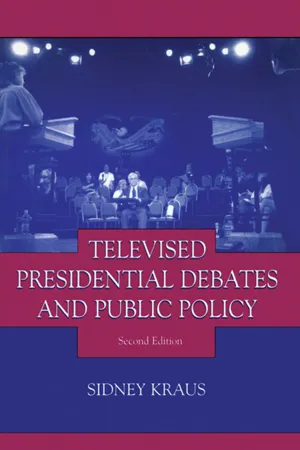
With this second edition, Kraus continues his examination of formal presidential debates, considering the experience of television in presidential elections, reviewing what has been learned about televised debates, and evaluating that knowledge in the context of the election process, specifically, and the political process, generally. He also examines the media and the role they occupy in presidential elections. Because critics often refer to the Lincoln-Douglas debates when reproaching presidential debates, comparisons of the two are discussed throughout the book. Much of the data and information for this accounting of televised presidential debates comes from the author's first-hand experience as one who was involved with these debates as a participant observer, on site at nearly all of the debates discussed.
Throughout these discussions, emphasis is placed on the implications for public policy. To suggest policy that will be accepted and adopted by politicians and the public is, at best, difficult. Proposals for changes in public policy based on experience -- even when scientific data support those changes -- must be subjected to an assessment of the values and predispositions of the proponent. These values and predispositions, however, may not necessarily inhibit the proponent's objectivity. As such, this review of television use in the presidential election process provides the context for examining televised debates.
- 344 pages
- English
- ePUB (mobile friendly)
- Available on iOS & Android
eBook - ePub
Televised Presidential Debates and Public Policy
About this book
Information
1
Introduction
The preliminaries to the presidential debates [in 1996] have been a mess. The system needs to be fixed before the next election in 2000 … The first step … lies with Congress.1
We have had seven presidential general elections in which the major party (Democratic and Republican) candidates debated on television.2 In five of those elections, vice-presidential candidates also debated. In two elections, minor party (independent and reform) candidates participated in the debates. The presidential election of 1996 marked 138 years since the Lincoln-Douglas debates,3 and 36 years since the first televised presidential debates between John F. Kennedy and Richard M. Nixon.
These televised debates have been examined closely in scientific studies conducted by social scientists; textual examinations by rhetoricians; reviews of studies by political writers; event recordings by historians; and discussions by politicians, political experts, broadcasters, sponsors, and debate participants. These assessments were presented in a variety of formats: books; articles in academic journals, newspapers, magazines, and pamphlets; television public affairs programming; meetings of academic associations; postelection analyses; and “think-tank” conferences. Topics examined include debate effects on voters; candidate performance in terms of issues and images; formats; television production; sponsorship; mandating candidates’ participation; legal and political aspects; political socialization; campaign advisers; debate consultants; polls and pollsters; and to a limited degree, public policy considerations.
As with elections generally, debates should be continually examined as political history, and included in the studies of several disciplines in both the humanities and the social sciences. Monitoring presidential elections and debates by scholars and media professionals may provide sponsors, candidates, and policymakers with the data and insight to improve televised debates. Although changes in the election process are difficult to come by—alterations and innovations usually defer to tradition—the improvement of televised debates can strengthen the presidential election process. That assumes, of course, that debate assessments persuade the public and policymakers of the debates’ continued value in presidential elections.
Whether or not policymakers act on the recommendations offered in debate assessments will, in part, depend on the predisposition of evaluators. Three “classes” of presidential debate evaluators can be identified— proponents, conditionals, and opponents.
Proponents see debates as an important contributing factor to the democratic process of electing a president. Their positive assessments are arrived at by the impact the debates have had on the American public, and the image of democracy conveyed to citizens of countries around the globe.4 Reviewing studies of the 1976 debates, Sears and Chaffee5 (as cited in Kraus, 1976) noted several latent functions for the political system. Among them were “the political socialization of pre-adults, the legitimization of institutions, and the international credibility of an incoming … president of the most powerful nation in the world.”6 Their appraisal was that “a variety of indicators converge[d] on the conclusion that the political system at large was positively served by the debates [and] voters seem to have profited from [them].”7 Proponents often are not supporters of the status quo. They may suggest particular improvements, but they want debates to continue in presidential elections despite their faults. Some would make debates mandatory in presidential elections. The general public is included in this category. Measuring the interest in receiving election information, the Times-Mirror postelection surveys in 1988 and 1992 found that the public ranked televised presidential debates highest among its sources of information. Chapter 6 discusses the legislative efforts to require presidential candidates to debate.
Conditionals will not settle for “flawed” debates. They demand specific repair of televised debates as a prerequisite for their support. Their conditions vary: a genuine, traditional, classical debate format; removal of the press as panelists; inclusion of minor party candidates; nonmandatory candidate participation; removal of third-party sponsors; inclusion of third-party sponsors; and issues predominating candidate image.
Opponents argue that presidents are not and should not be required to debate in office; debates fail to reveal the candidates’ qualifications for the presidency; personality and image of the candidates eclipse the discussion of issues; candidate gaffes are blown out of proportion in subsequent media reports; and the formats of debates have been glorified press conferences, contributing little that the voters have not heard before on the campaign trail.
These evaluator categories are not mutually exclusive. For example, an evaluator might be labeled as a proponent for most debates and suddenly appear as a conditional. There are other evaluators, critics, who can live with or without televised debates, and approach them as just another event worthy or unworthy of their attention. Critics roam (from debate to debate, or election to election) among the three evaluator categories.
The following selected 23 reviews and assessments provide an historical record and a mixture of support for, and criticism of, televised presidential debates (listed chronologically):8
1. (1962, reissued in 1977) Kraus, Sidney (Ed.). The Great Debates: Background, Perspective, Effects. A compendium of studies about the John F. Kennedy and Richard M. Nixon debates in 1960, debate preparations, legal aspects of televising debates, formats, finance, media, polls, nationwide review of effects on voters, and debate texts.
2. (1962) Mazo, Earl, Malcolm Moos, Hollock Hoffman, and Harvey Wheeler. The Great Debates: An Occasional Paper on the Role of the Political Process in the Free Society. Discusses the Kennedy-Nixon debates as part of the process of electing a president.
3. (1976) Kraus, Sidney (Ed.). Presidential Debates De-Briefing. Unpublished transcription of a 1976 Carter–Ford debate conference with Carter and Ford representatives, League of Women Voters Education Fund representatives, and broadcasters. Debate preparations, formats, legal, finance, media, polls, and effects.
4. (1978) Bishop, George, Robert G. Meadow, and Marilyn Jackson-Beeck (Eds.). The Presidential Debates: Media, Electoral, and Policy Perspectives. A series of studies about the Carter–Ford 1976 debates, preparations, formats, legal, finance, media, voter effects, and debate texts.
5. (1979) Kraus, Sidney (Ed.). The Great Debates: Carter vs. Ford, 1976. Primary forums, debate preparations, formats, legal, finance, media, polls, nationwide review of effects, and debate texts.
6. (1979) Mitchell, Lee. With the Nation Watching: Report of the Twentieth Century Fund Task Force on Televised Presidential Debates. A review of televised debates, preparations, formats, finance, and minor parties’ involvement.
7. (1979) Ranney, Austin (Ed.). The Past and Future of Presidential Debates. A series of articles based on a 1977 debate conference sponsored by the American Enterprise Institute with political columnists, political scientists, legal experts, communication specialists, and pollsters. Preparations, formats, legal, finance, media, polls, and voter effects.
8. (1979) U.S. Government Printing Office. The Presidential Campaign, 1976: Vol. 3, The Debates. Describes the debates within the context of the general election.
9. (1980) Bitzer, Lloyd and Theodore Rueter. Carter vs. Ford: The Counterfeit Debates of 1976. A critical review of the debates, formats, forensics, and debate texts.
10. (1981) Kraus, Sidney and Dennis Davis. “Political Debates,” in Dan D. Nimmo and Keith Sanders (Eds.), Handbook of Political Communication (pp. 273–296). Reviews debates in terms of contemporary political theory and empirical effects.
11. (1981) Ritter, Kurt W. (Ed.). The 1980 Presidential Debates. Special issue of Speaker and Gavel (Vol. 18, No. 2). Articles on myths, issues and images, candidate preparations, arguments, formats, opinion, and effects of the Carter-Reagan debates.
12. (1982) Davis, Dennis K. and Sidney Kraus. “Public Communication and Televised Presidential Debates,” in Michael Burgoon (Ed.), Communication Yearbook 6 (pp. 289–303). Places debates in the context of public communication from the Greeks through modern times.
13. (1983) Martel, Myles. Political Campaign Debates: Images, Strategies, and Tactics. One of Reagan’s 1980 debate advisers discusses televised debates from the point of view of the candidate, formats, debate strategies and tactics.
14. (1984) Swerdlow, Joel L. Beyond Debate: A Paper on Televised Presidential Debates. The Twentieth Century Fund’s second update of debates provides a brief historical account and suggests ways to improve debates.
15. (1987) Minow, Newton N. and Clifford M. Sloan. For Great Debates: A New Plan for Future Presidential TV Debates. Suggestions for improving and institutionalizing debates.
16. (1987) Swerdlow, Joel L. (Ed.). Presidential Debates: 1988 and Beyond. A series of articles most of which are written by professionals.
17. (1988) Jamieson, Kathleen H. and David Birdsell. Presidential Debates: The Challenge of Creating an Informed Electorate. Discusses American political debating prior to the broadcasting era; examines current issues, and makes recommendations.
18. (1988) Kraus, Sidney. Televised Presidential Debates and Public Policy. First edition of this book.
19. (1990) Friedenberg, Robert V. (Ed.). Rhetorical Studies of National Political Debates: 1960–1988. Various examinations of political discourse, rhetorical patterns, and trends.
20. (1992) Hellweg, S. A., Michael Pfau, and Steven R. Brydon. Televised Presidential Debates: Advocacy in Contemporary America. Presents an historical review of television and presidential debates; formats, verbal and visual aspects; impact.
21. (1993) Hinck, Edward. Enacting the Presidency: Political Argument, Presidential Debates, and Presidential Character. A rhetorical analysis of presidential and vice presidential debates, 1960–1988.
22. (1994) Carlin, Diana B. and Mitchell S. McKinney. The 1992 Presidential Debates in Focus. Focus group research during the 1992 debate period.
23. (1994) Friedenberg, Robert V. “The 1992 Presidential Debates,” in Robert E. Denton, Jr. (Ed.), The 1992 Presidential Campaign: A Communication Perspective (pp. 89–110). Analysis: brief discussion of issues, personalities, candidate control and suggestions for improving debates.
The present effort, a second edition, reexamines the various assessments of presidential debates. It considers the experience of television in presidential elections; reviews what we have learned about televised debates; and evaluates that knowledge in the context of the election process, specifically, and in the context of the political process, generally. It also examines the media and the role they occupy in presidential elections. Because critics often refer to the Lincoln-Douglas debates when reproaching presidential debates, comparisons of the two are discussed in chapter 4 and elsewhere when appropriate.
A variety of observation and retrieval techniques were employed to obtain the information needed to describe the presidential debate experience and to recommend policy. Much of the data and information for this accounting of televised presidential debates comes from my first-hand experience as a participant-observer of these debates, on site at all of the debates except those in 1960 and 1992. Credentialed variously by the debate sponsor, the media, or the television pools, I was able to examine how the debates were mounted for the television audience. Participant-observation procedures utilized for this study are described in the addendum.
Throughout these discussions, the implications for public policy are emphasized. To suggest policy that will be accepted and adopted by politicians and the public is, at best, difficult. Proposals for changes in public policy based on experience, even when scientific data support those changes, must be subjected to an assessment of the values and predispositions of the proponent. These values and predispositions, however, may not necessarily impair the proponent’s objectivity.9
It may prove useful to relate the assumptions underlying these discussions:
- Presidential debates further democratic goals.
- They serve the majority of the electorate better than any other single campaign communication device that attempts to present both the candidates’ personalities and their positions on issues.
- Future televised presidential debates will reach the largest single electoral audience (as they have in the past).
- These debates, and the attention given to them by the electorate, have the potential to bring about changes that improve the presidential selection process and use of television in ...
Table of contents
- Cover
- Half Title
- Title Page
- Copyright
- Contents
- Dedication
- Preface
- Dedication (First Edition)
- Preface (First Edition)
- 1. Introduction
- 2. Overview: Television and the Presidential Election
- 3. Debate Formats: Candidates in Charge
- 4. Debate Coverage: Who’s Winning
- 5. Debate Effects: Voters Win
- 6. Debate Policy: Every Four Years by Mandate
- Addendum: Participant-Observation and Retrospective Interviewing: Methods for Depicting Communication Events
- References and Bibliography
- Name Index
- Subject Index
Trusted by 375,005 students
Access to over 1.5 million titles for a fair monthly price.
Study more efficiently using our study tools.
Frequently asked questions
Yes, you can cancel anytime from the Subscription tab in your account settings on the Perlego website. Your subscription will stay active until the end of your current billing period. Learn how to cancel your subscription
No, books cannot be downloaded as external files, such as PDFs, for use outside of Perlego. However, you can download books within the Perlego app for offline reading on mobile or tablet. Learn how to download books offline
Perlego offers two plans: Essential and Complete
- Essential is ideal for learners and professionals who enjoy exploring a wide range of subjects. Access the Essential Library with 800,000+ trusted titles and best-sellers across business, personal growth, and the humanities. Includes unlimited reading time and Standard Read Aloud voice.
- Complete: Perfect for advanced learners and researchers needing full, unrestricted access. Unlock 1.5M+ books across hundreds of subjects, including academic and specialized titles. The Complete Plan also includes advanced features like Premium Read Aloud and Research Assistant.
We are an online textbook subscription service, where you can get access to an entire online library for less than the price of a single book per month. With over 1.5 million books across 990+ topics, we’ve got you covered! Learn about our mission
Look out for the read-aloud symbol on your next book to see if you can listen to it. The read-aloud tool reads text aloud for you, highlighting the text as it is being read. You can pause it, speed it up and slow it down. Learn more about Read Aloud
Yes! You can use the Perlego app on both iOS and Android devices to read anytime, anywhere — even offline. Perfect for commutes or when you’re on the go.
Please note we cannot support devices running on iOS 13 and Android 7 or earlier. Learn more about using the app
Please note we cannot support devices running on iOS 13 and Android 7 or earlier. Learn more about using the app
Yes, you can access Televised Presidential Debates and Public Policy by Sidney Kraus in PDF and/or ePUB format, as well as other popular books in Politics & International Relations & Communication Studies. We have over 1.5 million books available in our catalogue for you to explore.