- 639 pages
- English
- ePUB (mobile friendly)
- Available on iOS & Android
eBook - ePub
The Americans
About this book
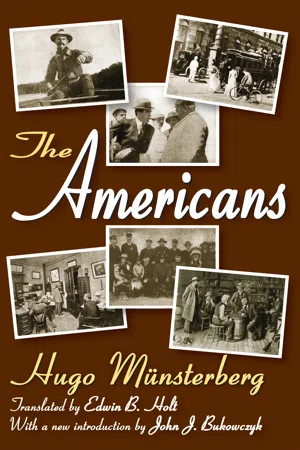
The Americans by Hugo Munsterberg stands alongside Alexis de Tocqueville's American Democracy as one of the great works on the New World written by a scholar deeply familiar with the Old World. When originally published, it gave the German public a sense of American life, and was described as "a book which deals in a detailed way with the political, economic, intellectual, and social aspects of American culture." Munsterberg, a world-renowned psychologist at the turn of the twentieth century, noted that "its purpose is to interpret systematically the democratic ideals of America."The primary aim of The Americans is to study the people and America's inner tendencies. It offers a "philosophy of Americanism," the ideology of a people writ whole. Munsterberg's sense of the "spirit" of a people, rather than facts about the people, is revealed in his four cardinal chapters: Self-Direction, Self-Realization, Self-Perfection, and Self-Assertion. While he covers the economic premises of the free market and the politics of party affairs, he considers these the least important. Instead it is the lasting forces and tendencies of American life, rather than problems of the day, that occupy the author. This focus was shared by German readers, for whom the book was conceived, and for those in the United States who read the book in English.The dynamic of strong basic tendencies of democratic forces and lesser, but significant, aristocratic tendencies underwrites the strains and tensions in American society. It also defines the special nature of a book, written more than one hundred years ago, that retains its lively sense of purpose and deep insight into American life. One could well say that this book is required reading in this day and age for Americans and Europeans alike. This is a neglected masterpiece.
Information
PART ONE
POLITICAL LIFE
CHAPTER ONE
The Spirit of Self-Direction
WHOSOEVER wishes to describe the political life of the American people can accomplish this end from a number of starting points. Perhaps he would begin most naturally with the Articles of the Constitution and expound the document which has given to the American body-politic its remarkable and permanent form; or he might ramble through history and trace out from petty colonies the rise of a great world-power; or he might make his way through that multitude of events which to-day arouse the keenest public interest, the party strifes and presidential elections, the burdens and amenities of city and state, the transactions of the courts and of Congress. Yet all this would be but a superficial delineation. Whoever wishes to understand the secret of that baffling turmoil, the inner mechanism and motive behind all the politically effective forces, must set out from only one point. He must appreciate the yearning of the American heart after self-direction. Everything else is to be understood from this.
In his social life the American is very ready to conform to the will of another. With an inborn good-nature, and often too willingly, perhaps, he lends himself to social situations which are otherwise inconvenient. Thus his guest, for instance, is apt to feel like a master in his house, so completely is his own will subordinated to that of the guest. But, on the other hand, in the sphere of public life, the individual, or a more or less restricted group of individuals, feels that it must guide its own activities to the last detail if these are to have for it any value or significance whatsoever. He will allow no alien motive to be substituted — neither the self-renunciation of fidelity or gratitude, nor the aesthetic self-forgetful-ness of hero-worship, nor even the recognition that a material advantage would accrue or some desirable end be more readily achieved if the control and responsibility were to be vested in some one else. This self-direction is neither arbitrary nor perverse; least of all does it indicate a love of ease or aversion to toil. In Russia, as a well-known American once said, serfdom could be wiped out by a stroke of the Czar’s pen, and millions of Russians would be freed from slavery with no loss of life or property. “We Americans had to offer up a half-million lives and many millions’ worth of property in order to free our slaves. And yet nothing else was to be thought of. We had to overcome that evil by our own initiative, and by our own exertions reach our goal. And just because we are Americans and not Russians no power on earth could have relieved us of our responsibility.”
When in any people the desire of self-direction dominates all other motives, the form of government ofthat people is necessarily republican. But it does not conversely follow that every republic is grounded in this spirit of self-direction. Hence it is that the republic of the United States is so entirely different from all other republics, since in no other people is the craving for self-determination so completely the informing force. The republics of Middle and South America, or of France, have sprung from an entirely different political spirit; while those newer republics, which in fundamental intention are perhaps more similar, as for instance Switzerland, are still not comparable because of their diminutive size. The French republic is founded on rationalism. The philosophy of the eighteenth century, with its destructive criticism of the existing order, furnished the doctrines, and from that seed of knowledge there grew and still are growing the practical ideals of France. But the political life of the United States sprang not from reasoned motives but from ideals; it is not the result of insight but of will; it has not a logical but a moral foundation. And while in France the principles embodied in the constitution are derived from theory, the somewhat doubtful doctrines enunciated in the Declaration of Independence are merely a corollary to that system of moral ideals which is indissolubly combined with the American character.
It is not here to be questioned whether this character is purely the cause and not also the effect of the American system; but so much is sure, that the system of political relations which has sprung from these ethical ideals constitutes the actual body-politic of America. Such is the America which receives the immigrant and so thoroughly transforms him that the demand for self-determination becomes the profoundest passion of his soul. Such is the America toward which he feels a proud and earnest patriotism. For the soil on which his kingdom has been reared he knows but scanty sentiment or love; indeed, the early progress of America was always an extension of the frontier, an unremitting pushing forth over new domain. The American may be linked by personal ties to a particular plot of land, but his national patriotism is independent of the soil. It is also independent of the people. A nation which in every decade has assimilated millions of aliens, and whose historic past everywhere leads back to strange peoples, cannot with its racial variegation inspire a profound feeling of indissoluble unity. And yet that feeling is present here as it is perhaps in no European country. American patriotism is directed neither to soil nor citizen, but to a system of ideas respecting society which is compacted by the desire for self-direction. And to be an American means to be a partizan of this system. Neither race nor tradition, nor yet the actual past binds him to his countryman, but rather the future which together they are building. It is a community of purpose, and it is more effective than any tradition, because it pervades the whole man. Participation in a common task holds the people together, a task with no definite and tangible end nor yet any special victory or triumph to look forward to, but rather a task which is fulfilled at each moment, which has its meaning not in any result but in the doing, its accomplishment not in any event which may befall, but only in the Tightness of the motive. To be an American means to cooperate in perpetuating the spirit of self-direction throughout the body-politic; and whosoever does not feel this duty and actively respond to it, although perhaps a naturalized citizen of the land, remains an alien forever.
If the new-comer is readily assimilated in such a society, commonly, yet it must not be overlooked that those who come from across the seas are not selected at random. Those who are strong of will are the ones who seek out new spheres of activity. Just those whose satisfaction in life has been stunted by a petty and oppressive environment have always cherished a longing for the New World. That conflict which every one must wage in his own bosom before he can finally tear himself away from home, has schooled the emigrant for the spirit of his new home; and only those who have been impelled by the desire for self-direction have had the strength to break the ties with their own past. Thus it is that those of Germanic extraction adapt themselves so much more quickly and thoroughly to the political spirit of America than those of Romanic blood. The Latin peoples are much more the victims of suggestion. Being more excitable, they are more imitative, and therefore as individuals less stable. The Frenchman, Italian, or Spaniard is often a sympathetic member of the social life of the country, but in its political life he introduces a certain false note; his republicanism is not the American republicanism. As a moral ideal he has little or no concern with the doctrine of self-direction.
The American political system, therefore, by no means represents an ideal of universal significance; it is the expression of a certain character, the necessary way of living for that distinct type of man which an historically traceable process of selection has brought together. And this way of living reacts in its turn to strengthen the fundamental type. Other nations, in whom other temperamental factors no less significant or potent or admirable are the fundamental traits, must find the solution of their political problems in other directions. No gain would accrue to them from any mere imitation, since it would tend to nothing but the crippling and estranging of the native genius of their people.
The cultivated American of to-day feels this instinctively. Among the masses, to be sure, the old theme is still sometimes broached of the world-wide supremacy of American ideals: and a part of the necessary paraphernalia of popular assemblages will naturally consist in a reaffirmation that the duty of America is to extend its political system into every quarter of the globe; other nations will thus be rated according to their ripeness for this system, and the history of the world appear one long and happy education of the human race up to the plane of American conceptions. But this tendency is inevitable and not to be despised. It must more nearly concern the American than the citizen of other states to propagate his ideals, since here everything depends on each individual co-operating with all his might, and this co-operation must succeed best when it is impelled by an uncritical and blindly devoted faith. And such a faith arouses, too, a zealous missionary spirit, which wants to carry this inspired state-craft unto all political heathen. But the foreigner is apt to overestimate these sentiments. The cultivated American is well aware that the various political institutions of other nations are not to be gauged simply as good or bad, and that the American system would be as impossible for Germany as the German system for America.
Those days are indeed remote when philosophy tried to discover one intrinsically best form of government. It is true that in the conflicts of diverse nations the old opposition of realistic and idealistic, of democratic and aristocratic social forces is repeated over and over. But new problems are always coming up. The ancient opposition is neutralized, and the problem finds its practical solution in that the opposing forces deploy their skirmish lines in other territory. The political ideas which led to the French Revolution had been outlived by the middle of the nineteenth century. A compromise had been effected. The whole stress of the conflict had transferred itself to social problems, and no one earnestly discussed any more whether republic or monarchy was the better form of government. The intellectual make-up of a people and its history must decide what shall be the outward form of its political institutions. And it is to-day tacitly admitted that there are light and shade on either side.
The darker side of democracy, indeed, as of every system which is founded on complete individualism, can be hidden from no one; nor would any one be so foolish, even though he loved and admired America, as to deny that weaknesses and dangers, and evils both secret and public, do there abound. Those who base their judgments less on knowledge of democratic forces than on obvious and somewhat sentimental social prejudices are apt to look for the dangers in the wrong direction. A German naturally thinks of mob-rule, harangues of the demagogue, and every form of lawlessness and violence. But true democracy does not allow of such things. A people that allows itself to turn into a mob and to be guided by irresponsible leaders, is not capable of directing itself. Self-direction demands the education of the nation. And nowhere else in the world is the mere demagogue so powerless, and nowhere does the populace observe more exemplary order and self-discipline.
The essential weakness of such a democracy is rather the importance it assigns to the average man with his petty opinions, which are sometimes right and sometimes wrong, his total lack of comprehension for all that is great and exceptional, his self-satisfied dilettanteism and his complacency before the accredited and trite in thought. This is far less true of a republic like the French, with its genius for scepticism, a republic nourished in aesthetic traditions and founded on the ruins of an empire. The intellectual conditions are there quite different. But in an ethical democracy, where self-direction is a serious issue, domination by the average intelligence is inevitable; and those who are truly great are the ones who find no scope for their powers. Those who appear great are merely men who are exploiting to the utmost the tendencies of the day. There are no great distinctions or premiums for truly high achievements which do not immediately concern the average man, and therefore the best energies of the nation are not spurred on to their keenest activity. All ambition is directed necessarily toward such achievements as the common man can understand and compete for — athletic virtuosity and wealth. Therefore the spirit of sport and of money-getting concerns the people more nearly than art or science, and even in politics the domination of the majority easily crowds from the arena those whose qualifications do not appeal to its mediocre taste. And by as much as mature and capable minds withdraw from political life, by so much are the well-intentioned masses more easily led astray by sharp and self-interested politicians and politics made to cater to mean instincts. In short, the danger is not from any wild lawlessness, but from a crass philistinism. The seditious demagogue who appeals to passion is less dangerous than the sly political wire-puller who exploits the indolence and indifference of the people; and evil intent is less to be feared than dilettanteism and the intellectual limitations of the general public.
But, on the other hand, it is also certain that when it comes to a critical comparison between the weaknesses and theoretical dangers of democracy and aristocracy, the American is at no loss to serve up a handsome list of shortcomings to the other side. He has observed and, perhaps overestimating, he detests the spirit of caste, the existence of those restrictions which wrongfully hamper one individual and as undeservedly advantage another. Again, the American hates bureaucracy and he hates militarism. The idea of highest authority being vested in a man for any other reason than that of his individual qualifications goes against all his convictions; and his moral feeling knows no more detestable breed of man than the incompetent aspirant who is servile with his superiors and brutal to his inferiors. It is typically un-American. And if, in contrast to this, one tries to do justice to the proved advantages of monarchy, of aristocracy and the spirit of caste, to justify the ruler who stands above the strife of parties, and to defend that system of symbols by which the sentiment of the past is perpetuated in a people, and the protection which is instituted for all the more ideal undertakings which surpass the comprehension of the masses, or if one urges the value of that high eificiency which can arise only from compact political organization — then the American citizen swells with contempt. What does he care for all that if he loses the inestimable and infinite advantage which lies in the fact that in his state every individual takes an active hand, assumes responsibility, and fights for his own ideals ? What outward brilliancy of achievement would compensate him for that moral value of co-operation, intiative, self-discipline, and responsibility, which the poorest and meanest citizen enjoys ? It may be that an enlightened and well-meaning monarch sees to it that the least peasant can sit down to his chicken of a Sunday; but God raised up the United States as an example to all nations, that it shall be the privilege of every man to feel himself responsible for his town, county, state, and country, and even for all mankind, and by his own free initiative to work to better them. The strife of parties would better be, than that a single man should be dead to the welfare of his country; and it is good riddance to aristocracy and plenty, if a single man is to be prevented from emulating freely the highest that he knows or anywise detained from his utmost accomplishment.
All such speculative estimates of different constitutional forms lead to no result unless they take into account the facts of history. Every side has its good and evil. And all such discussions are the less productive in that superiorities of constitution, although soundly argued, may or may not in any given country be fully made use of, while on the other hand defects of constitution are very often obviated. Indeed, to take an example from present tendencies in America, nothing is more characteristic than the aristocratic by-currents through which so many dangers of democracy are avoided. Officially, of course, a republic must remain a democracy, otherwise it mines its own foundations, and yet we shall see that American social and political life have developed by no means along parallel lines but rather stand out often in sharp contrast. The same is true of Germany. Official Germany is aristocratic and monarchic through and through, and no one would wish it other; but the intimate life of Germany becomes every day more democratic, and thus the natural weaknesses of an aristocracy are checked by irresistible social counter-tendencies. It may have been the growing wealth of Germany which raised the plane of life of the middle classes; or the industrial advance which loaned greater importance to manufacturer and merchant, and took some social gloss from the office-holding class; it may have been the colonial expansion which broadened the horizon and upset a stagnant equilibrium of stale opinion; or, again, the renewed efforts of those who felt cramped and oppressed, the labourers, and, above all, the women; it does not matter how it arose — a wave of progress is sweeping over that country, and a political aristocracy is being infused with new, democratic blood.
Now in America, as will often appear later, the days are over in which all aristocratic tendencies were strictly held back. The influence of intellectual leaders is increasing, art, science, and the ideals of the upper classes are continually pushing to the front, and even social lines and stratifications are beginning more and more to be felt. The soul of the people is agitated by imperialistic and military sentiments, and whereas in former times it was bent on freeing the slaves it now discovers “the white man’s burden” to lie in the subjugation of inferior races. The restrictions to immigration are constantly being increased. Now of course all this does not a whit prejudice the formal political democracy of the land; it is simply a quiet, aristocratic complement to the inner workings of the constitution.
The presence, and even the bare possibility, here, of such by-currents, brings out more clearly how hopeless the theoretical estimation of any isolated form of statehood is, if it neglects the factors introduced by the actual life of the people. The American democracy is not an abstractly superior system of which a European can approve only by becoming himself a republican and condemning, incidentally, his own form of government: it is rather, merely, the necessary form of government for the types of men and the conditions which are found here. And any educated American of to-day fully realizes this. No theoretical hair-splitting will solve the problem as to what is best for one or another country; for that true historical insight is needed. And even when the histories of two peoples are so utterly dissimilar as are those of America and Germany, it by no means follows, as the social by-currents just mentioned show, that the real spirit of the peoples must be unlike. Democratic America, with its unofficial aristocratic leanings, has, in fact, a surprising kinship to monarchical Germany, with its inner workings of a true democracy. The two peoples are growing into strong resemblance, although their respective constitutions flourish and take deeper root.
The beginnings of American history showed unmistakably and imperatively that the government of the American people must be, in the words of Lincoln, “a government of the people, by the people, and for the people” No one dreamed when the Constitution of the United States was framed, some hundred and seventeen years ago, that this democratic instrument would ever be called on to bind together a mighty nation extending from Maine to California. And, indeed, such a territorial expansion would undoubtedly have stretched and burst the unifying bonds of this Constitution, if the distance between Boston and San Francisco had not meanwhile become practically shorter than the road from Boston to Washington was in those early days. But that this Constitution could so adapt itself to the undreamt broadening of conditions, that it could continue to be the mainstay of a people that was indefinitely extending itself by exchange and purchase, conquest and treaty, and that in no crisis has an individual or party succeeded in any tampering with the rights of the people; all this shows convincingly that the American form of state was not arbitrarily hit on, but that it was the outcome of an historical development.
The spirit of this commonwealth was not first conceived in the year 1787. It was strong and ripe long before the delegates from the Thirteen States assembled under Washington’s leadership in Independence Hall at Philadelphia. The history of the English colonists to the Atlantic coast shows from the very first what weight they attached to the duties and rights of the individual, and foretells as well the inevitable result, their unloosing from the mother country and final declaration of their independence.
We may consider the different lines of development which began early in the seventeenth century, after the feeble attempts at colonization from England, France and Spain in the latter half of the sixteenth century had miscarried and left socially no traces. French settlements flourished as early as 1605, chiefly however in Nova Scotia and other parts of Canada, and in 1609 settlements of Dutch, whose colony on the Hudson River, the present New York, soon passed over into English hands. The development of the Spanish colonies on the Gulf of Mexico went on outside the territory of these young United States; and so the story of the meagre years of America is comprised in the history of the English colonies alone.
These colonies began diversely but came to resemble one another more and more as time went on. There can be no greater contrast than between the pioneer life of stout-willed men, who have left their native soil in order to live in undisturbed enjoyment of their Puritan faith, seeking to found their little communities on simple forms of self-government, and on the other hand the occupation of a rich trading company under royal charter, or the inauguration of a colony of the crown. But these differences could not be preserved. The tiny independent communities, as they grew in consideration, felt the need of some protecting power and therefore they looked once more to England; while, on the other hand, the more powerful, chartered colonies tended to loose themselves from the mother country, feeling, as they soon did, that their interests could not be well administered from across a broad ocean. In spite of the protecting arm of England, they felt it to be a condition of their sound growth that they should manage their domestic affairs for themselves. Thus it happened that all the colonies alike were externally dependent on England, while intern...
Table of contents
- Cover Page
- Title Page
- Copyright Page
- Table of Contents
- Introduction to the Transaction Edition
- Preface
- I. POLITICAL LIFE
- II. ECONOMIC LIFE
- III. INTELLECTUAL LIFE
- IV. SOCIAL LIFE
- Index
Trusted by 375,005 students
Access to over 1.5 million titles for a fair monthly price.
Study more efficiently using our study tools.
Frequently asked questions
Yes, you can cancel anytime from the Subscription tab in your account settings on the Perlego website. Your subscription will stay active until the end of your current billing period. Learn how to cancel your subscription
No, books cannot be downloaded as external files, such as PDFs, for use outside of Perlego. However, you can download books within the Perlego app for offline reading on mobile or tablet. Learn how to download books offline
Perlego offers two plans: Essential and Complete
- Essential is ideal for learners and professionals who enjoy exploring a wide range of subjects. Access the Essential Library with 800,000+ trusted titles and best-sellers across business, personal growth, and the humanities. Includes unlimited reading time and Standard Read Aloud voice.
- Complete: Perfect for advanced learners and researchers needing full, unrestricted access. Unlock 1.5M+ books across hundreds of subjects, including academic and specialized titles. The Complete Plan also includes advanced features like Premium Read Aloud and Research Assistant.
We are an online textbook subscription service, where you can get access to an entire online library for less than the price of a single book per month. With over 1.5 million books across 990+ topics, we’ve got you covered! Learn about our mission
Look out for the read-aloud symbol on your next book to see if you can listen to it. The read-aloud tool reads text aloud for you, highlighting the text as it is being read. You can pause it, speed it up and slow it down. Learn more about Read Aloud
Yes! You can use the Perlego app on both iOS and Android devices to read anytime, anywhere — even offline. Perfect for commutes or when you’re on the go.
Please note we cannot support devices running on iOS 13 and Android 7 or earlier. Learn more about using the app
Please note we cannot support devices running on iOS 13 and Android 7 or earlier. Learn more about using the app
Yes, you can access The Americans by Hugo Munsterberg in PDF and/or ePUB format, as well as other popular books in Politics & International Relations & Social History. We have over 1.5 million books available in our catalogue for you to explore.