- 320 pages
- English
- ePUB (mobile friendly)
- Available on iOS & Android
eBook - ePub
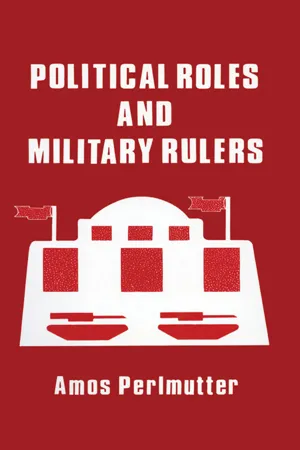
Political Roles and Military Rulers
About this book
This book represents three decades of Perlmutter's experiences and observations. The author studies the relationship between the military and politics in Middle East, focusing mainly on Egypt as a case study. He concludes by analysing the effect this internal relationship has on military performance.
Information
CHAPTER 1
The Praetorian Army and the Praetorian State
The philosophy of the revolution’s purpose is like that of a patrol. To patrol is the true purpose of the [Egyptian military] in the annals of Egypt. … We now are to fight the greatest of our wars: the liberation of our fatherland from all its chains.
Gamal Abdel Nasser, Falsafat al Thawra (The philosophy of the revolution), translated by Amos Perlmutter
Considered a deviant phenomenon before 1945, instances in which the military played an increasingly active role in politics became widespread after World War II. An army-dominated government was considered unnatural not because it was perceived as a new phenomenon—it had been recognized by political philosophers from Machiavelli to Mosca—but because some social scientists did not believe military rule was as worthy of study as civilian rule. This prejudice had a variety of causes, ranging from ignorance to antagonism toward war and the military profession. In the 1930s, for example, military government was identified as the ultimate type of totalitarianism.1
In the nineteenth and twentieth centuries military political interventionism was prevalent. Coups and counter coups occurred in all Latin American republics, in most independent Arab states, in most African states, in several Southeast Asian polities, in Pakistan, and in Greece and Portugal. These events confirm the historical and political fact that when civilian government is neither effective nor institutionalized the executive is unable to control the military. The collapse of executive power is a precondition for praetorianism. Under praetorian conditions, many civil-military combinations become possible: the army can take over the government with or without the consent of civilian politicians, on their behalf or against them, with the aim of replacing one civilian group with another or with the aim of eliminating rivals in the military.
Frederick Mundell Watkins’s classic definition of praetorianism appeared in the 1933 edition of the Encyclopedia of the Social Sciences: “Praetorianism is a word frequently used to characterize a situation where the military class of a given society exercises independent political power within it by virtue of an actual or threatened use of force.” There is an essential distinction between historical and modern praetorianism.
HISTORICAL PRAETORIANISM
The Roman Praetorian Guard, the prototype of historical praetorianism, was a small military contingent in the imperial capital that preserved the legitimacy of the empire by defending the Senate against rebellious military garrisons. The influence of the Roman Praetorian Guard was based on three factors: its monopoly of local military power, the absence of definitive rules of succession, and the prestige of the Roman Senate. Though there was no hard and fast rule concerning selection of the princeps, the Senate’s decree made him a legitimate ruler acceptable to the provincial armies; and the Praetorian Guard, the sole resident military force, was able to impose its candidate upon the Senate. Thus it was able to manipulate a widely subscribed concept of legitimacy and to attain a degree of political influence disproportionate to its size and military resources. Only when the provincial armies stumbled upon the secret that emperors need not be made in Rome did the legitimizing powers of the Senate as well as the strength of the Praetorians disappear.2
Patrimonialism and Praetorianism in Advanced Agricultural Societies
In Weberian theory, patrimonialism is defined as domination by honoratiores (honorable men, noblemen). It is a type of authority exercised in the manorial or patrimonial group (a more advanced unit than the patriarchal household, which is a relatively small unit based on blood ties). Patrimonialism is manifested in the decentralization of the patriarchal household and the extension of landholding, empire building, and “extrapatrimonial” recruitment (that is, recruitment not based on kinship). In this prebureaucratic political system, the ruler’s staff is recruited only to ensure subordination to patriarchal rule, extended in “extrapatrimonial” recruitment to relations based on feudal, bureaucratic, or merely personal rulership. In patrimonialism, as in the patriarchal system, dependent relationships are based on loyalty and fidelity. The chief obligation of the subject is the material maintenance of the ruler. Patrimonial conditions give rise to political domination, for both the military and judicial authorities “are exercised without any restraint by the master as components of his patrimonial power.”3
Whereas military authority and security arrangements are on an ad hoc basis in patriarchal types of domination, in a patrimonial state the military becomes a permanent establishment as the process of financial rationalization develops. Among the most important tributes which the patrimonial ruler extracts from his subjects are provision of troops or taxes to pay for mercenaries. Patrimonial states have recruited from the following sources: patrimonial slaves, retainers living on allowances (the coloni type); slaves completely separated from agricultural production; janissaries and mercenaries, supported by levies from the population but recruited from alien tribes or religious groups (Bedouins, Christians): or manorial peasants substituting military for economic service.4
The relationship between the patrimon and his conscripts has two pure forms, clientship and slavery, and various combinations. In the Ottoman Empire, for example, janissaries were recruited from aliens and pariah castes (Druze, Alawi, Kurds), while a “citizen” army was recruited from the peasants. The feudal armies of Western Europe, as an outgrowth of increased economic rationalism (with its need for organization, accounting, and planning), developed a group of privileged honoratiores, using peasant soldiers and military technology. As training became crucial, however, the relationship between patrimonial authority and the military was altered. The patrician no longer handled military affairs directly. With the development of military professionalization, it became possible for the military establishment to be used against the patrimonial authority’s own political subjects. If a patrimon’s political authority rested solely on threats—on the army or “coercive compliance”—his power to dominate might collapse. The Weberian term for the disintegration of the patrimonial system was “Sultanism”; its modern equivalent in social science theory is praetorianism.5
Patrimonial power was particularly susceptible to military domination in advanced agrarian societies (historical bureaucratic empires) that had large mercenary armies. “Native or foreign, once regularly organized mercenaries have become the preponderant force in a country, they have normally tried to force their rule upon the rest of society.” If the military was not subdued, it became institutionalized as an autonomous group, and with every gain in professionalism its political importance increased. Then when legitimate authority faltered, the military could supplant it and fill the gap. For example, in the Ottoman Empire, the ruling institution became identical with the army during and after the reign of Suleiman the Magnificent in the sixteenth century; the janissaries remained the chief instrument of the sultan until 1827. Gradually they became a formidable and complex bureaucracy, and the introduction of firearms and cavalry increased their effectiveness. As praetorian values were routinized in the new technical units, they ensured the cohesiveness and political loyalty of all branches of the janissaries, the upholders of legitimacy.6
The Imperial-Colonial Legacies
In the European colonies during the nineteenth and twentieth centuries, the military was specifically oriented toward external conquest and dominance. External domination provided a vocational ideal, which was expressed in such organizations as the civil and military services in British India, the French Foreign Legion, the French Equatorial Army (the “Africans”), and the Spanish army in Morocco and South America. The values of the system were embodied in “civilisation française”, Kipling’s “white man’s burden”, and the missionary zeal of General Lyautey (a military administrator of French Africa). The concept of “civilisation française” was developed by the military who administered and in fact dominated French imperial policy in Africa and who were dedicated to the expansion of the empire.7 The mission-oriented military was prone to become interventionist, particularly in the French and Spanish colonies.
This military type represented “the extreme in separation between a military organization and its supporting society”. The basis of recruitment was particularistic: the aristocracy served as officers and the minorities as common soldiers. “Officers regard [ed] themselves as agents of a spiritual force, civilization, and view [ed] their service as a mission as well as a profession.”8 Soldiers were recruited from the imperial power’s periphery or from the “native” population of the colonies, a procedure that was designed to safeguard imperial rule and loyalty. These natives were generally drawn from ethnic, cultural, and religious minorities (Druze, ‘Alawi, and Kurd in the Arab East; Ghurka and Goumi in India; non-Moslems and members of small tribes in French Equatorial Africa). The imperial officer, who was expected to be a model for his colonial subordinate, might gain the reward of political domination through his subordinate capacity for leadership. For the colonizer (the imperial officer), soldiering and service in the empire were either the crucial test of an aristocrat or rungs on the climb up the social ladder for the middle class. The imperial officer was slavishly emulated by his subordinates and this model had considerable influence on modern Arab and African praetorians.
MODERN PRAETORIANISM
In developing polities the military functions somewhat as it did in the patrimonial states, serving as a center for political turmoil, political ambition, and threats to legitimate authority. But modern praetorianism differs from the patrimonial model in two respects. First, the patrimonial military represented and defended legitimacy, but the modern military challenges legitimacy and offers a new type of authority.9 Second (though less important), in historical praetorianism the authority relationship between the military establishment and political order is based on a traditional orientation, but in modern praetorianism authority relationships are based on a legal-rational orientation.10 Modern praetorianism is the praetorianism of the professional soldier.
A modern praetorian state is one in which the military tends to intervene in the government and has the potential to dominate the executive. Among its characteristics are an ineffective executive and political decay.
The political processes of the praetorian state favor the development of the military as the core group and encourage the growth of its expectations as a ruling class. The political leadership of the state (as distinguished from its bureaucratic, administrative, and managerial leadership) is chiefly recruited from the military or from groups sympathetic to it. Constitutional changes are effected and sustained by the military, which plays a dominant role in all political institutions.
A modern praetorian government is most likely to develop when civilian institutions lack legitimacy; that is, they lack electoral support and effective executive power.* Such governments have often arisen from the ashes of weak republics. The most conspicuous examples have been the nineteenth-century nationalist polities in Spain and Latin America. Spain was the best model of praetorianism in the nineteenth century. Its regime was the handiwork of disgruntled civilians and power-seeking politicians, all groping for ways to dominate central political power. Lacking popular support, liberal and progressive politicians viewed the army as a vehicle of hope and liberation, the instrument for gaining power and establishing an effective executive. In seeking military support, however, they threatened the very constitutional and political practices to which they were dedicated. Furthermore, when army officers entered politics, they adopted political behavior (that is, they aspired to rule), thus gradually losing their hold over the army. Their strength was challenged by rivals within the military: professionally oriented officers dedicated to the separation of the military and political spheres; politically oriented officers, dissatisfied with their own lack of power or status; a branch, section, or service discontented with its position within the military; or peripheral and fratricidal elements. Officers turned politician were also hurt by the civilian governments’ failure to supply generals with armies, by soldiers’ revolts, or by defeat in war.
In the twentieth century a developing country is ripe for praetorianism when the civilian government fails in its pursuit of such nationalist goals as unification, order, modernization, and urbanization. Various types of praetorianism probably represent specific stages of development. By the 1970s, for example, praetorianism often appeared in states that were in the early and middle stages of modernization and political mobilization.11 Generally the army is propelled into political action in underdeveloped states when civilian political groups fail to legitimize themselves. The army’s presence in civilian affairs is often an indicator of the existence of a corruption that is not expected to disappear in the near future. Modern praetorians are most likely to specify the “betrayal” and “corruption” of civilian politicians, parties, and parliaments as the reason for military intervention. Gamal Abdel Nasser, for instance, stated that the army must patrol society and that military rule is rule by order, shorn of “complicating” (that is independent) political structures and institutions. On the other hand, military intervention may occur when a state’s material improvements are not appropriate to its corporate perspectives or when traditional institutions have been unable to produce such gains. Or it may be that, because of the traditional orientation of the people, modernized elites have proved incapable of establishing political institutions that would sustain the momentum of social mobilization and modernization.12 Whatever the cause, in the ensuing disorganization both economy and ideology suffer setbacks.
TYPES OF MODERN MILITARY PRAETORIANISM
There are three forms (or subtypes) of military praetorianism: autocracy, oligarchy, and authoritarian praetorianism. Autocracy is a simple military tyranny, military rule by one man. In this system, unchecked personal authority is embodied in the single supreme ruler. The second subtype, military oligarchy, is government by the few. The executive is composed primarily of military men. The only intrinsic difference between the military oligarchy and the military autocracy is the number of rulers.
Authoritarian praetorianism, the third subt...
Table of contents
- Cover
- Half Title
- Title Page
- Copyright Page
- Table of Contents
- Acknowledgments
- Preface: Egypt Face-to-Face
- 1. The Praetorian Army and the Praetorian State
- 2. Prefatory Note by A.P. The Birth of a New Class by Manfred Halpern
- 3. Egypt and the Myth of the New Middle Class (A.P.’s critique)
- 4. Reaffirmations and New Explorations (M.H.’s reply)
- 5. The Myth of the Myth (A.P.’s rejoinder)
- 6. The Syrian Military and the Ba’th Party
- 7. The Arab Military Elite
- 8. Experiments in Praetorianism
- 9. Political Power and Social Cohesion in Nasser’s Egypt
- 10. Perspectives on Praetorianism
- 11. Military Incompetence and Failure
- Index
Trusted by 375,005 students
Access to over 1.5 million titles for a fair monthly price.
Study more efficiently using our study tools.
Frequently asked questions
Yes, you can cancel anytime from the Subscription tab in your account settings on the Perlego website. Your subscription will stay active until the end of your current billing period. Learn how to cancel your subscription
No, books cannot be downloaded as external files, such as PDFs, for use outside of Perlego. However, you can download books within the Perlego app for offline reading on mobile or tablet. Learn how to download books offline
Perlego offers two plans: Essential and Complete
- Essential is ideal for learners and professionals who enjoy exploring a wide range of subjects. Access the Essential Library with 800,000+ trusted titles and best-sellers across business, personal growth, and the humanities. Includes unlimited reading time and Standard Read Aloud voice.
- Complete: Perfect for advanced learners and researchers needing full, unrestricted access. Unlock 1.5M+ books across hundreds of subjects, including academic and specialized titles. The Complete Plan also includes advanced features like Premium Read Aloud and Research Assistant.
We are an online textbook subscription service, where you can get access to an entire online library for less than the price of a single book per month. With over 1.5 million books across 990+ topics, we’ve got you covered! Learn about our mission
Look out for the read-aloud symbol on your next book to see if you can listen to it. The read-aloud tool reads text aloud for you, highlighting the text as it is being read. You can pause it, speed it up and slow it down. Learn more about Read Aloud
Yes! You can use the Perlego app on both iOS and Android devices to read anytime, anywhere — even offline. Perfect for commutes or when you’re on the go.
Please note we cannot support devices running on iOS 13 and Android 7 or earlier. Learn more about using the app
Please note we cannot support devices running on iOS 13 and Android 7 or earlier. Learn more about using the app
Yes, you can access Political Roles and Military Rulers by Amos Perlmutter in PDF and/or ePUB format, as well as other popular books in Politics & International Relations & Comparative Politics. We have over 1.5 million books available in our catalogue for you to explore.