eBook - ePub
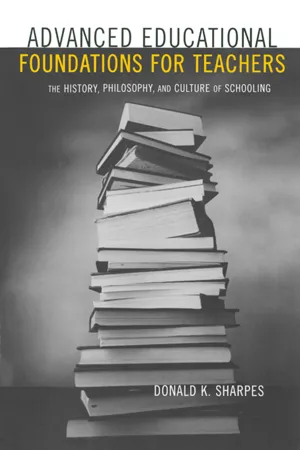
Advanced Educational Foundations for Teachers
The History, Philosophy, and Culture of Schooling
- 368 pages
- English
- ePUB (mobile friendly)
- Available on iOS & Android
eBook - ePub
Advanced Educational Foundations for Teachers
The History, Philosophy, and Culture of Schooling
About this book
Sharpes' approach synthesizes historical, philosophical, and cultural standpoints. The text contains practical teaching applications alongside theory and an integrated emphasis of diversity and other multicultural themes. It also covers the history of schooling from ancient times to the present, including biographies of major non-Western figures as well as the canon of educational innovators.
Information
1.
Education and the Social Sciences
Overview
Writing a textbook might seem like an act intended to discipline minds and to torment students. In this case, however, the endeavor fulfills a career objective of designing the ideal education course--one should not be considered complete without a text that embraces the principal social sciences for teachers. In this exchange of knowledge, the writer gladly suffers most, though students may think otherwise. I offer this text hopefully for your welcome consideration, professional advancement, and instructional enhancement.
Intended for teachers and educators interested in the intellectual ideas that have significantly influenced educational theory and schooling practice, this text focuses on the historical, philosophical, and cultural foundations of American education and schooling broadly considered. Foundations, a topic that you likely studied in an undergraduate teacher education course, refers, in this advanced text to the relevant social sciences-history, philosophy, and culture--that have theoretical underpinnings and knowledge bases useful for understanding educational agendas, schooling objectives, and instructional practices. In this text I attempt to combine these social science studies for your professional educational development and your own intellectual stimulation with an expanded series of teaching applications and case studies adaptable to early childhood, elementary, and secondary classroom use.
Tracing the history of schooling, or more relevantly the intellectual history of education, may seem like an ambitious quest for a single text. In my effort, I have synthesized its various disciplines and ideas into a theme by answering and unifying two rather straight-forward questions: Why have some ideas persisted in education and others have not, and who has benefitted from education? I have no illusions that I will actually answer these questions fully, only that I will identify for you a constellation of factors that will make it possible to draw reasonable conclusions about the ideas, figures, and features that significantly shaped education as we know it today.
Chapter 1 also explores the relevance of social sciences in their varied meanings to education, and how knowledge of the broad patterns of understanding that they provide can promote professional teacher knowledge, as well as encourage a variety of improved instructional practices.
We will begin with an exploration of teacher knowledge and teaching acts. We will then elaborate on the proposed theme that considers the two questions posed earlier, followed by an exploration of the relevance of the social sciences in education, and then finally conclude with a model for instructional practice and a teaching guide that can also be used as a guide for reading the text.
Teacher Knowledge and Teaching Acts
Educational foundation experiences for the teacher candidate usually begin with an introduction to formal schooling and study of a selection of topics: why people become teachers, the definition of schooling, the demographics of the teaching profession, and the current topical issues concerning schools, like vouchers and charter institutions. This book not only acknowledges these subjects, but also explores in great detail the intellectual foundation and the advanced professional knowledge necessary for teacher education. Much of the curriculum content, including school organization, and methods of instruction have been derived from the long history, philosophy, and culture of education. Accordingly, the major ideas, cultures, and key people who have made substantive educational contributions are integral to a teacher’s common knowledge and teaching repertoire.
Equally important are teachers’ need for classroom activities, lessons plans, and ideas for units that can assist them daily in the classroom. Thus, throughout each chapter I have suggested the incorporation of various teaching activities, discussion questions, and case studies that can be used in lesson planning or inclusion on an already existing curriculum unit.
Teachers, like all professionals, need continuous intellectual stimulation. Hence, while writing this text, I have asked myself two questions: first, what would teachers like to know about ideas that have formed the intellectual development of education (Tarnas 1991); and, second, what curricular, instructional, and teaching activities, exercises, projects, and discussions might teachers use as a result of their professional learning with students? The following twin working principles guided me: to enhance teachers’ competency by deepening their knowledge of educational ideas, and to provide a series of classroom teaching exercises (derived from an intellectual quest) that have profoundly impacted schooling and the content of the curriculum.
Occasionally students will question whether learning information that may never be used is purposeful. The fact is no one will ever be certain of when any type of knowledge may be useful, unless one has it. The real question should then be: Useful for what? For teachers, the utility of knowledge is obvious; but for others, it is the utility of the intellect, not just potential occupational utility, that any knowledge should be sought and acquired. Cultivating the intellect is a good and worthy goal in itself, and indeed is the purpose of education (Newman 1947, 147; Chambliss 1996). When we read, for example, we enter the world of ideas and make conversation with the enlightened minds of the past and present.
Knowledge, however, does not remain static and, indeed, the sciences and humanities seem to exist, for all their presumed cooperation, on separate planets governed by different knowledge gods. Drucker (1994) in a seminal article argues that knowledge workers in the third millennium will all be highly specialized, but his argument about knowledge is based on occupational, not personal or intellectual, needs.
Consider education not as the painful accumulation of facts and dates and reigns, nor merely as the necessary preparation of the individual to earn his keep in the world, but as the transmission of our mental, moral, technical and aesthetic heritage as fully as possible to as many as possible, for the enlargement of man’s understanding, control, embellishment and enjoyment of life. (Durant & Durant 1968)
In the quest for heightened professional understanding, it might be helpful to abandon the dualism that exists between several categories of thought, that is, the occasional artificial distinctions between education and training, theory and practice, liberal versus vocational education, and consider instead how all formal (schooling) and informal (educational) means of learning advance an individual’s grasp of self and the world (Wilson 1998). For example, the professional education of teachers, I believe, incorporates both a liberal education rooted in the humanities and social sciences as well as knowledge that is occupationally useful in the classroom (Pring 1995). A teacher’s intrinsic, and thus personal, knowledge is of extrinsic utility during instruction. A teacher who combines personal learning goals and the acquisition of new knowledge with such occupational objectives as learning how to deal with a troublesome student or how to design an intricate lesson plan is thus creating the ideal combination for a foundations unit.
With this brief review as background, let us now visit in more detail the unifying theme of this text.
In search of these natures of human beings our Science proceeds by a severe analysis of human thoughts about the necessities or utilities of social life. Our Science is therefore a history of human ideas, on which it seems the metaphysics of the human mind must proceed. (Giambattista Vico 1725, 92)
Theme: Why Certain Ideas, and who Goes to School?
Choosing a theme allows a writer to integrate ideas. It may, however, prove to be disadvantageous in that it risks simplifying complex ideas regarding the type of knowledge that should be taught in school. The term “educational foundations” is itself a term that camouflages a host of disparate social science and pedagogical perspectives. As a way of maintaining contextual unity I have chosen to thematize two separate but related questions, which I will attempt to answer in each chapter.
- Why have certain ideas, like alphabetic writing, science, and technology, persisted in education?
- Why have only some people been educated and not others?
In addition, to demonstrate the relevance of intellectual ideas to contemporary schooling, I will also note the relevance of those topics that have become embedded in the curriculum.
Responses to the questions of which ideas have persisted and which people have benefited from schooling will be more complex as history unfolds, and not all responses will be logical. In fact, chaotic and unpredictable may be better observations of how educational history will develop. A further explanation for why some individuals have had more educational opportunities than others is that throughout most of history formal schooling has been available only to boys and, depending on the region, only a few chosen males from the elite classes. But, as we will later learn, there were exceptions.
So entrenched are some school bureaucratic and logistical procedures, that some curriculum items and reform have persisted throughout educational history, despite their impracticality. For example, the typewriter alphabet system, otherwise known as the QWERTY system (named after the six letters on the top left of the keyboard), and on which the computer keyboard is also based, was developed in 1873 to force people to learn to type more slowly in order to prevent the typewriters from jamming whenever adjacent keys were struck too quickly in succession. Due to the complex arrangement of letters the QWERTY system has endured. Changing it would be costly; furthermore hundreds of millions of people currently use it, despite how clumsy, digitally awkward, difficult to learn, and impractical it is.
The integration of educational ideas from past, related social science disciplines includes how civilizations themselves evolve and interact with each other (Diamond 1999), and how cultural phenomena such as food production, disease, weapons, technology, writing, and governments have altered our perceptions of education and where its knowledge base originated. However the existing civilization and culture are defined, the persistent purpose of education everywhere is to instruct the young.
For example, European culture, education systems and ideas have heavily influenced five continents (including North and South America, Australia, and Mrica) as a result of global conquest. Advanced maritime technology (larger boats, more sophisticated navigational skills and instruments), weapons technology (guns), and animal domestication (horses especially) all contributed to the ease of European colonization. Thus, Europe’s conquest, not only introduced a new type of culture but also helped define a new and standard form of education across five continents. The conquering and colonization of continents and countries has spawned an interest among many educators in developing programs elaborating upon various ethnic histories, as chapters 9-12 will seek to explain culturally.
Natural barriers such as oceans and mountain chains prevented most dispersed peoples from learning about historical developments in neighboring areas and throughout the rest of the world. In the Americas for example, the narrow isthmus of Panama, which separated the Aztecs from the Incas by only a few hundred miles, permanently prevented both cultures. Cultural diffusion and the perpetuation of ideas from generation to generation was also interrupted. During the Cultural Revolution in China from 1966 to 1976, the Communist government, led by Mao Tse Tung, suspended schooling and sent all artistic and intellectual peoples into the fields to form an agricultural society similar to that of prehistoric peoples, but one that had an intact centralized government, which controlled all social and political policies. As a result, a generation of approximately two hundred million Chinese youth and adults were forced to abandon their artistic and intellectual pursuits, lest they be accused and arrested as dissenters from the Party.
For that matter, why didn’t China, with its superior political organization, control of the seas, and navigational abilities, conquer North America in the fifteenth century before that persistent Italian Columbus who had to travel to several European countries to get authorization and funding for his wild inaccuracies about where he thought Asia was? Again, the decision to abandon Chinese exploration and sea traffic five hundred years ago was made in China by one man. Thus, unenlightened autocrats, or rampaging barbarians, can disrupt continuing civilized development and destroy existing cultural and educational foundations right to the core.
Writing, a chief dissemination of knowledge, has contributed to the persistence of ideas in education. Unlike oral tradition, writing passes information from point to point with greater accuracy and less distortion; furthermore, as a medium, it reaches a far greater number of people. Thus we can still read today what prophets or poets wrote millennia ago.
Have television, movies, the computer, and advances in technology generally become the modern equivalent to writing? Do they offer the same educational advantage as writing? Certainly, visual imagery and computer-generated enhancements have profoundly changed the process of learning, if not the formal system of schooling. Although popular entertainment may strengthen spectator status, it limits human interaction. The Internet makes global access to information easy and possible, but has reportedly curtailed the time students would have on average spent reading and studying, enhancing aesthetic sensibilities, and learning how to analyze and evaluate more comprehensively. Televisions and computers may be ubiquitous now but their promotion of educational objectives is still tenuous and inconclusive.
The power of an idea, like quantum mechanics, can change our worldview and of course our science curriculum. But where an idea begins, which individual started it, and how it entered our culture and curriculum are partly the quest of this foundations text. Here are some oversimplified examples of how ideas were disseminated to American schools: Alexander the Great’s conquest of India brought Asian and Near Eastern ideas to Greece; Rome’s conquest of the Mediterranean disseminated these same ideas to Europe; and Europe’s conquest of North America filtered these same ancient cultural concepts to Americans. In 1947 Bell Laboratories invented the transistor, but it was perfected 8,000 miles away in Japan, which began a commercial rivalry that still persists and helped to spawn an international competition of educational achievements against the United States and other developed countries. Although ample evidence supports the claim that war and commercial theft are the two principal conveyors of civilized practices and cultural developments, schooling remains the chosen agency for instructing the young.
Let us start our thematic journey of ideas by looking at three social sciences’ knowledge sources: history, philosophy, and culture; these disciplines will also serve as the basis of an integrative foundation for studying educational history.
History is the first level on the foundational hierarchy, since all ideas and cultures arise from it, followed by philosophy and social values, that is, a set of beliefs that essentially define a culture and its modes of behavior.
History as Educational Foundation
It may well be that my history will seem less easy to read because of the absence in it of a romantic element. It will be enough for me, however, if these words of mine are judged useful by those who want to understand clearly the events which happened in the past and which (human nature being what it is) will, at some time or other and in much the same ways, be repeated in the future. (Thucydides, c. 400 BC)
It seems obvious to include history in a discussion on educational foundations, but it is not. Arguably, not everyone will care to know in which year an ancient king succeeded another in an empire that no longer exists. Such isolated facts are meaningless without a suitable historical and social context within which they can be best understood...
Table of contents
- Cover
- Title
- Copyright
- Contents
- Acknowledgments
- Outline
- CHAPTER ONE EDUCATION AND THE SOCIAL SCIENCES
- CHAPTER TWO THE ANCIENT EDUCATIONAL HERITAGE
- CHAPTER THREE EDUCATION IN CLASSICAL GREECE
- CHAPTER FOUR EDUCATIONAL IDEAS AND PRACTICES IN THE CLASSICAL ROMAN PERIOD
- CHAPTER FIVE EDUCATION IN THE MIDDLE AGES
- CHAPTER SIX THE REFORMATION, RENAISSANCE, AND EDUCATION
- CHAPTER SEVEN PHILOSOPHY AND SCIENCE DURING THE ENLIGHTENMENT
- CHAPTER EIGHT EDUCATION IN COLONIAL AND REVOLUTIONARY AMERICA
- CHAPTER NINE AFRICAN AMERICAN HISTORY AND CULTURE
- CHAPTER TEN HISPANIC AMERICAN HISTORY AND CULTURE
- CHAPTER ELEVEN ASIAN AMERICAN HISTORY AND CULTURE
- CHAPTER TWELVE NATIVE AMERICANS AND EDUCATION
- CHAPTER THIRTEEN MODERN EDUCATIONAL PHILOSOPHIES
- CHAPTER FOURTEEN NINETEENTH- AND TWENTIETH-CENTURY EDUCATIONAL TRENDS
- CHAPTER FIFTEEN CONTEMPORARY AMERICAN EDUCATION
- References
- Subject Index
- Name Index
Trusted by 375,005 students
Access to over 1.5 million titles for a fair monthly price.
Study more efficiently using our study tools.
Frequently asked questions
Yes, you can cancel anytime from the Subscription tab in your account settings on the Perlego website. Your subscription will stay active until the end of your current billing period. Learn how to cancel your subscription
No, books cannot be downloaded as external files, such as PDFs, for use outside of Perlego. However, you can download books within the Perlego app for offline reading on mobile or tablet. Learn how to download books offline
Perlego offers two plans: Essential and Complete
- Essential is ideal for learners and professionals who enjoy exploring a wide range of subjects. Access the Essential Library with 800,000+ trusted titles and best-sellers across business, personal growth, and the humanities. Includes unlimited reading time and Standard Read Aloud voice.
- Complete: Perfect for advanced learners and researchers needing full, unrestricted access. Unlock 1.5M+ books across hundreds of subjects, including academic and specialized titles. The Complete Plan also includes advanced features like Premium Read Aloud and Research Assistant.
We are an online textbook subscription service, where you can get access to an entire online library for less than the price of a single book per month. With over 1.5 million books across 990+ topics, we’ve got you covered! Learn about our mission
Look out for the read-aloud symbol on your next book to see if you can listen to it. The read-aloud tool reads text aloud for you, highlighting the text as it is being read. You can pause it, speed it up and slow it down. Learn more about Read Aloud
Yes! You can use the Perlego app on both iOS and Android devices to read anytime, anywhere — even offline. Perfect for commutes or when you’re on the go.
Please note we cannot support devices running on iOS 13 and Android 7 or earlier. Learn more about using the app
Please note we cannot support devices running on iOS 13 and Android 7 or earlier. Learn more about using the app
Yes, you can access Advanced Educational Foundations for Teachers by Donald K. Sharpes in PDF and/or ePUB format, as well as other popular books in Education & Education Theory & Practice. We have over 1.5 million books available in our catalogue for you to explore.