eBook - ePub
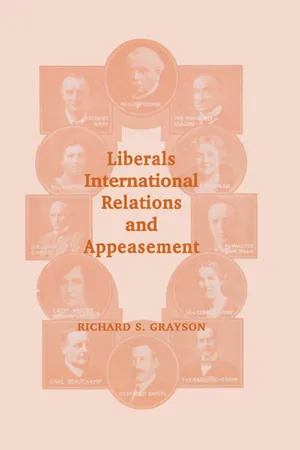
Liberals, International Relations and Appeasement
The Liberal Party, 1919-1939
- 224 pages
- English
- ePUB (mobile friendly)
- Available on iOS & Android
eBook - ePub
Liberals, International Relations and Appeasement
The Liberal Party, 1919-1939
About this book
This work shows the importance of analysing the "low" politics of areas that have traditionally been dominated by "high" politics. The role of bodies such as the Liberal Summer School and the Women's Liberal Federation are examined, along with the work of thinkers such as JM Keynes.
Information
—1—
Introduction
ONLY BY understanding the Liberal Party’s ideological inheritance, and the political context of the 1920s and 1930s, can we adequately assess the importance and nature of its policies on international affairs. So this chapter sets the scene. It does so first by surveying key back-ground material, and then by discussing the legacy of Liberal inter-nationalism as it existed from the middle of the nineteenth century to the end of the First World War. It also discusses the electoral progress of the Liberal Party in the inter-war period, and surveys the international situation of the time. The chapter concludes with an outline of current historiographical debates on British foreign policy in the 1930s.
LIBERAL INTERNATIONALISM
Background material
As an introduction to general Liberal thought, there is nothing better than Conrad Russell’s An Intelligent Person’s Guide to Liberalism (1999). An excellent starting point when studying political thought on international relations is Martin Ceadel’s Thinking About Peace and War (1987). In contrast to the traditional ‘idealist’ and ‘realist’ categorisations, Ceadel elaborates a more sophisticated framework which it is useful to understand in order to place Liberals in an appropriate ideological position. Ceadel divides those who have thought about peace and war into five major categories: militarism (war is inherently good); crusading (aggression can be contemplated for the sake of peace); defencism (aggression is always wrong, but defence is always right); pacific-ism (war can be prevented and eventually abolished by reforms, with defence justified as a way to protect reforms); and pacifism (war is never permissible). In most important cases, Liberals have fallen into Ceadel’s category of pacific-ism. There are also sub-divisions of pacific-ism formulated by Ceadel: internationalism to 1914, confederalism from 1914 to the 1940s, federalism from the late 1930s to 1950s.1 The application of this to the Liberal Party will be returned to in the Conclusion.
If Ceadel’s work offers an ideological framework, two historical overviews are provided by Michael Howard and A.J.P Taylor. Specific British Radicals are covered by A.J.P Taylor, The Trouble Makers: Dissent over Foreign Policy, 1792–1939 (1957). Although this book is now over 40 years old, the pages still fizz with Taylor’s enthusiasm for a diverse range of dissent in foreign policy from the late eighteenth century to the 1930s. A general study of liberal (rather than Liberal) attitudes to war is found in Michael Howard, War and the Liberal Conscience (1981), which traces the roots of liberal attitudes to international relations back to three thinkers: Erasmus, Thomas Paine and Jeremy Bentham. Erasmus put forward the idea that war was evil; Paine saw links between war and social problems; while Bentham emphasised the need for nations to abandon colonialism and accept free trade in his Plan for a Universal and Perpetual Peace (1789). Howard argues that by the end of the eighteenth century there existed a distinctly liberal view of the world, based upon a belief that war was the root of most social problems, and that if intercourse between nations was left to merchants rather than governments, all would be well. By the 1830s, a commitment to ‘nationalism’ had also been taken on board by many liberals, influenced by the enthusiastic advocacy of the cause by people such as Giuseppe Mazzini in Italy.2 The definitions of ‘nationalism’ and nation’ have been hotly debated (see, E.J. Hobsbawm, Nations and Nationalism since 1780: Programme, Myth, Reality (1992).
But in its simplest sense, nationalism as historically supported by liberals can be defined as the idea that nations have an ethnic and/or linguistic basis. Liberals further believed that each distinct group should rule itself as a nation state, rather than being part of an empire (as with the subject nations of the Ottoman Empire), or being divided into smaller political units (as with the pre-unification German states).
Moral legacies: c. 1850–1919
However, no distinctive liberal view of international affairs was associated with any particular party in Britain until the middle of the nineteenth century. By then, Liberal foreign policy was closely linked with Richard Cobden, a Liberal MP in 1841–65. He saw a moral and legalistic element to foreign policy, arguing that ‘the intercourse between communities is nothing more than the intercourse of individuals in the aggregate’.3 Perhaps Cobden’s influence should not be overestimated, as some writers have argued that at least in the 1860s ideology was less important in foreign policy than were straightforward prudence and caution. John Vincent points towards a willingness to partake in power politics in the East as indication of the lack of moral content in Liberal foreign policy at the time.4 However, foreign policy had the capacity to excite some Liberals. The Crimean War, the Italian Risorgimento and the American Civil War, all focused radical attentions on worthy causes abroad. In the first case, they were enthusiastic about war against despotic Russia, and in the second two, they found heroes to admire – Garibaldi and Lincoln.5 Such enthusiasm for causes to some extent contradicted Cobdenite inaction and disengagement. This was partly based on the strength of Protestant dissent in Liberalism, which believed that God intended an era of peace between nations, and that such a time was close at hand.6
If Cobden articulated moralism as the basis of the Liberal world-view, he basically favoured inaction over any active role in international affairs – this was, in essence, no foreign policy. With WE. Gladstone, everything changed.7 He brought a new positive direction to foreign policy, defined by his Midlothian campaign of 1879–80 and by his attacks on Disraeli’s position on the Bulgarian atrocities. These atrocities took place in May 1876, with 12,000 Bulgarians killed by Turks. Gladstone urged an inquiry, but Disraeli dismissed his calls, saying that reports were exaggerated. This position was opposed to Gladstone’s desire to protect minorities and sprang from his growing belief in ‘the public law of Europe’. Taylor has argued that Gladstone sought positive action, rather than simple Cobdenite inaction.8 In the Midlothian campaign, Gladstone outlined six key principles: (1) just laws and economy; (2) preservation of peace; (3) concert in Europe; (4) avoidance of needless and entangling alliances; (5) love of freedom; (6) equal rights of all nations. Some of these points were matters of consensus – there were no Conservative governments gleefully pursuing war or profligate spending. However, Gladstone’s rejection of alliances, combined with the pursuit of concert in Europe, was distinctly different from the policy on offer from the Conservatives. Indeed, the belief in Concert did much to undermine the earlier Liberal commitment to nationalism, which Gladstone’s ‘equal rights of all nations’ at least paid lip service to.
Yet even more important than that was the moral tone of Gladstone’s foreign policy. It remained a feature of Liberal foreign policy long after its author’s death, and, crucially, it was even more influential than some of his Midlothian principles. Thus, despite his warning against alliances, many pre-1914 Radicals were closely tied to the entente with France. They were deeply opposed to Prussian militarism, and believed that an alliance with Europe’s other great ‘liberal’ state was the best way to resist it.9
Gladstone died in 1898; his legacy to Liberal Party foreign policy was a strongbelief in international law (which was gradually becoming more dominant than the party’s belief in nationalism), combined with a moral fervour about its implementation. None of this, however, provided the Liberal Party with specific foreign policies. Thus, in the period before 1919, it became deeply divided over international policy. One extremely divisive issue was the Boer War of 1899–1902, during which ‘pro-Boers’, such as David Lloyd George, were highly critical of the government’s record. It is clear from this period that Liberal Imperialists such as Edward Grey believed that continuity was vital in international affairs, thus limiting any possible distinctiveness of Liberal foreign/imperial policy. However, many Liberals did believe that a moral international policy was possible, and many Liberals, notably Lloyd George, took up the Boer cause in the House of Commons.10 Other anti-imperialists in the Liberal Party were hostile to the Empire for a range of different reasons: these included the belief that empire was morally wrong, and concerns for financial retrenchment, but also the view that Africans were lazy and dishonest and should be left to rule themselves. However, except for the work of J.A. Hobson discussed below, Liberal antiimperialism was principally a phenomenon of the 1890s. Although significant issues such as Chinese slavery exercised Liberals, and although there was consistent pressure for retrenchment, the Empire was far less divisive by 1906. By that time, there were fewer Little Englanders in parliament, and vigorous imperialists were less vocal. Liberals had come to terms with the Empire. As a general principle, they were less concerned about ending it than with fair treatment for native peoples.11
For the 1905–14 period, Edward Grey (as foreign secretary) was in control of British foreign policy, and to the consternation of some Radical Liberals, he did not pursue any distinctively Liberal policy, other than self-government for the Transvaal and working closely with Europe’s other great liberal power, France.12 However, even the relationship with France had been initiated by his Conservative predecessor, Lansdowne, in April 1904. Grey merely continued that policy. For the Liberal Imperialists, who effectively controlled policy through Grey, such continuity was much valued. They thus played the same balance of power games that their Conservative predecessors had done. Grey differed from the Conservatives in charge at the turn of the century, only in his fear of Britain’s ‘splendid isolation’ – thus Russia (and therefore its ally, France) became the object of diplomacy. As Grey’s first biographer claimed, his policy was to avoid war through diplomacy, but to ensure that if war broke out, the United Kingdom would not be isolated.13 In defence policy, the Liberal Imperialists had nothing distinctive to offer except an extension of their domestic concept of efficiency to naval matters.14
It is also true that by 1906 fewer Liberals were preoccupied by international issues. Inspired by New Liberalism, the party was zealously pursuing the domestic social reforms that laid the foundation of the welfare state. However, New Liberals did make some contributions to thought on internationalism, especially the Liberal intellectual, J.A. Hobson, who argued in the Nation on 1 August 1908, that ‘the problem of peace is nothing less than the problem of democracy, in its political, industrial, and moral aspects’.15 Hobson primarily applied this to imperialism, in his most famous work, Imperialism: A Study (1902), in which he argued that the driving force behind imperialism abroad was poverty at home, which drove manufacturers to search for markets abroad due to the problem of ‘underconsumption’ – that is the inability of poor people in a domestic market to buy its products. If all at home were adequately paid, Hobson argued, they would be able to afford their own country’s products, and imperialism, and thus much aggressive international competition, would become unnecessary.
Apart from Hobson’s view of imperialism, New Liberalism gave little thought to international relations, and thus made no impact on the Liberals who were in control of government foreign policy. This did not prevent some backbenchers from criticising policy. A key episode was the 1911 Agadir Crisis, when the United Kingdom stood out against supposed German expansion in Morocco. Two radical Liberal MPs, Noel Buxton and J.H. Whitehouse, visited Germany and found that German attitudes towards Britain had been damaged by this; on their return, they urged the government to make it clear that Britain was not hostile to Germany. Although in 1904, many Radicals saw the Anglo-French entente as a Liberal policy (representing support for cultured liberal France against the dangers of Prussian militarism), the desire for Anglo- German rapprochement was shared by many Radicals, and anti-German sentiments were seen as largely unjustified. In particular, Grey’s personal fear of Germany was blamed for stirring up hostility to that country. It was said to have led to an illiberal foreign policy, not only regarding Morocco but in other parts of the world where Grey placed emphasis on not alienating countries who might support Britain against Germany in the future. Examples cited included Persia (appeasing Russia), Tripoli (appeasing Italy) and the Congo (appeasing Belgium).16 Continuity with Tory foreign policy, as practised by Grey, was also specifically criticised by Josiah Wedgwood, the MP for Newcastle-under-Lyme.17
If New Liberalism had provided no clear path for Liberal international policy, that did not prove a significant problem while the main challenges in politics came from within British shores. In 1914 all that changed, and neither Grey’s diplomacy, nor radical opposition to it, could do anything to prevent the outbreak of war in August of that year. With their hands on the levers of power, Liberals had to come up with methods of running Britain’s war effort. But, having brought Britain into the war, Liberals were again divided, as they were uneasy about fighting it. This was especially a problem when it came to the issue of conscription, which seemed necessary if the flow of soldiers to the Western Front was to be maintained, but sat uneasily with Liberal ideals of individual freedom.18
Such tensions had dire results for the party, with splits and defections taking place at all levels. A coalition formed with the Conservatives in May 1915 eventually led to severe discontent within the new government over Asquith’s leadership, and his replacement with Lloyd George in December 1916. Some recent work has sought to argue that Asquith laid the foundations for Lloyd George’s reputation as the ‘man who won the war’, and there may be some truth in this. It remains undeniable, however, that Asquith was uncomfortable as war leader, whilst Lloyd George was in his element after replacing him.19 Some Liberals, on the other hand, distanced themselves from the Liberal Party in 1914, by forming the Union of Democratic Control (UDC) with Labour politicians such as Ramsay MacDonald. This organisation blamed ‘secret diplomacy’ for the outbreak of the war, and as its name suggests, it called for democratic parliamentary control of foreign policy. As a recent work on the UDC argues, even today its ideas seem Utopian, as some secrecy is a hallmark of all foreign policy.20 Nevertheless, the UDC’s effects on the Liberal Party were marked; by 1918, figures such as E.D. Morel, and the MPs C.P Trevelyan and Arthur Ponsonby, had all joined the Labour Party. They had found it impossible to work within the Liberal Party as they opposed its foreign policy, and through their work in the UDC, they found that Labour’s policies were an attractive alternative.21
This is not to say that nobody who remained in the Liberal Party had any new ideas on foreign policy. Grey himself, having ceased to be foreign secretary on the formation of the Lloyd George coalition, became one of the most prominent advocates of the idea of a League of Nations.22 He believed that such a clear framework of international law and obligations would be a firm barrier against war. But overall, the state of Liberal internationalism at the end of the First World War was indicative of the rest of the party’s programme – strong on basic principles and moral fervour, but vague in terms of specific policies.
ELECTORAL FORTUNES OF THE LIBERAL PARTY, 1918–45
The years immediately following the 1914–18 war marked a rapid and decisive end to the Liberal Party’s tremendous record of success over the previous 70 years.23 Yet although the party was far from holding office for much of the 1920s and 1930s, it still represented and spoke for a significant section of public opinion, which ensured that the UK enjoyed one of its rare sustained periods of three-party politics.
The Liberal Party emerged from its wartime turmoil much weakened. At the 1918 election, Liberals favouring the maintenance of the wartime coalition with the Conservatives had continued to follow Lloyd George, and these Coalition Liberals gained 133 seats in the 1918 ‘Coupon’ election (see Appendix 1 for election figures). The Liberals who remained loyal to Asquith fared less well, gaining a similar percentage of votes to Lloyd George’s followers, but being reduced to only 28 MPs. The effects of this split at parliamentary level were very damaging to many local Liberal associations;24 it is the wartime split, and its continuation at the 1918 election, which is often blamed for the decline of the Liberal Party. However, many historians argue that the expansion of the electorate in 1918 to include a larger number of working-class people, meant that Labour was in a better position than the Liberal Party to be the main progressive party.25
There can be no resolution to this contentious debate here, but in either case, when Conservative MPs decided to end the coalition in October 1922, the National Liberals (as the Coalition Liberals were now known) were almost without a cause. They had based their existence on support for a coalition which was now rejected by the Conservatives. So Lloyd George’s following slumped to 62 seats, whilst the Asquith Liberals revived to 54 seats. Andrew Bonar Law now led a Conservative government with a substantial majority. For many Liberals, some kind of reunion of the two factions seemed to be the only alternative to a bleak future. In any case, their hand was forced by the decision of the Conservative prime minister, Stanley Baldwin (who had replaced Bonar Law, who was terminally ill, in May 1923), to call an election in December 1923, with the Conservatives basing their campaign on protection of British industries through tariffs.
If there was one point on which all...
Table of contents
- Cover
- Half Title
- Title Page
- Copyright
- Table of Contents
- List of Illustrations
- Series Editor’s Preface
- Preface
- Acknowledgements
- List of Abbreviations
- 1. Introduction
- 2. Liberal Thinkers
- 3. The Liberal Summer School
- 4. The Official Liberal Party: Conferences
- 5. The Official Liberal Party: Liberals in Parliament
- 6. Liberal Activists
- 7. Conclusion: Liberal Politics and Liberal Ideology
- Appendices
- Bibliography
- Index
Trusted by 375,005 students
Access to over 1.5 million titles for a fair monthly price.
Study more efficiently using our study tools.
Frequently asked questions
Yes, you can cancel anytime from the Subscription tab in your account settings on the Perlego website. Your subscription will stay active until the end of your current billing period. Learn how to cancel your subscription
No, books cannot be downloaded as external files, such as PDFs, for use outside of Perlego. However, you can download books within the Perlego app for offline reading on mobile or tablet. Learn how to download books offline
Perlego offers two plans: Essential and Complete
- Essential is ideal for learners and professionals who enjoy exploring a wide range of subjects. Access the Essential Library with 800,000+ trusted titles and best-sellers across business, personal growth, and the humanities. Includes unlimited reading time and Standard Read Aloud voice.
- Complete: Perfect for advanced learners and researchers needing full, unrestricted access. Unlock 1.5M+ books across hundreds of subjects, including academic and specialized titles. The Complete Plan also includes advanced features like Premium Read Aloud and Research Assistant.
We are an online textbook subscription service, where you can get access to an entire online library for less than the price of a single book per month. With over 1.5 million books across 990+ topics, we’ve got you covered! Learn about our mission
Look out for the read-aloud symbol on your next book to see if you can listen to it. The read-aloud tool reads text aloud for you, highlighting the text as it is being read. You can pause it, speed it up and slow it down. Learn more about Read Aloud
Yes! You can use the Perlego app on both iOS and Android devices to read anytime, anywhere — even offline. Perfect for commutes or when you’re on the go.
Please note we cannot support devices running on iOS 13 and Android 7 or earlier. Learn more about using the app
Please note we cannot support devices running on iOS 13 and Android 7 or earlier. Learn more about using the app
Yes, you can access Liberals, International Relations and Appeasement by Dr Richard S Grayson,Richard S. Grayson in PDF and/or ePUB format, as well as other popular books in Politica e relazioni internazionali & Storia britannica moderna. We have over 1.5 million books available in our catalogue for you to explore.