eBook - ePub
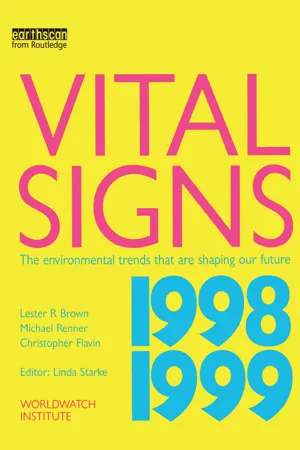
Vital Signs 1998-1999
The Environmental Trends That Are Shaping Our Future
- 142 pages
- English
- ePUB (mobile friendly)
- Available on iOS & Android
eBook - ePub
About this book
First Published in 1998. In this seventh annual edition of VITAL SIGNS the team at the Worldwatch Institute bring together an eclectic selection of disparate trends to offer a unique, multifaceted view of our rapidly changing world. This vital resource and reference guide traces the scientific, social, economic and environmental trends that have and continue to shape our world. Among the trends covered for the first time in VITAL SIGNS 1998-99, are frontier forests, plantation forestry, satellite launches, minerals exploration, small arms proliferation and female education. This year's edition points out that global emissions of carbon, the leading contributor to global climate change, hit another new high, while wind power has grown an amazing 26 per cent per year, and sales of solar cells jumped a phenomenal 43 per cent in 1997. VITAL SIGNS is the most comprehensive source of environmental and social information available.
Trusted by 375,005 students
Access to over 1.5 million titles for a fair monthly price.
Study more efficiently using our study tools.
Part ONE
Hey Indicators
Food
Trends
Trends
Grain Harvest Up Slightly |
At 1,881 million tons, the 1997 world grain harvest was up slightly from the previous record of 1,869 million tons in 1996.1 (See Figure 1.) Yet production per person dropped from 324 kilograms in 1996 to 322 kilograms, a decline of nearly 1 percent.2 (See Figure 2.) More important, the 1997 per capita figure was 6 percent below the all-time high of 342 kilograms in 1984.3
With good harvests in the major producing countries, wheat was the big gainer in 1997. (See Figure 3.) Record or near-record harvests in China, India, the United States, and the European Union pushed world wheat production to 609 million tons, passing 600 million tons for the first time.4 This was up from 583 million tons in 1996, a gain of more than 4 percent.5
Although it may surprise many people, the world’s leading wheat producer today is China. With a record 124-million-ton harvest, China is now getting close to doubling the U.S. wheat harvest of 69 million tons.6 Indeed, in some recent years, India also has eclipsed the United States, moving into the number two slot.7
The 1997 rice harvest barely held on to the gain of the year before, edging up to 382 million tons from 378 million tons.8 Gains in the rice harvests in Myanmar (formerly Burma), India, and Thailand were largely offset by slight declines in Indonesia and Japan.9 Not surprisingly, the world’s two leading rice producers are China and India. With harvests of 139 million tons and 82 million tons, respectively, these two population giants accounted for nearly 60 percent of the world rice harvest.10
Production of corn, the third major grain, totaled 579 million tons in 1997, down from the all-time high of 592 million tons the year before.11 Most of the reduction in the world corn crop came in China, the number two producer, where heat and drought dropped the harvest from 127 million tons to 105 million tons, a decline of 17 percent.12
The U.S. corn crop, essentially unchanged at 238 million tons, accounts for a staggering 41 percent of the world corn crop and more than one eighth of the overall grain harvest.13 This is far and away the largest harvest of a single grain by any country. Corn, the only grain crop originating in the New World, also has the highest worldwide yield per hectare of any grain.14
The big news on the grain front is the apparent loss of momentum in the growth of the world harvest during the 1990s. Even though the 11 million hectares of cropland that were idled under U.S. farm commodity programs in 1990 (1.6 percent of the world grainland total) have been returned to production, the world grain harvest has grown barely 1 percent a year since 1990.15
The backlog of unused agricultural technology that farmers can use to raise yields appears to be shrinking. For some farmers, such as U.S. wheat growers and Japanese rice...
Table of contents
- Cover
- Half Title
- Title Page
- Copyright Page
- Table of Contents
- ACKNOWLEDGEMENTS
- FOREWORD
- OVERVIEW: NEW RECORDS, NEW STRESSES
- Part One: KEY INDICATORS
- Part Two: SPECIAL FEATURES
- NOTES
- THE VITAL SIGNS SERIES
Frequently asked questions
Yes, you can cancel anytime from the Subscription tab in your account settings on the Perlego website. Your subscription will stay active until the end of your current billing period. Learn how to cancel your subscription
No, books cannot be downloaded as external files, such as PDFs, for use outside of Perlego. However, you can download books within the Perlego app for offline reading on mobile or tablet. Learn how to download books offline
Perlego offers two plans: Essential and Complete
- Essential is ideal for learners and professionals who enjoy exploring a wide range of subjects. Access the Essential Library with 800,000+ trusted titles and best-sellers across business, personal growth, and the humanities. Includes unlimited reading time and Standard Read Aloud voice.
- Complete: Perfect for advanced learners and researchers needing full, unrestricted access. Unlock 1.5M+ books across hundreds of subjects, including academic and specialized titles. The Complete Plan also includes advanced features like Premium Read Aloud and Research Assistant.
We are an online textbook subscription service, where you can get access to an entire online library for less than the price of a single book per month. With over 1.5 million books across 990+ topics, we’ve got you covered! Learn about our mission
Look out for the read-aloud symbol on your next book to see if you can listen to it. The read-aloud tool reads text aloud for you, highlighting the text as it is being read. You can pause it, speed it up and slow it down. Learn more about Read Aloud
Yes! You can use the Perlego app on both iOS and Android devices to read anytime, anywhere — even offline. Perfect for commutes or when you’re on the go.
Please note we cannot support devices running on iOS 13 and Android 7 or earlier. Learn more about using the app
Please note we cannot support devices running on iOS 13 and Android 7 or earlier. Learn more about using the app
Yes, you can access Vital Signs 1998-1999 by Lester R. Brown in PDF and/or ePUB format, as well as other popular books in Economics & Ecology. We have over 1.5 million books available in our catalogue for you to explore.