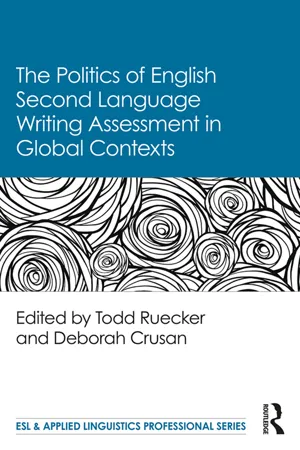
Reflecting the internationalization of the field of second language writing, this book focuses on political aspects and pedagogical issues of writing instruction and testing in a global context. High-stakes assessment impacts the lives of second language (L2) writers and their teachers around the world, be it the College English Test in China, Common Core-aligned assessments in the U.S., English proficiency tests in Poland, or the material conditions (such as access to technology, training, and other resources) affecting a classroom. With contributions from authors working in ten different countries in a variety of institutional contexts, the chapters examine the uses and abuses of various writing-related assessments, and the policies that determine their form and use. Representing a diverse range of contexts, methods, and disciplines, the authors jointly call for more equitable testing systems that consider the socioeconomic, psychometric, affective, institutional, and needs of all students who strive to gain access to education and employment opportunities related to English language proficiency.
eBook - ePub
The Politics of English Second Language Writing Assessment in Global Contexts
- 244 pages
- English
- ePUB (mobile friendly)
- Available on iOS & Android
eBook - ePub
The Politics of English Second Language Writing Assessment in Global Contexts
About this book
Trusted by 375,005 students
Access to over 1.5 million titles for a fair monthly price.
Study more efficiently using our study tools.
Information
Topic
EducationSubtopic
Education General1
The Intersections of Politics and Second Language Writing Assessment
What We Know
Pennycook (2013) claims, “English and English language teaching seems ubiquitous in the world, playing a role everywhere from large-scale global politics to the intricacies of people’s lives” (p. 4). Inextricably coupled with language teaching, perennially it seems, is language assessment. Whether it is the College English Test (CET) in China, Common Core-aligned assessments in the U.S., English proficiency tests in Poland, or material conditions such as access to technology, training, and other resources affecting classroom assessment in a variety of global contexts, assessment impacts the lives of L2 writers and their teachers around the world. Too often, assessment policies are imposed on teachers and their classrooms by those removed from these contexts, leading to policies that negatively impact the teaching and learning process, often demoralizing teachers and students in the process.
Let us provide an example from Todd’s state of New Mexico in the United States. The latest governor appointed a secretary of education early in her term who has connections with a neoliberal reform group called Chiefs for Change (Layton, 2015), a group that aims to promote policies such as using test scores to evaluate teachers and as report cards for schools. In New Mexico, this has translated into student test scores accounting for half of a teacher’s evaluation, creating an environment in which teachers are under intense pressure to teach to a particular test lest they face the possibility of losing their jobs. For a time, the state education department tried to issue a gag order preventing teachers from disparaging high-stakes standardized tests, but this did not hold up in court (Rivera, 2016). As Todd has documented elsewhere, high-stakes testing policies can have hugely negative impacts on schools with large numbers of English Language Learners (e.g., Ruecker, Chamcharatsri, & Saengngoen, 2015; Ruecker, 2013).
You (2004) has discussed ways the CET shapes writing instruction in China with this illustrative anecdote of a teacher leading students in exam practice. The teacher explained,
I scored your writing according to a 15-point scale. If your writing could not pass (did not get a passing score), here is the fanwen (model essay) on the blackboard (for your reference). As you can see, this is a typical sanduanlun (three-paragraph format): introduction, disadvantages and advantages of holiday economy, and the author’s own opinion.
(p. 101)
You noted that the teacher “already had the ‘correct’ writing in her mind before she asked her students to write” (p. 101). The teacher continued offering suggestions to her students: “Students with lower proficiency should try to memorize some model writings, so you can write with much more ease. There are 34 model writings in this booklet. It would be better if you could memorize all of them” (p. 101).
As teachers of writing, researchers, and administrators interested in assessment, we are dismayed at examples like the ones mentioned above. We feel strongly that well-designed, context-driven assessment is a force for good in improving classroom structure and student learning. Having clearly defined goals, focused criteria, and informal and formal assessments can help a teacher and student constantly gauge individuals’ progress so that teaching can be adjusted as needed to focus on a particular topic or theme. However, when politicians, big-money organizations, and distant administrators get involved and create poorly designed assessments and impose uninformed or heavy-handed penalties for low performance, the value of assessment gets distorted and has real potential to harm students and teachers.
As we will discuss a bit later, the policies of high-stakes testing have been well documented in the U.S. Further, as with much scholarship in second language writing and education, the work that gets published and disseminated is very much centered on English speaking countries like the U.S. Internationally, we don’t know enough about various local English as a foreign language (EFL) contexts of assessment, such as material or policy conditions in particular schools, whether secondary schools, private language institutes, or institutions of higher education. For those reasons, we were driven to create a collection to address these gaps, a collection that brings together teachers and scholars working in and writing about a variety of contexts around the world, helping to build a picture of the challenges L2 writing teachers face in relation to assessment policies and practices.
In general, we have been disappointed in our field’s aversion to engaging in political discussions, despite publication of works such as Matsuda, Ortmeier-Hooper, and You’s (2006) The Politics of Second Language Writing. This may be due in part to the sensitive nature of this topic and the contingent nature of the positions of many of those involved in the teaching of writing around the world. If one challenges entrenched power structures, then there is the real risk of losing one’s hard-earned position. Nonetheless, we have seen scholars make calls for more considerations of the sociopolitical contexts of writing and writing instruction. In a 2003 JSLW article, “Looking Ahead to More Sociopolitically-Oriented Case Study Research in L2 Writing Scholarship,” Casanave noted that L2 writing scholars “are attending to social and political aspects of writing that in the past were not considered central either to writing process research or to textual studies of writing” (p. 86), while calling for more work on the sociopolitical contexts of writing instruction. In this article, Casanave raised pointed questions about assessment and L2 writing, such as
What attitudes and strategies are taken by students, writing instructors, administrators, and evaluators who are involved in a particular competency exam system in a particular setting? How do particular exam requirements determine how students prepare and how teachers design class activities?
(p. 90)
A Bit on Terms
While we were disseminating the call for proposals (CFP) for this collection, we regularly were asked, “What do you mean by the politics of assessment?” and once we explained, were warned that we might have trouble finding authors because of the sensitive nature of political decisions in particular contexts. While dictionary definitions typically tend to connect politics with “government,” we are using this term broadly. On one level, we are concerned about the impact that national, state, and local governmental policies have on assessment. However, we also consider institutions, whether public or private, as governing bodies where policies are set at different levels, policies that impact those at other levels.
An important part of politics that the above dictionary definition doesn’t explicitly address is power, an issue that has been taken up extensively by critical theorists such as Foucault (1977) and Bourdieu and Passeron (1977). In Discipline and Punish, Foucault depicted power as a force spread throughout society whose workings are not always implicit. Teachers and students are embedded in a “political field” shaped by the workings of individuals, corporations, and other organizations that in turn shapes the assessment practices in their classrooms. At the most extreme, we see instances where teachers are mandated to teach a scripted curriculum designed to get students to pass a particular test. In such an instance, they are subjugated through the imposition of penalties that can cost teachers their jobs or, in a student’s case, success in an educational institution or acceptance for a particular job. One aspect of power not discussed as extensively by Foucault is the role wealth plays in shaping power structures; this is a concept that Bourdieu and Passeron (1977) captured through the concept of capital, which dealt with both social capital and economic capital, the latter of which Bourdieu and Passeron (1977) depicted as the most influential. In recent years, we have seen an increased role of big money involved in the shaping of assessments. With large foundations and corporations involved in the creation of tests and the textbooks behind them, these big money entities win contracts worth tens of millions of dollars, which essentially grants them carte blanche to define the teaching and learning processes in different institutions. Because tests affect the lives of and define the people who take them, we need to examine their uses and the consequences of those uses in society (Shohamy, 2001; McNamara & Roever, 2006) and their ties to power distributions in society. We aim to do that very thing with this book.
When we talk about assessment, we are often concerned with large-scale assessment since that is so frequently overtly political. However, we recognize that assessment is much more than that. For us, assessment is not only large-scale tests but also everyday practices in a classroom that enable a teacher to judge the progress of her students in order to provide additional guidance to help them develop and advance. For instance, depending on the information a teacher needs, a short timed writing assignment at the beginning of class can be used as an assessment as well as a larger research essay. In working towards an essay, there may be mini assessments, such as an annotated bibliography, an outline, and partial drafts of different components of the paper. All of these different assessments, micro or macro, are often shaped by the layers of political fields embedding teachers, classrooms, and students. For instance, if a teacher is required to teach towards a particular test, as in You’s (2004) aforementioned example, then the type of writing students will be completing and being assessed on during the class will be inevitably shaped by the test. In another example, resource disparities, often a product of political decisions about school funding, may mean that teachers work with too many students, preventing their ability to prioritize feedback and revision in assessing writing, instead looking for a scoring system that will streamline the process as much as possible.
Politics in Education
In “Importing Composition: Teaching and Researching Academic Writing Beyond North America,” Muchiri, Mulamba, Myers, and Ndoloi (1995) wrote, “Everyday academic work is still overwhelmingly determined by its national setting. The funding, the geography, the politics, the national ideology determine daily concerns like hours, class size, assessment, careers” (p. 194). Political forces at different levels have long played a role in shaping classrooms and the experiences of L2 writers within them. At the local level, we often see disparities between different schools and classrooms that shape the type of assessments teachers can do and the impact of those assessments on students. For instance, in the U.S., school funding is highly inequitable as it is mostly funded locally via property taxes. It has been well documented that schools in poorer neighborhoods tend to have lower quality facilities, larger class sizes, less qualified teachers, and higher concentrations of L2 learners (e.g., Turner et al., 2016). In a study of English teaching in Jordan, Al-Jarrah and Al-Ahmad (2013) similarly reported that a “shortage of qualified teachers and researchers, textbooks, school buildings, and facilities has been reflected negatively on the students’ attitudes toward the learning situation” (p. 90). The authors also noted that university writing classes have at least 60–70 students in a writing class, with primary and secondary public schools regularly having class sizes of 50 or more. Similarly, we have had colleagues from Thailand report teaching university language classes with hundreds of students. As we all know, writing assessment takes time, and material conditions such as large class sizes and access to computers impact what a teacher can do. Ruecker et al. (2014) stated that a lack of time to provide feedback was one of the top challenges reported by teachers on an internationally distributed survey on the contexts of L2 writing instruction.
On the national level, we have seen governments regularly intervene in education systems for a variety of reasons. For instance, Prendergast (2008) documented the spread of English language instruction in Slovakia as part of a larger government initiative to be competitive in the international economy. Al-Jarrah and Al-Ahmad (2013) explained how English teaching mandates in Jordan came under opposition from various forces, including religious figures, who were concerned about the teaching of a non-Arabic language in the country. The existence of national policies to encourage or require the teaching of a particular language impacts the attitudes teachers and students bring to a particular writing task and assessment. As Reichelt (2005) noted, “EFL writing pedagogy in Poland, as well as in other non-English-dominant contexts, is shaped by the role English plays, local attitudes toward English, the history of English-language teaching, and other context-specific educational factors” (p. 226). Muchiri et al. (1995), Clachar (2000), and Leki (2001) have all documented the problems when teachers bring or are required to teach and assess explicitly in a western style. For instance, Clachar (2000) noted how teachers and students both struggled with the expectations posed by an “alien rhetorical style” (p. 80).
Perhaps the most commonly identified national interventions concerning L2 writing assessment concern national mandates of standardized, high-stakes tests. A Council of the Great City Schools (2015) study reported that U.S. students take 112 mandated standardized tests between pre-kindergarten classes and twelfth grade. In contrast, other countries administer three tests to students during that same time period. The impact of increased testing on L2 writers over the past few decades has been well documented. For instance, Booher-Jennings (2005) reported that English Language Learners in doubt of passing the test were often ignored or, even worse, increasingly placed into special education programs where they did not impact a school’s overall grade. Ruecker (2013, 2015) has written extensively about how a school on the U.S.–Mexico border that was 40% English Language Learner (ELL) was forced to teach narrowly towards a particular state test, restricting the types of writing experiences students had during high school. Ruecker et al. (2015) reported that even the latest high-stakes standardized tests developed in the U.S. are rife with cultural bias and disproportionately harm schools with large numbers of ELLs.
Some scholars have documented the impact of high-stakes assessments in other countries. As cited earlier, You (2004) has explored how the CET has helped contribute to rote, reductive writing instruction in China. In what seems a nod towards positive washback, Reichelt (2005) explained how the new Polish Matura (the school leaving exam) was going to require writing whereas the older form of the test did not, thus increasing teachers’ interest in writing instruction. As Leki (2001) noted, “In a spiraling interaction of mutual reinforcement, once writing becomes important in academic settings, it becomes subject to testing; once writing is tested, its importance is further augmented” (p. 199). However, Reichelt (2005) found that the emphasis on preparing students for exams, especially in Polish universities, meant that students were writing essays in the current-traditional mold that bore little relation to the practical, culturally situated contexts in which they would be writing in throughout their lives.
Coupled with too much testing is the issue of how we use the test scores (Crusan, 2006). Often, the powers that be place too much emphasis on one score on one test and use that single score to evaluate both teachers and students. Since we believe that the primary function of testing is to promote teaching and learning in the classroom, it is often difficult for us to support the amount of standardized testing that goes on in...
Table of contents
- Cover
- Title
- Copyright
- CONTENTS
- List of Figures
- List of Tables
- Acknowledgments
- 1 The Intersections of Politics and Second Language Writing Assessment: What We Know
- PART I Local and National Policy Contexts
- PART II High-Stakes Assessment
- PART III Seeking Solutions: Assessing Better Locally and Internationally
- Afterword
- Author Biographies
- A Few Key Terms
- Index
Frequently asked questions
Yes, you can cancel anytime from the Subscription tab in your account settings on the Perlego website. Your subscription will stay active until the end of your current billing period. Learn how to cancel your subscription
No, books cannot be downloaded as external files, such as PDFs, for use outside of Perlego. However, you can download books within the Perlego app for offline reading on mobile or tablet. Learn how to download books offline
Perlego offers two plans: Essential and Complete
- Essential is ideal for learners and professionals who enjoy exploring a wide range of subjects. Access the Essential Library with 800,000+ trusted titles and best-sellers across business, personal growth, and the humanities. Includes unlimited reading time and Standard Read Aloud voice.
- Complete: Perfect for advanced learners and researchers needing full, unrestricted access. Unlock 1.5M+ books across hundreds of subjects, including academic and specialized titles. The Complete Plan also includes advanced features like Premium Read Aloud and Research Assistant.
We are an online textbook subscription service, where you can get access to an entire online library for less than the price of a single book per month. With over 1.5 million books across 990+ topics, we’ve got you covered! Learn about our mission
Look out for the read-aloud symbol on your next book to see if you can listen to it. The read-aloud tool reads text aloud for you, highlighting the text as it is being read. You can pause it, speed it up and slow it down. Learn more about Read Aloud
Yes! You can use the Perlego app on both iOS and Android devices to read anytime, anywhere — even offline. Perfect for commutes or when you’re on the go.
Please note we cannot support devices running on iOS 13 and Android 7 or earlier. Learn more about using the app
Please note we cannot support devices running on iOS 13 and Android 7 or earlier. Learn more about using the app
Yes, you can access The Politics of English Second Language Writing Assessment in Global Contexts by Todd Ruecker,Deborah Crusan in PDF and/or ePUB format, as well as other popular books in Education & Education General. We have over 1.5 million books available in our catalogue for you to explore.