eBook - ePub
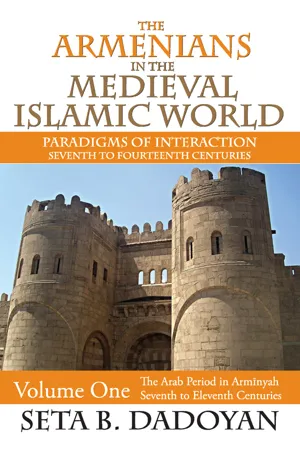
The Armenians in the Medieval Islamic World
The Arab Period in Armnyahseventh to Eleventh Centuries
- 235 pages
- English
- ePUB (mobile friendly)
- Available on iOS & Android
eBook - ePub
The Armenians in the Medieval Islamic World
The Arab Period in Armnyahseventh to Eleventh Centuries
About this book
In this first of a massive three-volume work, Seta B. Dadoyan studies the Armenian experience in the medieval Islamic world and takes the reader through hitherto undiscovered paradigmatic cases of interaction with other populations in the region. Being an Armenian, Dadoyan argues, means having an ethnic ancestry laden with narratives drawn from the vast historic Armenian habitat. Contradictory trends went into the making of Armenian history, yet most narratives fail to reflect this rich texture. Linking Armenian-Islamic history is one way of dealing with the problem. Dadoyan's concern is also to outline revolutionary elements in the making of Armenian ideologies and politics. This extensive work captures the multidimensional nature of the Armenian experience in the medieval Islamic world. The author holds that every piece of literature, including historical writing, is an artifact. It is a composition of many elements arranged in certain forms: order, sequence, proportion, detail, intensity, etc. The author has composed and arranged the larger subjects and their sub-themes in such a way as to create an open, dynamic continuity to Armenian history that is intellectually intriguing, aesthetically appealing, and close to lived experiences.
Information
1
Factors in the Pre-Islamic Armenian Condition— Fourth–Seventh Centuries
The ways in which Armenian institutions, classes, factions, trends, and individuals interacted with cultural and political Islam were to a large extent shaped by factors already active in the previous centuries.
While Byzantium smoothly replaced the Roman Empire in the West, the Arabs replaced the Persians in the East, at least as far Armenians were concerned. Even though it came into the stage as a distinct religious– political system, Islam in turn was a result and very much a part of local circumstances. Syrian and other Christians in the region persisted with varying degrees of influence. For Armenia and Armenians life between two superpowers was not interrupted. In all respects, they constituted a subsystem in a vast and ancient world of great civilizations. Commonly used terms like “influences,” “relations,” even “interactions” seem to be understatements in view of the symbiotic manner in which cultures and peoples evolved in the region. The factors that contributed to the shaping of the Armenian–Islamic experience were:
1. East–West rivalries in which were engaged Armenian kings, catholicoi, naxarars (heads of houses of nobility), and the common people
2. The cultural policies and the legacy of fundamental loyalties of the Armenian Classical or Golden Age in the Fifth century
3. Definitions of Armenian orthodoxy and the synthesis of the Armenian theologist Eznik (mid-fifth century)
4. Early Armenian social–religious dissent
I. East–West Rivalries: Kings, Catholicoi, Naxarars, Common People
From the beginning Armenian political history and culture were marked by pluralism. As of the first century AD to the middle of the seventh and increasingly, the political, social, and cultural evolution of Armenians was part of a world, which simultaneously divided and brought together the East and the West. The East was Persian then Islamic, and the West was Roman, then Byzantine. Centuries later, after the arrival of the Crusaders at the end of the eleventh century, in addition to being Chalcedonian-Byzantine, the West was also European and Catholic. The Armenian condition reflected the constant and simultaneous existence of hostile power bases and policies. Pre-dictably, the western choice was sometimes synonymous with anti-Easternism and vice versa. The Church and some of the nobles were consistently pro-Western, while other nobles, clergy, popular factions, and dissident-heterodox trends frequently sided with the East.
The Parthian-born Armenian Arsacid dynasty (Aršakunis, AD 53–428) were vassals to the two warring empires, Roman and Sassanid (AD 226–651), often to both simultaneously. In the meantime, as of the first century, Christianity in its early trends and forms was spreading in Armenia from the south and west. The new faith was unwelcome for the Persians, even though the Syriac-adoptinist channels and the versions through which it spread, were in turn rejected and persecuted by the Byzantine Church too. (According to these early Syriac trends, Jesus was born of Joseph and Mary in the normal way, in other words, He was not divine, He became divine by adoption by God at His baptism. Obviously, the idea contradicted the doctrine of Trinity, at least).
Religions in the Near East were always—and still are—politicized and inevitably caused and/or became political problems, hence the political dimensions of Armenian Christianity too.1 The adoption of Christianity by Arsacid King Trdat or Tiridades III (last term: 298–330) and his imposition of the new religion on the people of his kingdom, marked a shift toward Rome,2 even though he was said to be proud of his Parthian ancestry. Naturally, the Persians could not approve his move. At the time Armenian culture was predominantly Parthian and the circumstances of the conversion of the king at the hand of another Parthian, later to be known as St. Grigor I Lusaworič‘ (Gregory the Illuminator, incumbency 302–325) was in fact depicted in Iranian epic terms.3 The power struggle and politics of the Church, monarchy, and nobility caused deep crises on all levels. Later on in the century at least two Arsacid kings as well as some of the nobility entered into conflicts with the Church, for a variety of reasons. Aršak II (345–368) and his son Pap (368–373) “seem to have been Arianising heretics,” observes Russell, “but not outright infidels.”4 (The Arianists had adoptionistic views and were already rejected by the Byzantine and the Armenian Churches).
The conversion of the state did not mean the total conversion of all the Armenians to Christianity. The process took many centuries and encountered serious dissent. The new faith was imposed by force by King Tiridades III and Catholicos Grigor I. They were negligent and even hostile toward not only the native pagan culture, arts, and architecture, but the faith of already converted Armenians too. They did not seem to tolerate early communalistic Christianity in general. Furthermore, at the time on the popular level at least, Christian religious culture must have been syncretistic and paganism was very much active. In other words, syncretism, adoptionism, and communalism typified the early Armenian Christian trends.
Byzantine and Armenian Churches slowly began to define orthodoxy but negatively, or through what they considered unacceptable and challenging to the established order, be that moral, social, or religious. Any expression of dissent or form of deviance was classified as heresy. As Henderson rightly indicates, the so-called heresies were obviously taken very seriously, because they posed a threat from within the given system. From the beginning, dissident ideas and communities were associated with “dark forces from beyond the pale,” or outside and against standards of right and wrong. Early theology, says Henderson, was “hidden heresiography.” In fact, it began in heresiography or formulating the errors of others as opposed to “right” beliefs. The initial formulation of doctrines began in these contexts.5 Concerning Armenian religious culture and history in general, the most distinctive yet misrepresented aspect was its development along two paths: the institutional/orthodox and the popular/dissident or heretical. The latter level was largely obscured because almost without exception medieval chroniclers and historians were men of the church. Only recently some Armenologists in the west have concerned themselves with the peculiarities of Armenian Christianity. The heretical syndrome still obscures many historic aspects of Armenian Christianity. Soviet and eastern Armenian historians classified some dissident-related episodes of the tenth and eleventh centuries under what they described as “peasant uprisings against the feudal nobility and the church.” The approach did shed light on certain aspects of social history but fell short from defining the core problems of Armenian history.
The Arsacids may have been only political Christians. They were Persian, i.e., eastern in their culture and politics, and the Hellenophiles openly rebuked them. Even though founded by a Parthian convert to Christianity, Catholicos Grigor Pahlaw or Part‘ew Lusaworič‘, the Armenian Church was western in its politics and remained so, despite the Chalcedonian break after the mid-fifth century. The Sassanids on their part supported eastern Christians and Nestorians in particular. They established a bishopric for the Syrian Christians in their capital. Furthermore, while during pre-Christian times the pagan temple had little or no control over the state, the situation radically changed after the adoption of the new faith by the state. Led by Grigor and his descendants, the Church inherited the wealth, estates, and privileges of the temples and rose as a powerful feudal institution next to the monarchy and the naxarars. It was largely an autonomous institution with its own diplomacy and economy. Over a century before the adoption of the new religion by the state in the 310s, many Armenians had already converted to Christianity throughout historic Armenia, with the Plane of Ayrarat at the center of the area affected. The prominent historian Leo observes that what Grigor I the Illuminator introduced was “imperial” Christianity as opposed to the “poor” Christianity or the faith of the common people. Through the Church of the Illuminator the official faith was heavily politicized and deepened class distinctions in Armenian society, as Leo believes.6
Following the Iranian norm, similar to that of the monarch, the office of the catholicos too became hereditary. Grigor I and his clan (tohm) held the catholicosal chair for the next thousand years, including the Cilician times. Pagan structures and culture were destroyed and Aštišat, where the catholicos resided, became the most luxurious city in the province of Taron (which was also the estate of the catholicos). Since there were no educated and trained candidates in Armenia at the time of Christianization, clergy were brought in from abroad. They were placed at the heads of almost four hundred parishes and provided with estates, and a new class of clergy came about.7
Under the heavy shadow of the Church of Caesarea, the Armenian Church joined forces with the Hellenophile nobles, and the Mamikoneans in particular. The latter held the hereditary office of sparapet or army commander. Almost immediately a front was formed against the powerful Iranophile camp.8 Already at the middle of the fourth century, the interests of central monarchy clashed with those of the nobility and the Church. Eventually, tension between these forces as well as dissident factions dominated Armenian political culture for the next millennium and further. The reflections of the Byzantine–Iranian and later on the Byzantine–Islamic conflict were explicit not only in Armenian religious culture but the institution of the Catholicosate too.
The first council of the Armenian Church was held in 354 and a series of canons were issued always under the jurisdiction of Caesarea, and to the displeasure of the Persians and their sympathizers and allies. The construction of the open city of Aršakawan by King Aršak II (350–c.364/7) was a counter-action addressed to the fortified hellenophile camp. It was probably the first initiative to develop an independent and “urban” power base, as opposed to the agrarian-based power of the naxarars. The project also was designed to create a power center and to host all the persecuted, displeased, and dissident factions. The destruction of the city by the pro-catholicosal Hellenophile naxarars was followed by the violent deaths of the army commander or Sparapet Vasak Mamikonean, then King Aršak himself, the “cursed” Aršakuni (for his Parthian sympathies). Aršak’s son and successor King Pap (367–c.374) was raised in Rome but in turn wanted to consolidate his position as the central and sovereign authority. He ended the tradition of ordaining the Armenian catholicos in Caesarea and freed the Armenian Church from its influence. In these troubled circumstances, Catholicos Nersēs I Partew the Great (353–373), son of Lusaworič‘ w...
Table of contents
- Cover
- Half Title
- Title Page
- Copyright Page
- Dedication
- Table of Contents
- Contents of Forthcoming Volumes in This Series
- Transliteration Tables
- Prologue
- Introduction
- 1 Factors in the Pre-Islamic Armenian Condition—Fourth–Seventh Centuries
- 2 Early Arab Campaigns and the Regulation of Relations according to the MedīNan Legacy
- 3 The Umayyad Period and the Reconfirmation of Oaths
- 4 The Armenians in the ‘AbbāSid World—The Paradigms of Borderlands and Dissidence
- 5 Armenian Dynastic Principalities or the “Age of Kingdoms”
- Summary: The Arguments in Volume One
- Bibliography
- Appendix
- Index
Trusted by 375,005 students
Access to over 1.5 million titles for a fair monthly price.
Study more efficiently using our study tools.
Frequently asked questions
Yes, you can cancel anytime from the Subscription tab in your account settings on the Perlego website. Your subscription will stay active until the end of your current billing period. Learn how to cancel your subscription
No, books cannot be downloaded as external files, such as PDFs, for use outside of Perlego. However, you can download books within the Perlego app for offline reading on mobile or tablet. Learn how to download books offline
Perlego offers two plans: Essential and Complete
- Essential is ideal for learners and professionals who enjoy exploring a wide range of subjects. Access the Essential Library with 800,000+ trusted titles and best-sellers across business, personal growth, and the humanities. Includes unlimited reading time and Standard Read Aloud voice.
- Complete: Perfect for advanced learners and researchers needing full, unrestricted access. Unlock 1.5M+ books across hundreds of subjects, including academic and specialized titles. The Complete Plan also includes advanced features like Premium Read Aloud and Research Assistant.
We are an online textbook subscription service, where you can get access to an entire online library for less than the price of a single book per month. With over 1.5 million books across 990+ topics, we’ve got you covered! Learn about our mission
Look out for the read-aloud symbol on your next book to see if you can listen to it. The read-aloud tool reads text aloud for you, highlighting the text as it is being read. You can pause it, speed it up and slow it down. Learn more about Read Aloud
Yes! You can use the Perlego app on both iOS and Android devices to read anytime, anywhere — even offline. Perfect for commutes or when you’re on the go.
Please note we cannot support devices running on iOS 13 and Android 7 or earlier. Learn more about using the app
Please note we cannot support devices running on iOS 13 and Android 7 or earlier. Learn more about using the app
Yes, you can access The Armenians in the Medieval Islamic World by Seta B. Dadoyan in PDF and/or ePUB format, as well as other popular books in Social Sciences & European Medieval History. We have over 1.5 million books available in our catalogue for you to explore.