eBook - ePub
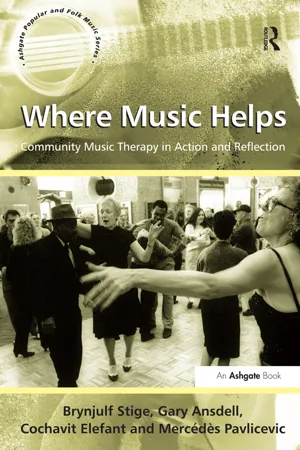
Where Music Helps: Community Music Therapy in Action and Reflection
- 364 pages
- English
- ePUB (mobile friendly)
- Available on iOS & Android
eBook - ePub
Where Music Helps: Community Music Therapy in Action and Reflection
About this book
This book explores how people may use music in ways that are helpful for them, especially in relation to a sense of wellbeing, belonging and participation. The central premise for the study is that help is not a decontextualized effect that music produces. The book contributes to the current discourse on music, culture and society and it is developed in dialogue with related areas of study, such as music sociology, ethnomusicology, community psychology and health promotion. Where Music Helps describes the emerging movement that has been labelled Community Music Therapy, and it presents ethnographically informed case studies of eight music projects (localized in England, Israel, Norway, and South Africa). The various chapters of the book portray "music's help" in action within a broad range of contexts; with individuals, groups and communities - all of whom have been challenged by illness or disability, social and cultural disadvantage or injustice. Music and musicing has helped these people find their voice (literally and metaphorically); to be welcomed and to welcome, to be accepted and to accept, to be together in different and better ways, to project alternative messages about themselves or their community and to connect with others beyond their immediate environment. The overriding theme that is explored is how music comes to afford things in concert with its environments, which may suggest a way of accounting for the role of music in music therapy without reducing music to a secondary role in relation to the "therapeutic," that is, being "just" a symbol of psychological states, a stimulus, or a text reflecting socio-cultural content.
Information
PART I
Chapter 1
Introduction
Music and Health in Community
Listening to Musical Minds
“The arts are not drugs,” wrote the British novelist E. M. Forster; “they are not guaranteed to act when taken.”1 We have experienced how popular opinion often associates music therapy with the systematic application of specific music for specific purposes, such as relaxing people. This may sound proper and scientific in many people’s ears, but it leaves little space for personal participation. We could say that it is an idea based upon a mechanical metaphor, reducing music to a “pill” and focusing upon the effect of musical stimuli on the human organism. Within the discipline of music therapy critique of this idea has been quite common. In music therapy there is an interest in human interaction through music and not just in the organism’s reaction to music. Music therapy practice therefore often focuses upon human expression and communication.
We acknowledge the importance of this critique. Still, this book is based upon a critique of the critique, claiming that it has not been radical enough. Human interaction through music requires space and place, and it is therefore not enough to critique ideas based upon mechanical metaphors. The implications of contextual or ecological metaphors must also be taken into consideration. Music is a sociocultural phenomenon and musical activity involves social action, as the projects described in this book will illuminate in various ways.
In this book you will hear about:
•A singing group called Musical Minds who meet weekly in a deprived area of East London. They meet under the auspices of an organization that helps adults with long-term mental health problems, and music and singing are for the group unique ways of finding meaning and a sense of belonging in a difficult environment.
•Two diverse groups of young children who attended schools in separate parts of the town Raanana in Israel; one group in an elementary school and the other in a center for special education. Through participation in collaborative musical activities involving an intricate intergroup process these children gradually became connected. The story of this process illuminates how the children creatively performed their own solutions to social problems.
•The Music for Life programme in Western Cape, South Africa, where two music therapists have set up a traveling service with the aim of working with and within local communities rather than providing a music therapy place that others come to. The programme includes the Heideveld Children’s Choir, which prepares for the annual Heideveld Community Concert, and this event illuminates the traveling music therapy service’s contribution to the musical and social life of Heideveld as well as Heideveld’s contribution and support for the work.
•The Cultural Festival for adults with intellectual disabilities in Sogn og Fjordane, Western Norway. The association organizing this festival stresses its function as an inclusive arena for musical and social participation and it turns out that the participants indeed are involved in many different ways, ranging from the most silent and careful partaking to adventurous and eccentric acts that challenge established procedures and role relationships.
•A unique performance project in rural South of England for adults with neurological disabilities, which was called Scrap Metal. Beginning from a conventional music therapy program, the project evolved into a complex socio-cultural collaboration where participants (both able and disabled) used scrap metal to build instruments, workshop musical idioms and perform a one-off concert in a church to a local audience.
•Renanim, a choir of adults with physical disability and normal cognition living in the Israeli town of Natanya. Giving voice to this choir was the idea behind a performance in collaboration with another choir, but this gave a contradictory outcome. Renanim felt that their voices were not heard, in spite of the good intentions of the music therapist. An adjusted Participatory Action Research project follows the development of the choir in their communication and exploration towards the discovery of how they could achieve their shared concern – claiming their voice.
•A music project in Eersterust, close to Pretoria in South Africa, where a music therapist works at Youth Development Outreach, a community-based organization that caters for young people in trouble with the law. Through group singing, drumming, and dancing young people who are used to conflict, violence, and mistrust in their daily lives develop skills in listening to one another, co-operating, and supporting one another, and also consider what these experiences mean in terms of their daily lives.
•The Senior Choir in Sandane, rural Western Norway, with members who eagerly participate in choir rehearsals and performances in spite of various constraints. The rehearsals mean hard work on “getting the music right” and include challenging negotiations on values that shape their culture and everyday life, but the overall atmosphere is still one of warmth, hospitality, and mutual care.
All these groups and projects are being facilitated by music therapists but are not necessarily identified formally as music therapy groups and projects. They exemplify a movement within contemporary music therapy that has been labeled Community Music Therapy. As practices these projects are characterized by collaborative and context-sensitive music-making and they focus upon giving voice to the relatively disadvantaged in each context. The participants’ interest in and love for music is essential, but the shared music-making also relates to concerns for health, human development, and equity. Community Music Therapy therefore involves what we could call health musicing2 (Stige, 2002), as it focuses on the relationships between individual experiences and the possible creation of musical community (Pavlicevic and Ansdell, 2004).
Community Music Therapy is controversial in some music therapy circles, since it may involve some substantial rethinking of music therapy theory and practice. In our view it fills a need in a range of contexts and also contributes to further development of music therapy as discipline and profession. We consider Community Music Therapy as one voice in a broader multi-disciplinary dialogue on the relationships between the musical and the social in human life. This book is therefore written to the music therapist as well as to any student of music, health, and social life. Our ambition has been to document and analyze practices that have been underreported in the literature so far, so that we can listen to and learn from groups such as Musical Minds, who remind us about how our musical minds are embodied and embedded in real world situations.
Music and Music Therapy as Social and Situated Activity
Music therapy was established as university discipline and professional practice in the US in the 1940s and was pioneered in Europe, South America, and Australia a decade or two later. Currently music therapy is growing in all continents and is in the process of being instituted in an increasing number of countries. In the 1960s and 1970s, formative years for attempts by modern music therapy to link music and health in theory and practice, most musicologists concentrated on Western music history or the analysis of works of the Western classical canon and thus did not have much to say about ordinary people in contemporary real world situations (whether in the West or anywhere else). Their scholarly work was thus not of much use for music therapists, who either developed a quite pragmatic approach with little consideration of theory or concentrated on cultivating relationships to theories in medicine, special education, psychology, and psychotherapy.
The recent emergence of Community Music Therapy implies that theories from fields such as systems theory, anthropology, sociology, and community psychology are taken into consideration as well. Particularly, we suggest that it implies that music studies become more important for music therapy, and possibly vice versa. Recently, music therapists have had to ask themselves questions like: “What has the New Musicology to say to music therapy?” (Ansdell, 1997) and “Musicology: misunderstood guest at the music therapy feast?” (Ansdell, 2001). One of the reasons why there is need for more sophisticated music thinking in music therapy is that most theories in disciplines such as medicine and psychology have had little to say about music. Also, musicology has changed and become more relevant for music therapy, by focusing more upon music as social and situated activity.
The work of music therapy theorist Even Ruud illustrates quite well how relationships between music therapy and other branches of music studies have been strengthened lately. In one of his most important early works, Music Therapy and its Relationship to Current Treatment Theories (Ruud, 1980a), the focus is almost entirely on relationships to theories of medicine, psychology, and sociology, even though various concepts of music in different music therapy theories are discussed. In an introduction to music therapy published about the same time, Ruud (1980b) indicates that music therapy is interesting and important for musical reasons also, for instance in relation to handicapped people’s right to music. A few years later this trend is more explicit; Ruud (1987/1990) locates music therapy in the humanities and argues that relationships between music therapy and musicology would be mutually beneficial. Some of Ruud’s later work, such as his studies of music and values (Ruud, 1996) and of music and identity (Ruud, 1997b), is quite explicit in its ambition to bridge various approaches to music studies, including music therapy. In other words; there has been more and more of an integration of Ruud’s work as a music therapy theorist and a musicologist. We propose that Community Music Therapy may contribute to integration of music therapy and music studies more generally.
An openness to interdisciplinary perspectives linked to an interest in the relationships between music, culture, and society is quite characteristic of the development of music studies in the last two decades. The story of how and why this happened has been told many times, in many different ways. Some have focused upon the emergence of a “new musicology” with integration of critical and cultural perspectives, as developed by e.g. Gary Tomlinson and Susan McClary and pioneered by Joseph Kerman (1985) and others. Some have focused upon developments in ethnomusicology, which after the “cultural turn” proposed by Alan Merriam (1964) worked out perspectives of broader relevance for the understanding of music in any culture (as has been demonstrated by researchers such as John Blacking and Steven Feld). Others again have focused upon the emergence of a culturally informed music sociology (as developed by e.g. Howard Becker and Tia DeNora). The importance of the new area of popular music studies (with scholars such as Simon Frith and Philip Tagg) has also been underscored. Richard Middleton (2003) describes these developments as “distinctive but often mutually affecting routes” toward a position against pure musical autonomy:
“Music is more than notes” represents the bottom line, an idea whose seeming banality today perhaps signals its triumph. (Middleton, 2003, p. 2)
For a lay person who conceivably thinks of music in terms such as emotion, energy, and engagement in everyday life activities it would probably be somewhat surprising that a range of scholars have had to work hard for years to show that music is “more than notes.” Part of the scholarly context is of course that musicology had established itself quite firmly as the study of the works of the great masters (of Western art music). We could say that the idea of music as autonomous art belonging to a “special sphere” separated from e.g. the market and other social circumstances had insulated musicology from taking interest in how most people use and experience music. The abovementioned change in music studies could thus be described in various ways; as a cultural turn; as a critique of an elitist and ethnocentric heritage, and as the merging of musicology, ethnomusicology, music sociology, and popular music studies.3
In more straightforward language we could say that students of music increasingly have realized that there is no clear dividing line between classical music and popular music or between music of the West and music of “the rest.” The cultural, contextual, and interpretive turn in music studies thus also could be described as a move in the direction of a musicology with people in it, a “populated musicology,” which suggests that dialogues between music therapy and other fields of music studies become more relevant and interesting than used to be the case. Most scholars would agree that a “populated musicology” could not take interest in the construction of geniuses only. It could thus be described as a democratization of music studies. This change in perspective has implications for the conception of musicality, which no longer could be thought of as a gift for the happy few but rather as a shared capacity of the human species (a capacity which unfolds and develops in ways that depend on the life history and cultural context of the individual).4
If music is acknowledged as a situated activity not only reflecting but also performing human relationships, then it is not just legitimate but in fact highly relevant to study how people actually use music. Use is an important asset of human interaction with the world and could not be reduced to instrumental purposes in the narrow and negative sense of that term.5 In the flow of texts on this theme the term musicing has been appropriated by a variety of authors. The books of David Elliott (1995) and especially Christopher Small (1998) discuss this notion in detail, and Small most carefully underscores how the idea of music as an activity is linked to a contextual and relational understanding of human life.6 The idea of musicing, then, goes far beyond the simple point of suggesting that music could be treated as a verb and not just as a noun; it suggests awareness about how music affords and requires human interaction and collaboration in any given context.7
Perhaps in the margins of these cultural and disciplinary shifts, music therapists have developed their practice with a wide range of people in a wide range of contexts. An interest in how and where people use music is one of the places where music therapy thinking and newer music thinking could meet. While traditional musicology could privilege very specific uses (such as contemplation) and disparage others (such as distraction and entertainment), contemporary music studies would examine how such value attribution is linked to social interests and cultural values in broader contexts.
At the time Ansdell (2001) asked if musicology was a “misunderstood guest at the music therapy feast” it would probably also have been relevant to ask if music therapy was a misunderstood guest in various music studies contexts. Integration of music therapy perspectives has not been too common in music studies. There are signs, however, suggesting that things are in the process of changing: Increasingly, music therapy is part of broader multidisciplinary discourses on music, in relation to themes such as the origins of music (Grinde, 2000; Merker, 2000; Kennair, 2001; Dissanayake, 2001), communicative musicality (Trevarthen and Malloch, 2000; Malloch and Trevarthen, 2009; Wigram and Elefant, 2009; Pavlicevic and Ansdell, 2009), music and communication (Ansdell, 2005b; Thaut, 2005), music and emotion (Bunt and Pavlicevic, 2001), and music in everyday life (Berkaak and Ruud, 1992, 1994; DeNora, 2000). The above examples are in no way meant to be comprehensive but illuminate a higher degree of interdisciplinary exchange than used to be the case just a few years ago.
One of the reasons why music therapy contributes to the broader field of music studies is that music therapist...
Table of contents
- Cover
- Half Title
- Title Page
- Copyright Page
- Table of Contents
- List of Figures
- General Editor’s Preface
- Acknowledgments
- Part I
- Part II
- Part III
- Part IV
- Part V
- Part VI
- Part VII
- Part VIII
- Part IX
- Part X
- Bibliography
- Index
Trusted by 375,005 students
Access to over 1.5 million titles for a fair monthly price.
Study more efficiently using our study tools.
Frequently asked questions
Yes, you can cancel anytime from the Subscription tab in your account settings on the Perlego website. Your subscription will stay active until the end of your current billing period. Learn how to cancel your subscription
No, books cannot be downloaded as external files, such as PDFs, for use outside of Perlego. However, you can download books within the Perlego app for offline reading on mobile or tablet. Learn how to download books offline
Perlego offers two plans: Essential and Complete
- Essential is ideal for learners and professionals who enjoy exploring a wide range of subjects. Access the Essential Library with 800,000+ trusted titles and best-sellers across business, personal growth, and the humanities. Includes unlimited reading time and Standard Read Aloud voice.
- Complete: Perfect for advanced learners and researchers needing full, unrestricted access. Unlock 1.5M+ books across hundreds of subjects, including academic and specialized titles. The Complete Plan also includes advanced features like Premium Read Aloud and Research Assistant.
We are an online textbook subscription service, where you can get access to an entire online library for less than the price of a single book per month. With over 1.5 million books across 990+ topics, we’ve got you covered! Learn about our mission
Look out for the read-aloud symbol on your next book to see if you can listen to it. The read-aloud tool reads text aloud for you, highlighting the text as it is being read. You can pause it, speed it up and slow it down. Learn more about Read Aloud
Yes! You can use the Perlego app on both iOS and Android devices to read anytime, anywhere — even offline. Perfect for commutes or when you’re on the go.
Please note we cannot support devices running on iOS 13 and Android 7 or earlier. Learn more about using the app
Please note we cannot support devices running on iOS 13 and Android 7 or earlier. Learn more about using the app
Yes, you can access Where Music Helps: Community Music Therapy in Action and Reflection by Brynjulf Stige,Gary Ansdell,Mercédès Pavlicevic in PDF and/or ePUB format, as well as other popular books in Media & Performing Arts & Ethnomusicology. We have over 1.5 million books available in our catalogue for you to explore.