- 304 pages
- English
- ePUB (mobile friendly)
- Available on iOS & Android
eBook - ePub
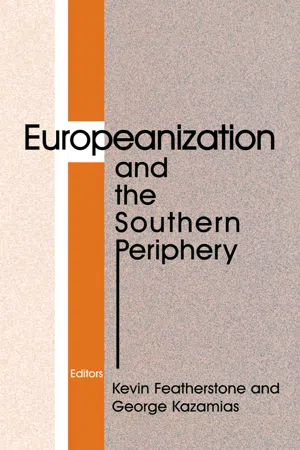
Europeanization and the Southern Periphery
About this book
Europeanization" is a term increasingly used in the social sciences to descibe the impact, convergence or response of politicians and institutions in relation to the European Union. This volume explores the concept in a variety of different settings in order to clarify its meaning.
Information
Europeanization and Domestic Structural Transformation
European Policy-Making and the Machinery of Italian Government
DOI: 10.4324/9781315039855-2
Introduction: The Italian Decision-Making Culture and European Policy-Making
Each EU member state relates to the European Union in ways that reflect its own political and administrative culture.1 Italy’s relationship has from the outset been characterized by a strong commitment to European integration, linked to a corresponding willingness, at least nominally, to cede sovereignty across a broad front. However, while there is a high level of domestic consensus on the integration process, the quality of Italian participation in European policy-making has been widely criticized (Massai 1982; Chiti 1991; Franchini 1993). The domestic political management of the policy agenda and the weaknesses of the administrative system both appear to militate against timely and effective definition of Italian interests. At the other end of the policy process, Italy has had notorious difficulties of implementation. This has been evident both in the transposition of European directives into national law and in the wider approximation of policy to the requirements of harmonization programmes. Italy is a frequent defendant in the ECJ, and it has had numerous high-profile clashes with the Commission over state aids (Hine 1993: 286–90). The explanation of this combination of a strong commitment to integration, and a poor record of delivery, lies in well-known aspects of the political system_ the long-standing difficulties of domestic political management in a fragmented, coalition-based, multi-party system, and the poor cross-departmental coordination that characterizes the public administration, and that itself stems from deep-rooted features of Italian public law.
Summarized in the simplest way, the culture of Italian public law could be said to consist of ‘government by legally defined institutional competence’. Institutions are allocated explicit, circumscribed and precisely defined powers through legislation. Policy is supposed to emerge from formally defined pathways. Individual departments of government are highly compartmentalized and relations between them are governed by strict procedures. The idea of a unified, organically cohesive government in which interdepartmental boundaries are porous and flexible is alien to the Italian culture.
This outlook has been highly visible in the development of institutions dealing with European policy. There has been a self-conscious focus on the definition of procedure. The roles and relationships between the various actors are set down in law and in government decrees. The procedures they must follow, even at relatively early stages in the policy cycle, are fairly rigid. Moreover, because implementing legislation (the transposition of European directives into domestic law) is concrete and legally definable, while the formative phase of European policy-making is fluid and largely beyond the control of Italian law, the focus of debate has tended to fall on end-stage implementation (the so-called fase discendente or implementation phase) rather than first-stage policy formation (the fase ascendente or ascendant phase). The implementation phase fitted much better with the formalism of Italian decision-making culture. The European policy circuits at the formative stage are fluid and complex, Franco-German leadership for long traditionally held the upper hand, and package deals emerging from the decisional black box of heads of government summits became the norm. Parliamentary and party contributions to the formative phase have thus been modest, and because of the lack of a cohesive executive capable of defining and managing objectives, there has been, even in this phase, a tendency to try to formalize administrative procedures rather than exercise real political control over them.
A second culturally determined feature of the Italian approach to European policy-making has been a high level of agreement on Italian objectives, and a reluctance to see the European Community as working against Italy’s fundamental interests. Italians have a predisposition to think of policy handed down from Europe as enlightened and benevolent, rather than as dangerous interference in national autonomy. Hence the task of the elected government is less to defend Italian interests against Europe than to ensure that the various parts of the state machinery understand what they are required to do by Europe (and are properly prepared, in particular as regards structural funds, to extract from Europe). Where Europe becomes politically controversial for the Italian government is therefore not so much in making choices which influence the eventual policy decided on by European institutions, but in ensuring that policy is implemented, and that Italy is in the best position to draw benefit from Europe’s distributive policies.
These features of the Italian approach have come under great challenge over the last 15 years. Italian policy-makers have become seriously concerned about the country’s capacity to respond both to developments in the EU agenda and to broader patterns of economic change that have integrated European markets. A more self-assertive stance has been called for as Italy’s status in the European system has changed, as its net financial position in the EC budgetary system has deteriorated, as its interests have come under challenge in various ways by new member states, and as its domestic markets have become more exposed to European competition by integration and harmonization. There has also been a gradual realization that failures of domestic policy are a more serious handicap the more integrated Europe becomes. Poor education, poor transport and communications infrastructure, a complex regulatory environment for business planning and investment, inflexible labour markets, and uncertain standards of probity in public life provide testimony to the difficulties Italy has of harmonizing its practices with European standards. Equally, for a country that, despite prosperity, continues to qualify for a significant, albeit diminishing, share of structural payments, Italy has had far greater problems in managing the flow of funds than most. Administrative mechanisms for identifying and planning projects qualifying for assistance, and bringing them forward to deadlines, have been inadequate. And there have been serious problems of fraud in the management of CAP payments.
These pressures were greatly enhanced by the intensification of the European policy impact on member states that came from the internal market programme in the 1980s, and monetary union and the addition of two new pillars of EU action in the 1990s. The volume, scope and impact of European legislation has increased, and has made the political class much more aware of the costs of poor Italian preparation and input as policy is being made. Similarly, the difficulties of coping with the flow of legislation to be implemented in the descendant phase if the earlier phase has not taken Italian interests sufficiently into account have also been thrown into sharper relief.
Default Mode: Coordination by Ministry of Foreign Affairs
The mechanisms for making and implementing Italy’s EU policies, and coordinating both processes, include:
- the Ministry of Foreign Affairs (MAE)
- the Italian permanent representation in Brussels (ITALRAP)
- the Presidency of the Council of Ministers (PCM)
- the special department for coordinating EC/EU policies (Dipartimento per il co-ordinamento delle politiche europee (DPCE)), located in the PCM
- individual ministerial departments in cases where there is one department which is more involved than all others, and where its specialist expertise is at a premium
- ad hoc working groups and commissions to deal with special problems, including other agencies of government such as the Bank of Italy or representatives of regional and local government
- the two chambers of the Italian Parliament.
Within the complex interactions that exist across this range of agencies, two relationships stand out as the key ones. The first is that between the MAE and the rest of the government machine, including the PCM. The second, within the PCM itself, is that between the DPCE and the remainder of the Prime Minister’s office.
Locating the structures of power that these relationships imply in a comparative European framework is not easy. In so far as EU member states choose one of two routes to EU coordination (Chiti 1991: 235), these tend to consist of either:
- a decentralized system, in which the relevant department (i.e. that most closely involved, or perhaps first involved, in the issue in question) takes the lead in negotiations with other departments, and acts as temporary coordinator-in-chief, periodically benefiting, but only in a fairly light-touch manner, from the intervention and support of a central agency, normally the MAE; or
- a central agency, generally linked to the Prime Minister’s office, which has final arbitrating authority over individual sectoral departments.
Initially, Italy opted for the first of these. In the early decades of membership, the default mode of EU policy-making was light-touch coordination through the MAE. There were successive versions of a grand interministerial committee grouping the ministers of Foreign Affairs, Industry, Agriculture and Finance, and subsequently the Treasury and Labour ministers, together with others on an ad hoc basis. At the administrative level, its work was prepared by a parallel committee of directors-general from the various ministries involved. Indeed, the inter-ministerial committee gradually faded out, meeting only to resolve difficulties not capable of being resolved at the administrative level. As a result, in practice, as individual departments developed some expertise in EC affairs, each came in its own field to play the lead role (Ronzitti 1987, 1990).
The one department that sought to maintain oversight over the whole range of policy was the Ministry of Foreign Affairs, in time taking over the generalized coordinating role played by the interministerial committee. This was a natural state of affairs in the sense that European policy — certainly in the first two decades of the EC’s existence — was still seen as a matter of external relations. Foreign ministry staff were understandably anxious to stay in the policy-making loop when any issue of external relations was being decided, believing that they normally had a better perspective of the broader consequences of any particular outcome than other actors within government. As in most other member states, the permanent representation (ITALRAP) was established, organized, led and largely staffed by the MAE: it was the official channel of communication between EU institutions and the Italian state. Its role was similar to that of all other national representative delegations: not merely official channel of communication, bu...
Table of contents
- Cover
- Half Title
- Series Page
- Title Page
- Copyright Page
- Table of Contents
- Biographical Notes
- Editors Note
- Biographical Notes
- Editors' Note
- Introduction
- Part 1: Europeanization and Domestic Structural Transformation
- Part 2: Europeanization and Domestic Macro-Economic Policy Regimes
- Part 3: Europeanization and National Identity
- Abstracts
- Index
Trusted by 375,005 students
Access to over 1.5 million titles for a fair monthly price.
Study more efficiently using our study tools.
Frequently asked questions
Yes, you can cancel anytime from the Subscription tab in your account settings on the Perlego website. Your subscription will stay active until the end of your current billing period. Learn how to cancel your subscription
No, books cannot be downloaded as external files, such as PDFs, for use outside of Perlego. However, you can download books within the Perlego app for offline reading on mobile or tablet. Learn how to download books offline
Perlego offers two plans: Essential and Complete
- Essential is ideal for learners and professionals who enjoy exploring a wide range of subjects. Access the Essential Library with 800,000+ trusted titles and best-sellers across business, personal growth, and the humanities. Includes unlimited reading time and Standard Read Aloud voice.
- Complete: Perfect for advanced learners and researchers needing full, unrestricted access. Unlock 1.5M+ books across hundreds of subjects, including academic and specialized titles. The Complete Plan also includes advanced features like Premium Read Aloud and Research Assistant.
We are an online textbook subscription service, where you can get access to an entire online library for less than the price of a single book per month. With over 1.5 million books across 990+ topics, we’ve got you covered! Learn about our mission
Look out for the read-aloud symbol on your next book to see if you can listen to it. The read-aloud tool reads text aloud for you, highlighting the text as it is being read. You can pause it, speed it up and slow it down. Learn more about Read Aloud
Yes! You can use the Perlego app on both iOS and Android devices to read anytime, anywhere — even offline. Perfect for commutes or when you’re on the go.
Please note we cannot support devices running on iOS 13 and Android 7 or earlier. Learn more about using the app
Please note we cannot support devices running on iOS 13 and Android 7 or earlier. Learn more about using the app
Yes, you can access Europeanization and the Southern Periphery by Kevin Featherstone,George Kazamias in PDF and/or ePUB format, as well as other popular books in Politics & International Relations & Economic Policy. We have over 1.5 million books available in our catalogue for you to explore.