eBook - ePub
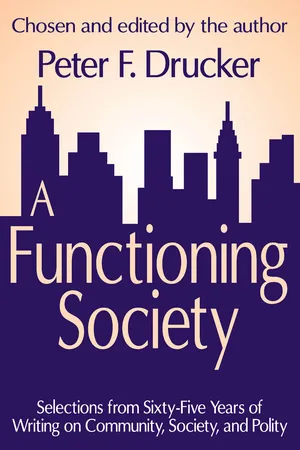
A Functioning Society
Community, Society, and Polity in the Twentieth Century
- 266 pages
- English
- ePUB (mobile friendly)
- Available on iOS & Android
eBook - ePub
About this book
Peter F. Drucker may be best known as a writer on business and management, but these subjects were not his foremost intellectual concern. Drucker's primary concerns were community, in which the individual has status, and society, in which the individual has function. Here he has assembled selections from his vast writings on these subjects. This collection presents the full range of Drucker's thought on community, society, and political structure and constitutes an ideal introduction to his ideas.The volume is divided into seven parts. The selections in parts 1 and 2 were mostly written during World War Two and in the wake of the Great Depression. Part 3 deals with the limits of governmental competence in the social and economic realm. It contains some of Drucker's most influential writings concerned with the difference between big government and effective government. The chapters in part 4 explore autonomous centers of power outside government and within society. Part 5 contains chapters from Drucker's path-breaking work on the corporation as a social organization rather than merely an economic one. The rise of the so-called "knowledge industries" forms the background for part 6. The concluding part 7 is devoted entirely to Drucker's long essay "The Next Society." Drucker examines the emergence of new institutions and new theories arising from the information revolution and the social changes they are helping to bring about.In organizing these representative writings, Drucker chose to be topical rather than chronological, with each excerpt presenting a basic theme of his life's work. As is characteristic of his efforts, A Functioning Society appeals both the general reader as well as a cross-disciplinary scholarly readership.
Information
Part 1
Foundations
Introduction to Part 1
The Future of Industrial Man (1942) was my second book. But it was the first one conceived and written in its entirety in the U.S., that is, after I had come to New York from London in early 1937 as American feature writer for a group of British newspapers. The book’s predecessor, The End of Economic Man (excerpted in part 2 of this volume), was published in the U.K. in late fall 1938 and in the U.S. in early spring 1939. But it was only finished in the U.S. Most of it had already been written before I left Europe. In fact, an excerpt (predicting Hitler’s “Final Solution,” that is, the extermination of the Jews) was actually published in 1936 in an Austrian Catholic, anti-Nazi magazine.
The American economy in 1937 was in deep depression—far deeper than the economy of the England I had left. But what immediately struck me—it was a profound shock—was the vibrant health of American society. Today, more than sixty years later, the New Deal is often condemned for doing absolutely nothing to revive the American economy. In fact, the U.S. economy was in worse shape in 1937 than it had been in 1932 before Franklin D. Roosevelt had taken over. It seems inconceivable today with our slogan “It’s the Economy, Stupid.” But the New Deal consciously, deliberately, publicly put “reform,” that is, society, ahead of “recovery,” that is, the economy. That was indeed the Republicans’ complaint and their criticism of the New Deal. But the voters overwhelmingly approved, again and again.
In respect to the economy, the U.S. looked backwards as much as did Europe. “Pre-Depression” was the measure of all things economic. But society in the U.S. looked forward—and by no means only (or even primarily) in terms of government action. Every American college, even the smallest “cow college,” was engaged in educational reform and educational experimentation—ranging all the way from the return to the Medieval Trivium preached by Mortimer Adler at the University of Chicago, to the abolition of all disciplines in favor of “doing one’s own thing” preached with equal fervor and equal fanfare in such places as Black Mountain College. Reinhold Niebuhr and Paul Tillich galvanized the Protestant churches, Jacques Maritain and the Neo-Thomists, the Catholic ones. A few pioneers— Massachusetts General in Boston, Presbyterian and Mt. Sinai in New York—were converting the hospital from a place for the poor to die into a science-based place to diagnose and heal. Every museum was reforming itself with New York’s Museum of Modern Art in the lead. And even quite small cities—Palo Alto in California, for instance—were forming their own symphony orchestras. Economically the U.S. was in a deep depression. Socially it experienced a veritable renaissance.
This then raised the question in my mind to which The Future of Industrial Man addresses itself: What is a functioning society? And what are the institutions that could recreate the community the collapse of which in Europe had produced totalitarianism? The Future of Industrial Man did not answer these questions—I am still asking them. But it laid the foundations for all my work since then on community, society, and polity.
1
From Rousseau to Hitler
(From The Future of Industrial Man, 1942)
It is almost an axiom in contemporary political and historical literature that our freedom has its roots in the Enlightenment and the French Revolution. So general is this belief, so complete its acceptance, that the descendants of the eighteenth-century rationalists have preempted for themselves the very name of Liberty in their designation as Liberals.
It cannot be denied that the Enlightenment and the French Revolution contributed to the freedom of the nineteenth century. But their contribution was entirely negative; they were the dynamite that blew away the debris of the old structure. In no way, however, did they contribute to the foundation of the new structure of freedom on which the nineteenth-century order was built. On the contrary: The Enlightenment, the French Revolution, and their successors down to the rationalist Liberalism of our days are in irreconcilable opposition to freedom. Fundamentally, rationalist Liberalism is totalitarian.
And every totalitarian movement during the last two hundred years of Western history has grown out of the Liberalism of its time. There is a straight line from Rousseau to Hitler—a line that takes in Robespierre, Marx, and Stalin. All of them grew out of the failure of the rationalist Liberalism of their times. They all retained the essence of their respective liberal creeds, and all used the same mechanism to convert the latent and ineffective totalitarianism of the rationalist into the open and effective totalitarianism of the revolutionary despot. Far from being the roots of freedom, the Enlightenment and the French Revolution were the seeds of the totalitarian despotism which threatens the world today. The fathers and grandfathers of Hitlerism are not medieval feudalism or nineteenth-century romanticism but Bentham and Condorcet, the orthodox economists, and the liberal constitutionalists, Darwin, Freud, and the Behaviorists.
The great discovery of the Enlightenment was that human reason is absolute. On this discovery were based not only all subsequent liberal creeds but also all subsequent totalitarian creeds from Rousseau on. It was no accident that Robespierre installed a Goddess of Reason; his symbolism was cruder than that of the later revolutionaries but not really very different. Nor was it an accident that the French Revolution chose a living person to act the role of Goddess of Reason. The whole point of the rationalist philosophy is that it attributes to actual living men the perfection of absolute reason. The symbols and slogans have changed. Where the “scientific philosopher” was supreme in 1750, it was the sociologist with his economic utilitarianism and the “pleasure-pain calculus” a hundred years later. Today it is the “scientific psycho-biologist” with his determinism of race and propaganda. But we fight today basically the same totalitarian absolutism that first was formulated by the Enlighteners and Encyclopedists—the rationalists of 1750—and that first led to a revolutionary tyranny in the Terror of 1793.
It must be understood that not everything that is called liberalism is of necessity an absolutist creed. Every liberal movement, it is true, contains the seeds of a totalitarian philosophy—just as every conservative movement contains a tendency to become reactionary. On the continent of Europe there never were any liberal movements or parties which were not totalitarian in their fundamental beliefs. In the United States the totalitarian element was strongly represented from the start—based as much upon the influence from Europe as upon the Puritan tradition. And since the last war liberalism everywhere has become absolutist. Today it is true, almost without reservation, that the liberal is an absolutist in his objective creed.
But for a hundred years before 1914 Great Britain had a liberal movement that was not absolutist, not incompatible with freedom and not based upon a man-made absolute reason. The United States had during the same period a liberal tradition which was as much opposed to absolutist liberalism as it was close to English liberalism. This free and antitotalitarian tradition, which was expressed in its most lucid form by Mr. Justice Holmes, was usually not the dominant liberal tradition in America. It was often completely overshadowed by the absolutist liberalism of which the Abolitionists and the radical Republicans of the Reconstruction Period are the outstanding representatives. It produced, however, in Lincoln the nineteenth century’s greatest symbol of an anti-absolutist and truly liberal liberalism. It became politically effective in Populism—the most indigenous American political movement since the early days of the republic. And the New Deal, though very largely dominated by rationalism, owed its appeal and political effectiveness to its populist heritage.
The fundamental difference between the free and constructive Anglo-American liberalism of the nineteenth century, and the absolutist and destructive liberalism of the Enlightenment and of our Liberals today, is that the first is based on religion and Christianity, while the second is rationalist. The true liberalism grew out of a religious renunciation of rationalism. The English Liberal party of the nineteenth century was based partly on the tradition of the settlement of 1688. But the main element was the “Nonconformist Conscience.” The first was a reaffirmation of freedom against the rationalist absolutism of both, Cromwellian theocracy and centralized monarchy. The second sprang from the great religious revivals of the eighteenth century, notably Wesley’s Methodism and Low Church Evangelism. Both were appeals to Christian love, faith, and humility. And both were directed against the rationalism of their time—Methodism against Enlightenment, the Evangelical movement against the utilitarianism of Bentham and the classical economists.
In the United States similarly the true and genuinely “liberal” liberalism traces back to a religious protest against rationalist absolutism. Its forefather, Roger Williams, attacked in the name of Christian freedom the rationalist theocracy of the New England divines who had set up their scripture learning as absolute reason. And the Popu-list movement—whatever its economic causes—rested squarely upon an evangelical protest against rationalist utilitarianism and orthodox economists. It was an invocation of the dignity of man against the tyranny of absolute reason and of “inevitable economic progress.”
That objectively the rationalist’s creed is incompatible with freedom is no denial of the individual rationalist’s or liberal’s good will or good faith. Doubtless the individual rationalist liberal believes sincerely that he, and he alone, stands for freedom and against tyranny. There is also no doubt that he subjectively abhors totalitarian tyranny and all it represents. And in turn, he is the first victim of the despots.
But these antitotalitarian sentiments of the individual rationalist are entirely ineffective in politics. Altogether rationalism is incapable of positive political action. It can function only in opposition. It can never make the step from negative critique to constructive policy. And it always opposes the free institutions of society fully as much as the unfree and oppressive ones.
The rationalist liberal sees his function in the opposition to the injustices, superstitions and prejudices of his time. But this opposition to injustice is only a part of a general hostility to all institutions of society including free and just ones. The Enlighteners, for instance, swept away aristocratic privileges, serfdom and religious intolerance. They also destroyed provincial autonomies and local self-government; and no country on the continent of Europe has ever fully recovered from this blow to freedom. They attacked clerical abuses, privileges, and oppression. They also degraded the churches of Europe into administrative arms of the political government. They did their best to deprive religious life of its social autonomy and moral authority. And the full force of Enlightened scorn was directed against independent courts and against the common law. The insistence of the eighteenth-century rationalist on a “rationally perfect” law code and on state-controlled courts leads straight to the omnipotent total state. It is no accident that the “free” Anglo-American liberalism of the nineteenth century was based to a large extent on these very institutions which the Enlighteners had repudiated: local self-government, free autonomous churches, the common law, and an independent judiciary.
The rationalist not only destroys and opposes existing institutions; he is completely incapable of developing new institutions for the old ones which he destroys. He does not even see the need for constructive activity. For to him the good is only the absence of evil. He thinks that he has done his job if he has criticized away bad or oppressive institutions. But in political and social life nothing is effective unless it is given institutional realization. Society must be organized on the basis of functional power-relations. To subvert is only legitimate in politics if it leads to the construction of something better. But just to sweep away something—however bad—is no solution. And unless a functioning institution is put into the place of the destroyed institution, the ensuing collapse of social life will breed evils which may be even worse than the one that was originally destroyed.
Wherever the rationalist liberal has come to power, he always failed. The fate of Kerenski’s Liberal government in Russia, which collapsed into Bolshevism after half a year of political paralysis, is only the most obvious case. The German Social Democrats were equally incapable of political action when they came to power in 1918. They had been an extremely useful opposition under the Kaiser. There is no doubt that their leaders were sincere and honorable, that they were capable administrators, personally courageous and popular. Yet what is amazing is not that they failed but that they lasted as long as they did. For by 1922 or 1923 they had become completely bankrupt. The same is true of French Radicals, of Italian Liberals, or of Spanish Democrats. And the “reformer” in the United States also normally ended in frustration. The history of every city government in America shows the political ineffectiveness of these well-meaning rationalists.
It is impossible to explain so extraordinary and consistent a record of failure as one of circumstances and accidents. The real reason is that rationalist liberalism is by its very nature condemned to political sterility. It lives in constant conflict with itself. It is based on two principles which exclude each other. It can only deny but it cannot act.
On the one hand the rationalist believes in an absolute reason. Yesterday it was inevitable progress or national harmony between individual self-interest and the common weal. Today it is the creed that libido, frustration, and glands explain all personal or group conflicts. On the other hand rationalist liberalism believes that its absolutes are the result of rational deduction, are provable and rationally incontrovertible. It is the essence of rationalist liberalism that it proclaims its absolutes to be rationally evident.
Absolute reason can, however, never be rational; it can never be proved or disproved by logic. Absolute reason is by its very nature above and before rational argument. Logical deduction can and must be based upon an absolute reason but can never prove it. If truly religious, an absolute principle is superrational—a true metaphysical principle which gives a valid basis of rational logic. If man-made and man-proclaimed, absolute reason must be irrational and in insoluble conflict with rational logic and rational means.
All the basic dogmas of rationalism during the last hundred and fifty years were not only irrational but basically antirational. This was true of the philosophical rationalism of the Enlighteners who proclaimed the inherent reasonableness of man. It was true of the utilitarian rationalism of the generation of 1848 which saw in the individual’s greed the mechanism through which the “invisible hand” of nature promoted the common good. It is particularly true of the twentieth-century rationalism which sees man as psychologically and biologically determined. Every one of these principles denies not only free will. It denies human reason. And every one of the these principles can be translated into political action only by force and by an absolute ruler.
But this the rationalist cannot admit. He must maintain that his principles are rational and that they can be made effective by rational means. He maintains as a dogma that his principles are rationally evident. Hence the rationalist liberal cannot attempt to translate them into political action except through rational conversion—which attempt must fail. On the one had he cannot respect any opposition, for it can only be opposition to absolute truth. On the other hand, he cannot fight it. For error—and all opposition to his absolute truth must be error to a rationalist—can only be due to lack of information. Nothing shows this better than the saying current during the twenties and early thirties in Europe as well as in the United States that an intelligent person must be on the Left. And today the belief in the omnipotence of propaganda expresses openly and clearly the absolutist basis and the self-contradiction of the rationalist creed.
On the one hand, the rationalist liberal cannot compromise. His is a perfectionist creed which allows of no concession. Anyone who refuses to see the light is an unmitigated blackguard with whom political relations are impossible. On the other hand, the rationalist cannot fight or suppress enemies. He cannot admit their existence. There can be only misjudged or misinformed people who, of necessity, will see reason when the incontrovertible evidence of the rational truth is presented to them. The rationalist liberal is caught between holy wrath at conspirators and educational zeal for the misinformed. He always knows what is right, necessary, and good—and it always is simple and easy. But he can never do it. For he can neither compromise for power nor fight for it. He is always paralyzed politically: ultra-bold in theory and timid in action, strong in opposition and helpless in power, right on paper but incapable in politics.
It is the tragedy of the rationalist liberal that there is only one way from his position to political effectiveness: totalitarianism. His subjectively sincere belief in freedom can objectively lead only to tyranny. For there is only one way out of the political sterility of the rationalist liberal: to drop the rationalism and to become openly totalitarian, absolutist and revolutionary.
During the Enlightenment it was Rousseau who made the fatal step from rationalism and pretended rationality to openly irrational and antirational totalitarianism. There is no pretense that the “general will” is rationally ascertainable or rationally realizable. It is admittedly an irrational absolute which defies rational analysis and which is outside and beyond rational comprehension. It exists—but how, where and why no one knows. It must prevail—naturally, since it is perfect and absolute. Whoever is in possession of reason, whoever understands the supreme will of society, is entitled and, indeed, is duty bound to enforce it upon majority, minority and individual alike. Freedom lies only in the perfect realization of the volunté générale. There is no pretense in Rousseau of individual reason or individual freedom.
It is true that Rousseau insisted upon the small unit of the city-state with its direct, nonrepresentative democracy as the only perfect form of government. And he laid down an inalienable right of the individual to disagree by leaving his society. This has been taken as an indication of his desire for individual freedom. But in a world in which these conditions were as impossible of fulfillment as in that of the middle-eighteenth century, they can hardly be taken as anything but romantic flourishes in an otherwise unyieldingly realistic and unromantic totalitarianism. Otherwise Hitler’s “offer” of emigration to the Jews would also be “freedom.”
Rousseau’s plunge into the irrational absolute made the basic concepts of the Enlightenment politically effective. Rousseau was right when he saw in the repudiation of rationalism the basic difference of his system from that of the philosophes. His open irrationalism enabled him to shake off the fetters which had condemned the Encyclopedists to political ineffectiveness. Where they believed in the slow and painstaking rational process of education and scientific investigation, he believed in the inner light of revelation. They tried to define man as within the laws of physics. But Rousseau saw man as a political being acting upon impulse and emotion. Where they saw the gradual rationalist improvement, he believed in the millennium that could and would be established by that most irrational of forces: the revo...
Table of contents
- Cover Page
- Title Page
- Copyright Page
- Contents
- Introduction: Community, Society, Polity
- Acknowledgements
- Prologue: What is a Functioning Society?
- Part 1 Foundations
- Part 2 The Rise of Totalitarianism
- Part 3 The Sickness of Government
- Part 4 The New Pluralism
- Part 5 The Corporation as a Social Institution
- Part 6 The Knowledge Society
- Part 7 The Next Society
- Index
Trusted by 375,005 students
Access to over 1.5 million titles for a fair monthly price.
Study more efficiently using our study tools.
Frequently asked questions
Yes, you can cancel anytime from the Subscription tab in your account settings on the Perlego website. Your subscription will stay active until the end of your current billing period. Learn how to cancel your subscription
No, books cannot be downloaded as external files, such as PDFs, for use outside of Perlego. However, you can download books within the Perlego app for offline reading on mobile or tablet. Learn how to download books offline
Perlego offers two plans: Essential and Complete
- Essential is ideal for learners and professionals who enjoy exploring a wide range of subjects. Access the Essential Library with 800,000+ trusted titles and best-sellers across business, personal growth, and the humanities. Includes unlimited reading time and Standard Read Aloud voice.
- Complete: Perfect for advanced learners and researchers needing full, unrestricted access. Unlock 1.5M+ books across hundreds of subjects, including academic and specialized titles. The Complete Plan also includes advanced features like Premium Read Aloud and Research Assistant.
We are an online textbook subscription service, where you can get access to an entire online library for less than the price of a single book per month. With over 1.5 million books across 990+ topics, we’ve got you covered! Learn about our mission
Look out for the read-aloud symbol on your next book to see if you can listen to it. The read-aloud tool reads text aloud for you, highlighting the text as it is being read. You can pause it, speed it up and slow it down. Learn more about Read Aloud
Yes! You can use the Perlego app on both iOS and Android devices to read anytime, anywhere — even offline. Perfect for commutes or when you’re on the go.
Please note we cannot support devices running on iOS 13 and Android 7 or earlier. Learn more about using the app
Please note we cannot support devices running on iOS 13 and Android 7 or earlier. Learn more about using the app
Yes, you can access A Functioning Society by Peter F. Drucker in PDF and/or ePUB format, as well as other popular books in Politics & International Relations & Political History & Theory. We have over 1.5 million books available in our catalogue for you to explore.