- 375 pages
- English
- ePUB (mobile friendly)
- Available on iOS & Android
eBook - ePub
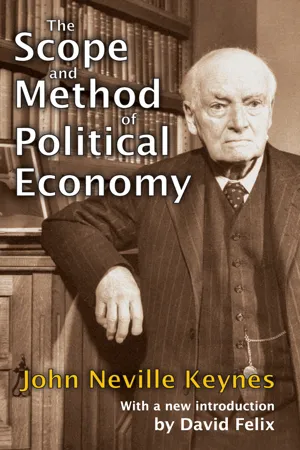
The Scope and Method of Political Economy
About this book
The elder Keynes argues that almost every problem connected with the scope and method of political economy has given rise to conflict of opinion. The resulting controversies have sometimes been bitter. Those readers, who already have any acquaintance with the literature of economic method should be prepared to find that several of the chapters are controversial in character. At the same time, Keynes avoids the tone of a partisan and represents both sides of the argument without prejudice.While making no attempt to bring about a complete reconciliation between opposing views, Keynes shows the nature of the opposition between them has sometimes been misunderstood, and its extent consequently exaggerated. Since the scope and method of a science can never be satisfactorily discussed at the commencement of its study, some knowledge of political economy in its general outlines is assumed.The nature of the topics discussed in this classic is indicated in the introductory chapter. The abstract discussion of methods is one to which students of economics must necessarily give attention in the course of their reading, and its indirect bearing on the solution of practical economic questions is very close in contemporary importance in today's society.
Chapter I
Introductory
§ 1. Nature and importance of the enquiry into the scope and method of political economy.—
In the terms economy and economic there is an ambiguity, that underlies much of the current confusion as to the nature of political economy. Any line of action is commonly termed economic, when it attains its end with the least possible expenditure of money, time, and effort; and by economy is meant the employment of our resources with prudence and discretion, so that we may derive from them the maximum net return of utility.
But the words are also used in a sense not implying any specially reasonable adaptation of means to ends; and in works on political economy, the term economic is generally employed simply as an adjective corresponding to the substantive wealth. By an economic fact, accordingly, is understood any fact relating to the phenomena of wealth. By economic activities are meant those human activities that direct themselves towards the creation, appropriation, and accumulation of wealth; and by economic customs and institutions, the customs and institutions of human society in regard to wealth.
Political economy or economics is a body of doctrine relating to economic phenomena in the above sense; and the purpose of the following pages is to discuss the character and scope of this doctrine, and the logical method appropriate to its development. In seeking to define the scope of any department of study, the object in view is primarily to determine the distinguishing features of the phenomena with which it deals, and the kind of knowledge that it seeks concerning these phenomena. The enquiry also involves an examination of the relations between the study in question and cognate branches of study. In passing to the consideration of method, we are dealing with a branch of applied logic, the object being to determine the nature of the logical processes specially appropriate to the study—that is, the methods of investigation and proof of which it can avail itself— and the logical character of its conclusions as affected thereby.
The discussion that follows belongs, then, to what may be called the philosophy or logic of political economy, and does not directly advance our knowledge of economic phenomena themselves. For this reason, a certain impatience is sometimes felt when any such discussion is proposed. What we want, it is said, is not any more talk about method, but rather useful applications of the right method; let us increase our actual stock of economic truths, instead of indulging in barren disputes about the way in which economic truths are to be attained. To this objection the logician might reply that the enquiry has at any rate a logical, even if it has not an economic, significance. But it has also an economic significance. A moment's consideration will shew that from the point of view of political economy itself, it is of material importance that its scope and method should be rightly understood.
There is, to begin with, a widely current confusion in regard to the nature of economic laws; and for this reason, amongst others, it is imperative that the economist should seek to define as accurately as possible the nature and limits of his sphere of enquiry. There should be no vagueness on the question whether political economy is concerned with the actual or the ideal, whether it treats merely of what is, or asks further what ought to be, laying down rules for the attainment of those ends that it pronounces desirable. Even if theoretical and practical enquiries are both to be included within its scope, still the distinction between the two, and their mutual relations, need to be clearly and unambiguously set forth. Misunderstanding on these points has led to a misunderstanding of economic truths themselves, and has consequently impaired the influence and authority of economic science.
Next as to method, it is said that instead of arguing about what method of investigation is the right one, it is better to exemplify the right method by employ ing it in the actual attainment of new economic truths. But are we then to beg the question of its rightness? In the long run, time cannot but be saved by making a preliminary study of the instruments of investigation to be used, the proper way of using them, and the kind of results that they are capable of yielding. For in so far as methods of reasoning are employed without due regard to the conditions of their validity, the results gained must likewise be of uncertain validity, and the progress of economic knowledge, instead of being advanced, will be retarded.
The process, moreover, whereby a conclusion is reached affects its character and value, and the qualifications and limitations as to range, &c., subject to which it is to be accepted. If it is purely empirical, then it will be established only with a more or less high degree of probability, and it cannot be extended far beyond the range of space or time, over which the instances on which it is based were collected. If, on the other hand, it is obtained deductively, then it is hypothetical until it has been determined how far, and under what conditions, the assumptions on which it rests are realised in fact. It has been plausibly argued that Ricardo’s chief weakness was that he did not clearly appreciate the true nature of his own method. At any rate he did not, in interpret ing his results, take the precautions necessary to pro vide against misconception on the part of many of his readers.
It is true that it is one thing to establish the right method for building up a science, and quite another thing to succeed in building it up. It is also true, as the Austrian economist Menger has remarked, that sciences have been created and revolutionized by those who have not stopped to analyse their own method of enquiry. Still their success must be attributed to their having employed the right method, even if they have employed it unconsciously or without going out of their way to characterize it. Their method must, moreover, be subjected to careful analysis before the value of their contributions to the science can properly be estimated.
Economics is not in any way peculiar in requiring that its method should be discussed. The logic of other sciences is, however, for the most part sufficiently dealt with in general works on logic or methodology There are special reasons, partly to be found in the nature of the subject itself, and partly due to extrinsic causes, why the logic of political economy needs a more detailed consideration.
In the first place, economic science deals with phenomena that are more complex and less uniform than those with which the natural sciences are concerned; and its conclusions, except in their most abstract form, lack both the certainty and the universality that pertain to physical laws. There is a corresponding difficulty in regard to the proper method of economic study; and the problem of defining the conditions and limits of the validity of economic reasonings becomes one of exceptional complexity. It is, moreover, impossible to establish the right of any one method to hold the field to the exclusion of others. Different methods are appropriate, according to the materials available, the stage of investigation reached, and the object in view; and hence arises the special task of assigning to each its legitimate place and relative importance.
Another reason for discussing the true principles of economic method in some detail is that fallacious reasonings are more common in political economy than in most other studies. This is due only in part to the difficulty and complexity of the subject-matter with which the science is concerned. It also deals with phenomena which, while encompassed with difficulties, are matters of every-day observation; and it has few technical terms that are not also terms of every-day discourse. A not unnatural consequence is that people think themselves competent to reason about economic, problems, however complex, without any such preparatory scientific training as would be universally considered essential in other departments of enquiry. This temptation to discuss economic questions without adequate scientific preparation is all the greater, because economic conditions exert so powerful an influence upon men's material interests. "Few men," says General Walker, "are presumptuous enough to dispute with the chemist or mechanician upon points connected with the studies and labours of his life; but almost any man who can read and write feels himself at liberty to form and maintain opinions of his own upon trade and money. The economic literature of every succeeding year embraces works conceived in the true scientific spirit, and works exhibiting the most vulgar ignorance of economic history, and the most flagrant contempt for the conditions of economic investigation. It is much as if astrology were being pursued side by side with astronomy or alchemy with chemistry." Broadly speaking, the general tendency of popular economics is towards rash generalizations and fallacious arguments post hoc ergo propter hoc. This is frequently combined with an imperfect analysis of fundamental conceptions, that leads to confusion of thought and the selection of false propositions as self-evident postulates; and where deductive reasoning is employed, its results are often applied without regard to the conditions requisite for their valid application.
To this it must be added that the sharp distinction drawn by opposing schools, and their narrow dogmatism, have unnecessarily complicated the whole problem. The subject has become involved in heated controversies, that have not only made it wearisome to unprejudiced persons, but have also done injury to the credit of political economy itself. Outsiders are naturally suspicious of a science, in the treatment of which a new departure is so often and so loudly proclaimed essential. So far, it may be inferred, from economists having made progress in their science, they cannot even agree how to set about their work.
The besetting fallacy of writers on economic method has been well said to be one of exclusiveness. A single aspect or department of economic study is alone kept in view, and the method appropriate thereto aggrandized, while other methods, of equal importance in their proper place, are neglected or even explicitly rejected. Hence the disputants on both sides, while right positively, are wrong negatively Their criticisms on rejected methods are, moreover, too often based on misapprehension or misrepresentation. Methods are attacked for not doing what those who advocate their use have never imagined they could do; and the qualifications and limitations, with which each side expounds its own method, are overlooked by the other side. Thus combined with the fallacy of exclusiveness, or rather in consequence of it, there is in these controversies a remarkable prevalence of ignoratio elenchi. In the following pages, an attempt will be made to do justice to all the different instruments of investigation of which the economist can avail himself, while attention will also be drawn to the limitations to which each in turn is subject.
§ 2. The conception of political economy as a theoretical, abstract, and deductive science.—
The main points involved in controversies about economic method may be indicated in outline by briefly contrasting two broadly distinguished schools, one of which describes political economy as theoretical, abstract, and deductive, while the other describes it as ethical, realistic, and inductive. It should be distinctly under stood that this sharp contrast is not to be found in the actual economic writings of the best economists of either school. In the methods that they employ—when they are really discussing the same problems—there is to a great extent substantial agreement. They differ, how ever, in the relative importance that they attach to different aspects of their work; and in their formal statements about method, these differences become exaggerated.
The question of the right method of economic enquiry was not as such discussed by Adam Smith; and his views on the subject have, therefore, to be gathered from his way of dealing with actual economic problems. As a matter of fact, the support of his authority has been claimed on behalf of both the schools above referred to. It has been said of him that he first raised political economy to the dignity of a deductive science. But he has also been regarded as the founder of the historical method in pol i tical economy.
The reason for this apparent contradiction is not far to seek, ft is to be found in Adam Smith’s freedom from excess on the side either of à priori or à posteriori reasoning. He rejected no method of enquiry that could in any way assist him in investigating the phenomena of wealth. For argument or illustration he had recourse, as the occasion might arise, either to elementary facts of human nature, or to complex facts of industrial life. He believed in a “natural” order of events, which might be deduced à priori from general considerations; but he constantly checked his results by appeals to the actual course of history. He worked up from abstractions to the complex realities of the economic world in which he lived. Thus, if on deductive grounds he lays down a doctrine of the tendency of wages to equality, he combines it with an inductive enquiry into the causes that check or restrict the operation of this tendency. If he sets forth the “natural” progress of opulence, he enters also upon an historical investigation of what the actual progress of opulence has been. If he condemns the doctrine of protection to native industry mainly on abstract grounds, he enforces his views with concrete illustrations and arguments in the greatest variety.
As regards the inductive tendencies noticeable in Adam Smith, his successor is to be found in Malthus; for the continuation and development of the abstract deductive tendencies we turn to Ricardo. Subsequent economists of the English school assimilated what was most characteristic in both these writers; but it was Ricardo, rather than Malthus, who gave to their work a distinctive tone, particularly in their specific analysis of the method to be pursued.
Senior and J. S. Mill were the earliest English economists who definitely formulated principles of economic method. Senior's views are contained in his introductory lectures before the University of Oxford, and in his treatise on Political Economy; Mill's views are to be found in his Essays on Some Unsettled Questions of Political Economy, and in the sixth book of his Logic. The problem is discussed in more detail by Cairnes in his Character and Logical Method of Political Economy, a work of admirable lucidity, which has long been considered the authoritative text-book of English political economy so far as concerns its logic. Bagehot's essays on the postulates of English political economy and on the preliminaries of political economy published in his Economic Studies, have also in some respects a representative character.
There are minor differences in the principles laid down by these four writers respectively, but funda mentally they are in agreement in regarding political economy as a science that is in its scope theoretical, and in its method abstract and deductive. The follow ing is a very brief summary of their characteristic doctrines.
In the first place, a sharp line of distinction is drawn between political economy itself and its applications to practice. The function of political economy is to investigate facts and discover truths about them, not to prescribe rules of life. Economic laws are theorems of fact, not practical precepts. Political economy is, in other words, a science, not an art or a department of ethical enquiry. It is described as standing neutral between competing social schemes. It furnishes information as to the probable con sequences of given lines of action, but does not itself pass moral judgments, or pronounce what ought or what ought not to be. At the same time, the greatest value is attached to the practical applications of economic science; and it is agreed that the economist ought himself to turn his attention to them—not, however, in his character as a pure economist, but rather as a social philosopher, who, because he is an economist, is in possession of the necessary theoretical knowledge. It is held that if this distinction is drawn, the social and ethical aspects of practical problems—which may be of vital importance—are less likely to be overlooked or subordinated.
As to its position amongst the sciences, political economy is not regarded as inseparably bound up with social philosophy in general. Economic facts are, it is allowed, influenced by social facts of very various kinds, and in their turn influence them; but it is nevertheless held to be possible up to a certain point to isolate the study of the phenomena of wealth from the study of other phenomena of society. Such isolation is, indeed, said to be necessitated by the requirements of science, which always proceeds by analysing concrete phenomena, so as to deal separately wit...
Table of contents
- Cover
- Half Title
- Title
- Copyright
- Contents
- Introduction to the Transaction Edition
- Preface
- Chapter I Introductory
- Chapter II On the Relation of Political Economy to Morality and Practice
- Chapter III On the Character and Definition of Political Economy regarded as a Positive Science
- Chapter IV On the Relation of Political Economy to General Sociology
- Chapter V On Definition in Political Economy
- Chapter VI On the Method of Specific Experience in Political Economy
- Chapter VII On the Deductive Method in Political Economy
- Chapter VIII On Symbolical and Diagrammatic Methods in Political Economy
- Chapter IX On Political Economy and Economic History
- Chapter X On Political Economy and Statistics
- Index
Trusted by 375,005 students
Access to over 1.5 million titles for a fair monthly price.
Study more efficiently using our study tools.
Frequently asked questions
Yes, you can cancel anytime from the Subscription tab in your account settings on the Perlego website. Your subscription will stay active until the end of your current billing period. Learn how to cancel your subscription
No, books cannot be downloaded as external files, such as PDFs, for use outside of Perlego. However, you can download books within the Perlego app for offline reading on mobile or tablet. Learn how to download books offline
Perlego offers two plans: Essential and Complete
- Essential is ideal for learners and professionals who enjoy exploring a wide range of subjects. Access the Essential Library with 800,000+ trusted titles and best-sellers across business, personal growth, and the humanities. Includes unlimited reading time and Standard Read Aloud voice.
- Complete: Perfect for advanced learners and researchers needing full, unrestricted access. Unlock 1.5M+ books across hundreds of subjects, including academic and specialized titles. The Complete Plan also includes advanced features like Premium Read Aloud and Research Assistant.
We are an online textbook subscription service, where you can get access to an entire online library for less than the price of a single book per month. With over 1.5 million books across 990+ topics, we’ve got you covered! Learn about our mission
Look out for the read-aloud symbol on your next book to see if you can listen to it. The read-aloud tool reads text aloud for you, highlighting the text as it is being read. You can pause it, speed it up and slow it down. Learn more about Read Aloud
Yes! You can use the Perlego app on both iOS and Android devices to read anytime, anywhere — even offline. Perfect for commutes or when you’re on the go.
Please note we cannot support devices running on iOS 13 and Android 7 or earlier. Learn more about using the app
Please note we cannot support devices running on iOS 13 and Android 7 or earlier. Learn more about using the app
Yes, you can access The Scope and Method of Political Economy by John Neville Keynes in PDF and/or ePUB format, as well as other popular books in Economics & Economic Theory. We have over 1.5 million books available in our catalogue for you to explore.