- 596 pages
- English
- ePUB (mobile friendly)
- Available on iOS & Android
eBook - ePub
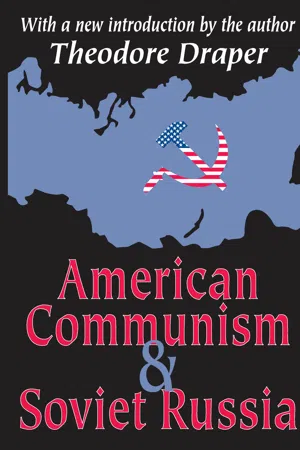
American Communism and Soviet Russia
About this book
This companion volume to The Roots of American Communism brings to completion what the author describes as the essence of the relationship of American Communism to Soviet Russia in the fi rst decade after the Bolsheviks seized power. The outpouring of new archive materials makes it plain that Draper's premise is direct and to the point: The communist movement "was transformed from a new expression of American radicalism to the American appendage of a Russian revolutionary power." Each generation must fi nd this out for itself, and no better guide exists than the work of master historian Theodore Draper. American Communism and Soviet Russia is acknowledged to be the classic, authoritative history of the critical formative period of the American Communist Party. Based on confi dential minutes of the top party committees, interviews with party leaders, and public records, this book carefully documents the infl uence of the Soviet Union on the fundamental nature of American Communism. Draper's refl ections on that period in this edition are a fi tting capstone to this pioneering effort. Daniel Bell, in Saturday Review, remarked about this work that "there are surprisingly few scholarly histories of individual Communist parties and even fewer which treat of this crucial decade in intimate detail. Draper's account is therefore of great importance." Arthur M. Schlesinger, in The New York Times Book Review, says that "in reading Draper's closely packed pages, one hardly knows whether to marvel more at the detachment with which he examines the Communist movement, the patience with which he unravels the dreary and intricate struggles for power among the top leaders, or the intelligence with which he analyzes the interplay of factors determining the development of American Communism." And Michael Harrington, in Commonweal, asserted that Draper's book "will long be a defi nitive source volume and analysis of the Stalinization of American Communism."
1
The New Day
THE WORLD is on the verge of a new era. Europe is in revolt. The masses of Asia are stirring uneasily. Capitalism is in collapse. The workers of the world are seeing a new life and securing new courage. Out of the night of war is coming a new day."1*
Thus began the first Manifesto of the newly formed Communist Party of America in September 1919. Its aspirations, faith, and certainty belonged to a long, inspiring, self-destructive, and ever-renewing tradition of revolutionary idealism. For a brief moment, the founders of American Communism were destiny-intoxicated men, appointed to end misery and oppression, break the chains of war, halt the exploitation of man by man, and create a new social order based on justice, freedom, and equality.
But to become a social force, revolutionary idealism must be transmuted into an ideological doctrine and an organized movement. The leap from the ideal to the doctrine, and from the doctrine to the movement, has been too much for all the great revolutionary doctrines and movements of the last century—socialism, syndicalism, anarchism, and communism. All have passed through a cycle of exaltation and disenchantment. All came as fresh, liberating visions; all became stale, imprisoning dogmas. Somewhere between the revolutionary ideal and the social force, a miscarriage took place.
* Numbered reference notes begin on page 445.
This is the study primarily of a movement, less of a doctrine, and least of all of an ideal. Ideals can often bring people into—and take them out of—revolutionary movements, but ideals play little part in the day-by-day organizational drudgeries, political maneuvers, and struggles for power. Yet the eternally frustrated pursuit of the ideal gives revolutionary movements a special dimension and peculiar fascination for their devotees, as well as for some outsiders. Without it, much that is tragic would merely be sordid.
But no one can study the Communist movement without getting enmeshed in doctrinal problems and disputes. The early Communists grew out of the Marxian Socialist movement, and their pre-Communist period was largely spent struggling over the true interpretation of the Marxian doctrine. In the dark years before the seizure of power in Russia, only the promise of the doctrine gave them the strength and hope to carry on in the face of seemingly hopeless odds. After the seizure of power, the doctrine gave them a "principle of legitimacy" without which their dictatorship would have rested on nothing more than brute force. Other systems legitimatize themselves by reason of historical continuity or democratic sanction. Of necessity, the Communist movement validates itself by means of its own doctrine. It posits communism as the path of an inevitable historical process which objectively serves the interests of the workers and ultimately all mankind. The reasoning is elliptical: Communism gives the Communists the right to impose their rule on the masses.
In theory, Marx, Engels, and Lenin provided their disciples with guides to action; in practice, they provided them with too many guides to too much action. They wrote over long periods for many different situations at various stages of their development. For three-quarters of a century, they handed down a vast stock of apt quotations for any conceivable policy, prowar and antiwar, sectarian and opportunist, dictatorial and democratic. In some areas they left an embarrassment of riches and in others an embarrassing void. Like all scriptures, their writings have needed interpretation and application to "changed conditions" and different "objective circumstances." The same words could not mean or imply the same things in places and times as far apart as the Great Britain of the middle nineteenth century with which Marx and Engels were primarily concerned, the Russia after the turn of the century which Lenin had chiefly in mind, and the United States in the third decade of the twentieth century in which American Communism was formed.
Thus the Communist movement has been massively built on shifting sands of doctrine. It is filled with uneasy tensions within the doctrine, and between the doctrine and the reality. In no other country have these tensions been as great as in the United States. According to the doctrine, the revolution should have come first in a capitalist state with an advanced industrial system and a large, organized proletariat. The United States most nearly conformed to these classical specifications. According to the reality, however, in the United States capitalism was most dynamic, the class structure most fluid, and the proletariat least class-conscious. In large part, therefore, the story of American Communism has been one of struggle between doctrine and reality. This struggle has taken many forms with varying degrees of success. But even the greatest success of American Communism has been tainted by the fact that it has succeeded in coming closest to the reality by departing furthest from the doctrine.
As a result, American Communism has been torn between the conflicting demands of political orthodoxy and mass influence. In the ideal Communist world, piety and power would always go together. But in the United States, where the Communists must compete in the open political market, they have most often obtained power at the price of piety and piety at the price of power. Political orthodoxy, however it may be defined at the moment, has invariably condemned them to sectarianism, isolation, and impotence. Opportunism has invariably paid off in increased membership, sympathizers, and influence. The pendulum has regularly swung from sectarianism to opportunism and back again in an effort to correct the imbalance between political orthodoxy and mass influence. But this imbalance has never been corrected; it has merely been shifted from one extreme to the other.
Other revolutionary movements in the United States had faced similar problems. But one other factor has been uniquely Communist and has made the Communist movement unique. Only the Communists have belonged to a centralized, disciplined international organization. The Socialists, anarchists, and syndicalists had considered themselves integral parts of international movements, but their organizational ties were purely nominal. No American Socialist, anarchist, or syndicalist had ever imagined that decisions could be made for him in Berlin, London, or Paris. With the American Communists, for the first time, the questions arise: Who makes the fundamental decisions? What final authority interprets the Communist doctrine and applies it to the American reality? What supreme power determines the permissible limits of political orthodoxy and mass influence?
The answers to these questions cannot be found solely or even primarily in the American Communist party. We must search for them in the interrelation between the American Communist party and the Communist International, and in the interrelation between the Communist International and the Russian Communist party. We must study an American movement whose seat of power was not located in the United States. No other American political movement presents such complex and difficult problems of decision-making and organizational control. We might well go abroad in search of the intellectual influences that helped to shape other American political movements, but we would hardly ever leave the country to account for their continuous development and day-by-day operations. In the case of the Communist movement, however, we must constantly go far afield in order to understand what was happening at home. We must regularly shuttle back and forth between New York or Chicago and Moscow. We must always know what was simultaneously occurring in the Communist International and the Russian Communist party. The route may sometimes seem long and circuitous, but if we refuse to be content with half the story, and the more superficial half at that, there is no other way.
Doctrine and reality, political orthodoxy and mass influence, inner development and outer control—the entire history of American Communism has consisted of variations on these themes. They can be recognized at the inception of the movement. They ring out firmly and clearly at every crisis. They run through and bind together the complex and far-flung jumble of tactics and events.
Doctrine and reality
The first fledgling doctrine of American Communism derived in the main from two revolutionary traditions—socialism and syndicalism. They were represented organizationally by the Socialist Labor party, formed in 1877, the Socialist party, formed in 1901, and the Industrial Workers of the World (I.W.W.), formed in 1905. For half a century, the radicals and revolutionists in these organizations had fought and split over a series of interlocking issues—political or economic action; the "pure and simple" trade-unionism of the American Federation of Labor or the revolutionary "dual unionism" of the I.W.W.; violent overthrow of capitalism or peaceful gradualism; orthodox Marxism or "revisionism"; emphasis on immediate demands or on the ultimate goal; class struggle or class collaboration; proletarian revolution or middle-class reformism. The traditional Left Wing by and large regarded political action, or "parliamentarism," with contempt; it extolled the "direct action" of economic struggle. It despised the American Federation of Labor and glorified the I.W.W. It entertained grave doubts about the ultimate efficacy of peaceful methods and did not shrink from contemplating violent ones if necessary. It identified itself with orthodox Marxism, the ultimate goal, class struggle, and proletarian revolution. To be sure, the Left and Right Wings cannot be neatly sealed off from each other. Some of the most violent strikes of the late nineteenth and early twentieth centuries were waged by A.F. of L. unions. The Socialist Labor party leader, Daniel De Leon, included peaceful political methods and trade-union dualism in his system.2
The early Communists inherited most of these traditional Left-Wing preconceptions. They considered the class struggle a political struggle in the sense that it aimed at the conquest of political power. But they approved of political or parliamentary activity only for the purpose of propaganda, and regarded the industrial forms of "mass action," especially mass strikes and demonstrations, as far more important. They wrote off the A.F. of L. as a "bulwark of capitalism" and heartily endorsed the "revolutionary industrial unionism" of the I.W.W. The early Communist infatuation with force and violence was sometimes implied in the term "mass action," sometimes openly expressed in terms of "armed insurrection and civil war." They contemptuously spurned immediate demands, Marxist "revisionism," class collaboration, middle-class reformism.3
But the first American Communists also inherited important influences from other revolutionary traditions. One influence came from the Dutch Left Wing, which was represented personally in the United States from 1915 to 1918 by a politically minded engineer, S. J. Rutgers. It was from the Dutch that the Americans borrowed the vague and elastic term "mass action," which for some years, before the Russian influence became paramount, served them as the key to all the mysteries of revolutionary thought and action. Another influence came from the Lettish (or Latvian) immigrant movement, the stronghold of the Left Wing in the Socialist party of Massachusetts. The Lettish Socialist federation was most instrumental in setting up the first Left Wing organization generally regarded in the direct line of American Communist ancestry, the Socialist Propaganda League, founded in Boston in October 1915. A third influence, even in advance of the Bolshevik revolution, emanated from a number of Russian émigrés who came to the United States during the First World War, the most notable of whom were Madame Alexandra Kollontay, Nikolai Bukharin, and Leon Trotsky. Rutgers, the Letts, and the Russians, as well as other Left Wing émigrés, such as the Japanese Sen Katayama and the Irish James J. Larkin, worked together closely and their influence far exceeded their numbers.4
The Bolshevik revolution in Russia of November 1917 did not immediately displace these older traditions. The incipient American Communists did not at first recognize the novel features of the Bolshevik revolution and the Leninist ideology. In the beginning they saw them in their own image, and embraced them as the embodiment of their own previous ideas. The American Communist leader, Charles E. Ruthenberg, explained Bolshevism early in 1919 not as something "strange and new," but as the consequence of the same type of education and organization that the Socialist movement had been and was carrying on in the United States. The Socialist-syndicalist background of his thought crept into his description of the Bolshevik state as a "Socialist industrial republic." 5
This conglomeration of influences went into American Communism at its inception partially as a result of the peculiar flair of its first outstanding ideological propagandist, Louis C. Fraina, for soaking up ideas from different sources. Self-taught, doctrinaire, precocious, Fraina typified the fanatically dedicated young Left Wing intellectual. First a disciple of Daniel De Leon in the Socialist Labor party, he took over the Dutch Left Wing mystique of "mass action" and embraced the cause of the Russian Bolsheviks early in 1917, even before their seizure of power. As long as the development of the Left Wing was primarily propagandistic in nature, his key roles in the literary organs of the Left Wing gave him a position of primacy. In 1914 the influential New Review took him on its board of editors— in such distinguished company as Max Eastman, Floyd Dell, and Walter Lippmann—and he had come to dominate the paper and to swing it to the extreme Left by the time it suspended publication in the summer of 1916. The following year, Fraina edited the two new organs of the Left Wing—The New International by himself and The Class Struggle with Louis B. Boudin and Ludwig Lore. He went on to edit The Revolutionary Age in 1918-19, the first collection in English of the writings of Lenin and Trotsky in 1918, and the first issues of the official Communist organ, The Communist, in 1919. He wrote most of the early manifestoes and programs, which clearly bore the marks of his personal intellectual development—from the "industrial government of the working class" to "mass action" to "the dictatorship of the proletariat." And after ten years of revolutionary activity he was in 1919 only twenty-five years old.6
Postwar Europe influenced the pre-Communist American Left Wing in another, more pervasive way. The revolutionary wave that swept over Europe between 1917 and 1919 seemed to portend the long-awaited world revolution. After the Russian revolution of 1917 came the Hungarian, Austrian, and Bulgarian revolutions of 1918. At the war's end, German Kaiserdom toppled, and for a time a revolutionary socialist regime seemed more likely than a bourgeois republic to replace it. Abortive Soviet regimes arose in Hungary, Finland, and Bavaria in 1919. "New Soviet governments will arise as the months go by and it will not be long until the eastern [western] boundary of Soviet Europe is the Rhine," Ruthenberg wrote in the spring of 1919. "Can capitalism stop the Soviet movement there? It is not likely. The Soviet movement will sweep forward and onward until the Soviet Republic of the World comes into being." 7
At home, a token of the same unrest appeared to justify the most extravagant revolutionary expectations. The Seattle general strike, the Lawrence textile strike, the Butte mine walk-out, the Boston police strike, the national coal strike, the great steel strike, and lesser labor disputes involved more workers in 1919 than the total number involved during the next six years. In Butte, Montana, and Portland, Oregon, short-lived "Councils" or "Soviets" of "workers, soldiers, and sailors" scared the wits out of local guardians of law and order. A recent historian of this period has written: "By the autumn of 1919 millions of Americans had come to believe that the country was faced by the menace of revolution, although genuine revolutionaries constituted almost no threat of any kind and the great strikes were for the most part expressions of legitimate grievances." 8
Nevertheless, the newly converted American Communists stopped short of believing that conditions in the United States in 1919 contained the stuff of immediate revolution. The industrial unrest that year had been set off by the soaring cost of living in a booming economy, not by a mass revolt against an exhausted and demoralized system. The Manifesto of the Communist party in 1919 recognized that the war had strengthened American capitalism, whereas it had weakened European capitalism, but confidently predicted that the collapse of capitalism in other countries "will play upon and affect events in this country." From this basic premise, it went on to characterize the prospect in the United States: "While this is not the moment of actual revolution, it is a moment of struggles pregnant with revolution." 9 The "psychological attitude of 1919" was ruefully recalled by Ruthenberg: "The proletarian world revolution had begun. The workers were on the march. The Revolution would sweep on. In a few years—two, three, perhaps five—the workers of the United States would be marching step by step with the revolutionary workers of Europe." 10
Thus, from the outset, the tension between doctrine and reality in the American Communist movement was expressed in terms of two kinds of realities—the European, which came closest to fulfilling the doctrine, and the American, which lagged furthest behind. The early Communists worked out an American revolutionary perspective by hitching it to a European revolutionary perspective. They saw the American revolution through European lenses because they devoutly believed that the collapse of American capitalism was only a few steps behind the collapse of European capitalism.
This was one way of getting around the problem of a revolutionary movement in a country exceptionally unripe for revolution. Yet if revolution depended on an end to the development of the productive forces, as Marx believed,11 the United States was further from revolution than any country in history. If revolution depended on the unwillingness of tens of millions of people to live in the old way any longer, as Lenin claimed,12 the United States was ripe for many forms and degrees of discontent, but they were less directed at overthrowing the existing order than at squeezing more out of it individually. At bottom, this deviation between reality and doctrine has compelled American Communism to resort to revolutionary fantasies...
Table of contents
- Cover Page
- Title Page
- Copyright Page
- Table of Contents
- Dedication
- Introduction to the Transaction Edition
- Preface
- Introduction
- 1 The New Day
- 2 The Farmer-Labor United Front
- 3 Roads to Chicago
- 4 The Parting of the Ways
- 5 The LaFollette Fiasco
- 6 How to Win a Majority
- 7 Bolshevization
- 8 Party Life
- 9 Politics and Trade-Unionism
- 10 Ruthenberg's Last Wish
- 11 Lovestone in Power
- 12 American Exceptionalism
- 13 The Turning Point
- 14 The Sixth World Congress
- 15 The Negro Question
- 16 The Birth of American Trotskyism
- 17 The Runaway Convention
- 18 How to Lose a Majority
- Afterword
- Notes
- Acknowledgments
- Index
Trusted by 375,005 students
Access to over 1.5 million titles for a fair monthly price.
Study more efficiently using our study tools.
Frequently asked questions
Yes, you can cancel anytime from the Subscription tab in your account settings on the Perlego website. Your subscription will stay active until the end of your current billing period. Learn how to cancel your subscription
No, books cannot be downloaded as external files, such as PDFs, for use outside of Perlego. However, you can download books within the Perlego app for offline reading on mobile or tablet. Learn how to download books offline
Perlego offers two plans: Essential and Complete
- Essential is ideal for learners and professionals who enjoy exploring a wide range of subjects. Access the Essential Library with 800,000+ trusted titles and best-sellers across business, personal growth, and the humanities. Includes unlimited reading time and Standard Read Aloud voice.
- Complete: Perfect for advanced learners and researchers needing full, unrestricted access. Unlock 1.5M+ books across hundreds of subjects, including academic and specialized titles. The Complete Plan also includes advanced features like Premium Read Aloud and Research Assistant.
We are an online textbook subscription service, where you can get access to an entire online library for less than the price of a single book per month. With over 1.5 million books across 990+ topics, we’ve got you covered! Learn about our mission
Look out for the read-aloud symbol on your next book to see if you can listen to it. The read-aloud tool reads text aloud for you, highlighting the text as it is being read. You can pause it, speed it up and slow it down. Learn more about Read Aloud
Yes! You can use the Perlego app on both iOS and Android devices to read anytime, anywhere — even offline. Perfect for commutes or when you’re on the go.
Please note we cannot support devices running on iOS 13 and Android 7 or earlier. Learn more about using the app
Please note we cannot support devices running on iOS 13 and Android 7 or earlier. Learn more about using the app
Yes, you can access American Communism and Soviet Russia by Theodore Draper in PDF and/or ePUB format, as well as other popular books in History & North American History. We have over 1.5 million books available in our catalogue for you to explore.