eBook - ePub
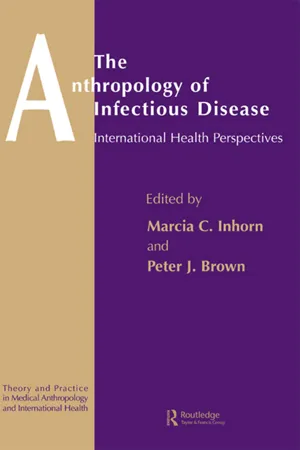
The Anthropology of Infectious Disease
International Health Perspectives
- 512 pages
- English
- ePUB (mobile friendly)
- Available on iOS & Android
eBook - ePub
The Anthropology of Infectious Disease
International Health Perspectives
About this book
Anthropological contributions to the study of infectious disease and to the study of actual infectious disease eradication programmes have rarely been collected in one volume. In the era of AIDS and the global resurgance of infectious diseases such as tuberculosis and malaria, there is widespread interest and concern about the cultural, ecological and political factors that are directly related to the increased prevalence of infectious disease. In this book, the authors have assembled the growing scholarship in one volume. Chapters explore the coevolution of genes and cultural traits; the cultural construction of 'disease' and how these models influence health-seeking behaviour; cultural adaptive strategies to infectious disease problems; the ways in which ethnography sheds light on epidemiological patterns of infectious disease; the practical and ethical dilemmas that anthropologists face by participating in infectious disease programmes; and the political ecology of infectious disease.
Information
Part One
Anthropologies
CHAPTER 1
Introduction
Marcia C. Inhorn and Peter J. Brown
INTRODUCTION
As the year 2000 approaches, a large portion of the world’s population still suffers from, and struggles against, diseases caused by infectious agents. Indeed, at the dawn of the new millennium, infectious diseases remain the major cause of death worldwide, and are an incalculable source of human misery and economic loss. The Institute of Medicine’s recent, ominous report, Emerging Infections: Microbial Threats to Health in the United States (1992), outlines the daunting number and variety of microbial threats to human health. More infectious pathogens exist than ever before, and, given the current state of preventive and therapeutic knowledge, the vast majority of these infectious disease threats are likely to persevere well into the twenty-first century (Institute of Medicine 1992).
Indeed, the committee charged with writing the Institute of Medicine report focuses on what it calls the “trouble ahead” – namely, the emergence, and re-emergence, of serious infectious disease problems. These problems comprise four basic categories. First, a host of “new” infectious diseases have been identified during the past two decades, and they are affecting more and more people every year. AIDS, caused by the human immunodeficiency virus (HIV), provides the most sobering global example of this class of new emergent infections. There are numerous examples of other new infectious diseases that have been shown to be lethal, despite their more limited geographic scope than HIV. Diseases such as Hantavirus pulmonary syndrome, Legionnaires’ disease, and the widely publicized Ebola hemorrhagic fever can be included in this category.
The second category of threats includes a number of “old,” well-known infectious diseases – once considered by many to be “under control” – that have increased in incidence beyond all expectations during the past two decades. The two primary examples of these re-emergent infectious diseases are malaria and tuberculosis. Not surprisingly, both of these diseases also provide excellent examples of what happens when microbial agents become resistant to mainstay therapeutic drugs and what happens when public health control measures slacken or break down altogether. The re-emergent infectious disease category includes many other examples, some of which, such as dengue, cholera, and measles, will be described along with malaria and tuberculosis in this volume. Taken together, the numbers of infectious disease agents in these first two categories are quite impressive: seventeen forms of bacteria, rickettsiae, and chlamydiae, twenty-seven forms of viruses, and eleven forms of parasites (both protozoans and helminths) and fungi (Institute of Medicine 1992). All the scientific evidence suggests that these are not merely newly identified forms of disease, but actually new species of pathogens that have evolved through natural selection, often because human behavior has changed the ecological context.
The third category includes microbial agents that are the likely causes of some widely occurring chronic diseases whose precise etiology had previously remained obscure. Two salient examples of such diseases are peptic ulcer (and possibly stomach cancer), which appears causally linked to previous infection with the Helicobacter pylori bacterium, and cervical cancer, many cases of which seem causally linked to previous exposure to a sexually transmitted pathogen, the human papillomavirus (HPV). Although not listed in the Institute of Medicine’s report, many other non-infectious conditions, such as tubal infertility described in Chapter 7 of this volume, also share an underlying infectious etiology. The important point here is that morbidity and mortality from some chronic diseases may actually be caused by infectious agents, so that prevention efforts must target the earlier infectious causes.
The final category of “trouble ahead” identified in the Institute of Medicine report involves the introduction of infectious disease agents into previously unaffected populations. Throughout history, the introduction of infectious diseases to “virgin” populations with no immunities to the disease has caused untold human suffering and massive mortality. Indeed, McNeill (1976) has tied such epidemics to the collapse of New World civilizations. Nevertheless, it is impossible to build impenetrable epidemiologic borders between populations, so that constant surveillance and political willingness to protect populations proactively from new diseases (while justly and humanely treating infected people) will remain an important challenge for the future. In this regard, the notion of infectious disease “traffic” – a term coined by virologist Stephen Morse (1993) in reference to the movement of infectious disease agents to new species or new individuals – is significant. Indeed, Morse, who is not a behavioral scientist, recognizes that human beings are often unwittingly responsible for infectious disease traffic through, for example, ecologically disruptive agricultural practices or various culturally prescribed methods of water impoundment and storage. As he concludes in his book on Emerging Viruses:
Viral traffic, often abetted by human actions, is the major factor in viral emergence. Because human activities are often involved in emergence, anticipating and limiting viral emergence is more feasible than previously believed. Basically, people are creating much of the viral traffic, even though we are doing it inadvertently. We need to recognize this and learn how to be better traffic engineers (Morse 1993:210).
Given the role of human behavior in infectious disease traffic, it seems only logical that anthropologists, as professional observers and interpreters of human behavior in its social and cultural context, play a significant role in global efforts to curb infectious disease problems.
This volume on The Anthropology of Infectious Disease is dedicated to four simple propositions: first, that infectious diseases are profoundly important to all human societies for the reasons outlined above; second, that anthropologists, particularly medical anthropologists with interests and experience in international health, should therefore study these diseases; third, that these anthropologists should share their research findings in cross-disciplinary dialogues and collaborative efforts with people in biomedical sciences and international public health who are working to stop the spread of infectious diseases; and fourth, that these anthropological research findings should be seriously considered by biomedical scientists and international public health personnel. Although these propositions may appear simple and even self-evident, they have been met with variable reception in both anthropology and international public health circles. Why might this be so? To answer this question, one must first take a look back at the history of infectious disease research in international health, before examining the role of anthropologists in that history.
LOOKING BACK: THE HISTORY OF INFECTIOUS DISEASE RESEARCH AND CONTROL IN INTERNATIONAL HEALTH
Although infectious diseases have once again gained the spotlight, the history of infectious disease research and control during the modern, post-World War II era of international health has generally been inglorious. Without a doubt, there are some well-deserved success stories – including the global eradication of smallpox (to be described in this volume), the elimination of poliomyelitis from the Western hemisphere, and the substantial reduction in childhood killers like diphtheria and measles in the Western industrialized countries (AMA Council on Scientific Affairs 1996). In general terms, however, this fifty-year period has been characterized by: (1) the scientific neglect of both major and minor infectious diseases, leading to numerous “scientific blind spots” in our understanding of infectious disease threats; (2) missed opportunities for basic and applied research that may have improved public health interventions; (3) an overzealous emphasis on eradication of certain priority infectious diseases, mixed with often feeble attempts to control others; (4) a general “mood of complacency,” or a critically low awareness of and concern about infectious diseases, except among a handful of infectious disease specialists (Institute of Medicine 1992); and (5) the underdevelopment of a global infectious disease surveillance and public health infrastructure to deal with epidemics. These historical characteristics, in turn, have affected how anthropologists have – or have not, in most cases – contributed to infectious disease research and control programs.
International health efforts to understand and control infectious disease problems harken back much longer than fifty years – at least to the turn of the twentieth century, when the discipline of Tropical Medicine emerged to help cope with the diseases of colonizing groups, including military forces, and, to a lesser extent, colonized labor forces (Brown 1976; Curtin 1989; Warren 1990). However, modern international health programs are largely a post-WWII phenomenon linked to the foreign policy aims of Western industrialized nations, who continue to use health aid as a part of attempts to gain or maintain national political loyalties in the post-colonial era.
Some of the neglect of infectious disease in international health circles during this period is certainly linked to disappointments regarding disease eradication programs, particularly the failure of malaria eradication during the 1950s and 1960s. As described by Warren (1990), the concept of eradication of a major human disease may have originated with the Rockefeller Foundation, which set as its major goal in 1913 the eradication of hookworm, the so-called “germ of laziness,” in the southern United States. Although the Rockefeller campaign to eliminate hookworm infection from the U.S. (as well as fifty-two other countries where the campaign was carried out) was a failure, this did not prevent the foundation from attempting to eradicate another disease, yellow fever, from the Western Hemisphere. Again, this campaign was unsuccessful, but the concept of disease eradication remained in tact. Undaunted, Rockefeller Foundation officers worked with World Health Organization (WHO) officials to initiate a global campaign to eradicate malaria in 1955. This campaign lasted for seventeen years and was responsible for eliminating malaria from large areas of the world, including the United States and Europe (see Chapter 5 of this volume). However, malaria eradication was never even remotely complete due to the development of resistance to both insecticides and drugs, as well as the impossibility of controlling malaria-carrying mosquitoes in their native African habitat (Warren 1990). Thus, WHO decided to terminate the effort – or, at least, to redefine the goal to malaria control – after spending approximately four billion dollars. Following malaria program termination, malaria has re-emerged in some parts of the world in massive proportions.
Although the subsequent eradication of smallpox was an absolute and unprecedented success – the world was declared officially free from smallpox on December 9, 1979 – the failure of malaria eradication (as well as programs that had preceded it) had taken its toll in the international public health community. As described by Warren (1990:149), “there was a major backlash, not only against the concept of eradication of disease but against direct, targeted (vertical) attempts to improve health in the developing world.” As part of this backlash, the international health community renounced the high-technology, “engineering” approach to solving infectious disease problems through drugs, vaccines, and insecticides. The decline of the vertical disease-oriented approach was linked to the growth of international health’s Primary Health Care (PHC) revolution of the late 1970s. But there was a negative consequence in that the rise of PHC succeeded in further marginalizing the many serious, but underappreciated infectious disease problems that had never been targeted for eradication.
With the concept of eradication all but eliminated from international public health discourse by the 1970s, few of the international health agencies were interested in tackling what appeared to be insurmountable infectious disease problems in the developing world. As a result, WHO remained the sole – and seriously underfunded – force in international infectious disease research and control. Specifically, WHO responded to the demands of public health leaders from sub-Saharan Africa that the organization increase its prioritization of infectious disease work. In 1975, WHO initiated the Special Program for Research and Training in Tropical Diseases (TDR), with the following statement: “The recent enormous extension of knowledge in the biomedical sciences has as yet hardly begun to be applied to the problems of tropical diseases where methods of control and treatment have scarcely changed in the past 30 years.” Through its TDR program, WHO hoped to terminate the old colonial tradition in tropical medicine, where European experts would go “to the field” for short periods of time. The emphasis instead was on self-reliance through the training of researchers in the countries where tropical diseases were endemic. However, given the huge number of tropical disease problems present in the developing world and WHO’s limited funds for TDR (raised outside the regular WHO budget, but with an average annual level of twenty-five million dollars), WHO restricted its TDR program to six “priority” diseases. Five of these – filariasis, leishmaniasis, malaria, schistosomiasis, and trypanosomiasis – were parasitic. Only one – leprosy – was bacterial. The soil-transmitted helminths (or intestinal “worms” to be described in Chapter 9 of this volume) were left out despite their global prevalence; essentially, WHO recognized that control first required fundamental (and expensive) improvements in environmental sanitation and water supply.
Soon after, a few philanthropies joined WHO in attempting to curb infectious, primarily parasitic, diseases. The Edna McConnell Clark Foundation initiated an innovative schistosomiasis research program, later extended to include trachoma. In 1977, the Rockefeller Foundation started the “Great Neglected Diseases” program, which involved many of the important infectious diseases of the developing world as well as the hemoglobinopathies related to malaria (Warren 1990). In the early 1980s, the MacArthur Foundation began a five-year program, the Biology of Parasitic Diseases, while Burroughs Wellcome initiated fellowships in the Molecular Biology of Parasitic Diseases (Warren 1990).
These programs resulted in many basic scientific advancements in the biology, diagnosis, treatment, and prevention of parasitic diseases during the 1970s and 1980s (Warren 1990). But these programs were small compared to other major international...
Table of contents
- Cover
- Title page
- Copyright page
- Contents
- Introduction to the Series
- Acknowledgments
- List of Contributors
- Part One Anthropologies
- Part Two Histories
- Part Three Methods
- Part Four Ethnographies
- Part Five Political Economies
- Index
Trusted by 375,005 students
Access to over 1.5 million titles for a fair monthly price.
Study more efficiently using our study tools.
Frequently asked questions
Yes, you can cancel anytime from the Subscription tab in your account settings on the Perlego website. Your subscription will stay active until the end of your current billing period. Learn how to cancel your subscription
No, books cannot be downloaded as external files, such as PDFs, for use outside of Perlego. However, you can download books within the Perlego app for offline reading on mobile or tablet. Learn how to download books offline
Perlego offers two plans: Essential and Complete
- Essential is ideal for learners and professionals who enjoy exploring a wide range of subjects. Access the Essential Library with 800,000+ trusted titles and best-sellers across business, personal growth, and the humanities. Includes unlimited reading time and Standard Read Aloud voice.
- Complete: Perfect for advanced learners and researchers needing full, unrestricted access. Unlock 1.5M+ books across hundreds of subjects, including academic and specialized titles. The Complete Plan also includes advanced features like Premium Read Aloud and Research Assistant.
We are an online textbook subscription service, where you can get access to an entire online library for less than the price of a single book per month. With over 1.5 million books across 990+ topics, we’ve got you covered! Learn about our mission
Look out for the read-aloud symbol on your next book to see if you can listen to it. The read-aloud tool reads text aloud for you, highlighting the text as it is being read. You can pause it, speed it up and slow it down. Learn more about Read Aloud
Yes! You can use the Perlego app on both iOS and Android devices to read anytime, anywhere — even offline. Perfect for commutes or when you’re on the go.
Please note we cannot support devices running on iOS 13 and Android 7 or earlier. Learn more about using the app
Please note we cannot support devices running on iOS 13 and Android 7 or earlier. Learn more about using the app
Yes, you can access The Anthropology of Infectious Disease by Peter J. Brown,Marcia C. Inhorn in PDF and/or ePUB format, as well as other popular books in Social Sciences & Infectious Diseases. We have over 1.5 million books available in our catalogue for you to explore.