eBook - ePub
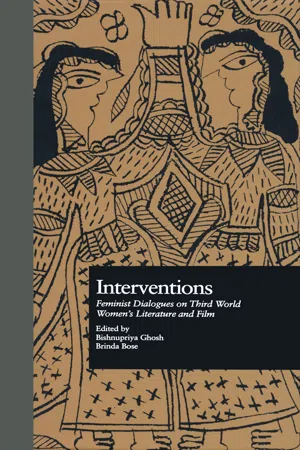
Interventions
Feminist Dialogues on Third World Women's Literature and Film
- 292 pages
- English
- ePUB (mobile friendly)
- Available on iOS & Android
eBook - ePub
Interventions
Feminist Dialogues on Third World Women's Literature and Film
About this book
The editors are committed to destroying perceptions and stereotypes of third world women as passive victims who need to be "liberated" by Western feminists. The essays address cases in which women have challenged and resisted the political formations-nationalist struggles, revolutions, religious fundamentalist practices, and authoritarian regimes-that shape their daily lives. Each critic presents a close reading of the circumstances under which the feminist writers and film-makers.
Information
Chapter 1
National Identities, Tradition, and Feminism
The Novels of Ama Ata Aidoo Read in the Context of the Works of Kwame Nkrumah
If you educate a man, you educate an individual. If you educate a woman, you educate a nation.1 Dr. Kwegyir Aggrey
Feminist and postcolonial theory are increasingly invoked in the same breath, forming critical alliances that are new and noteworthy. In reading literature coming from what are commonly referred to as “Third World” or postcolonial parts of the globe, feminism can be extremely insightful in illuminating the often complex and shifting terms that shape the search for identity and community. Feminism furthers postcolonial theory by revealing how much colonial and postcolonial theorizing of nationalism and national identity rests on gendered rhetoric which assumes women as the moral barometers of a nation rather than as active participants in the nation.
Nationalism, Tradition, Gender
While many writers have explored the created, constructed, or imagined nature of national identities after colonialism, very little has been said about the possibility that women and men experience the colonial condition differently. Many historians agree that colonialism exacerbated the gender oppression that existed in some precolonial African societies. For example, girls were sent to school less often, and, consequently, men were more quickly incorporated into cash economies and elite structures. Yet these differences in the experiences of colonialism represented by gender were not often reflected in the struggle for independence. With the coming of independence, the predominately male African nationalist leaders often reasserted their rights to rule themselves in terminology that focused on recapturing their manhood. Lloyd Brown (1981) points to Ama Ata Aidoo’s story “For Whom Things Did Not Change” as an example of this type of thinking about the nationalist struggle. This story, claims Brown, “dramatizes how sexual roles were disrupted by colonialism” (115). Brown traces how one of the characters, an African doctor who is the employer of the main character, Zirigu, reflects on the gendered implications of colonial and neocolonial relationships:
…this disruption has persisted after colonialism. As the doctor observes, Zirigu would not cook in the context of traditional culture, since that is a woman’s job, but outside that culture, it was proper for him to cook for whites. As the doctor muses to himself, a black man is a man when his wife cooks for him, and he willingly occupies a woman’s role when he cooks for whites. What then, the doctor wonders ironically, is a black man who cooks for other black men like himself? (115)
In this description of Aidoo’s story, what is clearly at stake for Brown is masculinity.2 Chimalum Nwankwo offers a similar reading of this story in “The Feminist Impulse and Social Realism in Ama Ata Aidoo’s No Sweetness Here and Our Sister Killjoy.’1 Nwankwo points to “For Whom Things Did Not Change” as central to understanding Aidoo’s formulation of social problems in the neocolonial context. Nwankwo cites the “searing irony” of this passage as an example of the fact that: “Africans accept inferior social status as a result of colonialism. That acceptance is a dangerous social habit like female passivity which lingers despite independence” (153). As with Brown’s reading of this story, the quality of national independence is linked to the strength of the male gender role, with the feminine being evidence of weakness or incomplete decolonization. If colonialism is read as an emasculating enterprise, then independence becomes the search for masculinity, and the loss of tradition points to a feared loss of clearly defined gender identities. This description of the coming into being of national consciousness leaves little room for women to assume active roles in the new nation. In discussing how women are inserted into that nationalist struggle that is often coded as a reassertion of manhood, I do not mean to suggest that the struggle for independence was the same everywhere. As Chandra Mohanty warns us, this kind of gesture is equivalent to a “suppression—often violent—of the heterogeneity of the subject(s) in question” and leads to a “discursive colonization” (333). In this paper, I will attempt to take Mohanty’s warning to heart and explore the dynamics of women’s roles in the nationalist enterprise with reference to one specific context—that of the role of women in Ghana during the struggle for independence and the establishment of a postcolonial nation-state. In doing so, I will look at general theories of the role of gender and the language of nationalism, then seek to show how the role of women was described in pre- and postindependence Ghana, and finally, I will discuss how one Ghanaian woman author, Ama Ata Aidoo, offers us her own critique of the role prescribed for women in the nationalist rhetoric that provides one context for the reception of her work.
In an essay titled ‘Tsitsi Dangarembga’s Nervous Conditions: At the Crossroads of Feminism and Postcolonialism,” Sally McWilliams argues for the usefulness of linking the postcolonial and feminist theoretical projects in order to describe new subject positions: “Women as historical subjects are complex interactions of not only sexual, but also racial, ethnic, class, cultural, and religious differences” (103). McWilliams goes on to say that considering these things together allows an author (or reader) “to open a space for the emergence of postcolonial subjects” (104). McWilliams’ statements suggest that Anthony Appiah’s theory that the “post” in postcolonial is essentially a “space-clearing gesture” needs to be expanded: adding feminism to the picture opens up a new kind of space that has remained covered over by much postcolonial theory itself.3
How necessary is it to claim a space specifically for women in the postcolonial setting? In looking at the history of women in the nationalist struggle in Ghana, we begin to see how certain gendered assumptions about the construction of a national identity relegate the role of women essentially (and I use the word advisedly) to secondary positions. In an article titled “The African Woman Today,” Ama Ata Aidoo argues that three basic factors influence the position of women in African society: “…indigenous social patterns; the conquest of the continent by Europe; and the apparent lack of vision or courage in the leadership of the postcolonial period” (1992, 321). She goes on to explain that by leadership she understands not only political leaders but “the entire spectrum of the intellectual, professional, and commercial elites” (321). In other places, Aidoo has given some suggestions as to how she sees this lack of vision manifesting itself. During an interview with Rosemary Marangoly George and Helen Scott that took place in 1991 at Brown University, Aidoo explained that the stories in the collection No Sweetness Here focus on the minutia of culture as an indicator of wider political tendencies. Aidoo says:
These stories are part of the many discourses of culture in the postcolonial context, that are about what has been lost in the process of colonization and what is being lost in the process of “Westernization.” Clothes for example, are part of the minutia of culturization; they can symbolize cultural loss and gain. Such things are pointedly illustrated in terms of women: women are the ones who wear the traditional clothes, the saris in India, the slits in Ghana. Women are expected to be African or Indian or Pakistani by the way we dress. Men talk about it whilst wearing their western suits. At a conference, elite men will stand up in three piece suits and talk about the need to be culturally authentic. We women have to wear the clothes, keep our hair. (302)
What Aidoo points to in this passage, in stressing that women are supposed to be African, is the tendency for the discourse of cultural authenticity in the name of self-definition to make women the site of cultural reproduction rather than the site of cultural production. The quote from Kwegyir Aggrey that equates educating a woman with educating a nation is one example of how, in the name of promoting the role of women, nationalists in many countries, not the least of which was Ghana, tended to see women as the keepers and guarantors of cultural identity and not agents in the discourse that produced identity.4
History, Tradition, and National Identities in Postcolonial Africa
The concern for tradition as an indicator of identity points to one of the main problematics of establishing national identities in the nation-state form imported from and imposed by Europe: how to write the narrative of the nation in the face of a historical record that has been wiped out or distorted by colonial powers. Throughout the colonial era, Africa was “asked” to forget itself. It and its people were denied a history or a culture. It was presented to itself as a tabula rasa, waiting to be written upon by the white man. This is one of the first stereotypes that nationalists responded to by stressing the antiquity and glory of Africa’s past civilizations. These ancient traditions were cited as a source of pride for the new nation. And yet, among western theorists, some form of forgetting of historical differences is widely accepted as a crucial part of forming a nation. Most theorists of nationalism make nods to the quote from Ernest Renan that Benedict Anderson finds so important for creating what Anderson calls “the imagined community5: “Yet the essence of a nation is that all individuals have many things in common, and also that they have forgotten many things” (Renan, 11). However, the act of forgetting proves to be a paradox when applying commonly accepted theories of nationalism in Africa, where intellectuals and writers are constantly trying to reclaim aspects of their long-denied history in the name of self-determination. If forgetting some things is indeed necessary to foster the national community, in the African context, what to forget becomes a very problematic and ideologically loaded question. The problem in trying to write a national culture into being in the colonial or postcolonial states more often involves remembering than forgetting because indigenous histories have been denied, distorted, or even destroyed. African politics then, in the search for nationalities, becomes more often a search for historical identities wherein forgetting is seen as a rejection or betrayal of the African past.
Nationalism in Ghana: The Theories of Kwame Nkrumah
Kwame Nkrumah and his flagship party, The Convention Peoples Party (CPP), dominated the discourse of the debates about national identity in Ghana. From its advent in 1948 until Nkrumah’s overthrow in 1966, Nkrumah and the CPP were the leaders of what Aidoo referred to earlier as the “entire spectrum of the intellectual, professional and commercial elite in positions to make vital decisions on behalf of the entire community” (1992, 321). Aidoo, often, expresses her concern with the way that the African Personality is defined by “the elite” and put forward to the people of the nation-state. Like most theorists of nationalism in Africa, Nkrumah’s formulations of national identity begin with a desire to reclaim a history that has been denigrated through rehabilitating what he defines as a truly “African Personality” (the phrase which came to characterize his theories of identity).6 For Nkrumah, the reestablishment of the African Personality depends primarily on a réévaluation of history that places the European and even earlier Arab invasions of Africa in the context of an African view of history. Perhaps the most important legacy of the African heritage for Nkrumah was his belief that before contact with Europe, Africa was a single community. While Nkrumah does not push this claim nearly as far as other Ghanaian authors, it form an important basis for his conception of a future Africa when Pan-Africanism, an avatar of the best African traditions, should unite the continent into one political unity.7
Perhaps the most coherent rendering of Nkrumah’s ideas about the role of history in forming the new national community came in his address to the Parliament of 1956, when he petitioned formally for independence. In his “motion of destiny,” as he was to call it, Nkrumah outlined at length the reasons why he felt that the new country should be named Ghana, leaving behind the colonial name of the Gold Coast. In his autobiography, Nkrumah recounts in full this speech:
In the early days of the Christian era, long before England had assumed any importance, long even before her people had united into a nation, our ancestors had attained a great empire…. It is said that lawyers and scholars were much respected in this empire and that the inhabitants of Ghana wore garments of wool, cotton, silk and velvet. There was trade in copper, gold, and textile fabrics, and jewels and weapons of gold and silver were carried.
Thus we may take pride in the name of Ghana, not out of romanticism, but as an inspiration for the future. It is right and proper that we should know about our past. For us as the future moves from the present so the present has emerged from the past. […] What our ancestors achieved in the context of their contemporary society gives us confidence that we can create, out of that past, a glorious future, not in terms of war and military pomp, but in terms of social progress and peace.
Mr. Speaker, in calling up our past, it is meet, on a historic occasion such as this, to pay tribute to those ancestors of ours who laid our national traditions… (197–8)
Nkrumah goes on to stress that the history of Ghana is one of resistance and organization, based on the knowledge of “the necessity of unity and government” coming from “our traditions and experience” (198). Nkrumah, here, clearly lays out his philosophy that the past, in so far as it suggests the necessity of unity, the communal tradition, and the desire for peace, should be the guide for the new nation. However, Nkrumah’s strictly utilitarian or pragmatic view of how to make use of history and tradition leads him to make claims that may surprise a reader versed in the history of Africa. In this quote, Nkrumah claims the traditions of the empire of Ghana as the traditions of the ancestors’ of the present day Ghana. The eleventh- and twelfth-century empire of Ghana covered parts of what are now Mali and...
Table of contents
- Cover
- Half Title
- Series Page
- Title
- Copyright
- Contents
- Series Editor’s Foreword
- Preface
- Acknowledgements
- Introduction: Feminist Interventions and Locational Politics
- The Intervening Configuration: Gender and Feminist Practice
- The Intervening Discourse: Problematizing Transnational Feminist Dialogues
- List of Contributors
- Index
Trusted by 375,005 students
Access to over 1.5 million titles for a fair monthly price.
Study more efficiently using our study tools.
Frequently asked questions
Yes, you can cancel anytime from the Subscription tab in your account settings on the Perlego website. Your subscription will stay active until the end of your current billing period. Learn how to cancel your subscription
No, books cannot be downloaded as external files, such as PDFs, for use outside of Perlego. However, you can download books within the Perlego app for offline reading on mobile or tablet. Learn how to download books offline
We are an online textbook subscription service, where you can get access to an entire online library for less than the price of a single book per month. With over 1.5 million books across 990+ topics, we’ve got you covered! Learn about our mission
Look out for the read-aloud symbol on your next book to see if you can listen to it. The read-aloud tool reads text aloud for you, highlighting the text as it is being read. You can pause it, speed it up and slow it down. Learn more about Read Aloud
Yes! You can use the Perlego app on both iOS and Android devices to read anytime, anywhere — even offline. Perfect for commutes or when you’re on the go.
Please note we cannot support devices running on iOS 13 and Android 7 or earlier. Learn more about using the app
Please note we cannot support devices running on iOS 13 and Android 7 or earlier. Learn more about using the app
Yes, you can access Interventions by Bishnupriya Ghosh,Brinda Bose in PDF and/or ePUB format, as well as other popular books in Literature & Feminist Literary Criticism. We have over 1.5 million books available in our catalogue for you to explore.