- 320 pages
- English
- ePUB (mobile friendly)
- Available on iOS & Android
eBook - ePub
About this book
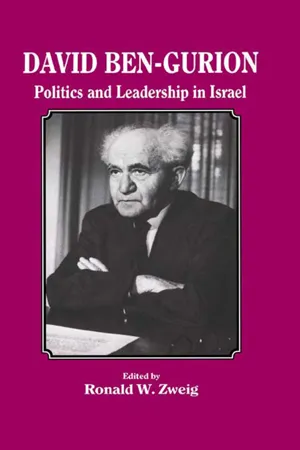
First published in 2004. It may well be that genius begins where fear ends: not to be afraid to question what is known, not to be afraid to be original. David Ben-Gurion did not try to imitate anyone...He was endowed with a mind that sought out whats was new and was capable of penetrating the deepest recesses. First and foremost, he challenged every Jew who believed it was the fate of Jews to live in the Diaspora, and he believed that the Jews could be a nation of farmers, industrialists, soldiers, pioneers, and not only scientists and intellectuals. He decided that the time had come to establish a Jewish state, yet once it had been founded, he was not satisfied- it must be an exemplary state, a chosen state.
Information
Statehood
THE WAR OF INDEPENDENCE
Following the end of World War II and the Holocaust, the Zionist movement resumed its struggle for independence in a mood of fierce resolution. The Jewish Agency conducted the struggle in Palestine and abroad, employing a variety of means: political campaigns and negotiations, large-scale clandestine immigration (Ha'apalah), intensified settlement activities, and guerrilla-strikes at strategic installations, intended mainly to achieve legalized mass immigration. To this end it formed the Jewish Resistance Movement (Tenu'at Hameri), in which the dissident I.Z.L. and Lehi underground movements joined the Haganah and accepted—for the time being—the authority of the Agency and its chairman, David Ben-Gurion. From Fall 1945 until the UN Assembly decision on November 29, 1947, the number of clandestine immigrants reached almost fifty thousand, eleven new settlements were set up in the Negev in a concerted overnight operation in October 1946, and during 1947 they were connected by long-distance pipelines to a regular water supply. Armed acts of resistance were stringently restricted, in order to minimize casualties and to avoid giving the British a pretext for repressive countermeasures.
Tenu'at Hameri's military operations reached their peak in 1946. On the night of June 16–17, the Palmach effectively isolated Palestine from neighboring states by destroying ten rail and road bridges along the country's borders. On the following night, Lehi attacked railway yards in Haifa. On June 18, the I.Z.L. kidnaped British hostages in order to prevent the execution of its members, convicted in military courts. On Saturday, June 29, “Black Sabbath,” the British countered with the arrest of prominent Jewish leaders and countrywide searches for Palmach members and arms. On July 22, the I.Z.L. retaliated, blowing up a wing of Jerusalem's King David Hotel then occupied by Palestine government offices. As a result of internal misunderstandings following this operation, Tenu'at Hameri disintegrated. Subsequently combat activity of the Haganah was in large measure limited to naval sabotage carried out by the Palmach. The I.Z.L. and Lehi returned to their course of independent action.
At the 22nd Zionist Congress in December 1946, Chaim Weizmann was deposed as president, and, in effect, Ben-Gurion became head of the Zionist movement. Until that time, the Haganah had acted according to the guidelines laid down by the Political Department of the Jewish Agency. However, at this Congress, Ben-Gurion stressed the potentially grave security dangers posed by the Arabs of Palestine and the neighboring states, in the event of war. He proposed the establishment of a Security Department within the Agency's Executive and took personal responsibility for the portfolio. From the outset, Ben-Gurion had stood at the center of confrontations with the Mandatory authorities, and his assumption of the security portfolio thus went undisputed. His became a dual role: chairman of the Jewish Agency Executive and chief of its Security Department. Following the establishment of the Provisional Government, he was both prime minister and minister of defense.
In February 1947, the British Government abandoned its efforts to attain an agreed settlement between Arabs and Jews, and announced that it was transferring responsibility for Palestine to the United Nations. This shift in the diplomatic arena transformed Zionist policy. The anti-British struggle was de-emphasized in favor of actions designed to bring about a pro-Zionist majority decision in the UN General Assembly.
During the summer of 1947, following inspection tours of the Haganah and intensive discussions with its leaders, Ben-Gurion instructed them to prepare for a new approach:
The confrontation between Zionism and the policy of the White Paper is basically political and not military in nature…. [The Haganah] is only one of the factors within the Jewish people, and only an overall effort, on the part of the Yishuv and the people, in immigration, the armed struggle and the diplomatic campaign in the international arena—will succeed in tilting the scales.1
Throughout the Yishuv's long anti-British campaign, the Arabs of Palestine had rarely acted against the Jewish community. Nevertheless, Ben-Gurion ordered that preparations be made for a war which the Arabs were likely to launch as soon as the United Nations took a stand on the Palestine problem.2
The United Nations Special Committee on Palestine (UNSCOP) completed its work by the end of August 1947, with the majority of its members in favor of the political partition of Palestine. Their recommendations would only be binding if at least two-thirds of the General Assembly endorsed them. During early October, a period of political uncertainty as the UN deliberated, the General Staff of the Haganah received Ben-Gurion's instructions regarding its mission in the war which was liable to erupt:
The full capacity of the Yishuv is to be mobilized…to safeguard the entire Yishuv and the settlements (wherever they may be), to conquer the whole country or most of it, and to maintain its occupation until the attainment of an authoritative political settlement.3
When the General Staff asked for operational clarifications, Ben-Gurion tied his answer to the outcome of the UN debate: “If the decision [on partition] is favorable we shall defend every settlement, resist any attack, and maintain services to the Jewish Yishuv and to all the Arabs who so desire; we shall not restrict ourselves territorially.”4
The goals outlined in this directive committed the Haganah to a twofold mission, defensive as well as offensive. Defensively, it meant protecting Jewish Jerusalem', as well as maintaining Western Galilee, the Dead Sea potash works and those Jewish settlements which could easily be cut off, such as the Etzion Bloc. The offensive significance of the mission was that Haganah forces would have to break out of the Jewish settlement zone, which extended over only about one-third of the territory alloted to the Jewish state, in order to secure the Negev, beyond Revivim and Nevatim, all the way to Eilat.
The goals were far-reaching, even pretentious, and could only be realized if the Yishuv would be able to invest considerable resources in mobilizing, equipping and training for war. The political leadership took for granted the readiness of tens of thousands of Haganah members to enlist voluntarily and assumed the willingness of Jewish settlers to stand firm in the defense of their homes against Palestinian Arab attackers and invading Arab armies.
On Saturday, November 29, 1947, Ben-Gurion was at the Kaliya Hotel. He was sixty-one years old, and, due to backaches from which he suffered, used to bathe in the Dead Sea during the weekends. After midnight he was awakened to be told that the UN General Assembly had carried the Palestine Resolution with a majority that exceeded the necessary two-thirds. Everywhere crowds gathered to dance in the streets, but after Ben-Gurion hurried back to Jerusalem he felt as a “man in mourning among the celebrators…4*
Since his appointment as chairman of the Jewish Agency Executive in 1935, Ben-Gurion had gained experience in leading the Zionist movement: during the crisis of the 1936–1939 Arab Revolt, the war years, and lately—the resistance. He was now keenly aware of the sufferings which the war ahead would bring, but was determined to strive for the attainment of a dual aim: statehood for the Yishuv and the successful defence of the new state.
Ben-Gurion's diary shows clearly how much of his time and energy was invested in the manifold aspects of state-building: foreign and internal affairs, the achievement of a national consensus, the forming of a provisional government and a legislative assembly, and the financing of the state of war. The success of the Jewish leadership in nation-building can be appreciated in the light of the achievements in immigration and settlement during wartime. More than 120,000 immigrants arrived during 1948 and had to be somehow absorbed, and about 40 new settlements were set up during that year in the new areas occupied and to improve security along vulnerable borders. These aspects, though mentioned only briefly here, should not be overlooked in an assessment of Ben-Gurion's role in Israel's War of Independence. His most vital and urgent task in the context of nation-building was probably the creation of an army.
The Foundation of the Israel Defense Forces
When hostilities broke out, the burden of the Yishuv's defense had to be carried by less than 4,500 men and women: Haganah members “on active service” in the skeleton staff, the Palmach, and the Jewish Settlement Police (although formally under Palestine Police command), located in rural settlements. The geographical layout of the settlements, rural and urban, determined the Yishuv's actual defensive alignment. In the relative security provided by the settlements, Jewish field-forces were able to enlist, equip and train their manpower, and organize it into companies, battalions and brigades. Thus the Israel Defense Forces (I.D.F.) came into being.
Some of Ben-Gurion's bitterest controversies with the High Command of the Haganah centered on this very process of forming the I.D.F., a process which involved transforming what had been essentially an underground militia into a regular army. This complex task was further complicated by the illness of the Haganah's Chief of Staff, Ya'akov Dori, which prevented him from functioning on a regular basis, and by the difficulty encountered in appointing a substitute who would be willing to take his place and would be accepted by his colleagues in the High Command. Yisrael Galili, who served as the “Head of the National Command,” the civilian authority supervising the Haganah on behalf of the Jewish Agency, fulfilled some staff-coordination functions, and acted as a de facto deputy for Ben-Gurion. On the eve of the declaration of independence, Ben-Gurion abolished the “National Command,” which was to become obsolete with the formation of a Ministry of Defense. Galili was relieved of his former position, but reconciled himself to continue in a mediating function.5
The Haganah became a regular army amid the campaign to contain the joint Arab invasion; this process was continued and completed during the months of the truces. At the end of the war, the I.D.F.'s composition had to be revised again in order to fit Israel's needs following the armistice, with tens of thousands of soldiers gradually being demobilized. This was a wide-ranging, complex and lengthy undertaking, accompanied by disputes over immediate military problems and organizational and doctrinal concepts, as well as by some sharp personal differences.
The establishment of the I.D.F. required the procurement of armaments from sources both in Palestine and abroad, the building and training of infantry units and their amalgamation into twelve brigades, and the formation of defensive forces able to join with civilian settlements to create a territorial defense system. This system's firm stand along the overextended front lines made it possible to concentrate and deploy field-forces in offensive missions. Residents of the defensive settlements were in effect part of the I.D.F., whether or not they had been formally mobilized; this phenomenon was part of the Haganah heritage. Air and naval forces were set up with the help of Jewish volunteers who had served in ...
Table of contents
- Cover
- Half Title
- Title Page
- Copyright Page
- Table of Contents
- Preface
- The Praxis of Leadership
- The Early Years
- The Challenge of World War
- Statehood
- Contributors
Trusted by 375,005 students
Access to over 1.5 million titles for a fair monthly price.
Study more efficiently using our study tools.
Frequently asked questions
Yes, you can cancel anytime from the Subscription tab in your account settings on the Perlego website. Your subscription will stay active until the end of your current billing period. Learn how to cancel your subscription
No, books cannot be downloaded as external files, such as PDFs, for use outside of Perlego. However, you can download books within the Perlego app for offline reading on mobile or tablet. Learn how to download books offline
We are an online textbook subscription service, where you can get access to an entire online library for less than the price of a single book per month. With over 1.5 million books across 990+ topics, we’ve got you covered! Learn about our mission
Look out for the read-aloud symbol on your next book to see if you can listen to it. The read-aloud tool reads text aloud for you, highlighting the text as it is being read. You can pause it, speed it up and slow it down. Learn more about Read Aloud
Yes! You can use the Perlego app on both iOS and Android devices to read anytime, anywhere — even offline. Perfect for commutes or when you’re on the go.
Please note we cannot support devices running on iOS 13 and Android 7 or earlier. Learn more about using the app
Please note we cannot support devices running on iOS 13 and Android 7 or earlier. Learn more about using the app
Yes, you can access David Ben-Gurion by Ronald W Zweig in PDF and/or ePUB format, as well as other popular books in Politics & International Relations & Political Biographies. We have over 1.5 million books available in our catalogue for you to explore.