![]()
1
An Overview of Cocoa and the Coffee Industry
Ching Lik Hii and Flávio Meira Borém
Contents
1.1 History
1.2 Botany
1.2.1 Cocoa
1.2.2 Coffee
1.3 Processing
1.3.1 Cocoa Processing
1.3.2 Coffee Processing
1.4 Production
1.5 Consumption
1.6 Quality
1.7 Health Benefits
1.8 Concluding Remarks
References
1.1 History
Cocoa and coffee have been harvested for centuries for their unique characteristics, especially their taste and aroma upon processing. Both materials have been used as ingredients in many food products such as chocolates, confectioneries, sweets, pastries, beverages, dairy products and can even be used in non-food products. Commercial products made from these materials are available all year round and can be purchased anywhere from grocery shops to high street stores. Traditionally, chocolates and coffee beverages are the two most consumed products that are derived from cocoa and coffee, respectively.
It has been reported that the Maya people were probably the first to cultivate cocoa in 400 AD and the origin of today’s cocoa plant can be traced as far back as 35,000 years ago (Verna, 2013). In the sixteenth century, when Hernán Cortés (a famous Spanish explorer) discovered Mexico City, he found that the Aztecs prepared a special drink known as “Chocolatl” by mixing roasted cocoa beans with maize meal, vanilla and chili (Wood, 1985). Cocoa beans were consumed not only as food but also used as currency by the Maya and Aztecs people. However, according to a famous legend, the discovery of coffee in Ethiopia was quite accidental when a goat herder noticed that his goats became more energetic after consuming coffee berries. The coffee bean was also used by Arab traders in 1000 AD in the preparation of a drink that was known as “Qahwa,” which translates as “that which prevents sleep” (BCA, 2017).
Historically, coffee was introduced much earlier to Europe, in the fifteenth century, as compared to cocoa which was only introduced later in the sixteenth century. Cocoa was initially consumed purely as a drink by mixing ground-roasted beans with sugar and seasoning with spices. It was not until 1847, that the first solid chocolate bar was successfully produced by the Fry family in Britain (Verna, 2013). On the other hand, coffee is still consumed mainly as drink even today, and it has been documented that the world’s first coffee shop (Kiva Han) was opened in Turkey in 1475, with later coffee houses opening around Europe such as in Italy (1645), England (1651), France (1672) and Austria (1683). It was not until 1901, that instant coffee was invented by a chemist named Satori Kato from Chicago, Illinois (BCA, 2017).
At the beginning of the twentieth century, products made from cocoa and coffee were popular, and there was a growing demand especially from the middle-class consumers. To date, cocoa continues to serve as a major ingredient in chocolate making, but its usage can also be found in several non-food applications such as pharmaceutical, cosmetic and toiletries products. The coffee drinking culture is now embedded in every level of society with almost two billion cups consumed daily worldwide (BCA, 2017).
1.2 Botany
1.2.1 Cocoa
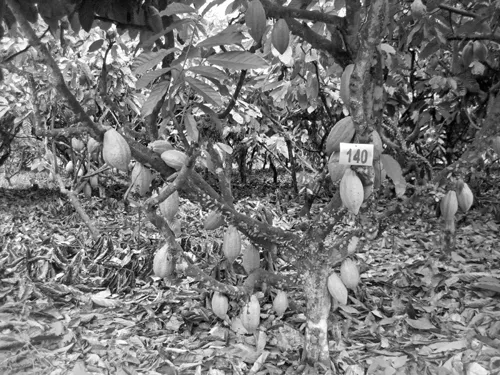
Cocoa (family Malvaceae, genus Theobroma) is indigenous to South America and grows mostly in tropical regions that are 20 degrees north and south of the equator. Annual rainfall of at least 1000 mm but not more than 3000 mm is conducive for cocoa planting with a temperature variation of around 18–32°C. Countries such as Côte d’Ivoire, Ghana, Brazil, Ecuador, Indonesia, Malaysia and Papua New Guinea are examples of countries that produce cocoa beans (Awua, 2002). Theobroma cacao (Figure 1.1) is the most widely cultivated species as compared to other lesser known species such as Theobroma bicolor and Theobroma grandiflorum (Toxopeus, 1985).
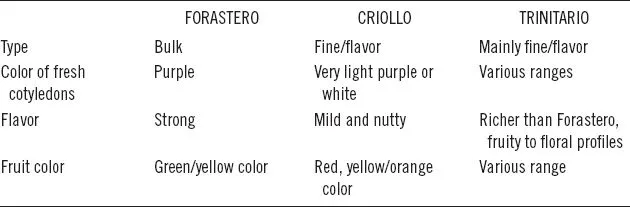
The scientific name Theobroma cacao was given by Carl Linnaeus, a Swedish botanist, in his book Species Plantarum in 1753. In Latin, Theobroma means “Food of the Gods” and cacao is derived from the Nahuatl (Aztec) word “xocolatl.” The main varieties of T. cacao that are planted on commercial farms are Forastero, Criollo and Trinitario (Hancock and Fowler, 1994). The Trinitario variety is a hybrid of the Forastero and Criollo trees. In the current cocoa market, most of the beans traded are from Forastero trees and are commonly known as “bulk” cocoa while the Criollo beans are known as the “fine” or “flavor” cocoa which is associated with its unique flavor. Prior to ripening, the color of the cocoa fruits can range from green to red or purple; eventually turning to yellow or orange as they ripen. A ripe cocoa fruit contains beans that are covered with sweet, white mucilaginous pulps. Typically, each cocoa fruit contains about 30–50 fresh beans, but the Criollo fruit usually contains a lesser number of beans (< 30). Table 1.1 shows the characteristics of the three main cocoa varieties as mentioned above.
Table 1.1 Characteristics of Forastero, Criollo and Trinitario Cocoa Beans
1.2.2 Coffee
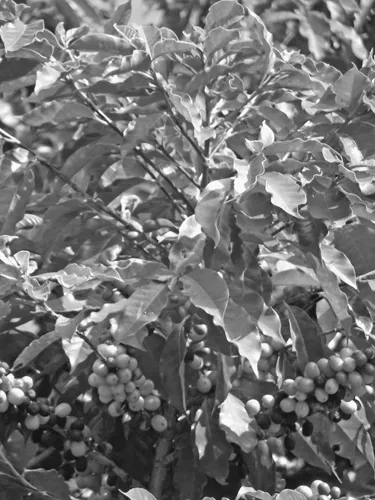
The coffee plant (Figure 1.2) belongs to the Rubiaceae family and two genus species: Coffea and Psilanthus. The Coffea genus has over a 100 species, all originating from the equatorial region of Africa. Although the species diversity of the Coffea genus is very significant, two are the most widely produced worldwide for commercial purposes, Coffea arabica L. and Coffea canephora Pierre. (Carvalho, 2008).
Among the species of the Coffea genus, C. arabica L. is the one that exhibits the most widely appreciated sensory profile internationally. The beverage obtained from this species is generally described as aromatic, flavorful and pleasant to the taste. Nevertheless, some genotypes of C. canephora Pierre produce beverages with sensory scores appreciated in various markets and classified as being of good quality.
Although the species C. arabica L. has a number of varieties cultivated around the world, its genetic basis is quite narrow. Most of the known cultivars are derived from two botanical forms: typica and bourbon. On the other hand, the diversity of C. canephora Pierre varieties is much broader (Carvalho, 2008). C. arabica L. is understory vegetation from deciduous forests of the southwest of Ethiopia. These are high altitude regions, from 1300 to 2800 m, with mean annual temperatures from 18 to 21°C and total annual rainfall from 1300 to 1800 mm. The four driest months are November to February, with approximately 10% of the total annual rainfall. This is the vegetative resting period for the coffee tree. Flowering is stimulated at the beginning of the rainy period in March, associated with photoperiods greater than 12 hours daily. C. arabica L. is commercially produced in the equatorial high plateau regions of Africa, Central America, South America, Mexico, India and Indonesia, mainly under tree cover. In Kenya, Brazil and Colombia, Arabica coffee is mainly grown in the full sun (Meireles and Volpato, 2007; Pereira et al., 2008a).
C. canephora Pierre is vegetation from rainforests of the Congo River basin, near Lake Victoria, regions with altitudes of up to 1000 m, mean annual temperatures from 22 to 26°C and total an...