- 208 pages
- English
- ePUB (mobile friendly)
- Available on iOS & Android
eBook - ePub
About this book
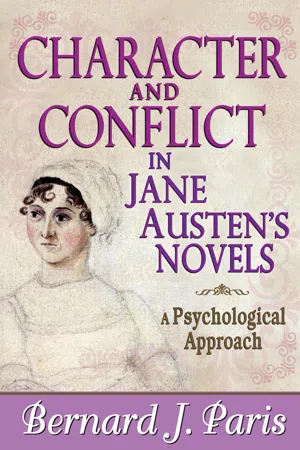
In Character and Conflict in Jane Austen's Novels , Bernard J. Paris offers an analysis of the protagonists in four of Jane Austen's most popular novels. His analysis reveals them to be brilliant mimetic creations who often break free of the formal and thematic limitations placed upon them by Austen. Paris traces the powerful tensions between form, theme, and mimesis in Mansfield Park , Emma , Pride and Prejudice , and Persuasion . Paris uses Northrop Frye's theory of comic forms to analyse and describe the formal structure of the novels, and Karen Horney's psychological theories to explore the personalities and inner conflicts of the main characters. The concluding chapter turns from the characters to their creator, employing the Horneyan categories of self-effacing, detached, and expansive personality types to interpret Jane Austen's own personality. Readers of Jane Austen will find much that is new and challenging in this study. It is one of the few books to recognise and pay tribute to Jane Austen's genius in characterisation. Anyone who reads this book will come away with a new understanding of Austen's heroines as imagined human beings and also with a deeper feeling for the troubled humanity of the author herself.
Information
6
Jane Austen: The Authorial Personality
1
We know many of the facts of
Jane Austen’s life; but there is little evidence, outside of her writings, of her attitudes, values, and beliefs, and of the dynamics of her personality. Her letters, after Cassandra’s excisions, are not highly revealing; and she did not move among literary people who could have left us penetrating accounts of her character. I believe that we can learn a good deal about Jane Austen by analyzing the personality which can be inferred from all of her fiction. I shall call this her authorial personality to distinguish it from the implied authors of her individual novels and from the historical person, who had a life independent of her artistic creations.
Jane Austen’s life; but there is little evidence, outside of her writings, of her attitudes, values, and beliefs, and of the dynamics of her personality. Her letters, after Cassandra’s excisions, are not highly revealing; and she did not move among literary people who could have left us penetrating accounts of her character. I believe that we can learn a good deal about Jane Austen by analyzing the personality which can be inferred from all of her fiction. I shall call this her authorial personality to distinguish it from the implied authors of her individual novels and from the historical person, who had a life independent of her artistic creations.
I shall analyze Austen’s authorial personality with the aid of Horneyan psychology, which, as I have shown, is congruent with a great many aspects of her fiction.1 This approach will lead me to focus, of course, upon those phenomena to which it is well suited. I do not rule out the use of other psychological theories, which may reveal different aspects of Austen’s personality; but, for the most part, I have left that task to others. Though I shall draw upon a general knowledge of Austen’s life when I try to trace her development from novel to novel, my portrait of her is based primarily upon what can be learned from her fiction; and I shall make no attempt to trace the etiology of her character or to integrate my findings with the biographical data. To do so would require a separate study.
We must be careful, of course, when making inferences about an author from his fictions. We must allow for artistic motivations, for the requirements of the genre and of the telos of the individual work. A writer of comedy does not necessarily believe that the real world operates according to the mythos of Spring, and works of art have an inner logic of their own which often takes the author in unexpected directions. Still, we can learn much about an author from his works by examining such things as his recurring preoccupations, the personal element in his fantasies, the kinds of characters he creates, and his rhetorical stance. Although Jane Austen’s authorial personality may not be identical in all respects with that of the historical person, it provides the richest source of insight into her character structure and her inner life.
Horneyan psychology can help to illuminate the author through his works because in the course of artistic creation the author’s defensive strategies tend to express themselves in a variety of ways. His works are, among other things, efforts to reinforce his predominant solution and to resolve his inner conflicts by showing himself, as well as others, the good and evil consequences of the various trends which are warring within him. He will tend to glorify characters whose strategies are similar to his own and to satirize those who embody his repressed solutions. His rhetoric will affirm the values, attitudes, and traits of character which are demanded by his dominant shoulds, while rejecting those which are forbidden by his major solution. His plots will often be fantasies in which his claims are honored in a magical way, while his repressed strategies are shown to bring misery and retribution. Because he cannot help expressing his subordinate trends, however, his works will frequently manifest his inner conflicts. His attitudes, values, and beliefs will often be inconsistent or self-contradictory. His conflicting shoulds will lead him to criticize each solution from the point of view of the others and to have toward his characters the mixed feelings which he has toward the aspects of himself which they embody. The relationships among his solutions may vary, moreover, in the course of his life; and this will be reflected in changes in the kinds of characters he portrays, in his rhetoric, and in his dominant fantasies.
All of this may seem readily applicable to a tormented artist like Dostoevsky, but of dubious relevance to so poised a novelist as Jane Austen. A look at the criticism reveals, however, that there are fierce disagreements about Austen’s true character. As I have observed, some critics emphasize the aggressive, satirical component of her art; some stress her gentleness and conservatism; and some focus upon the detached, ironic quality of her vision. A psychological analysis of Austen’s authorial personality will show how these diverse components of her nature are related to each other within a structure of inner conflicts.
2
The major unvarying element in Jane Austen’s fiction is a code of values and conduct that serves as the norm by which all deviations are satirized and judged. The code is not always what the fiction is primarily about, and different aspects of it are explored in different works; but it is almost always present in one form or another, and no character gains Austen’s sympathy or approval who does not either subscribe to it from the beginning or come to feel its force at some point in his development. Austen associates the code at various times with such influences as religion, education, and example; but it is often embraced in the absence of good training, desirable models, or the support of the surrounding community. It has the independent authority of self-evident truth. Those who are faithful to it seem to be innately superior to their fellows in intelligence, disposition, or rationality. Experience is important, however; for some well-endowed people are irremediably corrupted by bad influences, while others need to err and suffer in order to be purged of their faults.
The code embraces six major areas of life: family relations, courtship and marriage, friendship, everyday social intercourse, duties to oneself, and duties to the community. Different aspects of the code are operative for different individuals, depending upon their age, sex, economic status, and social and familial roles; but its general principles are always the same. The values which it endorses include prudence, judgment, good sense, self-knowledge, sensitivity, perceptiveness, propriety, civility, self-control, sincerity, integrity, respect for authority, dutifulness, responsibility, unselfishness, consideration of others, self-denial, humility, gratitude, moderation, patience, fortitude, tenderness, generosity, warm feeling, domestic affection, and the sanctifi-cation of marriage by love and mutual esteem. Deviations from the code result from selfishness, stupidity, ill-nature, self-indulgence, pride, ambition, materialism, vanity, or commitment to a competing code which glorifies opposite values.
One competing code is that which is associated with the cult of sensibility. Austen ridicules it in the Juvenilia, most notably in “Love and Freindship,” and subjects it to serious criticism in Sense and Sensibility. In “Love and Freindship,” Laura not only ignores, but consciously scorns proper values and takes an intense pride in her own false standards. She is boastful, self-indulgent, ungrateful, dishonest, irresponsible, and insensitive to the rights of others. She judges by externals, falls in love at first sight, and marries her hero within an hour of their meeting. She wears her “sensibility too tremblingly alive to every affliction of [her] Freinds, [her] Acquaintance and particularly to every affliction of [her] own” as a badge of honor.2 She has contempt for the few sensible characters she encounters (see pp. 83, 93, 100-101) and worships those who share her own perverted code of values. Her husband, Edward, is a model of filial impiety. “Tt is my greatest boast,’” he proclaims,” ‘that I have incurred the displeasure of my Father!’” (p. 85). Her friends, Augustus and Sophia, are self-absorbed (p. 87), improvident, and dishonest. They “scorned to reflect a moment on their pecuniary Distresses and would have blushed at the idea of paying their Debts” (p. 88). Sophia ultimately dies from her excess of sensibility. When Edward and Augustus are killed in an accident, Sophia faints “every moment” and Laura runs mad “as often” (p. 99). So...
Table of contents
- Cover Page
- Half title
- title
- copy
- dedication
- Content
- fmchapter
- preface
- Form, Theme, and Mimesis
- Mansfield Park
- Emma
- Pride and Prejudice
- Persuasion
- Jane Austen: The Authorial Personality
Trusted by 375,005 students
Access to over 1.5 million titles for a fair monthly price.
Study more efficiently using our study tools.
Frequently asked questions
Yes, you can cancel anytime from the Subscription tab in your account settings on the Perlego website. Your subscription will stay active until the end of your current billing period. Learn how to cancel your subscription
No, books cannot be downloaded as external files, such as PDFs, for use outside of Perlego. However, you can download books within the Perlego app for offline reading on mobile or tablet. Learn how to download books offline
Perlego offers two plans: Essential and Complete
- Essential is ideal for learners and professionals who enjoy exploring a wide range of subjects. Access the Essential Library with 800,000+ trusted titles and best-sellers across business, personal growth, and the humanities. Includes unlimited reading time and Standard Read Aloud voice.
- Complete: Perfect for advanced learners and researchers needing full, unrestricted access. Unlock 1.5M+ books across hundreds of subjects, including academic and specialized titles. The Complete Plan also includes advanced features like Premium Read Aloud and Research Assistant.
We are an online textbook subscription service, where you can get access to an entire online library for less than the price of a single book per month. With over 1.5 million books across 990+ topics, we’ve got you covered! Learn about our mission
Look out for the read-aloud symbol on your next book to see if you can listen to it. The read-aloud tool reads text aloud for you, highlighting the text as it is being read. You can pause it, speed it up and slow it down. Learn more about Read Aloud
Yes! You can use the Perlego app on both iOS and Android devices to read anytime, anywhere — even offline. Perfect for commutes or when you’re on the go.
Please note we cannot support devices running on iOS 13 and Android 7 or earlier. Learn more about using the app
Please note we cannot support devices running on iOS 13 and Android 7 or earlier. Learn more about using the app
Yes, you can access Character and Conflict in Jane Austen's Novels by Bernard J. Paris in PDF and/or ePUB format, as well as other popular books in Letteratura & Critica letteraria inglese. We have over 1.5 million books available in our catalogue for you to explore.