- 322 pages
- English
- ePUB (mobile friendly)
- Available on iOS & Android
eBook - ePub
About this book
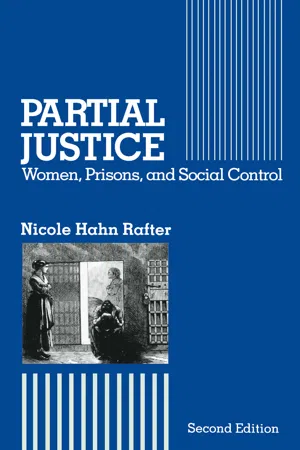
Contemporary Research on crime, prisons, and social control has largely ignored women. Partial Justice, the only full-scale study of the origins and development of women's prisons in the United States, traces their evolution from the late eighteenth century to the present day. It shows that the character of penal treatment was involved in the very definition of womanhood for incarcerated women, a definition that varied by race and social class. Rafter traces the evolution of women's prisons, showing that it followed two markedly different models. Custodial institutions for women literally grew out of men's penitentiaries, starting from a separate room for women. Eventually women were housed in their own separate facilities-a development that ironically inaugurated a continuing history of inmate neglect. Then, later in the nineteenth century, women convicted of milder offenses, such as morals charges, were placed into a new kind of institution. The reformatory was a result of middle-class reform movements, and it attempted to rehabilitate to a degree unknown in men's prisons. Tracing regional and racial variations in these two branches of institutions over time, Rafter finds that the criminal justice system has historically meted out partial justice to female inmates. Women have benefited in neither case. Partial Justice draws in first-hand accounts, legislative documents, reports by investigatory commissions, and most importantly, the records of over 4,600 female prisoners taken from the original registers of five institutions. This second edition includes two new chapters that bring the story into the present day and discusses measures now being used to challenge the partial justice women have historically experienced.
Information
PART I Development of the Women’s Prison System
CHAPTER 1 “Much and Unfortunately Neglected”: Women in Early and Mid-Nineteenth-Century Prisons
The early nineteenth century witnessed the emergence of one of the most dramatic innovations in the history of punishment: the penitentiary, a fortress-like institution designed to subject prisoners to total control. Although historians argue about why the penitentiary came into existence at that time, most agree about the nature of convict life within such prisons. According to the usual picture, penitentiaries were designed to isolate inmates from the moral contamination of other felons; unlike the very first state prisons, in which several inmates were held together in one room, penitentiaries separated convicts into individual cells. Some held prisoners in perpetual solitary confinement, while others herded them together during the day for labor. But in both “separate” and congregate penitentiaries, speech and even eye contact were forbidden. In congregate institutions especially, strict routines governed every activity. Convicts with shaven heads and identical striped uniforms rose with the morning bell, marched in lockstep to their meals and workshops, and returned in the evening to their cells. Officials scorned idleness as corrupting; they scheduled every moment of their charges’ lives, mainly for the labor that, in congregate penitentiaries, was expected to be financially profitable to the institution as well as morally profitable to the prisoners. “The doctrines of separation, obedience, and labor,” writes David Rothman in a typical description, “became the trinity around which officials organized the penitentiary.”1
Few historians of the penitentiary have noted that women as well as men inhabited these gloomy institutions. Had they investigated the treatment of incarcerated women, they would have found that in nearly every respect, it contradicted the usual picture of penitentiary discipline. Women were punished in nineteenth-century prisons, but few officials tried to transform them into obedient citizens through seclusion and rigorous routines.2
Even after states replaced their original prisons with penitentiaries, many continued to hold a number of women en masse in old-fashioned large cells, inside penitentiary walls but away from the men’s cellblocks. Women did not receive the supposed benefits of unbroken silence and individual isolation. Exempted from the most extreme forms of regimentation, they encountered other sorts of deprivation. Descriptions of women’s conditions in Jacksonian prisons emphasize the intolerable noise and congestion of their quarters. Whereas male prisoners were closely supervised, women seldom had a matron. Often idleness rather than hard labor was their curse. As time went on and women were transferred from large rooms to individual cells, their treatment became more like that of men. But in general, female convicts in nineteenth-century prisons experienced lower levels of surveillance, discipline, and care than their male counterparts. Describing the situation of women in his institution as “inhuman—barbarous—unworthy of the age,” one penitentiary chaplain concluded that “To be a male convict in this prison, would be quite tolerable; but to be a female convict for any protracted term, would be worse than death.”3
To illustrate these differences between the sexes, we will look in some detail at the conditions of women incarcerated from the late eighteenth through the mid-nineteenth centuries in the prisons of New York, Ohio, and Tennessee—the three states that this study will use throughout to exemplify penal practices in the Northeast, Midwest, and South. (Because the southern prison system developed more slowly than that of the Northeast and Midwest, several late nineteenth-century changes are used to illustrate southern practices; because the prison system of the West developed later still, no western representative is included here.) These examples indicate diversity in regional styles of incarceration, but they also show that women imprisoned in the various regions had much in common. Their conditions of confinement, while outwardly resembling those of men held in the same institutions, were often inferior.
DIFFERENTIAL PUNISHMENT: WOMEN IN THE PRISONS OF NEW YORK, OHIO, AND TENNESSEE
New York’s Newgate prison, opened in 1797 in the Greenwich Village section of New York City, was the first state institution established to hold felons only. In it, as in other prisons of the pre-penitentiary era, there were no marked differences in the handling of the sexes. Evenhandedness was not to remain the rule for long, but in Newgate and other original state prisons, officials had little alternative. Like Newgate’s male convicts, women were lodged in chambers “sufficient for the accommodation of eight persons.” Their quarters were separated, for women resided in a north wing with “a courtyard entirely distinct from that of the men”; yet the institution’s small size did not permit women to be isolated from the mainstream of prison life, as they were later isolated in penitentiaries. The women had no matron, but as several lived together in each room, they could protect one another from lascivious turnkeys. Thus they were less exposed to sexual attack than women later held in individual penitentiary cells. Newgate’s women were required to wash and sew, while the males were assigned to shoemaking and other manufactures. However, because profit making had not assumed the importance that it later did in penitentiary management, the women’s apparently lower productivity did not yet furnish an excuse for inequitable care.4
Treatment of both male and female felons changed radically when, about 1820, the penitentiary system was inaugurated at New York’s new Auburn State Prison. Auburn’s disciplinary methods—the individual cell, lockstep, prohibition on prisoner communication, harsh punishments for rule infractions, hard labor—captured the imagination of penologists throughout the western world and soon became staples in penal regimens. With the advent of penitentiary discipline, New York closed the outmoded Newgate, transferring that prison’s male inmates to Auburn. But women did not receive the benefits thought to accrue to penitentiary discipline for another decade. Instead they became pawns in a heated dispute between Auburn and another New York state penitentiary that opened somewhat later at Sing Sing. Neither wanted the women, who were shunned as a particularly difficult type of prisoner; each made strenuous efforts to ensure that females would be sent to the other location. While the men’s prisons engaged in this squabble, women formerly incarcerated at Newgate, along with others subsequently committed from the New York City area, were held at the city’s Bellevue Penitentiary.
At Bellevue, standards sank far below those established at the state penitentiaries, for aside from semiannual visits by the inspectors of Sing Sing (who technically had custody of these women), the female prisoners almost wholly lacked supervision. No matron was hired to attend to their needs and maintain order. Visiting state officials lamented the wretchedness of conditions at Bellevue: the impossibility of separating old from young, and hardened criminals from novices; the women’s “constant and unrestrained intercourse” (a fault of special seriousness at a time when most penologists endorsed the silent system); the poor quality and quantity of the food; the lack of a matron; and the absence of proper sanitary and security precautions (during a cholera epidemic, eight women died and eleven escaped). But these complaints had little effect on Bellevue’s officials, who also actively sought to avoid responsibility for the state’s female convicts.5
While these conditions prevailed for New York City-area women, courts in the western part of the state began, in 1825, to commit females to Auburn. There, however, they were housed not in cellblocks but in a third-floor attic above the penitentiary’s kitchen. Like their Bellevue counterparts, they suffered extreme neglect. Until a matron was hired in 1832, women at Auburn had no supervision. Once a day a steward delivered food and removed the waste, but otherwise prisoners were left to their own devices. Their lack of protection from one another, and the psychological strain of being forced to share an overcrowded, un ventilated space, sharply distinguished their care from that of men in the nearby cellblocks. Visiting in the early 1830s, Harriet Martineau reported a scene of almost complete chaos:
The arrangements for the women were extremely bad. . . . The women were all in one large room, sewing. The attempt to enforce silence was soon given up as hopeless; and the gabble of tongues among the few who were there was enough to paralyze any matron. . . . There was an engine in sight which made me doubt the evidence of my own eyes; stocks of a terrible construction; a chair, with a fastening for the head and for all the limbs. Any lunatic asylum ought to be ashamed of such an instrument. The governor [warden] liked it no better than we; but he pleaded that it was his only means of keeping his refractory female prisoners quiet while he was allowed only one room to put them all into.6
Reports such as Martineau’s—together with the scandal that ensued when one Auburn inmate became pregnant, was flogged while five months into her pregnancy, and later died—finally forced New York to construct regular quarters for its female felons. This was the Mount Pleasant Female Prison, to which Auburn and Bellevue inmates were transferred in 1839. Nearly two decades had passed since New York had indicated, at Auburn and Sing Sing, that individual cells, close supervision, and reformational discipline were desirable for prisoners.7
The development of Ohio’s prison system paralleled that of New York. Like Newgate, Ohio’s first prisons resembled large houses; they were relatively small buildings, and their cells opened off central corridors. In 1834, Ohio abandoned this nonsecure type of structure, substituting a penitentiary patterned after Auburn. Like Auburn and Bellevue, the Ohio penitentiary segregated female prisoners into separate quarters. But in two respects, the penal practices of Ohio diverged from those of New York. First, Ohio had much lower standards for handling prisoners of both sexes: throughout the nineteenth century, observers ranked the Ohio penitentiary as one of the worst prisons in the country. Diseases ravaged the population, administrative corruption flourished, and, as Dorothea Dix put it in an indictment scathing even for her, the institution was “so totally deficient of the means of moral and mental culture . . . that little remains to be said, after stating the fact.” Second, Ohio’s prisoner population was smaller than New York’s, reflecting its smaller general population. Whereas New York’s relatively large number of female convicts pushed the state into creating a separate women’s prison at mid-century, Ohio was able to wait until the early twentieth century to do so.8
The Ohio penitentiary developed a novel method of sequestering females, that of building a Women’s Annex adjacent to the institution but outside its front wall. Constructed in 1837, the annex was one of the earliest extramural structures in the country designed specifically for female state prisoners. Originally the annex consisted of eleven two-person rooms and a yard. Crowding later necessitated construction of additional cells, but because the annex had been jammed between the perimeter wall and the street, it could not be expanded, and the women’s quarters became increasingly cramped. Like the men’s section, the annex sometimes fell into such disrepair that it was impossible to keep out the elements. The wings of the men’s prison, “which have leaked for years,” were recovered in 1850 with cement. “The female prison has been served in the same way,” according to the annual report, but “Much more needs to be done by way of improvements.” Similar observations about the miserable state of the annex were made for the next sixty years.9
As in New York, segregation of women led to their neglect. The men’s section was patrolled by guards, but until 1846, the annex had no matron. Thereafter, owing to underfunding and political turmoil in the central administration, supervision remained sporadic and inadequate at best. As a result, discipline was often more lax for female than male prisoners. Lack of discipline was accompanied by absence of other forms of attention and control. Unguarded, the women were vulnerable to unwelcome sexual advances by male officials. Pandemonium sometimes prevailed. Gerrish Barrett, a representative of the Boston Prison Discipline Society who visited the Ohio penitentiary in the mid-1840s, reported that although there were only nine women, they gave more trouble than the five hundred male convicts. “The women fight, scratch, pull hair, curse, swear and yell, and to bring them to order a keeper has frequently to go among them with a horsewhip.” That there was some accuracy in Barrett’s description is indicated by Dorothea Dix’s independent observation of about the same period: “There was no matron in the woman’s wing at the time I was there, . . . and they were not slow to exercise their good and evil gifts on each other.” Later in the century, former prisoner Sarah Victor wrote, “[T]he knives had all been taken from the female department, to prevent some refractory prisoners from cutting each other, which they had done, in a terrible manner, at times. . . .”10
Even at the Ohio penitentiary, strict rules were sometimes imposed on women. Sarah Victor reported that in the early 1870s the “discipline of the prison was very strict . . . , the prisoners not being allowed to speak to each other. . . .” And on occasion, women were punished severely. Victor describes one women beaten so terribly “that she was black-and-blue all over her body.” She herself, when she arrived at the penitentiary about 1870, was kept in solitary confinement for five months. In 1880, a new matron alluded with awe to a brutal penalty used by her predecessor; she hoped never to resort to it herself. This was probably the “hummingbird,” a form of punishment that forced the naked offender to sit, blindfolded, in a tub of water while steam pipes were made to shriek and electric current was applied to the body.11
At times, then, women in the annex did taste the bitterness of penitentiary discipline. At others, they were practically free of control. But because leniency often went hand in hand with anarchy, it was not necessarily preferable to the austerities of a solitary cell and close surveillance.
Tennessee’s first prison, opened in Nashville in 1831, also adopted the Auburn system of convict discipline: inmates were brought together during the day for silent labor (for the women, mainly sewing), and at night they were locked in individual cells. For its first ten or fifteen years of operation, the Tennessee State Penitentiary was a relatively progressive institution. More than Ohio’s prison, it attempted to approximate New York’s standards of care. By 1845, however, decline had set in. Concern with maximizing profits from prison labor, combined with increasing preoccupation with the issue of slavery, corroded the quality of convict care. Tennessee started exhibiting the indifference to prisoner health and safety that came to characterize penal treatment throughout the South. On the eve of the Civil War the institution lacked an adequate water supply, and the warden was forced to inquire of the legislature, “What shall be done with the excrement arising in the prison in the future? You are aware it has been deposited on a vacant lot adjoining the prison property for the last fifteen years.” The Civil War destroyed any possibility that Tennessee might have returned to northern standards. As in other Southern states, the conflict severely damaged the prison system, and prisoners were virtually forgotten. After it was over, as Chapter 6 shows in more detail, the penitentiary filled with newly freed blacks and began to replicate the techniques of slavery.12
Few women were held in Tennessee’s penitentiary before the Civil War. The first male prisoners had arrived in 1831; the first woman, sentenced to the institution in 1840, had been preceded by 453 men. According to the convict record book, only thirty-one other women arrived over the next quarter of a century. In outward respects, they received care similar to that of men. Apparently they were not even isolated in a separate section of the prison. In the early 1840s Governor James K. Polk appealed for “suitable apartments” in which to segregate the women, but his recommendation went unheeded for four decades. So egalitarian was the penitentiary in its treatment of the sexes that, after the Civil War, it sent women to labor alongside men in coal mines and on railroads.13
But despite surface similarities between the care of female and male prisoners, women held at the Tennessee penitentiary in fact experienced disadvantages. Because of their low commitment rate, the...
Table of contents
- Cover Page
- Half Title Page
- Title Page
- Copyright Page
- Dedication
- Contents
- Tables and Figures
- Preface To The Second Edition
- Acknowledgments
- Preface
- Introduction
- Part I. Development of the Women’s Prison System
- Chapter 1 “Much and Unfortunately Neglected”: Women in Early and Mid-Nineteenth-Century Prisons
- Chapter 2 Origins of the Women’s Reformatory, 1870–1900
- Chapter 3 The Women’s Reformatory Movement, 1900–1935: From Success to Decline
- Chapter 4 Custodial Prisons For Women, 1870–1935
- Part II. The Implementation of Punishment
- Introduction
- Chapter 5 Conviction Offenses, Sentences, and Prisoners at Five Institutions
- Chapter 6 Race and Racism in State Prisons Holding Women, 1865–1935
- Chapter 7 The Realization of Partial Justice: A Case Study of The Social Control of Women
- Chapter 8 The Third Stage: The Women’s Prison System Since 1935
- Part III. Gender and Justice
- Chapter 9 Sex Discrimination in the Prison System: New Responses to the Perennial Problem
- Appendix A States in the Regional Divisions
- Appendix B Offense Categories-Definitions
- Appendix C Data Collection from Registries of Prisoners: Materials and Sampling Procedures
- Notes
- Selected Bibliography
- Index
Trusted by 375,005 students
Access to over 1.5 million titles for a fair monthly price.
Study more efficiently using our study tools.
Frequently asked questions
Yes, you can cancel anytime from the Subscription tab in your account settings on the Perlego website. Your subscription will stay active until the end of your current billing period. Learn how to cancel your subscription
No, books cannot be downloaded as external files, such as PDFs, for use outside of Perlego. However, you can download books within the Perlego app for offline reading on mobile or tablet. Learn how to download books offline
Perlego offers two plans: Essential and Complete
- Essential is ideal for learners and professionals who enjoy exploring a wide range of subjects. Access the Essential Library with 800,000+ trusted titles and best-sellers across business, personal growth, and the humanities. Includes unlimited reading time and Standard Read Aloud voice.
- Complete: Perfect for advanced learners and researchers needing full, unrestricted access. Unlock 1.5M+ books across hundreds of subjects, including academic and specialized titles. The Complete Plan also includes advanced features like Premium Read Aloud and Research Assistant.
We are an online textbook subscription service, where you can get access to an entire online library for less than the price of a single book per month. With over 1.5 million books across 990+ topics, we’ve got you covered! Learn about our mission
Look out for the read-aloud symbol on your next book to see if you can listen to it. The read-aloud tool reads text aloud for you, highlighting the text as it is being read. You can pause it, speed it up and slow it down. Learn more about Read Aloud
Yes! You can use the Perlego app on both iOS and Android devices to read anytime, anywhere — even offline. Perfect for commutes or when you’re on the go.
Please note we cannot support devices running on iOS 13 and Android 7 or earlier. Learn more about using the app
Please note we cannot support devices running on iOS 13 and Android 7 or earlier. Learn more about using the app
Yes, you can access Partial Justice by Nicole Hahn Rafter,Nicole Rafter in PDF and/or ePUB format, as well as other popular books in Social Sciences & North American History. We have over 1.5 million books available in our catalogue for you to explore.