- 400 pages
- English
- ePUB (mobile friendly)
- Available on iOS & Android
eBook - ePub
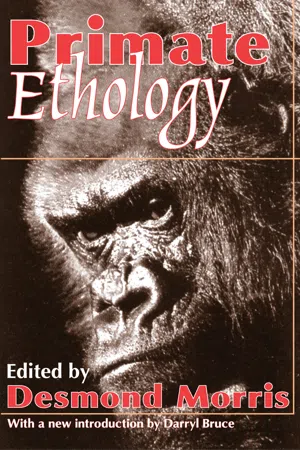
Primate Ethology
About this book
This is a groundbreaking workwhich brought together studiesof monkeys and apes from boththe laboratory and the field. Manybroad aspects of primate life,including facial expressions,sexual signals, grooming, play,social organization and parental care, are covered bythe contributors and provided a whole new approach toprimate behavior.
Information
Chapter One
Introduction : The Study of Primate Behaviour
DESMOND MORRIS
THE objective investigation of primate behaviour is probably the most demanding branch of zoological study. There are two reasons for this. Firstly, monkeys and apes are so intelligent, their brains so advanced, their social organizations so intricate and variable, that the student of animal behaviour can easily become dazzled by the complexity of the scene. All too often in the past he has stood at the edge of the problem, gesticulating airily with expansive generalizations, or puffing himself up with elaborate but fact-starved theories.
Alternatively, if he has been sufficiently subjected to experimentalist indoctrination, he has defended himself by plunging head-first into some minute facet of primate life, where the scale of the task is so limited that he can feel reasonably secure, and can quickly assemble fashionable quantifications.
Secondly, monkeys and apes are so closely related to the human animal that the dangers of anthropomorphism are constantly present. This ‘humanizing’ can be deliberate or accidental. In the former case, the primate is purposely used as a substitute for man in some rigorous test situation, with the specific intention of applying the results obtained from the animal to a human context. In particular, medical and psychiatric research has utilized primates extensively in this way, but this can hardly be classified as a true study of primates as primates ; it is the study of primates as dummy-humans, and anything we learn about them as unique zoological specimens here is a purely secondary benefit.
Accidental ‘humanizing’ of primate activities can distort objectivity in a subtle but damaging way. If a zoologist sees that an animal such as a fish has, say, a ‘fierce expression’ he will be in little danger of drawing the conclusion that this generally indicates an aggressive motivation. He will be aware that the facial expression of the fish is entirely fortuitous, the result merely of a special configuration of jaw muscles and bones that give it an obviously accidental resemblance to human ‘fierceness’. The anthropomorphism is so far-fetched that it is clearly recognized and discarded. But when an observer notes a ‘fierce expression’ on the face of a monkey or an ape, he is less likely to discard it. Monkeys and apes do, after all, possess aggressive facial expressions and they are, of course, closely related to the faces made by man. Closely related, yes, but identical, no; hence the real danger of anthropomorphic distortion. The student of primate behaviour must be constantly aware of this problem. He must work hard to keep a perfect balance when recording the similarities and the differences between man and his primate relatives.
In addition to these theoretical difficulties there are also formidable practical obstacles to be overcome, both in the laboratory and the field. In the laboratory it is possible to keep a vast army of rats or mice in the space required by a mere handful of monkeys or apes. A million fruit-flies can be housed in the area required for a dozen apes. Furthermore, primates are expensive to feed, difficult to keep clean, hard to handle, and often dangerous. If they are maintained in typical laboratory cages it is impossible to study any but their simplest behaviour patterns. If they are set up in a social group, then a large enclosure is required and it immediately becomes difficult to manipulate or control the individual members of the group for experimental purposes. A fish, a small bird, or a rat can be put into a social group or removed from it in a matter of seconds by means of a small hand-net, or some similar device. To perform the same operation with a monkey in a colony can easily become a major undertaking.
In the field, observations also provide special difficulties for the primatologist. Birds have fixed nesting-sites, display grounds, or feeding areas. Monkeys and apes tend to be more nomadic, the groups perpetually moving from place to place in an extensive home range. The good field observer must copy them, must roam with them, often in an unfriendly and hazardous environment. Even when face to face with them at close quarters there is the frustrating problem of the branch or clump of leaves behind which the monkey performers disappear at a vital moment in a behaviour sequence.
Given all these disadvantages and difficulties, how exactly has the study of primate behaviour fared? How did it begin and what advances have been made in recent years? There is little to record of any importance in pre-Darwinian times, and this is not surprising. Only after Darwin had clarified the nature of the true evolutionary relationship between man and the monkeys and apes, were these difficult objects of study considered to be worth the special trouble their serious investigation demanded. Previously they had been looked upon as some strange kind of’counterfeit’ of the human, interesting enough for morphological comparisons in order, as the nineteenth-century anatomist Richard Owen put it, to appreciate ‘those modifications by which a material organism is especially adapted to become the seat and the instrument of a rational and responsible soul’, but still ‘brute beasts’ unworthy of comparison with rational man when it came to the question of behaviour.
Early on in the post-Darwinian epoch a number of authorities began to realize that our new-found relatives demanded a closer scrutiny. It took an interestingly distorted form:
In effect, Darwin set off two trends (in the present context). One was to consider the behaviour of living animals, especially monkeys and apes, as worthy of detailed scientific study. As our near relations, their way of life became of more than passing interest. The other development, which accompanied it, was the ‘uplifting’ of our poor relatives to a level that, while keeping them in a suitably inferior status, nevertheless raised them to a plane that did not disgrace their richer, human cousins. ... The gap between monkey and man is narrowed - to satisfy Darwinism - while man remains on his pedestal - to satisfy the church. (From Men and Apes by Ramona and Desmond Morris, pp. 151-2.)
Observations in zoos and occasionally in the field were all heavily biased towards showing how startlingly complex and advanced were the social and other behavioural activities of our simian relations. It was over half a century later before the dust from the Darwinian explosion had settled sufficiently for the air to be clear enough to see what primates really did and did not do. In the 1920s and early 1930s a number of independent pioneering studies were undertaken that set off a new epoch of primate behaviour investigation. On the Canary Islands the German Wolfgang Kohler carried out his now classic tests of chimpanzee intelligence. In Moscow Nadie Kohts began an intensive comparison of the behaviour patterns of a young chimpanzee and a human infant. In the United States, Robert Yerkes set up a major ape station at Orange Park in Florida. In London, Solly Zuckerman made a detailed study of the social behaviour of a large colony of baboons at the Regent’s Park Zoo. Harold Bingham, Henry Nissen and C. R. Carpenter all ventured into the field to investigate respectively, gorillas, chimpanzees and howler monkeys.
From these individual and separate endeavours came an exciting new picture of the primate way of life. The stage was set for a coordination of the new findings and an extensive attack on a broad front of the whole primate problem. Unhappily this did not follow. Instead, World War II concentrated attention strictly on to the aggressive behaviour of a single primate species.
After the war, comparative primate studies were slow to start again. The momentum had been lost. It was as if man’s own behaviour had not endeared him to the group of which he was a member. A decade passed before serious work began again on any appreciable scale. Then, with increasing rapidity, field and captive studies were planned and initiated. Research workers from the United States, Switzerland and Britain took to the field again, concentrating their efforts largely in Africa. In Japan a flourishing Monkey Centre was established at Inuyama. In the last few years more and more laboratory behaviour studies on a wide variety of primate species have been set in motion, especially in the United States where, during the first half of the present decade, government grants of nearly twenty million dollars were made available to enable the establishment of seven major Regional Primate Research Centres. Primate investigations are no longer isolated individual projects, but concerted and co-ordinated programmes involving thousands of monkeys and apes and hundreds of research workers.
Much work of great value is being carried out, but there is a risk that, in the rush, certain aspects of the problem or, to be more precise, certain approaches to it, will be given insufficient attention. To understand why this danger should exist it is necessary to look back again at the inter-war period. At that time there were two major approaches to the study of animal behaviour in general: comparative psychology and comparative ethology. The former was well established, the latter a struggling newcomer. Comparative psychologists were concentrating almost entirely on the white rat and on strictly experimental work in the laboratory. If they called themselves ‘comparative’, the comparison was a narrow one: the rat was compared with man. They were not trained as zoologists and lacked an evolutionary or functional approach - even scorned it. The comparative ethologists, under the leadership of Konrad Lorenz and Niko Tinbergen, were zoologists who felt that there was more to animal behaviour than rats running mazes or pressing levers. They worked in the field as well as in the laboratory and were basically Darwinian in approach. They stressed the importance of controlled experimentation but insisted that it must be relevant to the species under study. This relevance, they claimed, could not be established without an initial period of prolonged observation covering as much as possible of the whole behaviour repertoire of a species. Their basic unit of behaviour became the ‘fixed motor pattern’. Their initial records in any investigation were ‘ethograms’ listing the nature and context of every classifiable action performed by the animal in question. Their further analyses attempted to unravel the inter-relationships between these actions, and their functions, causations and possible derivations. Whereas the comparative psychologists had reduced the stimuli and the responses to the most easily managed minimum and concentrated on the intervening variables, the ethologists attempted to take into their sphere of interest as many natural stimuli and responses as possible. Also, they were truly comparative, frequently investigating many related species alongside one another at the same time.
If comparative ethologists considered comparative psychologists too narrow and artificial in their approach to behaviour, it could, of course, be levelled at the ethologists that they were too broad, that they were little more than scientifically respectable ‘natural historians’. It could be argued that by trying to encompass too much they could never hope to produce any really detailed analyses. The ethologists were fully aware of this difficulty and dealt with it to some extent by avoiding what they considered to be the more behaviourally complex forms of animal life. They restricted themselves almost entirely to insects, fish and birds and concentrated on the more rigidly fixed patterns of inborn behaviour. Mammals, especially primates, were avoided.
When ethology was gaining momentum after the war the fish and birds still held the centre of the stage, but during the past decade certain of the younger ethologists from the ranks of those trained by Konrad Lorenz and Niko Tinbergen, or by their pupils, have been becoming increasingly interested in primate behaviour. They have been dissatisfied by certain aspects of existing primate research, especially by the lack of zoological and evolutionary lidnking. Most primate behaviour research workers have, in fact, been drawn from the worlds of psychology and anthropology, and too little attention has been paid to detailed observation and motor pattern description.
By bringing together in this present volume, for the first time, the results of a variety of ethological attacks on primate behaviour problems, it is hoped that the great value of this type of approach will become evident. Whatever happens, it is clear that ethology is inevitably going to infiltrate this important area of scientific research, but I would like to think that by assembling these papers and presenting them as a volume at the present moment in the history of primatology, it will in some small way help this process along and that the infiltration will be more readily recognized and accepted.
Of the ten contributors, three (Morris, Moynihan and Blurton Jones) were trained by Tinbergen, and one (Hinde) came under his influence at an early stage. Three (van Hooff, Sparks and Loizos) studied under Morris, two (Rowell and Goodall) under Hinde and one (Wickler) under Lorenz. Wickler, like myself, made his earliest research studies on fish; Hinde, Moynihan, Blurton Jones and Sparks on birds. They have approached monkeys and apes from the humbler side of the evolutionary scale, looking up at them from simpler, less brainy species, rather than down from the dizzy behavioural heights of man. In so doing they have, I think, illuminated the subject in a new and exciting way.
Chapter Two
The Facial Displays of the Catarrhine Monkeys and Apes
J. A. R. A. M. VAN HOOFF
INTRODUCTION
IN the last few years a considerable number of publications have appeared dealing with the expression movements of primates, especially the facial expressions and calls. Five of these (Hinde and Rowell, 1962; van Hooff, 1962; Andrew, 1963a and c; Bolwig, 1964), pay tribute in their opening phrases to Darwin who in 1872 was the first to attempt a systematic, comparative description of the principal expression movements of man and a number of other mammals, especially primates. His interest was mainly focused on the complex mammalian displays, known as facial expressions. Although since that time much work has been done on the behaviour and sociology of primates (for a review see Carpenter, 1958), no comprehensive study of the above-mentioned specialized method of communication has been made, except for the classic work on the chimpanzee by Kohts (1935). As in other early studies that occasionally touch on the subject, Koht’s and Darwin’s interpretation of the expressions do not go much deeper than a rather anthropomorphic labelling of these in terms such as ‘attention’, ‘astonishment’, ‘anger’, ‘timidness’, and so on.
The rise of comparative ethology in recent decades has provided a great amount of data as well as a theoretical foundation in connection with, among other things, the kinds of behaviour known as displays (see, for instance: Tinbergen, 1948, 1959; Lorenz, 1951, i960; Eibl-Eibesfeldt, 1957; Marler, 1959).
This development has obviously inspired a number of workers to turn their attention to the analysis of primate displays. These studies, all qualitative so far, have been started independently of each other. Hinde and Rowell (1962) have described a number of postures and facial expressions in the rhesus monkey {Macaca mulatta), which are likely to play a rôle in communication between individuals, and have made an attempt to interpret these. With the help of spectrographic analysis, they have been able to distinguish a considerable number of calls in this species (Rowell and Hinde, 1962). An account of the major categories of displays in which the facial structures take part has been given by van Hooff (1962) for the higher primates, especially the Old World monkeys and apes. A similar study has been made by Bolwig (1964). An extensive inventory, especially of calls of representatives of the major groups of lower and higher primates has been made by Andrew (1963a), who shows particular interest in the derivation and evolution of calls and facial expressions. The social behaviour patterns of the night monkey (Aotus trivirgatus) form the subject of a recent publication by Moynihan (1964).
The present paper closely follows van Hooff (1962). Unless otherwise stated, the observational data have either been taken from this publication or have been newly added.
Conditions Influencing the Appearance of Facial Displays in Mammals
Elsewhere (van Hooff, 1962) the conditions which have facilitated the development of a system of facial postures and movements which may serve as social signals have been considered extensively. These postures and movements suppose the presence of a more or less elaborate system of facial muscles.
In cold-blooded vertebrates and to a certain extent in birds, this system is still of a relatively simple nature. It is, throughout the vertebrates, served by the nervus facialis, which in the vertebrate ground plan innervates the part of the serially arranged musculus constrictor superficialis, belonging to the second segment of the hyoid arch. This muscle complex is attached to the branchial skeleton and serves the respiratory mechanism. In amphibians the afore-mentioned segment of this complex has become independent and has split up in two layers, of which the lower, in the facial region, gives rise to the m. depressor mandibular Reptiles show a similar situation; the superficial layer has formed the m. sphincter colli, which has a large extension in birds, especially in the long-necked species. In mammals this m. sphincter colli has split up again on two layers : the superficial platysma and the deep sphincter colli. Both extend their territory well into the...
Table of contents
- Cover Page
- Title Page
- Copyright
- Introduction to the Aldine Transaction Edition
- Chapter One Introduction: The Study of Primate Behaviour
- Chapter Two The Facial Displays of the Catarrhine Monkeys and Apes
- Chapter Three Socio-sexual Signals and their Intra-specific Imitation among Primates
- Chapter Four Allogrooming in Primates: a Review
- Chapter Five Play Behaviour in Higher Primates: a Review
- Chapter Six Variability in the Social Organization of Primates
- Chapter Seven Comparative Aspects of Communication in New World Primates
- Chapter Eight The Effect of Social Companions on Mother-Infant Relations in Rhesus Monkeys
- Chapter Nine Mother-Offspring Relationships in Free-ranging Chimpanzees
- Chapter Ten An Ethological Study of Some Aspects of Social Behaviour of Children in Nursery School
Trusted by 375,005 students
Access to over 1.5 million titles for a fair monthly price.
Study more efficiently using our study tools.
Frequently asked questions
Yes, you can cancel anytime from the Subscription tab in your account settings on the Perlego website. Your subscription will stay active until the end of your current billing period. Learn how to cancel your subscription
No, books cannot be downloaded as external files, such as PDFs, for use outside of Perlego. However, you can download books within the Perlego app for offline reading on mobile or tablet. Learn how to download books offline
Perlego offers two plans: Essential and Complete
- Essential is ideal for learners and professionals who enjoy exploring a wide range of subjects. Access the Essential Library with 800,000+ trusted titles and best-sellers across business, personal growth, and the humanities. Includes unlimited reading time and Standard Read Aloud voice.
- Complete: Perfect for advanced learners and researchers needing full, unrestricted access. Unlock 1.5M+ books across hundreds of subjects, including academic and specialized titles. The Complete Plan also includes advanced features like Premium Read Aloud and Research Assistant.
We are an online textbook subscription service, where you can get access to an entire online library for less than the price of a single book per month. With over 1.5 million books across 990+ topics, we’ve got you covered! Learn about our mission
Look out for the read-aloud symbol on your next book to see if you can listen to it. The read-aloud tool reads text aloud for you, highlighting the text as it is being read. You can pause it, speed it up and slow it down. Learn more about Read Aloud
Yes! You can use the Perlego app on both iOS and Android devices to read anytime, anywhere — even offline. Perfect for commutes or when you’re on the go.
Please note we cannot support devices running on iOS 13 and Android 7 or earlier. Learn more about using the app
Please note we cannot support devices running on iOS 13 and Android 7 or earlier. Learn more about using the app
Yes, you can access Primate Ethology by Pendleton Herring,Desmond Morris in PDF and/or ePUB format, as well as other popular books in Biological Sciences & Zoology. We have over 1.5 million books available in our catalogue for you to explore.