- 479 pages
- English
- ePUB (mobile friendly)
- Available on iOS & Android
eBook - ePub
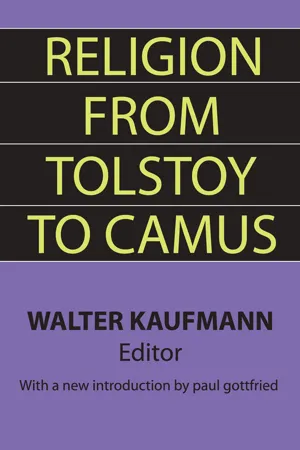
Religion from Tolstoy to Camus
About this book
Walter Kaufmann devoted his life to exploring the religious implications of literary and philosophical texts. Deeply skeptical about the human and moral benets of modern secularism, he also criticized the quest for certainty pursued through dogma. Kaufmann saw a risk of loss of authenticity in what he described as unjustied retreats into the past. This is a compilation of signicant texts on religious thought that he selected and introduced.
Information
Introduction
Religion from Tolstoy to Camus
The story of religion, whether in Biblical times or in the last three quarters of a century, is not reducible to the superficialities of the masses and the subtleties of priests and theologians. There are also poets and prophets, critics and martyrs.
It is widely recognized that one can discuss religious ideas in connection with works of literature, but exceedingly few poets and novelists have been movers and shakers of religion. Leo Tolstoy, who was just that, has not been given the attention he deserves from students of religion. With all due respect to twentieth-century poets and novelists who are more fashionable, it is doubtful that any of their works have the stature of Tolstoy's Resurrection. This novel does not merely illustrate ideas one might like to discuss anyway but aims rather to revise our thinking about morals and religion. To say that Tolstoy was a very great writer, or even that his stature surpassed that of any twentieth-century theologian, may be very safe and trite. But a much bolder claim is worth considering: perhaps he is more important for the history of religion during the century covered in this volume than any theologian; perhaps he has contributed more of real importance and originality and issues a greater challenge to us. That is why his name appears in the title of this book, and why he has been given more space than anyone else.
Those who follow are a heterogeneous group, selected not to work toward some predetermined conclusion but to give a fair idea of the complexity of our story. The work of the theologians has been placed in perspective, no less than that of the literary figures, philosophers, and others who are not so easy to classify.
Almost all the men included were "for" religion, though not the popular religion which scarcely any great religious figure has ever admired. Like the prophets and Jesus, like the Buddha and Luther, these men were critical of much that was and is fashionable; but their point was for the most part to purify religion. Only three of the twenty-three represented here wrote as critics of religion without being motivated by an underlying sympathy: Nietzsche, Freud, and Morris Cohen.
No effort has been made to give proportional representation to various denominations. As it happens, Roman Catholicism and the Greek Orthodox church, Judaism, atheism, and various forms of Protestantism are all represented by at least one adherent; but with the exception of the popes, these are not spokesmen. The point is not to appease everybody but to provoke thought.
The men included disagree with one another on fundamental issues. Hence one cannot help disagreeing with most of them unless one refuses to think. These men did not aim to please but to make us better human beings. By wrestling with them we stand some chance of becoming more humane.
Tolstoy
It is customary to think of Tolstoy as a very great novelist who wrote War and Peace and Anna Karenina, but who then became immersed in religion and wrote tracts. His later concerns are generally deplored, and many readers and writers wish that instead he might have written another novel of the caliber of his masterpieces. A very few of his later works are excepted; chief among these is The Death of Ivan Ilyitch, which is acknowledged as one of the masterpieces of world literature. And some of those who have read the less well-known fable, How Much Land Does a Man Need? have said that it may well be the greatest short story ever written. But these are stories. Such direct communications as My Religion, with their unmistakable and inescapable challenge, one prefers to escape by not reading them. This makes it likely that most admirers of the stories, and even of Anna Karenina, come nowhere near understanding these works—a point amply borne out by the disquisitions of literary critics.
Lionel Trilling, as perceptive a critic as we have, has said that "every object . . . in Anna Karenina exists in the medium of what we must call the author's love. But this love is so pervasive, it is so constant, and it is so equitable, that it created the illusion of objectivity. . . . For Tolstoi everyone and everything has a saving grace. . . . It is this moral quality, this quality of affection, that accounts for the unique illusion of reality that Tolstoi creates. It is when the novelist really loves his characters that he can show them in their completeness and contradiction, in their failures as well as in their great moments, in their triviality as well as in their charm." Three pages later: "It is chiefly Tolstoi's moral vision that accounts for the happiness with which we respond to Anna Karenina."
Happiness indeed! Love, saving grace, and affection! Surely, the opposite of all this would be truer than that! After such a reading, it is not surprising that the critic has to say, near the end of his essay on Antia Karenina (reprinted in The Opposing Self): "Why is it a great novel? Only the finger of admiration can answer: because of this moment, or this, or this. . . ." The point is not that Trilling has slipped for once, but that Anna Karenina is generally misread—even by the best of critics.
Any reader who responds with happiness to this novel, instead of being disturbed to the depths, must, of course, find a sharp reversal in Tolstoy's later work which is so patently designed to shock us, to dislodge our way of looking at the world, and to make us see ourselves and others in a new, glaring and uncomfortable, light. Even if we confine ourselves to Anna Karenina, I know of no other great writer in the whole nineteenth century, perhaps even in the whole of world literature, to whom I respond with less happiness and with a more profound sense that I am on trial and found wanting, unless it were Søren Kierkegaard.
Far from finding that Tolstoy's figures are bathed in his love and, without exception, have a saving grace, I find, on the contrary, that he loves almost none and that he tells us in so many words that what grace or charm they have is not enough to save them.
Instead of first characterizing an apparently repulsive character and then exhibiting his hidden virtues or, like Dostoevsky, forcing the reader to identify himself with murderers, Tolstoy generally starts with characters toward whom we are inclined to be well disposed, and then, with ruthless honesty, brings out their hidden failings and their self-deceptions and often makes them look ridiculous. "Why is it a great novel?" Not on account of this detail or that, but because Tolstoy's penetration and perception have never been excelled; because love and affection never blunt his honesty; and because in inviting us to sit in judgment, Tolstoy calls on us to judge ourselves. Finding that most of the characters deceive themselves, the reader is meant to infer that he is probably himself guilty of self-deception; that his graces, too, are far from saving; that his charm, too, does not keep him from being ridiculous—and that it will never do to resign himself to this.
The persistent preoccupation with self-deception and with an appeal to the reader to abandon his inauthenticity links Anna Karenina with The Death of Ivan llyitch, whose influence on existentialism is obvious. But in Anna Karenina the centrality of this motif has not generally been noticed.
It is introduced ironically on the third page of the novel, in the second sentence of Chapter II: "He was incapable of deceiving himself." To trace it all the way through the novel would take a book; a few characteristic passages, chosen almost at random, will have to suffice. "He did not realize it, because it was too terrible to him to realize his actual position. . . . [He] did not want to think at all about his wife's behavior, and he actually succeeded in not thinking about it at all. . . . He did not want to see, and did not see. . . . He did not want to understand, and did not understand. . . . He did not allow himself to think about it, and he did not think about it; but all the same, though he never admitted it to himself . . . in the bottom of his heart he knew. . . ." (Modern Library ed., 238 ff.) "Kitty answered perfectly truly. She did not know the reason Anna Pavlovna had changed to her, but she guessed it. She guessed at something which she could not tell her mother, which she did not put into words to herself. It was one of those things which one knows but which one can never speak of even to oneself. . . ." (168) "She became aware that she had deceived herself. . . ." (279) "He did not acknowledge this feeling, but at the bottom of his heart. . . ." (334)
Here is a passage in which bad faith is specifically related to religion: "Though in passing through these difficult moments he had not once thought of seeking guidance in religion, yet now, when his conclusion corresponded, as it seemed to him, with the requirements of religion, this religious sanction to his decision gave him complete satisfaction, and to some extent restored his peace of mind. He was pleased to think that, even in such an important crisis in life, no one would be able to say that he had not acted in accordance with the principles of that religion whose banner he had always held aloft amid the general coolness and indifference." (335)
Later, to be sure, Anna's husband becomes religious in a deeper sense; but as soon as the reader feels that Tolstoy's cutting irony is giving way to affection and that the man "has a saving grace," Tolstoy, with unfailing honesty, probes the man's religion and makes him, if possible, more ridiculous than he had seemed before. And the same is done with Varenka: she is not presented as a hypocrite with a saving grace but as a saint—until she is looked at more closely.
Inauthenticity is not always signaled by the vocabulary of self-deception. Sometimes Tolstoy's irony works differently: "Vronsky's life was particularly happy in that he had a code of principles, which defined with unfailing certitude what he ought and what he ought not to do. . . . These principles laid down as invariable rules: that one must pay a cardsharper, but need not pay a tailor; that one must never tell a lie to a man, but one may to a woman; that one must never cheat anyone, but one may a husband; that one must never pardon an insult, but one may give one, and so on. These principles were possibly not reasonable and not good, but they were of unfailing certainty, and so long as he adhered to them, Vronsky felt that his heart was at peace and he could hold his head up." (361) Here, too, we encounter a refusal to think about uncomfortable matters. Here, too, as in the passage about religion, it is not just one character who is on trial but a civilization; and while the reader is encouraged to pass judgment, he is surely expected to realize that his judgment will apply pre-eminently to himself.
Such passages are not reducible, in Trilling's words, to "this moment, or this, or this." The motifs of deception of oneself and others are absolutely central in Anna Karenina. Exoterically, the topic is unfaithfulness, but the really fundamental theme is bad faith.
Exoterically, the novel presents a story of two marriages, one good and one bad, but what makes it such a great novel is that the author is far above any simplistic black and white, good and bad, and really deals with the ubiquity of dishonesty and inauthenticity, and with the Promethean, the Faustian, or, to be precise, the Tolstoyan struggle against them.
Exoterically, the novel contains everything: a wedding, a near death, a real death, a birth, a hunt, a horse race, legitimate and illegitimate love, and legitimate and illegitimate lack of love. Unlike lesser writers, who deal with avowedly very interesting characters but ask us in effect to take their word for it that these men are very interesting, Tolstoy immerses us compellingly in the professional experiences and interests of his characters. The sketch of Karenina working in his study, for example (Part III, Chapter XIV), is no mere virtuoso piece. It is a cadenza in which the author's irony is carried to dazzling heights, but it is also an acid study of inauthenticity.
When Tolstoy speaks of death—"I had forgotten—death" (413; cf. 444)—and, later, gives a detailed account of the death of Levin's brother (571-93), this is not something to which one may refer as "this moment, or this, or this," nor merely a remarkable anticipation of The Death of Ivan Ilyitch: it is another essential element in Tolstoy's attack on inauthenticity. What in Anna Karenina, a novel of about one thousand pages, is one crucial element, becomes in The Death of Ivan Ilyitch the device for focusing the author's central message in a short story. And confronted with this briefer treatment of the same themes, no reader is likely to miss the point and to respond with "happiness."
All the passages cited so far from Anna Karenina come from the first half of the book, and they could easily be multiplied without going any further. Or, turning to Part V, one could point to the many references to dread and boredom, which, in the twentieth century, are widely associated with existentialism, and which become more and more important as the novel progresses. Or one could trace overt references to self-deception through the rest of the book: "continually deceived himself with the theory . . ." (562); "this self-deception" (587); "deceived him and themselves and each other" (590); and so forth. Or one could enumerate other anticipations of existentialism, like the following brief statement which summarizes pages and pages of Jaspers on extreme situations (Grenzsituationen): "that grief and this joy were alike outside all the ordinary conditions of life; they were loopholes, as it were, in that ordinary life through which there came glimpses of something sublime. And in the contemplation of this sublime something the soul was exalted to inconceivable heights of which it had before had no conception, while reason lagged behind, unable to keep up with it." (831 f.) Instead, let us turn to the end of the novel.
"Now for the first time Anna turned that glaring light in which she was seeing everything on to her relations with him, which she had hitherto avoided thinking about." (887) Thus begins her final, desperate struggle for honesty. On her way to her death she thinks "that we are all created to be miserable, and that we all know it, and all invent means of deceiving each other." (892) Yet Tolstoy's irony is relentless—much more savage, cruel, and hurtful than that of Shaw, who deals with ideas or types rather than with individual human beings. Tolstoy has often been compared with Homer—by Trilling among many others—but Homer's heroes are granted a moment of truth as they die; they even see into the future. Not Anna, though numerous critics have accused the author of loving her too much—so much that it allegedly destroys the balance of the novel. Does he really love her at all? What she sees "distinctly in the piercing light" (888) is wrong; she deceives herself until the very end and, instead of recognizing the conscience that hounds her, projects attitudes into Vronsky that in fact he does not have. Like most readers, she does not understand what drives her to death, and at the very last moment, when it is too late, "she tried to get up, to drop backwards; but something huge and merciless struck her on the head and rolled her on her back."
Did Tolstoy love her as much as Shakespeare loved Cleopatra, when he lavished all the majesty and beauty he commanded on her suicide? Anna's death quite pointedly lacks the dignity with which Shakespeare allows even Macbeth to die. She is a posthumous sister of Goethe's Gretchen, squashed by the way of some Faust or Levin, a Goethe or a Tolstoy. Her death, like Gretchen's, is infinitely pathetic; in spite of her transgression she was clearly better than the society that condemned her; but what matters ultimately is neither Gretchen nor Anna but that in a world in which such cruelty abounds Faust and Levin should persist in their "darkling aspiration."
Their aspirations, however, are different. Faust's has little to do with society or honesty; his concern is pre-eminently with self-realization. Any social criticism implicit in the Gretchen tragedy is incidental. Tolstoy, on the other hand, was quite determined to attack society and bad faith, and when he found that people missed the point in Anna Karenina he resorted to other means. But there are passages in Anna Karenina that yield to nothing he wrote later, even in explicitness.
Here is a passage that comes after Anna's death. It deals with Levin. "She knew what worried her husband. It was his unbelief. Although, if she had been asked whether she supposed that in the future life, if he did not believe, he would be damned, she would have had to admit that he would be damned, his unbelief did not cause her unhappiness. And she, confessing that for an unbeliever there can be no salvation, and loving her husband's soul more than anything in the world, thought with a smile of his unbelief, and told herself that he was absurd." (912)
Tolstoy's interest in indicting bad faith does not abate with Anna's death: it is extended to Kitty's religion and to Russian patriotism. But in the end Levin's unbelief is modif...
Table of contents
- Cover
- Half Title
- Title
- Copyright
- Dedication
- Contents
- Introduction to the Transaction Edition
- 1 . INTRODUCTION
- 2 . TOLSTOY
- 3 . DOSTOEVSKY
- 4 . PIUS IX
- 5 . LEO XIII
- 6 . NIETZSCHE
- 7 . CLIFFORD
- 8 . JAMES
- 9 . ROYCE
- 10 . WILD
- 11 . FREUD
- 12 . COHEN
- 13 . ENSLIN
- 14 . NIEMÖLLER
- 15 . HAY
- 16 . BARTH and BRUNNER
- 17 . PIUS XII
- 18 . MARITAIN
- 19 . TILLICH
- 20 . WISDOM
- 21 . SCHWEITZER
- 22 . BUBER
- 23 . CAMUS
- 24 . JOHN XXIII
- 25 . McTAGGART
- 26 . FLEW and HARE and MITCHELL
Trusted by 375,005 students
Access to over 1.5 million titles for a fair monthly price.
Study more efficiently using our study tools.
Frequently asked questions
Yes, you can cancel anytime from the Subscription tab in your account settings on the Perlego website. Your subscription will stay active until the end of your current billing period. Learn how to cancel your subscription
No, books cannot be downloaded as external files, such as PDFs, for use outside of Perlego. However, you can download books within the Perlego app for offline reading on mobile or tablet. Learn how to download books offline
Perlego offers two plans: Essential and Complete
- Essential is ideal for learners and professionals who enjoy exploring a wide range of subjects. Access the Essential Library with 800,000+ trusted titles and best-sellers across business, personal growth, and the humanities. Includes unlimited reading time and Standard Read Aloud voice.
- Complete: Perfect for advanced learners and researchers needing full, unrestricted access. Unlock 1.5M+ books across hundreds of subjects, including academic and specialized titles. The Complete Plan also includes advanced features like Premium Read Aloud and Research Assistant.
We are an online textbook subscription service, where you can get access to an entire online library for less than the price of a single book per month. With over 1.5 million books across 990+ topics, we’ve got you covered! Learn about our mission
Look out for the read-aloud symbol on your next book to see if you can listen to it. The read-aloud tool reads text aloud for you, highlighting the text as it is being read. You can pause it, speed it up and slow it down. Learn more about Read Aloud
Yes! You can use the Perlego app on both iOS and Android devices to read anytime, anywhere — even offline. Perfect for commutes or when you’re on the go.
Please note we cannot support devices running on iOS 13 and Android 7 or earlier. Learn more about using the app
Please note we cannot support devices running on iOS 13 and Android 7 or earlier. Learn more about using the app
Yes, you can access Religion from Tolstoy to Camus by Walter Kaufmann in PDF and/or ePUB format, as well as other popular books in Theology & Religion & Sociology. We have over 1.5 million books available in our catalogue for you to explore.