- 245 pages
- English
- ePUB (mobile friendly)
- Available on iOS & Android
eBook - ePub
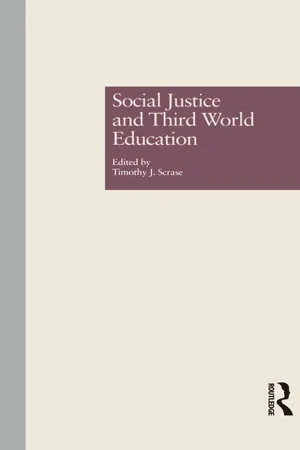
Social Justice and Third World Education
About this book
First Published in 1997. The impact of international social change is already having a marked effect on the Third World in their internal policies, budgets, and development programs. This collection of original articles addresses the importance of education in the creation of social and developmental policies; the effect of international changes on education; investment of limited resources in Third-World nations; the control of third-world elites over education and its continuation; the place of women and ethnic minorities in the educational schemes of the Third-World nations examined and country/regional case studies (Africa, India, China, South America).
Information
Part I
Problems and Issues
Education for Development and Social Justice in the Third World
M.K. Bacchus
Introduction
The overall purpose of this chapter is to examine the contribution that education can make or has made to “development” in Third World countries. The concept of “development” as it is used here includes economic, social, and political development—an intrinsic element of which is social justice for all sectors of the population. The topic suggests two major foci—whether social justice is reflected in the distribution of educational opportunities in these societies and whether the type of education that is provided helps or can help to ensure that social justice for all citizens would become and remain a key consideration of the State.
Social Justice and Greater Equality among Nations
“Development,” as manifested in greater social justice among the population, needs to be directly linked with a concurrent movement toward greater equality. Commenting on this issue, Galbraith suggested that there is a need for greater social justice as a prerequisite for sustained development because “Man is not so constituted that he will bend his best energies for the enrichment of some one else. As literacy is economically efficient, so is social justice” (1964, pp. 6–16).
But any discussion about greater equality in the economically less developed countries (the LDCs) needs to be situated within the wider context of a system of global social justice. Underdevelopment and inequality in the poorer countries cannot be ascribed simply to structural features or to the values, traditions, and beliefs of their population. It is partly a product of the international economic system, control over which is virtually in the hands of a small group of rich nations. This inter-relationship between the economic/political power of the industrialized countries and the poverty of the developing countries has been vividly described by Willy Brandt who in 1986 noted that, “Every minute of every day the nations of the world are spending around two million dollars on armaments and other military expenditure. And every minute, some thirty children aged five or six are dying because they do not have enough to eat, or there is no clean water for them, and because they are denied any kind of medical care” (1986, p. 15). His overall conclusion was that the arms race, led mainly by the rich industrialized countries, was inhibiting international efforts to improve the basic living standards of the poor in the Third World.
To overcome this, global inequality efforts need to be made to put an end to the dependency relationship that currently exists between the economically developed and the developing countries. Viewed from this perspective, global inequality that helps to determine the foundation of economic life in the poorer countries becomes largely a political problem. Its reduction would permit a removal of the obstacles that, at the moment, arbitrarily allow one group of people to impose their will over another, thereby reducing the ability of those being dominated to choose and pursue their own goals in life, with some realistic hope of success. However, any proposed step in this direction needs to start with an understanding of the sources of such inequality.
Sources of Global Inequality
The current economic and political domination of the world order by the richer countries has its roots in the industrialization of Europe that began in the nineteenth century. The industrial revolution led to a “race for colonies” among Western societies seeking new markets for their manufactured goods and additional sources of raw materials. Colonial policy was therefore largely the “daughter of industrialization.” A major outcome of colonization was “a long history of the subjugation” that transformed the social, political, and economic structures of the colonized societies (Weisskopf, 1972, p. 45).
In addition, the concentration of economic power in the more industrialized countries made it possible for them to shape the structure of the “world system” to serve their own interests, which contributed to the growing economic disparities between them and the poorer nations, especially after the 1850s (Patel, 1964, pp. 121–131). Colonialism thus led to the development of a world order that was based on a dominant/submissive relationship between the nations involved. This permitted the establishment of a world economy that allowed the dominant powers to pursue their own interests, irrespective of the consequences to the dominated.
Developments after the Second World War
After the Second World War, there emerged a number of new nation-states among the developing countries. But despite their achievement of “flag independence,” the economic polarization between them and the more affluent countries continued. For example, while the difference in per capita incomes between the rich and the poor nations was around 1:2 at the beginning of the nineteenth century, the ratio had reached about 1:23 in 1950 and 1:40 by the 1970s. This situation has continued to decline further since then and by the year 2000, it is estimated that the developing countries that will then be inhabited by about 78% of the world’s population will have only about 18% of the world’s GNP (Kahn and Weiner, in Bell, 1969, pp. 84–86.). Incidentally, these estimates were based on the assumption of a 5.75–6.5% increase in GNP per annum among the developing countries between 1985 and 2000, which now seems quite unlikely.
This widening income gap between the poor and the rich countries has been occurring despite the official development assistance that the latter was providing. In fact, the level of this aid, which has been declining over the past years was very limited, both in terms of its real value and as a percentage of GNP of the major aid donors. The official development assistance was 0.52% of the GNP of the major donor countries in 1962, but this figure fell to 0.34% a decade later. The developed countries, as a group, have reduced the share of their gross national product devoted to aid every single year between 1962 and 1973—except in 1967 and 1973. By 1981 it was only 0.35% of their GNP, a figure that was far from the target of 0.7% suggested by the United Nations. Further, while there has been a recent tendency to shift more aid to the poorest of the developing countries, in 1980 they received on a per capita basis less than half the aid provided to middle income developing countries.
In addition, the aim of the richer countries in providing aid is not always or even primarily to raise the levels of living among the poor. Howard Ellis (1959) noted that of the $60 billion expended by the U. S. Government on foreign aid between 1945 and 1959, not more than 5% went as economic aid to the developing countries—an average of $3.00 per capita spread over twelve years. Military and defense support have been and still remain a dominant focus of the aid that some countries like the United States provide.
Admittedly, the new products introduced in the enclave sectors of the various colonial economies often became their main source of export earnings. But, because the industries were often foreign owned, the profits that could have been used for further local investment were exported to the metropole. The foreign entrepreneurs were less willing to reinvest their profits in the colonies from which they were obtained. In addition, the terms of trade that were largely influenced by the metropolitan countries were moving against the exports from the developing countries. For example, between the 1950s and the 1970s the non-oil-producing Third World countries had increased the volume of their exports by over 30%, while their revenues had risen by only 4% over the same period.
Further, the economically more developed countries spend large sums subsidizing their own primary producers thereby placing great price hurdles that the poorer countries have to face in trying to penetrate the markets of the richer countries. These countries also put up high tariff walls against the manufactured goods from the poorer countries (Ul Haq et al., 1977, p. 20). In the early 1960s, the recommendation by GATT was for a standstill on further trade barriers against the LDCs, and a gradual reduction in existing ones. A nonreciprocal reduction in trade barriers was also authorized in favor of the poorest countries. But these recommendations were ignored by the industrialized nations. At the same time, “a new international textiles agreement was approved” by which the economically more developed countries were permitted to discriminate against low-income countries, and “a new instrument of protectionist policy was introduced—the ‘Voluntary’ export restraint, in which poor countries were induced, through threats of import quotas, to restrain their own exports” (Helleiner, 1976, p. 5). This attitude of the richer countries toward imported manufactured products from the developing countries has not substantially changed since. Hence, the long-term benefits of local economic growth often went to the metropolitan countries, contributing to the increasing income gap between these countries, both in relative and in absolute terms.
Finally, the richer countries utilize an inordinate amount of the world’s resources, thereby enhancing their own economic growth in relation to and sometimes at the expense of the poorer countries. For example, the ten major industrial countries utilize over 75% of the world’s energy resources, with the United States alone being responsible for consuming about of half of this amount (Tinbergen et al., 1977, p. 222). One outcome of this is the high price that developing countries have to pay for energy, which they can ill afford. In other words, as Professor Birch from the University of Sydney pointed out, one-third of the world became rich by continuing to use more than two-thirds of the world’s available resources (in Tinbergen et al., 1977, pp. 220–227).
Redressing This Global Imbalance
The question that arises is, Can anything be done to ensure a fairer distribution of the world’s wealth among its population? and if so, What role, if any, can education play in helping to readjust such growing economic, social, and political imbalances?
Judging from current international trends one has to admit that the possibility of achieving any marked reduction in the economic gap between these two groups of countries, which, “from an ethical… point of view…” is highly unlikely (Bhagwati, 1972, p. 9). There are a number of reasons for this conclusion. For example, in April 1974, the Sixth Special Session of the United Nations General Assembly made certain decisions—and these were nonbinding—that reflected the need for a more equitable distribution of the world’s wealth to ensure the continued social and economic development of poor countries. But despite this, little progress has since been made with these measures.
The richer nations do not see any moral basis for a redistribution of the world resources and are usually not willing to make any temporary sacrifices, even when, as the Brandt Report pointed out, it is in their own interest to do so. Robert McNamara, a former president of the World Bank, having eventually recognized that the gains accruing to the global economy over the recent past had not been fairly distributed among nations or among population groups within nations, suggested that this pattern of development was unacceptable. However, in advocating some steps that might be taken he went on to ignore the importance of the existing global inequalities in influencing the maldistribution of the benefits from current development efforts. He therefore argued that we should not “waste our time” trying to place the blame for this situation on the economically developed countries “or worse, wear ourselves out in fruitless confrontation between rich and poor countries.” Instead, we should concentrate our attention on reducing the marked income inequalities in the developing countries without paralyzing the incentive that they provide to increase productivity (McNamara cited in Chaliand, 1977, 13).
In 1984, when the World Bank tried to increase the amount of its interest-free loan to the poorest developing countries, or at least to make sure that the real value of the amount available for such loans was not reduced, the United States, which is economically and militarily the most powerful nation, unilaterally blocked these efforts and refused to make any compromise, despite the pressures from other nations. The result was that, as Brandt pointed out, in real terms there was less money available during the three-year period (1985–1987) than the preceding three years for such “soft loans.” In terms of purchasing power, the amount provided was just over half of the sum previously available while the population that was eligible for these loans had practically doubled during that time (Brandt, 1986, p. 126).
On the other hand, with an increase in direct private investment in the developing countries by U.S. companies and private citizens, it was noted that the Reagan Administration became more heavily engaged in a systematic effort to “shape the world” in ways that would be most beneficial to these business interests. This has been a primary motivating force behind various instances of U.S. intervention in the developing countries in recent years (see McMahan, 1984).
In terms of human rights and democracy in the developing countries, Chomsky noted the commitment of the U.S. Government to it could mostly be regarded as rhetoric, directly contrary to the actual policies that it has pursued. It has often allied itself with reactionary ruling and military elites in the Third World whose role was to contain popular efforts to bring about change in the local political systems and extend democracy to the masses (Chomsky and Herman, 1979). In addition, the richer countries, and the United States in particular, have increasingly attempted to shift their support from multilateral organizations to those over which they have a greater degree of control, particularly their own bilateral organizations and even the World Bank, the IMF, and the OECD. The objective was to strengthen further their position of dominance over Third World countries.
These types of action have led some international development specialists to conclude that there is little chance of achieving greater equity in the distribution of the world’s wealth. Birch (in Tinbergen et al., 1977, p. 226) noted that the economic gap between the developed and the developing countries is widening and
cannot be closed within the existing structures of international politics and economics. The present structures have brought us to a crisis which can only lead to deepening dimensions. Goods go to those who can afford to pay for them, and these are not usually those who need them most.
Possible Role of Education in Reducing Global Inequality
Nevertheless, many educators and others have not lost all hope in the possible contribution that education can make toward redressing some of this global imbalance. For example, the Brandt Report suggested that the provision of a broader education that would help people acquire a greater awareness of the interdependence among the nations of the world has been valuable in winning the support of some governments for increas...
Table of contents
- Cover Page
- Half Title Page
- Title Page
- Copyright Page
- Contents
- Series Editor's Preface
- Acknowledgments
- Introduction: Social Justice, Education and the Third World1
- Part I Problems and Issues
- Part II Case Studies
- List of Contributors
- Index
- Reference Books in International Education
Trusted by 375,005 students
Access to over 1.5 million titles for a fair monthly price.
Study more efficiently using our study tools.
Frequently asked questions
Yes, you can cancel anytime from the Subscription tab in your account settings on the Perlego website. Your subscription will stay active until the end of your current billing period. Learn how to cancel your subscription
No, books cannot be downloaded as external files, such as PDFs, for use outside of Perlego. However, you can download books within the Perlego app for offline reading on mobile or tablet. Learn how to download books offline
Perlego offers two plans: Essential and Complete
- Essential is ideal for learners and professionals who enjoy exploring a wide range of subjects. Access the Essential Library with 800,000+ trusted titles and best-sellers across business, personal growth, and the humanities. Includes unlimited reading time and Standard Read Aloud voice.
- Complete: Perfect for advanced learners and researchers needing full, unrestricted access. Unlock 1.5M+ books across hundreds of subjects, including academic and specialized titles. The Complete Plan also includes advanced features like Premium Read Aloud and Research Assistant.
We are an online textbook subscription service, where you can get access to an entire online library for less than the price of a single book per month. With over 1.5 million books across 990+ topics, we’ve got you covered! Learn about our mission
Look out for the read-aloud symbol on your next book to see if you can listen to it. The read-aloud tool reads text aloud for you, highlighting the text as it is being read. You can pause it, speed it up and slow it down. Learn more about Read Aloud
Yes! You can use the Perlego app on both iOS and Android devices to read anytime, anywhere — even offline. Perfect for commutes or when you’re on the go.
Please note we cannot support devices running on iOS 13 and Android 7 or earlier. Learn more about using the app
Please note we cannot support devices running on iOS 13 and Android 7 or earlier. Learn more about using the app
Yes, you can access Social Justice and Third World Education by Timothy J. Scrase in PDF and/or ePUB format, as well as other popular books in Didattica & Didattica generale. We have over 1.5 million books available in our catalogue for you to explore.