This book provides reader-friendly, easy-to-access information about the Special Educational Needs Code of Practice and what it means for the Early Years practitioner. It prunes away the jargon and 'legal-speak' of the DfEE documents, allowing the busy teacher to easily focus on the aspects they want to explore. It also contains practical suggestions and advice regarding the day-to-day classroom management of a special needs child and details on how to actually implement the requirements of the Code of Practice.
Teachers working in the Early Years and all those working in private nurseries and non-maintained Early Years settings should find this book enormously helpful.
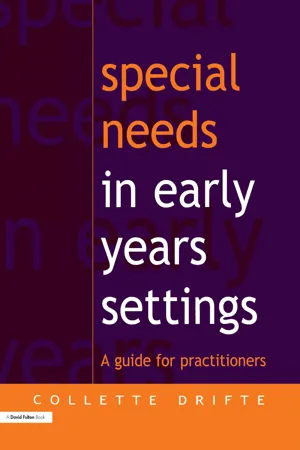
- 98 pages
- English
- ePUB (mobile friendly)
- Available on iOS & Android
eBook - ePub
About this book
Information
Chapter 1
Understanding the Special Educational Needs Code of Practice
The Special Educational Needs Code of Practice, which was implemented in 1994, underwent review and revision by the Department for Education and Employment (DfEE), now the Department for Education and Skills (DfES) and incorporated several important changes, implemented from January 2002. For Early Years practitioners, one of the most important of these changes is the inclusion of children with special educational needs (SEN) in Early Years provision, whether this is a formal educational setting or an approved network of childminders. The Code is written in language that is broadly school- or education-based and, while acknowledging that this may appear to exclude non-maintained provision, it emphasises that 'provider' means all settings in which Early Years children appear.
This naturally has far-reaching implications for such settings since it may be the first experience for many people of the day-to-day practical implementation of the special educational needs legislation. Even in settings where there is not, at present, a child with special educational needs, Early Years settings must make provision by drawing up and putting into place an SEN Policy, designating a Special Educational Needs Coordinator (SENCO), adopting the recommendations in the Special Needs Code of Practice and training staff to identify and manage children who have special educational needs within the Early Years setting. This can be quite a tall order for many settings without any experience, resources or the support of specialist agents from outside. The Code of Practice, however, does suggest that partnerships between maintained schools (i.e. those funded by the government) and other Early Years providers can be an excellent method of sharing good practice and providing mutual support. This is particularly the case for accredited childminders who are part of an approved network.
While the philosophy and ethos of the new Code of Practice remains the same as the old one, there are important changes which all professionals and childcare workers need to be familiar with. The specific (and specified) inclusion of children with SEN at the Foundation Stage means that all Early Years professionals will be involved at some stage, to a lesser or greater degree, in the implementation of the Code's requirements.
Involving the parents
In the years since the original Code was implemented, much has been done to liaise with parents and empower them to become actively involved in their child's education. The revised Code of Practice builds on this and lays a strong emphasis on the right of the parents to be closely involved at all stages of the planning and implementation of their child's education. The Code states that all parents of children with special educational needs should
- feel that they are treated as partners
- play an active role in the education of their child
- have their child's difficulties identified early, with appropriate intervention to address the difficulties
- play an active role in any decision-making process regarding their child's education
- have access to information, advice and support during their child's assessment
- have access to information, advice and support during any decision-making process about the educational provision for their child, including any transition planning.
Local education authorities (LEAs) should have a system in place which offers such advice and support to parents and should include Independent Parental Support (IPS). This service is not exclusive to children being educated within the state sector, and so is also available to parents of children who are in private settings or other non-maintained provision. This means, of course, that all providers need to be aware of their local IPS and how to access it.
The aims of the IPS are
- to ensure that the parents of children with special educational needs have access to information, advice and guidance in relation to the needs of their child
- to enable the child's parents to make informed and appropriate decisions about the education of their child
- to provide advice to all children with special educational needs, not just those with a Statement of Special Educational Needs
- to offer advice to the child's parents about the range of services and organisations that are available
- to refer the parents to specific voluntary organisations or parent support groups, which can offer a group service.
Involving the child
The revised Code of Practice places a stronger emphasis on including the child himself in the decision-making, planning and implementation of programmes of work, even when he is still at the Foundation Stage. This process naturally needs to take into account the ability and maturity of the child, but professionals should be wary of making an assumption that the child has less ability to express an opinion than he actually has. Sometimes, the child's parents may have reservations about his involvement in the process and sensitivity needs to be shown in encouraging them to perceive their child as part of the team.
The Curriculum Guidance for the Foundation Stage (Qualifications and Curriculum Authority (QCA) 2000) acknowledges the importance of the development of a child's ability to form and express an opinion as well as make decisions. The Code of Practice echoes the spirit of this when it advocates the child's involvement. At the Foundation Stage, this could include, for example, a choice of play activities, a decision about which clothes to wear or being encouraged to share wishes and feelings with their families and the setting staff.
Special Educational Needs
The Code of Practice assumes that a child's special educational needs fall within a number of broad areas, including
- communication and interaction
- cognition and learning
- behavioural, emotional and social development
- sensory and/or physical.
However, the Code recognises that a child's difficulties may well take in two or more of the areas. For example, a child with a physical disability could experience both learning difficulties and communication problems.
Early Years workers are in the vanguard of professionals who very quickly recognise and identify a child who is experiencing difficulties. The Code of Practice does not offer a blueprint for this, but acknowledges that staff will know their own children within their own social and Early Years setting or school environment and who are assessed with their own baseline checks. These may include the P Scales (standardised achievement levels outlined in DfEE 2001) and/or the setting's own assessments but they will offer a benchmark against which to judge the child's achievements and, later, to aid in planning the Individual Education Plan (IEP). State and maintained establishments will have copies of the P Scales in school. Private and non-maintained providers will be able to obtain them by contacting DfEE Publications Centre, PO Box 5050, Sherwood Park, Annesley, Nottingham, NG15 ODJ; telephone 0845 602 2260; fax 0845 603 3360; Minicom 0845 605 5560; e-mail [email protected]
The Code of Practice has sections for each of the above areas, with useful checklists that can be referred to by the Early Years practitioner who wants to know what 'symptoms' to look out for. These are only the first stage, of course, and should be used only as a starting point for seeking advice from a specialist in the relevant field.
Special Educational Needs Coordinator
When establishing a Special Educational Needs Policy, one of the first things an Early Years provider must do is designate a member of staff as a Special Educational Needs Coordinator (SENCO). This person plays a key role in all Code of Practice dealings and has responsibility for
- liaising with the child's parents
- liaising with other professionals who may become involved
- advising and supporting other members of staff who may be working with the child
- making sure that appropriate IEPs are planned and implemented
- collating and updating records and relevant background information about the child
- coordinating further assessments of the child and planning future support and programmes of work
- coordinating reviews of IEPs and making sure that all decisions taken at reviews are reported to everybody involved.
For a more detailed account of the responsibilities of the SENCO, see Chapter 7.
The Code in practice
The new Code of Practice sets out a model of graduated action and intervention which it recommends Early Years establishments should adopt. These include registered childminders, who may well be involved in working with a child who has special needs. There are two strands or thresholds to this action: Early Years Action and Early Years Action Plus.
Both stages involve individualised ways of working with the child, including the implementation of IEPs, on a gradually increasing level of involvement. If the child continues to experience difficulties after a reasonable time at Early Years Action Plus, he may need to be referred to the local education authority (LEA) for a statutory assessment, possibly leading to the writing of a Statement of Special Educational Needs.
Early Years Action
This is the initial stage of identifying the child's difficulties with a more focused approach. Early Years professionals are excellent at spotting a child with problems very quickly, but after the initial feeling that something is wrong, they need to sharpen their observations of the child in an attempt to identify specific difficulties. In the humdrum of day-to-day life in a busy Early Years setting, it is all too easy for the child to slip by without his problems being specifically targeted; the practitioner needs to make a conscious effort to spend some time observing him in action.
The Early Years professional should be alerted to a child's problems when he
- makes little or no progress, even when the setting has used approaches that have targeted his difficulties
- continues to work at a level well below that expected of a child of his age, in certain areas
- displays persistent emotional and/or behavioural difficulties despite behavioural management strategies that may have been used
- has sensory or physical problems and makes little or no progress despite having personal aids or equipment to support him
- has communication and/or interaction difficulties and needs specific support in order to learn.
If the child meets any or a combination of these criteria, the practitioner needs to take steps to focus on the problems, identify them specifically and plan appropriate action to meet the child's needs. Once difficulties have been identified, the professional should
- talk to the child's parents and tell them of the concerns; enlist their support in their work with the child and discuss with them the involvement of the SENCO; emphasise that this is a safety net for the child's own good, so that he can receive all the help he needs
- talk to the SENCO and provide as much information as possible about the child's difficulties; collect any baseline assessments or test results; ask the child's parents about any health or physical problems; observe his behaviour and performance and record as much about these as possible
- liaise with the child's parents, the SENCO and the child to plan and implement an IEP; encourage them to share in the recording and monitoring of their child's progress
- make sure that the IEP specifies the short-term targets for the child, the teaching strategies to be used, the provision to be put into place, the date of the review and the outcome of the action taken; check that the IEP focuses on a maximum of three or four targets and records only teaching provisions and strategies that are additional to or different from the normal differentiated curriculum.
The child should follow his IEP for as long as he is making progress, until it is due for a review. However, if the IEP is obviously mismatched, because the child is failing to meet his targets, staff should not wait, but ask for an earlier review in order to replan the IEP. Sometimes, though, even this fails and the child continues to struggle and make little or no progress. If this is the case, the team needs to consider the next phase of action.
Early Years Action Plus
Early Years Action Plus is the point at which the Early Years professionals feel the need to involve external specialists such as the LEA's support services, or health and medical services, who can offer support and help, give advice on new IEPs, provide more specialist assessment, suggest new strategies and possibly offer specialist support, activities or equipment.
The main things that will trigger the practitioner to refer the child to external support services are that he
- continues to make little or no progress in specific areas over a long period of time
- continues to work at an Early Years curriculum well below that of his peers
- continues to experience emotional and/or behavioural difficulties that impede his own learning or that of the group, despite having an individualised behaviour management programme
- has sensory or physical needs, requires specialist equipment and/or requires regular support or advice from specialist practitioners
- continues to have communication and interaction difficulties that impede the development of social relationships and cause problems with learning.
As with Early Years Action, if the child meets any or a combination of these criteria, the practitioner should then
- hold a review meeting with the child's parents and the SENCO to discuss his IEP, his progress to date, his parents' views and whether there is a need for more information and advice about the child
- collect all the records on the child, all the relevant information, all assessments and the results, the IEPs, records of teaching strategies and information regarding any targets that were set and achieved. (These will be needed by the external specialist to help with their assessment.)
- liaise closely with the external specialist, the SENCO and the child's parents to agree on a new IEP, appropriate targets and the teaching strategies to use
- revi...
Table of contents
- Cover
- Title
- Copyright
- Contents
- Introduction
- Glossary
- 1. Understanding the Special Educational Needs Code of Practice
- 2. Identifying and managing special educational needs
- 3. Working with the parents of special needs children
- 4. Writing and using Individual Education Plans
- 5. Planning and holding special needs reviews
- 6. Working with other agencies
- 7. The role of the SENCO
- 8. Drawing up a Special Educational Needs Policy
- 9. Including special needs children in a mainstream setting
- Appendix: useful addresses
- Additional reading
- Index
Trusted by 375,005 students
Access to over 1.5 million titles for a fair monthly price.
Study more efficiently using our study tools.
Frequently asked questions
Yes, you can cancel anytime from the Subscription tab in your account settings on the Perlego website. Your subscription will stay active until the end of your current billing period. Learn how to cancel your subscription
No, books cannot be downloaded as external files, such as PDFs, for use outside of Perlego. However, you can download books within the Perlego app for offline reading on mobile or tablet. Learn how to download books offline
We are an online textbook subscription service, where you can get access to an entire online library for less than the price of a single book per month. With over 1.5 million books across 990+ topics, we’ve got you covered! Learn about our mission
Look out for the read-aloud symbol on your next book to see if you can listen to it. The read-aloud tool reads text aloud for you, highlighting the text as it is being read. You can pause it, speed it up and slow it down. Learn more about Read Aloud
Yes! You can use the Perlego app on both iOS and Android devices to read anytime, anywhere — even offline. Perfect for commutes or when you’re on the go.
Please note we cannot support devices running on iOS 13 and Android 7 or earlier. Learn more about using the app
Please note we cannot support devices running on iOS 13 and Android 7 or earlier. Learn more about using the app
Yes, you can access Special Needs in Early Years Settings by Collette Drifte in PDF and/or ePUB format, as well as other popular books in Education & Early Childhood Education. We have over 1.5 million books available in our catalogue for you to explore.