eBook - ePub
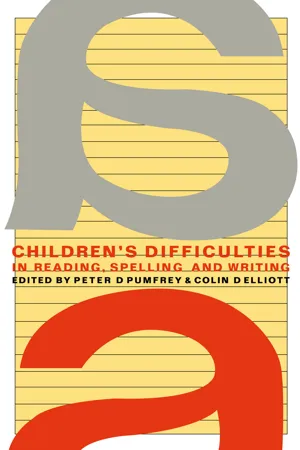
Children's Difficulties In Reading, Spelling and Writing
Challenges And Responses
- 316 pages
- English
- ePUB (mobile friendly)
- Available on iOS & Android
eBook - ePub
Children's Difficulties In Reading, Spelling and Writing
Challenges And Responses
About this book
Reflects a wide range of issues regarding children's literacy problems, mainly at the primary school level. The purposes of the book are twofold: in part 1, to identify some challenges in the field of literacy, and, in part 2, to give an account of
Information
Part One
Challenges
1
Literacy and the National Curriculum: the Challenge of the 1990s
How can standards of literacy be raised? How can national standards be assessed? How can individuals with special educational needs in the areas of literacy be identified and helped?
In all countries with state educational systems, literacy is seen as a key objective. The abilities of reading and writing (including spelling) are acknowledged as amplifiers of human capabilities. Via the medium of text, the skills of reading and writing give access to a high proportion of the accumulated thoughts, ideas and feelings of the culture. They also facilitate reflections concerning them. In most societies, not to be able to read is to be impoverished because of the effects both on career opportunities and on access to much of a country's (and the world's) cultural heritage. It is seen as a prime responsibility of schools to help all their pupils to read and write. Democratic societies require a literate and informed population.
The understanding of how literacy abilities are, or are not, learned is both complex and controversial. Contrasting opinions exist concerning how such developments can be conceptualized and how they can be assessed and encouraged. Theory, research and practice make their complementary and, at times, contradictory contributions in this continuing quest.
If it is believed that standards of literacy are falling, considerable public concern is typically expressed. Action is demanded to ensure that standards of literacy rise and that children learn to read and write adequately. In most countries, including Britain, the evidence for changes in primary school children's standards of literacy is often fragmentary. Characteristically, there is no systematic and comprehensive means of assessing standards of literacy. The absence of such information allows speculation and conjecture free rein. Even if all 7 year old children in Britain could accurately, fluently and with comprehension read Shakespeare, some would do so more accurately, fluently and with greater comprehension than others. It is quite possible that those performing at the lower levels would be deemed to have reading difficulties. The relative nature of the concept of literacy must never be forgotten. If we were collectively more aware, and more tolerant of inter- and intra-individual differences in children's standards of literacy, we might be able more effectively to improve standards (See Chapter 12).
The challenges to teachers and research workers generated by such a situation are many and varied. So are the responses in theory development, research and practice. The contributions contained in Parts 1, 2a and 2b of the present book testify to the range of challenges and the variety of responses.
At this stage, attention is drawn to three concerns. The first derives from the fact that each child is unique. Long before they attend school, there are marked differences in children's physical, mental and social /emotional characteristics. These are reflected in the ways and the rates at which children become literate. Are some of these characteristics important causes of success or failure in subsequent literacy? What does research tell us? Are differences between children in such pre-literacy abilities only quantitative, or are there qualitative differences characterizing some groups? Such issues have important implications for developing interventions that will prevent or alleviate children's reading, spelling and writing difficulties.
Accepted standards of literacy are usually based on what is typical of groups at particular times during their school careers. It has been shown that, for example, mean reading test scores for particular year groups can increase over a period of years. With this increase, it is also possible that there can be an increase in the proportion of children who fail. The increase in mean reading test scores over time was due to some able children doing much better, rather than all children doing better. Reading test scores became more widely dispersed over time. Intra-individual differences also differentiate: the individual's strengths and weaknesses in various aspects of literacy emerge.
The second point follows from the first. Many schoolchildren do not become literate. The estimate by the Adult Literacy Basic Skills Unit that some four hundred thousand adults in Britain are illiterate and that over five millions need help in basic skills, underlines the seriousness of the issue.
The third point is that children with a variety of learning difficulties, emotional and behavioural difficulties and other disadvantages, frequently show low standards of literacy for different reasons. The Education Act 1944 required that LEAs (Local Education Authorities) provide sufficient schools offering such variety that children could be educated according to their age, ability and aptitude. The provision of special educational treatment was based largely on a ‘defect’ model. LEAs were responsible for providing special educational treatment for pupils suffering any disability of mind or body. Ten different categories of handicap were officially recognized in England and Wales, and nine in Scotland. Approximately 2 per cent of children were identified as handicapped and were educated mainly in special schools, units or classes.
The Education Act 1981, (effective from 1st April 1983), changed the law on special education in the light of the Warnock Report and the consultations and discussions that ensued (Department of Education and Science, 1978).
Under Section 1 of the Education Act 1981, a child is deemed tohave special educational needs if they have a learning difficulty which calls for special educational provision to be made for them. Learning difficulty is defined in terms of children who have a significantly greater difficulty in learning than the majority of children of their age: and/or have a disability which either prevents or hinders them from making use of educational facilities of a kind generally provided in schools in their LEA area for children of their age.
How great must a child's reading, spelling or writing difficulty be to meet the requirements of Section 1? Nine years later we are still faced with the same question. Until the term ‘significantly greater’ is operationally defined, uncertainties will continue. Even if it is operationally defined, the arguments will not stop, but they would probably be somewhat different in nature. Special educational provision means educational provision that is additional to, or otherwise different from, that made generally for children of the same age in schools maintained by the LEA concerned. It is expensive.
LEAs must ensure that special educational provision is made for pupils who have special educational needs. It was accepted that most children with special educational needs would attend ordinary schools and that up to one in five pupils would, at some time during their school career, have such needs. Under the Act, children with identified special educational needs could be given the protection of a Statement. The status of such a document meant that the LEA was required to provide what was stipulated. The working of the Act is far from satisfactory. The great variation in the proportions of statemented pupils in LEAs emphasizes the ambiguity of the term special educational needs (Select Committee on Education, Science and the Arts, 1987). This situation has not been improved by the latest official advice on the identification and assessment of special educational needs (Department of Education and Science and the Welsh Office, 1988b).
Various voluntary organizations concerned with dyslexia were assured that the condition was recognized under the provisions of the Act. The British Dyslexia Association, The Dyslexia Institute, The Foundation for the Underachieving and Dyslexic and Dyslexia Defined, are but four of these. The problem of translating the terms of the Act into means of assessing and providing for children's special educational needs has led to a number of important legal actions being brought by parents whose children were experiencing severe literacy difficulties (see further discussion of this issue in Chapter 2).
Money to purchase the time and expertise required to assess and alleviate literacy difficulties is severely limited. The imprecise nature of the legal definition of special educational needs is an open invitation to legal action. Markedly different professional opinions exist concerning the nature and incidence of literacy difficulties and the means of alleviating such difficulties (Cornwall, Hedderley and Pumfrey, 1984). The Education Act 1981 widened the scope of special education by abolishing former categories and subsuming them under the superordinate category of special educational needs. The current consensus of professional opinion is that the former categories of handicap are undesirable. Not all workers agree with this viewpoint. Currently we now have two different and much larger categories. Either a child has, or does not have, special educational needs. When the incidence rises from about 2 per cent to about 20 per cent of the population, the numbers of children at the inevitable borderlines have increased dramatically. In such a situation, the incidence of parental dissatisfaction is bound to increase.
The causes of severe and prolonged difficulties in learning to read and write, are many and varied. They are likely to require different interventions if children are to be helped. If a pedagogic panacea to children's difficulties in reading, spelling and writing existed, it would probably have been identified by now. It has not.
The implementation of the Education Reform Act 1988 is intended to provide a framework wherein these three (and many other) challenges can be met. Making the Act effective will be a challenge for the next decade to all involved: pupils, parents and professionals.
The National Curriculum
The establishment of a National Curriculum applicable to all pupils aged from 5 to 16 years of age in all maintained schools, is now a legal requirement. The curriculum of every maintained school must include religious education for all pupils. In addition, the curriculum must incorporate specified ‘core’ and ‘foundation’ subjects. English, Mathematics and Science are designated core subjects. In Wales, Welsh is also a core subject in Welsh-speaking schools. The core subjects are seen as encompassing essential concepts, knowledge and skills without which other learning cannot take place effectively. The foundation subjects at all ages are History, Geography, Design and Technology, Music, Art and Physical Education. During the secondary school period, a modern foreign language is to be included (Department of Education and Science, 1989a).
In each area of the curriculum, attainment targets will be specified at up to ten levels of attainment, covering the age range 5 to 16 years. Attainment targets are defined in the Act as: ‘… the knowledge, skills and understanding which pupils of different abilities and maturities are expected to have by the end of each key stage’ (Education Reform Act, 1988, para. 2).
In the same Act, programmes of study are defined as: ‘… the matters, skills and processes which are required to be taught to pupils of different abilities and maturities during each key stage’ in each subject area (ibid., para. 2).
A national assessment system will monitor what children ‘… should normally be expected to know, understand and be able to do at the ages of 7, 11, 14 and 16. This will enable the progress of each child to be measured against national standards’ (Department of Education and Science, 1989a, para. 6.4). Standard Assessment Tasks (SATs) are being developed for assessing whether pupils have attained the achievement targets at each of the key stages.
The assessment system is intended to serve the following purposes. The information elicited will be:
- formative. It will help the teacher in deciding how the pupil's learning should be furthered, provide both teachers and pupils with clear and understandable targets and feedback on progress towards these. It will also indicate whether further diagnostic testing is required.
- summative. The cumulative achievements of the pupil will be appraised: this will include what the individual knows, understands and can do.
- evaluative. Used comparatively it will identify where further resources may be required or where curricular changes are needed.
- helpful to teachers' professional development.
- informative. Communication between parents, professionals and pupils will be facilitated.
Whilst it will be many years before the full requirements of the Education Reform Act 1988 are in operation, fundamental changes in the ways in which teachers and schools organize and assess the work that is done are already well in train (Department of Education and Science and the Welsh Office, 1987, 1988a). In December 1988 the Department of Education and Science issued contracts to three consortia to develop Standard Assessment Tasks. These were piloted in some primary schools in the Autumn of 1989- The first full-scale national assessments should be carried out in...
Table of contents
- Cover
- Half Title
- Title Page
- Copyright Page
- Table of Contents
- Acknowledgments
- Introduction
- Part 1: Challenges
- Part 2: Responses
- Notes on Contributors
- Subject Index
- Name Index
Trusted by 375,005 students
Access to over 1.5 million titles for a fair monthly price.
Study more efficiently using our study tools.
Frequently asked questions
Yes, you can cancel anytime from the Subscription tab in your account settings on the Perlego website. Your subscription will stay active until the end of your current billing period. Learn how to cancel your subscription
No, books cannot be downloaded as external files, such as PDFs, for use outside of Perlego. However, you can download books within the Perlego app for offline reading on mobile or tablet. Learn how to download books offline
Perlego offers two plans: Essential and Complete
- Essential is ideal for learners and professionals who enjoy exploring a wide range of subjects. Access the Essential Library with 800,000+ trusted titles and best-sellers across business, personal growth, and the humanities. Includes unlimited reading time and Standard Read Aloud voice.
- Complete: Perfect for advanced learners and researchers needing full, unrestricted access. Unlock 1.5M+ books across hundreds of subjects, including academic and specialized titles. The Complete Plan also includes advanced features like Premium Read Aloud and Research Assistant.
We are an online textbook subscription service, where you can get access to an entire online library for less than the price of a single book per month. With over 1.5 million books across 990+ topics, we’ve got you covered! Learn about our mission
Look out for the read-aloud symbol on your next book to see if you can listen to it. The read-aloud tool reads text aloud for you, highlighting the text as it is being read. You can pause it, speed it up and slow it down. Learn more about Read Aloud
Yes! You can use the Perlego app on both iOS and Android devices to read anytime, anywhere — even offline. Perfect for commutes or when you’re on the go.
Please note we cannot support devices running on iOS 13 and Android 7 or earlier. Learn more about using the app
Please note we cannot support devices running on iOS 13 and Android 7 or earlier. Learn more about using the app
Yes, you can access Children's Difficulties In Reading, Spelling and Writing by Peter Pumfrey,Colin Elliott in PDF and/or ePUB format, as well as other popular books in Education & Education General. We have over 1.5 million books available in our catalogue for you to explore.