eBook - ePub
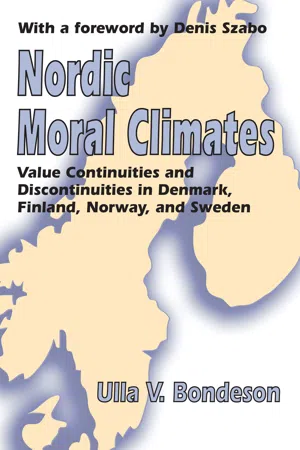
Nordic Moral Climates
Value Continuities and Discontinuities in Denmark, Finland, Norway, and Sweden
- 330 pages
- English
- ePUB (mobile friendly)
- Available on iOS & Android
eBook - ePub
Nordic Moral Climates
Value Continuities and Discontinuities in Denmark, Finland, Norway, and Sweden
About this book
Morality was a dominant theme in the 1990s, but concerns about morality seem omnipresent in the first years of the third millennium. The year 2002 witnessed the greatest corporate scandals ever seen in the United States, with immense impact financially and in human terms. Sex scandals were pervasive among Catholic priests in the United States, disrupting the lives of thousands of abused children. In Scandinavia, moral debates and scandals are of a smaller magnitude, and more often related to questions about the handling of money by politicians.This volume takes an overarching look at the impact of such moral questions in the Nordic countries. Its approach is multi-disciplinarian, embracing philosophy, history, sociology, and political science. Based mainly upon a survey of representative samples in Denmark, Finland, Norway, and Sweden, this unique study combines interview questions on crime and justice with moral questions concerning equality, confidence, tolerance, and also personal, social, religious, political, and national values. Bondeson first discusses the Nordic countries from a historical perspective and in statistical terms. She then presents interview data on the general sense of justice in Nordic countries, in particular exploring how much social and legal equality the Scandinavians have achieved in their welfare states. She touches upon criminal behavior and victimization, and discusses crime prevention and punishment. Bondeson also reviews the problems and methods of the study. Finally, she adds depth to the statistical analysis by using a number of indexes of morality. A trend analysis illustrates the stability of these attitudes over time.Nordic Moral Climates is an original empirical study of moral values in Scandinavia. It is one of the few comprehensive studies on this subject conducted in any nation or group of nations. The book will be of great interest to criminologists, sociologists, and social theorists.
Information
Part I
1
An Introduction to the Nordic Countries
The Nordic countries are often said to be homogeneous whether examined internally or compared cross-nationally. In the following short description both their similarities and differences will be emphasized.
This chapter provides a concise history of the Nordic countries, an analysis of their identities and stereotypes, a general description of present-day Scandinavia as well as a description of crime and justice in Scandinavia.
1.1 A Concise History of Scandinavia
There is a deficiency of historic literature describing Scandinavia as a single entity. The two most important sources in English are Derry (1979) and Nordstrom (2000). These sources have been used in the current review and supplemented by other more nationally orientated material in the original languages.
The Nordic countries consist of the five nation states of Denmark, Finland, Iceland, Norway, and Sweden, in addition to the three Home-Rule territories of Greenland, the Faroes, and Åland. Iceland became fully independent of Denmark in 1944, while the Faroes became a self-governing community within the Danish state in 1948 and Greenland obtained autonomy within the Danish kingdom in 1979. Finally, Åland became an autonomous province of the Finnish republic following a League of Nations’ ruling in 1921.
Scandinavia is usually meant to include Denmark, Norway, and Sweden, but more recently it has also been used to embrace Finland. In the following pages, designation as “Nordic” is used synonymously with “Scandinavian.”
Early History
The Sami or the Lappish people (as they have been called by others) living in the far North of Norway, Sweden, Finland, and Russia may be the indigenous inhabitants of the Nordic nations, except for Denmark. However, their origin is obscure, with some scholars including them among the Paleo-Siberian peoples and others maintaining that they are alpine and came from Central Europe. For centuries the Sami people were driven successively further north in Scandinavia. It is nowadays more commonly agreed that they were oppressed and discriminated against over time.
Early Nordic history is most renowned internationally for the Viking period between the eighth and eleventh centuries. In the eighth century, the Swedes dominated the Eastern Baltic Sea, and traded along the Russian rivers as far as Constantinople and Baghdad. During the same period, Danish Vikings ventured primarily westward invading England, while Norwegian Vikings settled in Scotland, Ireland, the Faroes, the Orkneys and Shetland, Iceland and Greenland. Canute, a Danish king who lived most of his life in England, first ruled a large part of England and then later Denmark, Norway, and parts of Sweden.
Christianity came relatively late to Scandinavia and it was only around the year 1000 that the Nordic kings were Christianized. The Lutheran reformation began in the Nordic countries during the 1520s and continued in Sweden throughout the sixteenth century without a real threat from the later counter-reformation in the seventeenth century.
The first provincial law codes were written around the year 1200. “National law” codes in Norway and Sweden date from the thirteenth and fourteenth centuries, and, in Denmark, from the late seventeenth century. Apparently, there was great homogeneity in the early provincial laws.
The Middle Ages
An early effort to create a common trading market in northern Europe involved a federation of all seventeen northern European trading towns with the aim of creating an economic sphere for all lands around the Baltic Sea. This Hanseatic League came to consist of over 200 cities and lasted for nearly four hundred years, from the early thirteenth century to the mid-seventeenth century, as an economic and political organization. Lübeck was the League’s capital, but it also had offices in other major towns, including Bergen and Stockholm. In addition to its economic power, the League was a political, military, and cultural force (Nordstrom 2000, 22). In the fourteenth and fifteenth centuries the Danish kings attacked and counterattacked the Hansa over, among other things, Danish customs duties.
A counterbalance to the Hanseatic League was created by the Kalmar Union, which formally spanned the period 1397 to 1523, but in practice only functioned for shorter periods. Through dynastic ties the regent, Margrethe I of Denmark, ruled in Denmark, Norway, and Sweden, which at that time included Finland. The Kalmar Union was the second largest accumulation of territories in Europe, although half of these in the upper north were thinly, or not at all, populated. Margrethe amassed power principally by collecting taxes and by taking away some privileges from the nobles.
Conflicts between the Danish kings and Swedish nobles led to eight “internal wars” between 1450 and 1523. Most notable in this context was the siege and capitulation of Stockholm, followed by the Stockholm Bloodbath in 1520 when Christian II of Denmark—probably on the advice of the Swedish archbishop (Nordstrom 2000, 26)—decapitated eighty-two leading Swedish opponents, including bishops and many aristocrats. The contrasting Danish and Swedish viewpoints on the executions are reflected by the fact that in Swedish school history books, Christian II is known as Christian the Tyrant, while simultaneously said to be called Christian the Good in Denmark, a fact that seems only to be correct though for Scania, the eastern province of Denmark.
Upon dissolution of the Kalmar Union in 1523, Gustav Vasa was elected king of Sweden and he is credited with establishing Sweden as a sovereign state. He was given both economic and military support by the Hanseatic League, and created a strong central administration, partly with the assistance of German administrators. He confiscated the properties of the Roman Catholic Church and could to some degree justify this by referring to the theses of Martin Luther. Similar confiscations established the wealth of the crown in Denmark and Norway as well. The Swedish Lutheran church was finally adopted as the state church at the end of the sixteenth century.
Changes in Territorial Borders and National Sovereignty
Sweden can be classified as an imperial state during its period as a great power in the seventeenth century. Gustav Adolf II, embarked on successful wars with Germany in the Thirty Years’ War. According to traditional history books, the bloody Thirty Years’ War was fought in order to protect Lutheranism. It is an irony of history that Gustav Adolf II’s only child, the highly gifted and cultivated Queen Kristina, clandestinely converted to Catholicism, fled Sweden, abdicated the throne, and was victoriously acclaimed in Rome by the Pope.
Continual wars between Sweden and Denmark resulted in the northern provinces of Jämtland and Härjedalen being ceded by Denmark to Sweden during the reign of Queen Kristina in 1645. Some years later, in 1658, under Carl Gustav X, Denmark ceded all of its provinces east of Öresund (Scania, Halland, Blekinge, and Bohuslän) to Sweden, thus establishing Sweden’s present-day borders. A systematic and brutal Swedish indoctrination of the former Danes took place immediately.
Norway is the Scandinavian country that has shifted nationhood most dramatically over the centuries. There was a Danish-Norwegian union between 1380 and 1814 that after 1660 was officially called a double monarchy. In 1450, a treaty was signed intended to guarantee equality of the twin-realms, but this was in theory and actual practice somewhat different (Norwegian Ministry of Foreign Affairs). In 1536, Norway ceased being an independent kingdom and formally became a Danish province. However, in the nineteenth century, a growing national awareness emerged within the Norwegian middle-class who resented the economic power concentrated in Copenhagen.
The Napoleonic wars ended with Denmark ceding Norway to Sweden in 1814. The Swedish-Norwegian Union lasted until 1905, when Norway, after decades of dissatisfaction with Swedish control of Norwegian foreign policy, finally became an independent nation, with a king who was the grandson of the Danish king.
Finland’s early history, as well as the ancestral heritage of its people, is somewhat unclear. Even before the beginning of the Viking Age, Swedes had settled on the southwestern coast of Finland. The first crusade seems to have been undertaken around 1157 by the Swedish king, Erik, accompanied by an English bishop named Henry, who later became Finland’s patron saint. From the twelfth century Finland became a battleground between the Russian duchy of Novgorod and Sweden. In a papal bull, the Swedes were advised to force the Finns into submission by permanently manning the Finnish fortresses in order to protect the Roman Church from attacks from the East. A Swedish earl, Birger Jarl, waged war against Finland beginning in 1249, and in 1323 a treaty finally made Finland a part of the Swedish realm. The treaty drew the boundary between Russian and Swedish spheres of influence in a vague line from the eastern part of the Gulf of Finland through the middle of Karelia, then northwest to the Gulf of Bothnia. Finland remained a part of Sweden for over five centuries, administered by the Swedish national government and adopting most Swedish traditions.
Finland became a grand duchy of Russia with extensive autonomy following the 1808-1809 war between Sweden and Russia. It finally declared independence during the Russian Revolution in 1917.
Although its liberation from Russia occurred peacefully, Finland was unable to avert a violent internal conflict. In 1918, a great number of former revolutionaries were either executed or died in prison camps, totaling more than 30,000 Finnish lives. Some of the “Reds” immigrated to the Soviet Union, but a considerable number returned to Finland, disillusioned in the 1930s (Nordstrom, 203).
Nationalism, Scandinavianism, and Emigration
Nationalism became increasingly politicized between 1830 and 1918, and was one of the key factors affecting the principal events in Norway, Finland, the Faroes, Iceland, and the Duchies of Schleswig and Holstein—with the northern part of Schleswig reunified with Denmark after the First World War. Paralleling the development of Nordic nationalism was the emergence in the 1840s of Scandinavianism. “Scandinavianism reflects the persistence of the unity theme in Nordic history, a theme with significant historical and cultural foundations, and one often lost in the shadow of nation-focused histories” (Nordstrom, 208). This idealistic concept had its center in student and intellectual movements, and was mainly prevalent in the universities of Denmark and Sweden. However, the limited support provided to the Danes by two Swedish kings in the wars of 1848 and 1864 in Schleswig and Holstein, contributed to a decline in inter-Scandinavian political sympathies. On the other hand, the Scandinavian academic collaboration increased in importance, and a Nordic legal collaboration started in 1872.
An additional factor contributing to a decline in Scandinavianism was the extensive poverty, partly leading to starvation, that many Scandinavians experienced for much of the last half of the nineteenth century. This led to more than two million people immigrating to the United States from the Nordic countries. Norway had the highest per capita rate of emigration of any European nation during this period, with 750,000 people leaving. Sweden lost around one million of its somewhat larger population, while approximately 300,000 left Denmark for the new land across the Atlantic.
The Two World Wars
Denmark, Norway, and Sweden were neutral during the First World War, and traded with both Great Britain and Germany. After the war, in 1920, all four Nordic countries became members of the League of Nations.
During the Second World War, however, the four countries went separate ways. In 1939, Denmark entered into a non-aggression treaty with Germany, whereas Norway, Sweden, and Finland rejected the same offer. Norway and Denmark were occupied by Germany between 1940 and 1945. Denmark had its own government, but it resigned in 1943 after not being able to accept a German ultimatum. In the same year, the Danish Freedom Council was formed. Under its leadership the resistance movements were organized, to some extent on railway and industrial sabotage, making German supply more difficult. Meanwhile, the Norwegian royal family and government were in exile in Britain until the end of the war, and substantial numbers of Norwegians enlisted with the allies. A Nazi government, led by the Norwegian nationalsocialist Quisling, was formed in 1942 and aroused strong resistance, resulting in a well-organized sabotage movement.
After the liberation, in both Denmark and Norway, legal proceedings were initiated against collaborators with the Germans. A considerable number was sentenced to death, and others received long prison sentences. In Denmark, in 1945, as many as 34,000 were arrested and interned. A special natural treason law was passed to cover the actions of collaborators and the legal proceedings went on for years. Some 20,000 people were investigated, of which about 13,000 were convicted and forty-six executed (Nordstrom, 310). In Norway, the process of denazification after the war resulted in the investigation of 90,000 persons, with 46,000 tried and found guilty, 18,000 imprisoned for varying periods, and 28,000 fined. Many lost their rights as citizens, thirty were condemned to death, and twenty-five executed (ibid., 314). Detailed descriptions of the judicial purge (retsopgøret) have been written, in Denmark by Tamm (1985, 1998)—who gives as high a figure as 40,000 interned and 14,000 convicted—and in Norway by Andenæs (1998).
During the Second World War, Finland was the Nordic country that was most directly involved in the war, and suffered the most. In 1939, the Soviet Union launched an attack on Finland. As a result of the Treaty of Moscow in 1940, Finland surrendered a large area of its southeastern territory. Due to the perceived threat from the East, Finland approached Germany, which offered its assistance. Like Sweden after Norway’s capitulation, Finland allowed the transit of German troops across its territory. When Germany attacked the Soviet Union in 1941, Finland was a co-belligerent, although no formal alliance was established. The “War of Continuation” (1941-1944) began with a successful Finnish offensive that led to the recapture of large areas of East Karelia. An armistice was signed in 1944 on condition that Finland recognized the terms of the Treaty of Moscow, and that all foreign (i.e., German), forces be evacuated. However, the German army refused to leave the country, and in a series of clashes it devastated great areas of northern Finland in its retreat. At the Paris Peace Treaty in 1947, one-twelfth of Finland’s territory was turned over to the Soviets. In addition to this, Finland had to pay reparations amounting to USD 300 million. These wars together cost nearly 80,000 Finnish lives (Nordstrom, 302).
Postwar Nordic Alliances and Cooperation
A Nordic Defense Alliance was proposed by Sweden in 1948, but failed to materialize. In the same year, Finland joined a Friendship and Mutual Assistance Pact with the USSR.
In 1949, Norway and Denmark joined the North Atlantic Treaty Organization, although NATO was not allowed to establish military bases on their territories, except for Greenland, where the United States already had one. Sweden, whose economy profited through the sale of munitions and iron ore, retained its non-aligned status.
The Nordic Council was founded in 1952 and the Nordic Council of Ministers in 1971, both with the aim of fostering inter-Nordic cooperation. This has led to the establishment of a Nordic passport area, to the free movement of labor for Nordic citizens within the Nordic countries, and to efforts toward introducing similar legislation in the four countries. However, with the new focus on Europe, the former Nordic collaboration diminishes successively.
The Nordic Countries and the EU (1972-1999)
Denmark was the first of the Nordic countries to join the European Economic Community in 1972. However, it rejected the Maastricht Treaty in an initial referendum in 1992. Only after opting out of several spheres of European cooperation did the electorate vote in favor of the treaty. Sweden and Finland did not join the European Union until 1995, after the end of the Cold War. Subsequently, Finland became the most enthusiastic EU member among the Nordic countries, and was the first to accept the common European currency.
Norway held a referendum on EEC membership in 1972 and the EU in 1994. On each occasion the results were negative, probably reflecting both a historical resentment of unions with other countries, in addition to a fear among fishermen and farmers that EU regulations could have negative effects on their livelihoods. These reasons should also be seen in light of Norway’s economic prosperity, a result of the successful development of its oil industry since the mid-1970s. Furthermore, the Agreement on the European Area (EEA), signed in 1992 by the EU and the competing EFTA (European Free Trade Association) countries, guarantees Norwegian industry similar terms of competition with other EFTA and EU countries on the Western European market.
1.2 Nordic Identities and Stereotypes
Despite all the concerted efforts at ...
Table of contents
- Cover Page
- Title Page
- Copyright Page
- Table of Contents
- Figures
- Tables
- Foreword
- Preface
- PART I
- PART II
- PART III
- PART IV
- A Sampling and Representativeness
- B Questionnaire
- Bibliography
- Index
Trusted by 375,005 students
Access to over 1.5 million titles for a fair monthly price.
Study more efficiently using our study tools.
Frequently asked questions
Yes, you can cancel anytime from the Subscription tab in your account settings on the Perlego website. Your subscription will stay active until the end of your current billing period. Learn how to cancel your subscription
No, books cannot be downloaded as external files, such as PDFs, for use outside of Perlego. However, you can download books within the Perlego app for offline reading on mobile or tablet. Learn how to download books offline
Perlego offers two plans: Essential and Complete
- Essential is ideal for learners and professionals who enjoy exploring a wide range of subjects. Access the Essential Library with 800,000+ trusted titles and best-sellers across business, personal growth, and the humanities. Includes unlimited reading time and Standard Read Aloud voice.
- Complete: Perfect for advanced learners and researchers needing full, unrestricted access. Unlock 1.5M+ books across hundreds of subjects, including academic and specialized titles. The Complete Plan also includes advanced features like Premium Read Aloud and Research Assistant.
We are an online textbook subscription service, where you can get access to an entire online library for less than the price of a single book per month. With over 1.5 million books across 990+ topics, we’ve got you covered! Learn about our mission
Look out for the read-aloud symbol on your next book to see if you can listen to it. The read-aloud tool reads text aloud for you, highlighting the text as it is being read. You can pause it, speed it up and slow it down. Learn more about Read Aloud
Yes! You can use the Perlego app on both iOS and Android devices to read anytime, anywhere — even offline. Perfect for commutes or when you’re on the go.
Please note we cannot support devices running on iOS 13 and Android 7 or earlier. Learn more about using the app
Please note we cannot support devices running on iOS 13 and Android 7 or earlier. Learn more about using the app
Yes, you can access Nordic Moral Climates by Ulla Bondeson in PDF and/or ePUB format, as well as other popular books in Social Sciences & Criminology. We have over 1.5 million books available in our catalogue for you to explore.