- 299 pages
- English
- ePUB (mobile friendly)
- Available on iOS & Android
eBook - ePub
The Life of the Sudanese Mahdi
About this book
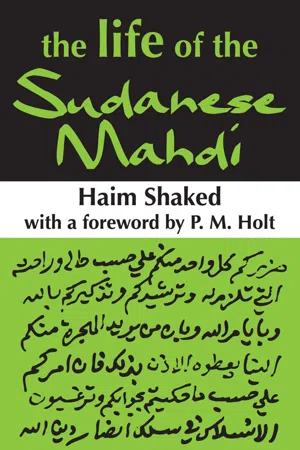
The Mahdia was an important Islamic millenarian movement of the Nilotic Sudan in the last two decades of the nineteenth century. It contributed substantially to the emergence of the Sudan as a nation-state in the twentieth century. The Mahdi's family and heritage played a major political and cultural role in the Sudan, both before and after independence.This volume begins with introductory material on the Mahdia and a biographical sketch of the author of the Sra, followed by discussion of composition, acquisition, sources, and literary features of the account. The text itself presents a condensed paraphrase of the account while retaining the spirit of the original document. It pays special attention to preserving historical events. Appendixes include full transcriptions of the main source materials for the biography, two photographic reproductions of the handwriting of the original Arabic manuscripts, and an annotated list of the Mahdist proclamations and letters transcribed in the original Arabic text of the Sra.
THE SĪRA OF THE MAHDI
EXPLANATORY NOTES
- References to the pages of the Arabic manuscript of the Sīra are given in the text of the following English summary in square brackets and in bold-face type, e.g., [20].
- The division of the summary into chapters follows that of Ismā‘īl. The arrangement into paragraphs and most subdivisions of the chapters are not in the Arabic manuscript of the Sīra.
- All the personal names, tribes and places mentioned in the Arabic text of the Sīra have been retained in the summary, in the form (sometimes inconsistent) in which they are rendered by Ismā‘īl.
- As will be noticed in the course of the summary, Ismā‘īl writes of the Mahdi both in the past tense and as though he were still alive during the compilation of the Sīra.
- References in the footnotes to the historical background of events are confined mainly to Holt, Mahdist State, which is the definitive historical work on the Mahdia and to Abū Salīm’s Arabic edition of the Sīra.
THE BOOK OF THE BLISS OF HIM WHO SEEKS GUIDANCE BY THE LIFE OF THE IMAM THE MAHDI
PREFACE1
1. GENERAL REMARKS2
[2] Following a basmala, thanksgiving to God and prayers for the Prophet Muḥammad, his family and Companions (aṣḥāb),3 the author of the Sīra identifies himself as Ismā‘īl b. ‘Abd al-Qādir. He then draws a parallel between the biography (sīra)of the Prophet and that of the Mahdi. The sīra of the Prophet was compiled by throngs of virtuous people and was thus preserved and handed down throughout the generations without alteration. Since the expected master of the Time (ṣāḥib al-zamān al-muntaẓar) is the successor (khalīfa) of the Prophet, all the Muslims are in duty bound by religion to spread his sīra and thus prevent its corruption with the passage of time.
The author, describing himself as one who swore allegiance to the Mahdi and was in his companionship, says that he was commanded [3] by the Khalifa ‘Abdallāhi to compile part of the Mahdi’s sīra, since it is beyond human ability to compile it in full. Without delay, the author adds, he obeyed the Khalīfa’s order, hoping that he would thereby be incorporated amongst the Mahdi’s Companions (aṣḥāb) and gain the favour of the Mahdi and the Khalifa.
The author names the work ‘The bliss of him who seeks guidance by the life of the Imam, the Mahdi’, and asks that God [4] assist him in its faultless completion.
2. THE CONTENTS OF THE SĪRA4
[4–6] The author lists the titles of the introduction, eight chapters and epilogue of the Sīra. [6] The preface is concluded with another prayer for the faultless completion of the work.
1. Sīra, 2/1–6/12.
2. Sīra, 2/1–4/4.
3. For the significance of this usage, see p. 220.
4. Sīra, 4/4–6/12.
INTRODUCTION
TRADITIONS ANNOUNCING THE MANIFESTATION OF THE MAHDĪ IN THE END OF THE TIME1
1. PROPHETIC TRADITIONS2 CONCERNING THE MAHDĪ AND HIS MANIFESTATION IN THE END OF THE TIME3
Since it is the unchanging custom and practice of God to return matters to their beginning after they have reached their extreme end, His wisdom and will made necessary the revival (iḥyā’) of the matter of Prophecy by the manifestation of the good news of the Lord of Mankind (sayyid al-anām), through whom God revived the signs of Islam, [7] the expected Fāṭimī Imam,4 Muḥammad al-Mahdī b. ‘Abdallah. The following Traditions announce him:
(1) The Prophet said: ‘The mahdī is of me. His forehead is bald, his nose is aquiline. He will fill the earth with equity and justice as it was filled with oppression and tyranny. He will live five, seven or nine [years].’
(2) The Prophet said: ‘If but one day remained of the temporal world, God would lengthen that day until He sent on [that same day] a man, of me or of the people of my house. His name would be identical with my name and his father’s name with my father’s name. He would fill the earth with equity and justice as it was filled with tyranny and oppression.’
(3) Abū Sa’īd al-Khudrī said: ‘The Messenger of God...mentioned an affliction which will befall this Community, such that a man will not find shelter whereunto he might take refuge from the tyranny. Then God will send a man of my family, by whom He will fill the earth with equity and justice as it was filled with tyranny and oppression. The dweller in Heaven and the dweller on earth will be pleased with him.’
(4) Umm Salima said: ‘I heard the Messenger of God...mention the mahdī and he said: “Surely! He is Right (ḥaqq) and he is of Fatima’s offspring.”’
(5) Abū Sa‘īd al-Khudrī said: ‘The Messenger of God...said: “The Hour (al-sā’a) will not arise until the earth will be filled with oppression, tyranny and enmity. Then, from the people of my house will come forth a man who will fill it with equity and justice as it was filled with tyranny and enmity.” ‘
(6) The Prophet also said: ‘The mahdī is of us, the people of the house. Through him God will put [things] in order in a night.’
(7) ‘Alī [b. Abī Ṭālib] said that he had asked the Prophet: ‘Is the mahdī of us or of [people] other [than us], O Messenger of God?’ [The Prophet] said: ‘Nay, of us. With him God will seal as with us he opened [the Line of the Prophets].’
(8) Abū Hurayra said: ‘My friend, Abū al-Qāsim [the Prophet Muḥammad] [8] said: “The Hour will not arise until a man of the people of my house will come forth against them and he will beat them until they return to the Truth.’”
(9) Ibn ‘Abbās said: ‘The Messenger of God...said: “The mahdī is the peacock of the people of paradise.”‘ (10) Al-Ṭabārānī narrated in the Prophet’s name that the Prophet had said: ‘The mahdī is of my offspring. His countenance is like the brilliant star. The complexion is an Arab complexion and the body is an Israelite body. He will fill the earth with justice as it was filled with oppression.’
(11) Jābir said: ‘The Messenger of God...said: “He who denies the mahdī is an unbeliever.” ’
This is the essence of the Prophetic Traditions concerning the mahdī and his emergence in the End of the Time.
2. TRADITIONS OF THE EARLY MUSLIMS (ĀTHĀR SALAFĪYA) WHICH GIVE PROOF OF THE MASTER OF THE TIME5
(1) One of the early Muslims said: ‘Alī [b. Abī Tālib], looking at his son al-Ḥasan said: “Verily, this son is a sayyid as the Messenger of God...named him. From his loins will come forth a man who will be named by the name of your Prophet. He will resemble him in nature (khulq) and he will not resemble him in physical constitution (khalq). He will fill the earth with justice.” ’
(2) Muḥammad b. al-Ḥanafīya said: ‘We were with ‘Alī...and a man asked him about the mahdī and he said: “That one will come forth in the End of the Time; if a man says Allāh, Allāh, he will be killed. God will gather for him a people, ragged like ragged clouds, whose hearts God will reconcile. They will neither grieve over anyone nor rejoice over one who joined them. Their number is [sic] the number of the people of Badr. The forefathers did not surpass them and the men of later times fell short of them.” ’
(3) [Muḥyī al-Dīn b. ‘Arabī,] the author of al-Futūḥāt al-Makīya said of the mahdī: ‘There will be with him three hundred and sixty men of God’s perfect men. This khalīfa [i.e., the mahdī], is of the family of the Messenger of God...[9], of Fāṭima’s offspring. His name is the name of the Messenger of God...and his agnomen (kunya) is the agnomen of his grandfather, al-Ḥasan b. ‘Alī. Those who know [the true essence of] God by divine communication will swear allegiance to him.’ They are godly men, they will elevate his call (yuqīmūna da‘watahu) and support him. They are the ministers (wuzarā’) who will bear the burdens of the kingdom and assist him.
(4) He also said that God would appoint as his ministers a group whom He had kept in his hidden concealment and shown the Truths (al-ḥaqā’īq). Thi...
Table of contents
- Cover
- Half Title
- Title Page
- Copyright Page
- Dedication
- Table of Contents
- Foreword P.M. Holt
- Preface
- Introduction
- The Sīra Of The Mahdi
- Conclusion
- Appendices
- Abbreviations
- Bibliography
- Index
- MAPS
Trusted by 375,005 students
Access to over 1.5 million titles for a fair monthly price.
Study more efficiently using our study tools.
Frequently asked questions
Yes, you can cancel anytime from the Subscription tab in your account settings on the Perlego website. Your subscription will stay active until the end of your current billing period. Learn how to cancel your subscription
No, books cannot be downloaded as external files, such as PDFs, for use outside of Perlego. However, you can download books within the Perlego app for offline reading on mobile or tablet. Learn how to download books offline
Perlego offers two plans: Essential and Complete
- Essential is ideal for learners and professionals who enjoy exploring a wide range of subjects. Access the Essential Library with 800,000+ trusted titles and best-sellers across business, personal growth, and the humanities. Includes unlimited reading time and Standard Read Aloud voice.
- Complete: Perfect for advanced learners and researchers needing full, unrestricted access. Unlock 1.5M+ books across hundreds of subjects, including academic and specialized titles. The Complete Plan also includes advanced features like Premium Read Aloud and Research Assistant.
We are an online textbook subscription service, where you can get access to an entire online library for less than the price of a single book per month. With over 1.5 million books across 990+ topics, we’ve got you covered! Learn about our mission
Look out for the read-aloud symbol on your next book to see if you can listen to it. The read-aloud tool reads text aloud for you, highlighting the text as it is being read. You can pause it, speed it up and slow it down. Learn more about Read Aloud
Yes! You can use the Perlego app on both iOS and Android devices to read anytime, anywhere — even offline. Perfect for commutes or when you’re on the go.
Please note we cannot support devices running on iOS 13 and Android 7 or earlier. Learn more about using the app
Please note we cannot support devices running on iOS 13 and Android 7 or earlier. Learn more about using the app
Yes, you can access The Life of the Sudanese Mahdi by Haim Shaked in PDF and/or ePUB format, as well as other popular books in History & Historical Biographies. We have over 1.5 million books available in our catalogue for you to explore.