eBook - ePub
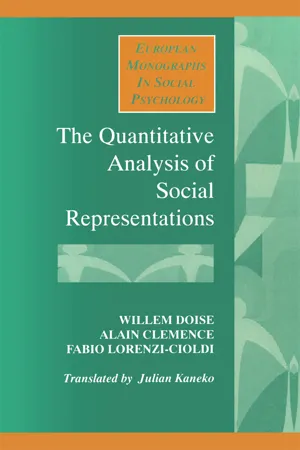
The Quantitative Analysis of Social Representations
- 176 pages
- English
- ePUB (mobile friendly)
- Available on iOS & Android
eBook - ePub
The Quantitative Analysis of Social Representations
About this book
Designed for undergraduate and postgraduate courses in sociology and social psychology, this textbook looks at the quantitative methodology of social representations research, using empirical and graphical illustrations and data tables.
Information
Part I
Common Knowledge
Part One will focus on objectification. While this notion denotes a process by which an abstract object a concept is transformed into an image or a figurative schema, the majority of empirical studies have called special attention to the product of this transformation. SRs are, in a way, confounded with a hierarchical structure of ‘words’ or images. It should be noted, however, that such a perspective, reductive though it is, allows us to demonstrate that this scientific apprehension of objectification is a momentum in the process of construction of a reality a momentum that springs from the formalization of concrete and everyday knowledge and transforms in return this ‘naive’ knowledge into a new reality.
Objectification implies cognitive operations such as selecting, categorization and schematization. They produce biases in everyday understanding that were often explained in terms of needs or desires and that, nowadays, are more often analyzed as shortcomings of human cognitive functioning (Nisbett and Ross, 1980). Cognitive biases are viewed as common characteristics of individuals’ information processing rooted in processes of stereotyping, distraction, self favouritism, etc. Much empirical evidence supports such social cognitive explanations of everyday cognitive functioning.
However, individual reasoning is also embedded in a thinking society or, in other words, individual cognitive systems are regulated by social metasystems. Information processing is inserted in patterns of social communication. To process and exchange information, subjects have to share common theories or social representations which have an existence outside the individual head (Moscovici, 1986). According to SR theory, cognitive products result from the intervention of social regulations in common knowledge more often than from imperfect information processing. Notwithstanding these differences in approaches, it is worthwhile to point out attempts of integration between the social cognition and the SR traditions (see Augoustinos and Innes, 1990).
Studies of objectification aim to assess the contents of ‘naive’ theories that individuals share about events, objects or situations in their social environment. Three main hypotheses orient these studies.
First, it is assumed that people share a limited number of meanings for a specific object. An important task for researchers, therefore, is to determine the entries of this dictionary of meanings. Which words, images, informations are available to and used by individuals who apprehend social events or social objects? This part of the study of SRs primarily concerns the nature of data and the methods of gathering them; we touch upon it as an introduction to the presentation of various analytic methods. Raw data can be different kinds of individual responses as well as products of media, groups or institutions.
A second hypothesis is that the shared contents of SRs are structured. Different kinds of organizations of common knowledge have been envisaged. The simplest structure is a basic dichotomy between two broad categories of contents but more complex organizations are usually defined. Evidencing such organizations is a matter of data analysis and will be dealt with at some length in the next chapters. Special attention will be paid to the kind of structures that can be investigated by means of the most commonly used techniques. Three such structures will be discussed. The first one results from a refinement of the idea of a dichotomous classification in terms of similarity or dissimilarity. In this sense, SR’s organization is presented as a hierarchical classification based on the degree of similarity between contents. A second type of study stems from the idea that the contents are organized around a few dimensions. Symbolic materials are conceived as distributed on dimensions linking contrasted meanings. The structure is no longer thought of as a tree with hierarchical levels of classification but as a mapping of distances between meanings. Complexity of this structure is reflected in the number of dimensions used to map out the data, more dimensions are needed when differentiations happen to be less consensual. The third form of structure is grounded on the same idea of a map. But in this map elements of meaning are arranged according to the degree with which their relationships deviate from the average relationships between all elements. Complexity of the structure is determined by the number of axes needed to account for the pattern of such deviations.
The third hypothesis assumes that the structure of a SR is oriented by a few attitudinal dimensions. Each element of a representation not only has a meaning but an evaluative connotation as well that is widely accepted by people of the same social world. Orientation of the structure can be defined by interpreting the different clusters, dimensions or axes. Another possibility is to determine the orientation by weighting the data according to subjects’ judgements. This aspect will lead us to report briefly on the use of attitude scales, and on Osgood’s scale in particular, for defining orientations of a structure.
For many researchers, a SRs structure is organized around a nucleus or a core which constitutes the stable and meaningful linkage of all the SR’s elements. In this sense, such a core is comparable to a schema (see Augoustinos and Innes, 1990). This view implies to some extent that such a structure is objectified in an internal, psychological structure shared by individuals in a same social world. The question is about the links between a statistical representation of data and their psychological organization. We address this point at the end of Part One.
But let us state here that the existence of SRs is without doubt objectified and crystallized in different symbolic and material institutions of the society (e.g. legal rules and norms, etc). If individuals take part in a common structure, this may merely imply that they refer to the same institutionalized systems of meanings. However, in Part Two we emphasize that individuals position themselves differently in relation to such common systems of meanings and that they can accentuate or weaken links that are objectified in a SR. Hence, their individual representations do not necessarily espouse the objectified structure of a common representation.
1
Automatic Cluster Analysis:
Proximities between Contents of a Social Representation
SR studies involve linguistic material such as responses to questionnaires, free associations of words and conversations. This fact has inevitably led to fierce debates over the relevance of statistical and theoretical methods used to treat such data. The disputes are, of course, all the more heated as they concern discourses culled from conversations, for instance, and we are dealing here not only with semantic indicators but also with syntactic structures. We are talking about material whose treatment does not preclude this kind of debate.
We will study, primarily but not exclusively, the data obtained by standardized or semi-standardized questionings. Most works on SRs often begin with open investigations that enable semantic universes to be defined. One of the most commonly used techniques is the free association of words (see De Rosa, 1988, and Le Bouedec, 1984).
Initially used in an individualistic perspective, free association of words was adapted by social-psychologists as a means to identify shared conceptions of widely used notions such as intelligence, work, health and sickness. The way they proceed in treating such associations results in an objectification of a consensual apprehension of reality. Differences between individuals or between groups are rarely taken into consideration as evidenced in the examples we will present in this part of the book. Parts Two and Three will develop our views on the analysis of inter-individual and inter-group variations in the study of SRs.
The material thus obtained can be put together in a collection of words used by the whole study population, one of its groups or each individual. Such collections are called dictionaries amenable to various types of treatment. Generally, there are two ways of treating this kind of material. The first consists of directly using the ‘words’ to reveal universes common to different stimuli. In the second type of treatment, the ‘words’ are used more to define their organization and apprehend a ‘deeper’ structure of the SR field. We will begin by briefly describing a study on the treatment of dictionaries by the first approach. This will give us the opportunity to introduce multivariate hierarchical cluster analysis, which we will then discuss in greater detail.
Hierarchical Cluster Analysis of Word Associations
To define the semantic universe of a SR, it may be useful to obtain, using a word-association technique, information on words that are known to be used to image the object of representation. These words can be defined by their links between themselves and with the represented object. This may involve links of similarity or difference or various implicative relationships. A comparison of the dictionaries obtained for each of the words then enables us to specify a representational field and its relationships with closely related fields. This operation can be performed for the whole study population without taking account of individual variations in the number and nature of associated words. It is generally admitted, implicitly or not, that there is a single SR of the object or at least a solid basis common to all individuals.
Illustration: A Protest Movement
Di Giacomo (1980) studied the SRs of a protest movement led by students at the Catholic University of Louvain, Belgium. Among other measures, the author selected nine stimulus words to define and compare semantic universes close to, or distant from, the movement. The stimulus words apt to characterize the movement were: the committee against the 10 000 (name given to the committee that organized the protest movement against the Belgian Government’s decision to double university enrolment fees from 5000 to 10 000 Belgian francs), strike (suggested by the committee), extreme left (the committee’s political leanings) and workers (because of the committee’s appeal to student-worker solidarity). As opposed to them, the following words were suggested: power (against which the movement was directed), extreme right (opposed to the committee’s extreme leftism), executives (in opposition to workers) and the AGL (the General Assembly of the Students of Louvain which took over the movement). The word students (group wooed by the committee and the AGL) may be considered the ‘hinge’ word: the author wanted to know if the students were perceived to be in the sphere of influence of the committee or the AGL. Each of the 281 questioned subjects was asked to associate as many words as he/she wished with one of the nine words.
Since the total number of different words used was large (977 for 1631 words), it was more than halved (to 453) by aggregating semantically similar words (examples: right-winger right; I don’t know unknown; Leninist, Trotskyist and Communist Marxist sic). The analyzed material was thus composed of nine dictionaries, each corresponding to a stimulus word, for comparison.
The author first built a similarity matrix between these dictionaries by calculating an index called Ellegard’s association index. This index was calculated by dividing the number of words common to two dictionaries by the square root of the product of the words of the two dictionaries. It thus varied between 0 and 1, because the higher the percentage of common words, the higher the index. In the above-mentioned study, the author observed a high similarity index between the committee against the 10 000 and strike (0.40), while the similar...
Table of contents
- Cover
- Half Title
- Title
- Copyright
- Contents
- Introduction: Nonconsensual Social Representations
- Part I: Common Knowledge
- Part II: Shared Knowledge and Individual Positions
- Part III: Group Effects on Individual Positioning
- Conclusion: Reference Points and Individual Positioning
- Bibliography
- Index
Trusted by 375,005 students
Access to over 1.5 million titles for a fair monthly price.
Study more efficiently using our study tools.
Frequently asked questions
Yes, you can cancel anytime from the Subscription tab in your account settings on the Perlego website. Your subscription will stay active until the end of your current billing period. Learn how to cancel your subscription
No, books cannot be downloaded as external files, such as PDFs, for use outside of Perlego. However, you can download books within the Perlego app for offline reading on mobile or tablet. Learn how to download books offline
Perlego offers two plans: Essential and Complete
- Essential is ideal for learners and professionals who enjoy exploring a wide range of subjects. Access the Essential Library with 800,000+ trusted titles and best-sellers across business, personal growth, and the humanities. Includes unlimited reading time and Standard Read Aloud voice.
- Complete: Perfect for advanced learners and researchers needing full, unrestricted access. Unlock 1.5M+ books across hundreds of subjects, including academic and specialized titles. The Complete Plan also includes advanced features like Premium Read Aloud and Research Assistant.
We are an online textbook subscription service, where you can get access to an entire online library for less than the price of a single book per month. With over 1.5 million books across 990+ topics, we’ve got you covered! Learn about our mission
Look out for the read-aloud symbol on your next book to see if you can listen to it. The read-aloud tool reads text aloud for you, highlighting the text as it is being read. You can pause it, speed it up and slow it down. Learn more about Read Aloud
Yes! You can use the Perlego app on both iOS and Android devices to read anytime, anywhere — even offline. Perfect for commutes or when you’re on the go.
Please note we cannot support devices running on iOS 13 and Android 7 or earlier. Learn more about using the app
Please note we cannot support devices running on iOS 13 and Android 7 or earlier. Learn more about using the app
Yes, you can access The Quantitative Analysis of Social Representations by Alain Clemence,Willem Doise,Fabio Lorenzi-Cioldi in PDF and/or ePUB format, as well as other popular books in Psychology & Research & Methodology in Psychology. We have over 1.5 million books available in our catalogue for you to explore.