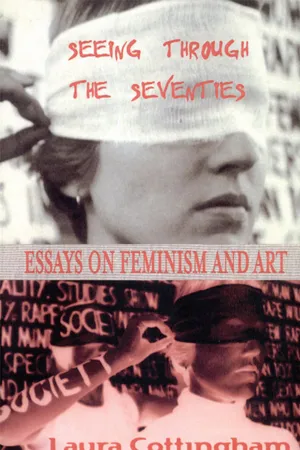
In recent years, Laura Cottingham has emerged as one of the most visible feminist critics of the so-called post-feminist generation. Following a social-political approach to art history and criticism that accepts visual culture as part of a larger social reality, Cottingham's writings investigate central tensions currently operative in the production, distribution and evaluation of art, especially those related to cultural production by and about women.
Seeing Through the Seventies: Essays on Feminism and Art gathers together Cottingham's key essays from the 1990's. These include an appraisal of Lucy R. Lippard, the most influential feminist art critic of the1970's; a critique of the masculinist bias implicit to modernism and explicitly recuperated by commercially successful artists during the 1980s; an exhaustive analysis of the curatorial failures operative in the "Bad Girls" museum exhibitions of the early 1990s; surveys of feminist-influenced art practices during the women's liberationist period; speculations on the current possibilities and obstacles that attend efforts to recover lesbian cultural history; and an examination of the life, work and obscuration of the early twentieth-century French photographer Claude Cahun.
- 224 pages
- English
- ePUB (mobile friendly)
- Available on iOS & Android
eBook - ePub
About this book
Considering Claude Cahun
Occurring decades after her death in 1954, the posthumous acculturation of Claude Cahun into dominant fine art discourse during the 1990s is both welcome and disturbing. It’s gratifying, of course, for those of us involved and concerned with twentieth-century art to find ourselves introduced to an artist of such obviously significant value—and one of whom we were previously, as a collective consciousness, all but unaware. Yet the problematics raised by this otherwise fortuitous cultural circumstance are not without their own hubristic significance. How, after all, was it possible that an artist as relatively well-born (and into a culturally active, eminent, family); well-connected (known to Georges Bataille, Andre Breton, Robert Desnos, Henri Michaux, and other leading Frenchmen of her time); and culturally engaged (productive as a writer, actor, and political activist, as well as an object maker and photographer) should have had her name left so underrecognized and her visual art misidentified and literally missing for so many decades?
Cahun’s cultural production in Paris between the two world wars includes published writings in leading Paris journals (especially in Mercure de France, edited by her uncle Marcel Schwob); authorship of three books Vues et Visions (1914); Aveux non Avenues (1930); Les Paris sont ouverts (1934); public involvement with the Communist debates on politics and aesthetics; work within experimental theater as an actor and stylist; sporadic publication of her photographs; and participation in two of the international surrealist exhibitions of the late 1930s.1 As an artist and writer on the margins of the surrealist activities that dominated Paris cultural life between the wars, Claude Cahun’s historical presence, subsequent cultural erasure, and reintroduction in the 1990s are worth examining in light of what they reveal about the organizing principles that encouraged artistic practices during the surrealist period and have subsequently determined how those practices have been scripted into history and understood in the present.
Until very recently—that is, until a cache of Cahun’s photographs and negatives were discovered on the British island of Jersey in the 1980s and put into commercial circulation—twentieth-century scholarship on the Paris surrealist circle has demonstrated little awareness of Claude Cahun and even less acknowledgement of Cahun as a visual artist. Even far-reaching scholarly compendiums such as the Encylopedie de Surréalisme (l975), and the Dictionnaire Général du Surréalisme et de ses Environs (1982), which itemize thousands of artists and artworks associated with the surrealist movement, neglect Claude Cahun completely.2
Contemporary critics and art historians in the 1990s, although apparently eager to rescue Cahun from oblivion and feature her in survey exhibitions, nonetheless appear confounded by Cahun’s exceptional refusal to participate in the visual generation of images of female sexual display and stereotypes of “femininity.” Many resort to collapsing Cahun’s resistence into evidence of her “maleness.” Referring to one of Cahun’s mirror self-portraits in an essay for the 1990 exhibition Anxious Visions: Surrealist Art, historian Sidra Stich says, “The artist presents an outward looking close-up of her own face and head reflected in a mirror displayed to appear suggestively like that of a man.”3 Similarly, an essay for the 1996 exhibition A Rrose is a Rrose is a Rrose claims that “Cahun performed both textual and photographic cross-dressing.”4 These and other contemporary deliveries of Cahun into maleness and supposed “cross-dressing” rely on extremely conservative notions of female appearance and female artistic production, for there is nothing demonstrably “male” in Cahun’s work. Rather, Cabin’s self-portraits often present a female image that eschews the conventional visual codes of feminine deportment: her hair is not long, her face is not concealed behind cosmetics, her body is not decorated by jewelry, and she is not wearing a dress. These choices that Cahun made for nonfeminized self-presentations—choices Cahun made in her every day life, not only in her artistic enactments (and more directly alligned with those of her nineteenth-century French lesbian artist precedent, Rosa Bonheur, than with twentieth-century transvestism)—are orchestrated in opposition to requisite codes of female appearance, not according to any deliberate attempt to pass as a man or otherwise “cross-dress.”
Cahun’s most evident difference from other surrealist photography, including other images produced by women associated with the movement, was obvious when a few of her self-portraits were first featured alongside those of other photographers in the 1986 survey, L’Amourfou: Surrealism and Photography. Reviewing the exhibition, Hal Foster singled out Cahun’s variance: “Woman appears in many guises in Surrealist photography; e.g., woman as erotic spectacle, woman as nature, woman as mystery. With the exception of Claude Cahun, a Cindy Sherman avant la lettre who deals in her self-portraits with masquerade, the work of the female photographers—Nusch Éluard, Dora Maar, Lee Miller—mostly complies with these fixed types, a demonstration, if one is needed, that they are culturally conditioned.”5
Despite the deployment of some of surrealism’s favored tropes—mirrors, doublings, distortions, theatrical props and stagings—Cahun’s self portraiture significantly adjusts, and implicitly critiques, the spectacularization of the female body offered in dominant surrealist practices. The process she utilized to construct female images was also different from the dominant procedure of men photographing women active in surrealism. Unlike the other women associated with surrealism, Gahun did not enter her life or her image into the muse-model-mistress script that surrealism wrote for its female participants. Honor Lasalle and Abigail Solomon-Godeau have observed that “insofar as it turns on the woman as both subject and object of representation, as artist and model, Cahun’s work departs from the more familar forms of surrealist photographic practice. If the femininity so prominently figured in surrealism is defined and perceived through the masculine imaginary, what differences are perceptible when that femininity is bodied forth by a woman?”6 Indeed, with Gahun, one must additionally ask: what difference did her lesbianism bring to her self-representational process?
Cahun’s only biographer, François Leperlier, suggests that the artist’s occlusion from historical accounts of Paris cultural life between the two world wars is partially explained by the iconoclastic diversity of her cultural engagements and encouraged by what he refers to as her “profoundly introverted attitude.” In an essay commissioned for a 1994 London exhibition Mise en Scene, Leperlier observes that Cahun’s photographic work did not enter the public realm until 1937—almost two decades after she began working in photography—when twenty-two of her tableaux pictures were used to illustrate Lise DeHarme’s poetic children’s book, Le Coeur de Pic. Leperlier suggests that Cahun maintained a “private” relationship to her photography: “The self-portrait that appeared in Bifur (a small Paris review that published one of Cahun’s images in April 1930) had remained something of a one-off. A few copies did the rounds. Claude Cahun enjoyed offering them to friends, but it was all very private. In this respect, as in others, she turned her back on all manner of professionalism and career. She always boasted about her “dilettantism,” her taste for differentness, and the indefinite. Photography should proceed from a closely pondered poetics, which ordains technical processes. Unlike most of the practitioners and artists of the day, Claude Cahun put photography squarely at the service of an existential, and profoundly introverted attitude.”7
Although Leperlier’s biography and other writings on Cahun provide the most informative accounts on the artist to date—and have corrected some of the most egregious errors of fact previously perpetuated against her—additional primary research on Cahun’s life is required before any generalizations about her life, personality, attitude, and reasons for her exclusion can be put forward with any degree of interpretive certitude. Indeed, before more contributive work and greater understanding of Cahun’s art can commence, a central blind spot in the art-historical mirror held up to Cahun’s life and work must be acknowledged and removed. Cahun was a lesbian. She spent her entire adult life with her lover Suzanne Malherbe, who, like Cahun, was born in Nantes in the early 1890S. The women met when both were less than twenty years old, when Cahun’s father married Malherbe’s mother. They were stepsisters, as well as lovers and lifelong companions. After Cahun’s studies at Oxford and the Sorbonne and Malherbe’s education at the Ecole des Beaux-Arts de Nantes, they moved to Paris together in 1921. Throughout the 1920s and 1930s, Cahun and Malherbe lived together in Montparnese among other lesbians and artists. Artistic as well as romantic partners, Malherbe produced the illustrations for Cahun’s selection of poetry, Vues et Visions (1919); signed the photomontages in Aveux non avenus (1930); and collaborated on Cahun’s photographic works.8 But Paris couples such as Cahun and Malherbe or Gertrude Stein and Alice B. Toklas—who were known and recognized as romantic companions among the demi-monde of Left Bank artists and writers in the twenties and thirties—were still cloaked in a cultural silence that left unstated the actual terms of their relationships and ignored the possibility that their lesbianism directly influenced their work.
The relative social and sexual freedom Paris offered women before the encroachment of World War II was conditioned by these and other implicit social and legal restrictions. Despite the active and obvious participation of lesbians in various fields of modernist and avant-garde cultural production —as writers, poets, architects, photographers, visual artists, magazine editors, publishers, and patrons — lesbians formed a network of social, sexual, and artistic relationships that ran parallel, and necessarily somewhat independent from, dominant heterosexual society. In Women of the Left Bank: Paris, 1900–1940, literary historian Shari Benstock stresses the enforced independence of lesbian cultural life: “Homosexual women [sic] of necessity were forced to define and create their own communities of friends; they could not assume that such support groups were a ‘given’ in the culture of any urban environment, although the city itself provided the meeting ground—in cafes, restaurants, bars—for these women. Paris lesbians, however, avoided public spaces and created their own private spaces within the city, redefining the nineteenth-century salon for their own emotional and intellectual purposes.”9
Although some publications in the 1990s, including those of Leperlier, name Cahun as a “lesbian,” they do so without serious regard to the social history lesbianism invokes, and they consistently deny and obscure the possibility that the cultural construction and political regulation of lesbianism might be an appropriate and necessary framework within which to examine and understand Cahun’s oeuvre. In this sense, a continuity exists between Cahun’s marginalization in the past and her “success” in the present: her lesbianism places her outside of dominant conventions of cultural authority and interpretation. To bring her into ...
Table of contents
- Cover
- Title page
- Copyright page
- Contents
- Acknowledgments
- Shifting Ground: On the Critical Practice of Lucy R. Lippard
- Hie Masculine Imperative: High Modern, Postmodern
- What's So “Bad” About ’Em?
- How many “bad” feminists does it take to change a lightbulb?
- Are You Experienced? Feminism, Art and the Body Politic
- Eating from the Dinner Party plates and other myths, metaphors, and moments of lesbian enunciation in feminism and its art movement
- L.A. Womyn: The Feminist Art Movement in Southern California, l970–1979
- Notes on lesbian
- Considering Claude Cahun
Trusted by 375,005 students
Access to over 1.5 million titles for a fair monthly price.
Study more efficiently using our study tools.
Information
Publisher
RoutledgeEdition
1Year
2013Topic
ArtPrint ISBN
9789057012228
9789057012129
Subtopic
Art & PoliticseBook ISBN
9781134394616
Frequently asked questions
Yes, you can cancel anytime from the Subscription tab in your account settings on the Perlego website. Your subscription will stay active until the end of your current billing period. Learn how to cancel your subscription
No, books cannot be downloaded as external files, such as PDFs, for use outside of Perlego. However, you can download books within the Perlego app for offline reading on mobile or tablet. Learn how to download books offline
Perlego offers two plans: Essential and Complete
- Essential is ideal for learners and professionals who enjoy exploring a wide range of subjects. Access the Essential Library with 800,000+ trusted titles and best-sellers across business, personal growth, and the humanities. Includes unlimited reading time and Standard Read Aloud voice.
- Complete: Perfect for advanced learners and researchers needing full, unrestricted access. Unlock 1.5M+ books across hundreds of subjects, including academic and specialized titles. The Complete Plan also includes advanced features like Premium Read Aloud and Research Assistant.
We are an online textbook subscription service, where you can get access to an entire online library for less than the price of a single book per month. With over 1.5 million books across 990+ topics, we’ve got you covered! Learn about our mission
Look out for the read-aloud symbol on your next book to see if you can listen to it. The read-aloud tool reads text aloud for you, highlighting the text as it is being read. You can pause it, speed it up and slow it down. Learn more about Read Aloud
Yes! You can use the Perlego app on both iOS and Android devices to read anytime, anywhere — even offline. Perfect for commutes or when you’re on the go.
Please note we cannot support devices running on iOS 13 and Android 7 or earlier. Learn more about using the app
Please note we cannot support devices running on iOS 13 and Android 7 or earlier. Learn more about using the app
Yes, you can access Seeing Through the Seventies by Laura Cottingham in PDF and/or ePUB format, as well as other popular books in Art & Art & Politics. We have over 1.5 million books available in our catalogue for you to explore.