eBook - ePub
Planning, Delivering and Assessing GNVQs
A Practical Guide to Achieving the "G" Units
- 224 pages
- English
- ePUB (mobile friendly)
- Available on iOS & Android
eBook - ePub
Planning, Delivering and Assessing GNVQs
A Practical Guide to Achieving the "G" Units
About this book
This work provides a guide to GNVQ assessor units that teachers must work towards, and is directly linked to the teacher's role in the planning and implementation of GNVQs. It provides examples and case studies across a number of different occupational areas.
Information
Chapter 1
GNVQs and the GPA Units
With the introduction of GNVQs there are now three clear pathways of qualifications:
• the academic route of GCSEs and GCE A-levels;
• the broad vocational route of GNVQs; and
• job-specific route of National Vocational Qualifications (NVQs).
In order to understand the role of GNVQs it is useful to see how these fit with the national framework of vocational qualifications. The purpose of NVQs was to introduce a work-based qualification enabling an individual to demonstrate skills and knowledge needed to do a job well within that working environment and meeting the national standard. As NVQs are strictly work-related it was necessary to develop a broader based qualification suitable for work preparation. In 1991 the government announced in the White Paper, Education and Training in the 21st Century, its intention to introduce GNVQs and asked NCVQ to oversee the development of these new qualifications. The aim of this qualification is to provide vocational educational opportunities to all people – young people and adults studying on a part- or full-time basis. However, GNVQs are mainly designed for 16–19-year-olds in full-time education with little or no work experience. All NVQs and GNVQs can be found listed on the National Database of Vocational Qualifications available at places such as Training and Enterprise Councils (TECs), colleges, careers services, libraries and at some companies.
GNVQ students follow broad vocational programmes of study, which keeps their options open for employment, further training or further or higher education. GNVQs do not focus only on vocational skills and knowledge but also on the key skills of Application of Number, Communication and Information Technology.
As with any new qualification it is essential that there is an appropriate system of quality assurance. Currently only three awarding bodies, BTEC, City & Guilds and RSA can accredit GNVQ programmes. Quality assurance is monitored by the awarding body itself and by an external verifier appointed by the awarding body. In addition, schools and colleges are monitored by inspection agencies; OFSTED reported on GNVQs in 1993 and noted several areas where improvements were needed to establish national standards. As a result, in 1994 the Parliamentary Under-Secretary of State responsible for GNVQs set out a six-point plan to enhance the quality of GNVQs. This is currently being implemented by NCVQ and the awarding bodies and has led to joint publications including the GNVQ Quality Framework. The six points are:
• to improve the quality, reliability and credibility of external assessment, having regard to cost-effectiveness and teacher workload;
• to clarify the role of external verifiers, so as to give more emphasis to moderation of standards, and to improve the selection and training of verifiers;
• to improve and simplify the grading criteria, to give more emphasis to the quality of students’ completed work and to secure rigour and consistency of standards; and to develop ideas for using external tests to contribute to grading;
• to clarify the knowledge requirements within each GNVQ and present GNVQ unit specifications in a way which is jargon-free and more readily understandable to teachers and students;
• to provide better and clearer guidance for teachers on portfolio assessment, grading, course planning and design, and to eliminate excessive form-filling;
• to introduce clear and consistent criteria, across all GNVQ awarding bodies, for the accreditation of schools and colleges offering GNVQs and for quality assurance.
Since that time NCVQ commissioned an independent review of the assessment of GNVQs chaired by Dr John Capey. This review group considered evidence from over 400 centres. The strengths identified were: specified outcomes, unit-based structure, the emphasis on active learning and the inclusion of key skills. The report noted that centres were very supportive of the GNVQ philosophy and structure but centres would welcome a simplified assessment regime.
The review group considered the evidence and came up with 19 recommendations to NCVQ which are too detailed to list here but are organized around four major themes: manageability of the assessment regime; key skills; grading; and external tests. The issue of quality assurance is a fundamental one for a national qualification which is intended to be broad based and to respond to the needs of a significant proportion of the population.
In March 1996 Sir Ron Dearing reported on his review of qualifications for 16–19-year-olds. This survey of a vast area will clearly have implications for the implementation of GNVQs in the future, and these are outlined in Chapter 11. The report welcomed the recommendations and conclusions of the Capey Committee, mentioned above.
Standards for assessment have been designed by the Training and Development Lead Body (TDLB) identified as Units D32 and D33. While these are highly suitable for assessors working with NVQs it was realized that they did not address the more complex understanding required by teachers in relation to planning, designing and assessing GNVQs and as a result the GPA units have been developed. The focus on assessment of NVQs is outcomes, while with GNVQs teachers have to develop learning programmes and plan assessment opportunities not only to evidence the vocational outcomes but also the grading criteria and the key skills. At present, it is not obligatory for teachers of GNVQs to hold D32/33 or the GPA units but NCVQ and the awarding bodies strongly advise that they are used as a focus for staff development within any school or college offering GNVQs.
One of the proposals for action in the Dearing report relates to teacher quality and teacher education, and highlights the need for further consideration to be given to programmes of initial, in-service and continuing training of teachers. In respect of GNVQs, the GPA units can be used a vehicle for training and for the development of continuing quality standards to assist schools and colleges in fulfilling this identified need.
In Chapter 2 we will examine the structure of GNVQs.
Chapter 2
How GNVQs Work
The purpose of this chapter is to provide an overview of the GNVQ framework and we will cover those topics which you will need to be aware of when you read the rest of the book. We have included a section on Part One GNVQs so if you are involved in these, please read this section before progressing further.
We do not intend to cover any aspect in detail in this chapter and we have indicated at appropriate points the relevant chapters which will provide you with more information. Throughout the book, we intend to focus on what a teacher needs to do to plan, deliver and assess GNVQs. We will give examples from specific vocational areas based on contact with many teachers involved in GNVQs. As a practitioner and a specialist in your own area you will need to refer to, or obtain, the detailed specifications from the awarding body of your choice.
GNVQs are currently offered at three levels: Foundation, Intermediate and Advanced. Consultation is currently taking place about higher level GNVQs. This framework enables people to enter at the point appropriate to them and to progress through it or onto another pathway (see Table 2.1).
Table 2.1 Qualification Equivalence Framework
NVQ | GNVQ | ACADEMIC |
1 | Foundation | 4 GCSEs (Grade D or below) |
Foundation Part One | 2 GCSEs (Grade D or below) | |
2 | Intermediate | 4–5 GCSEs (Grades A*–C) |
Intermediate Part One | 2 GCSEs (Grades A*–C) | |
3 | Advanced | 2 GCE A-levels |
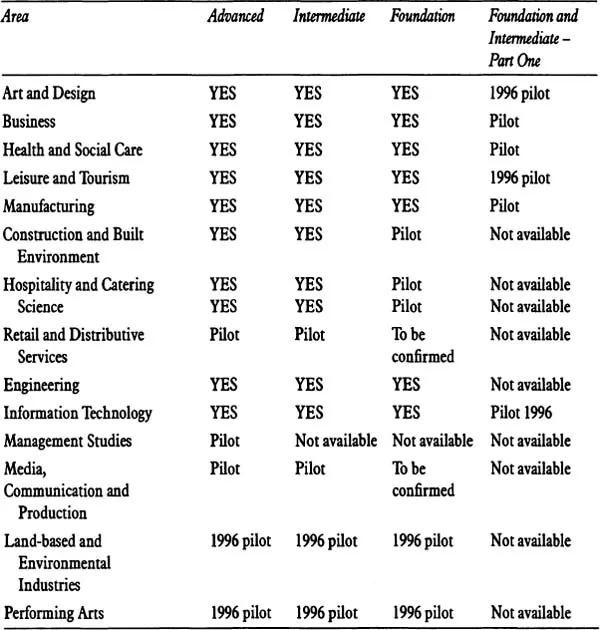
GNVQs are currently offered by three awarding bodies: BTEC, City & Guilds and RSA. The introduction of GNVQs has been phased and some have already undergone revision. Table 2.2 gives a list of GNVQs available.
Table 2.2 GNVQ availability as from September 1995
All GNVQs follow the same framework of:
• mandatory vocational units which cover the skills, knowledge and understanding a person needs for a broad range of jobs in a particular vocational area;
• optional vocational units which give people the opportunity to specialize;
• mandatory key skills units which develop skills in application of number, communication and information technology;
• external tests to examine the breadth of the range in most mandatory units.
The number of mandatory and optional units required for each level of GNVQ and the minimum level of key skills required are shown in Table 2.3. This is discussed further in Chapters 4 and 6.
Table 2.3 Units required for each GNVQ level
Mandatory units required | Optional units required | Mandatory key skills units | |
Foundation | 3 | 3 | Level 1 |
Intermediate | 4 | 2 | Level 2 |
Advanced... |
Table of contents
- Cover
- Title Page
- Copyright Page
- Table of Contents
- Acknowledgements
- Preface
- Section 1. Background
- Section 2. Planning for GNVQs
- Section 3. Assessing GNVQs
- Section 4. Future developments
- Appendix 1. Models of Timetabling for GNVQs
- Appendix 2. The GNVQ Grading Criteria
- Glossary of Terms
- Bibliography
- Index
Trusted by 375,005 students
Access to over 1.5 million titles for a fair monthly price.
Study more efficiently using our study tools.
Frequently asked questions
Yes, you can cancel anytime from the Subscription tab in your account settings on the Perlego website. Your subscription will stay active until the end of your current billing period. Learn how to cancel your subscription
No, books cannot be downloaded as external files, such as PDFs, for use outside of Perlego. However, you can download books within the Perlego app for offline reading on mobile or tablet. Learn how to download books offline
We are an online textbook subscription service, where you can get access to an entire online library for less than the price of a single book per month. With over 1.5 million books across 990+ topics, we’ve got you covered! Learn about our mission
Look out for the read-aloud symbol on your next book to see if you can listen to it. The read-aloud tool reads text aloud for you, highlighting the text as it is being read. You can pause it, speed it up and slow it down. Learn more about Read Aloud
Yes! You can use the Perlego app on both iOS and Android devices to read anytime, anywhere — even offline. Perfect for commutes or when you’re on the go.
Please note we cannot support devices running on iOS 13 and Android 7 or earlier. Learn more about using the app
Please note we cannot support devices running on iOS 13 and Android 7 or earlier. Learn more about using the app
Yes, you can access Planning, Delivering and Assessing GNVQs by Ros Ollin,Elaine Smith in PDF and/or ePUB format, as well as other popular books in Education & Education General. We have over 1.5 million books available in our catalogue for you to explore.