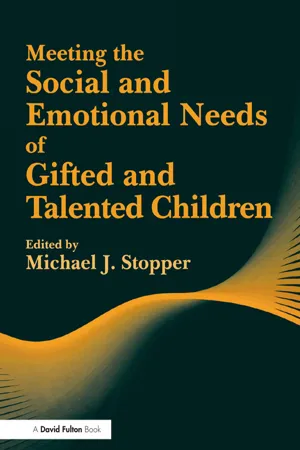
eBook - ePub
Meeting the Social and Emotional Needs of Gifted and Talented Children
- 146 pages
- English
- ePUB (mobile friendly)
- Available on iOS & Android
eBook - ePub
Meeting the Social and Emotional Needs of Gifted and Talented Children
About this book
First Published in 2000. The education of gifted and talented children is attracting increased interest and attention in schools, LEAs and within government. A widely accepted critical aspect of talent development has until now remained under-represented: namely that the principal factors underpinning all learning are social and emotional ones. This book addresses the complex relationship between intellectual, social and emotional development that is necessary for high achievement and personal fulfilment. The contributors aim to provide relevant practical guidelines for secure and confident learning for pupils that will support teachers, parents and others wishing to help translate potential into performance.
Information
CHAPTER 1
Introduction
Current interest in the gifted and talented
It is beyond the scope of this book to unfold the extensive historical backcloth to current national interest in, and concern for, the education of gifted and talented children. However, many will welcome the burgeoning literature which supports this and the higher profile which these children now have within the government’s educational agenda – driven by the principle of social inclusion. Some of the more recent influences which have given rise to current developments are, none the less clearly apparent; they include: intensive lobbying by national associations working in this field, the critical findings of Her Majesty’s Inspectorate (HMI) and the Office for Standards in Education (OFSTED), increased emphasis on both special need and differentiated provision in classrooms and a more discerning stance by parents with regard to mismatches between their children’s ability and the level of work they undertake in school. All of this has been interwoven with the enhanced ‘newsworthiness’ that issues regarding the gifted and talented now seem to have assumed in the media.
However, optimism generated by such developments needs to be tempered by the recognition that the key lead given by government is very much outcomes-focused and less concerned with inputs and procedures, i.e. with strategy. In particular, we are left to infer how to equip and enskill gifted and talented children within the social and emotional dimensions of learning.
The social and emotional foundations of learning
It has taken a considerable period of time for due consideration to be given to the effects of social and emotional development on knowing and thinking and understanding. As psychological inquiry has advanced (e.g. Hoffman 1986) we have come to accept the closeness of the relationship with greater certainty, although intuitive perceptions of it have long-existed (Stednitz 1995). Additionally, within the structure of the brain itself, we have the biological indicators to reinforce theory, intuition and observational study: its hemispherical architecture which respectively denotes functioning that is cognitive or more affective (left brain/right brain) in character, also features a greater array of inter-connecting ‘information pathways’ between the hemispheres than is found between the brain and any other area of the body.
In its potential for promoting effective learning, such knowledge has found a comfortable identity in integrated approaches to education such as that developed by Clark (1988). This embraced the premise that thinking, feeling, intuitive and physical sensing functions were interdependent, mutually reinforcing prerequisites for successful learning and living. The social and emotional underpinning of and interplay with effective learning has been similarly discussed by Butler-Por (1987), George (1992), Wallace and Adams (1993), Webb (1993), Lubinski (1993) and Landau and Weissler (1998) among others.
Socio-emotional constituents of definitions and models
While some authorities in the field have focused on the cognitive components of high ability, we can trace the evolution of alternative and, essentially, broader conceptions of giftedness and talent. Such insights were evident over 80 years ago when William Stern recognised that factors other than high intelligence were necessary for outstanding achievement. These factors, he suggested, included motivation and an appropriate environment (Stern 1916).
Although Terman (1925–9) had conducted research on the basis of a firm belief in intelligence as a unitary trait that was genetically determined and chronologically stable, his position was modified as a result of the later empirical data of his own genetic studies. These led him to conclude that many of his subjects had never made use of their ‘superior’ ability and (foreshadowing subsequent developmental theories) that factors other than intelligence fundamentally affect an individual’s ‘life success’. Renzulli’s (1977) model of giftedness reflected this concern for the inclusion of non-intellective factors. His ‘three-ring conception’ incorporated the trait of task commitment in addition to creativity and above average ability. In the analysis of task commitment we are able to note essential elements that are central to the concerns of this book. These include: high levels of interest and enthusiasm, sustained effort, self-confidence and self-belief and comfortable accommodation of self-criticism and the criticism of others.
Further development of the trait-orientated approach to theories of giftedness came with the work of Gardner (1983). His taxonomy of seven distinct intelligences has had a significant impact on the identification of talent and on consideration of the means by which it might best be nurtured. Of especial interest in any examination of the social and emotional determinants of high performance is Gardner’s proposition of intrapersonal (understanding of self) and inter-personal (understanding of others) intelligences.
Gagné’s (1991) ‘Differentiated Model of Giftedness and Talent’, which distinguished a correspondence to aptitude in respect of giftedness and a correspondence to performance in respect of talent, gave added weight to acknowledgement of social and emotional factors. Gagné included socio-affective aptitudes within the five domains that he proposed, though later commenting (Gagné 1993) that the exploration of sub-categories within this extensive area was still relatively limited. Among pro-social abilities that were likely to be included, however, Gagné notes empathy or understanding of the views and feelings of others and social influence. The model further specifies two distinctive catalysts that act upon the aptitudes and their application in acquiring knowledge and skills, in order for talent(s) to emerge: the two types of catalyst are intra-personal and environmental.
With regard to the intra-personal catalysts, recognition is given to the importance of Renzulli’s motivational component and to personality characteristics. The environmental catalysts are represented as ‘significant factors’ which relate to persons, places, interventions, events and chance. Of these, Gagné highlights the critical impact on talent development made by significant individuals such as parents and family members, teachers and other adult role models.
The extended consideration given here to Gagné’s model, ought to signal its suggested value in helping us to understand the interactive relationship between social, emotional and cognitive development and the means by which potential may be translated into performance.
In concluding this selective review of emerging social and emotional dimensions of giftedness and talent, it seems appropriate to note the ‘radical’ position of an author whose work propelled him to the top of a UK non-fiction ‘best-seller’ book-list. Daniel Goleman (1996) regards emotional intelligence as the key to effective thinking and decision-making processes – a ‘master aptitude’: one which can be taught; which is able to be regulated by the individual and one which promotes wide-ranging personal success. In offering a redefinition of more traditional notions of intelligence, Goleman argues that those qualities prerequisite for such success include self-awareness, impulse control, persistence, empathy and social dexterity.
Thus we can establish the consensus that social and emotional well-being is the seed of effective learning; what remains is the challenge of seeing this fully translated in terms of educational policy and process and within family and community life.
The concept of ‘needs’
The concept of ‘needs’ has a pivotal place within this book. It is important, therefore, I feel, for us to consider how needs might be derived and how they might be assessed or interpreted. ‘Need’ seems a common enough idea for us to easily assume a shared understanding and, consequently, of the kind of process that we might engage in when we seek to meet children’s needs. Much of what we read or hear on educational matters certainly creates that impression; yet, as I hope will become evident from the discussion that follows, such assumptions may not be well-founded. One way of thinking about needs can be to represent them in a ‘composite’ way. One ‘set’ of needs arises from the combination of characteristics particular to any given child – different from all others to some degree, and a result of the chance alchemy of experience or opportunity, personality, motivation and ability. In schools, such infinite variety will provide the challenge of translating public rhetoric into reality if the needs of individuals are truly to be taken into account.
Other needs can be seen to have their origin in what might be described as an ‘affiliation’ – shared with those who have similar talents and abilities and which form the basis for grouping strategies that bring such children together for targeted learning experiences. Such an affiliation might be seen as fundamental to the development of a healthy self-concept: in part providing a realistic appraisal of one’s talents and offering in parallel, reassurances that one is not isolated in the life challenges to be faced, by virtue of personal interests, or through one’s hopes and aspirations.
Finally, recognition can be given to those needs deemed common to all children in order to lead happy and fulfilling lives. The interaction between cognitive, social, emotional, physical and intuitive growth in optimising the development of all individuals, has been conceptualised in Maslow’s (1954) ‘Hierarchy of Human Needs’. Personal growth is portrayed as progression through the various levels of need which originate in the basic physical requirements that support life, and which lead ultimately to self-actualisation where potential is fully realised and one’s true self is discovered. Since Maslow’s work is examined in greater detail by Susan Gomme in a later chapter, it is sufficient only to further note here that the model has been referred to increasingly in recent debate about the holistic needs of the gifted and talented and has been viewed as an attractive means of structuring provision both at home and at school.
Needs and gender
We might examine also whether needs are gender specific: that is to say, whether boys and girls are sufficiently distinct in biological terms to merit differentiated support, or if it is the case that social and cultural expectations give rise to a self-fulfilling prophesy in respect of the behaviours that we observe. Space does not permit an extended discussion of this important topic here, but several issues might inform readers’ thinking on the matter in the various contexts addressed in the book. If we accept the importance of early learning experiences in the development of high ability, we will be keenly interested in the ‘messages’ that we give when learning begins. While we may not be conscious of these early cues, there is sufficient evidence (e.g. Fox and Zimmerman 1985) for us to acknowledge the encouragement given to boys in developing qualities of independence and self-reliance and a sense of responsibility. We know, too, that the abilities of girls are likely to be identified later and less often than is the case with boys (Walker et al. 1992). As formal education progresses, refuge can be taken in neatness and industry, which affects the judgements teachers make about the quality of work. It is not surprising to find that under-achievement among girls remains undetected more often (McCall et al. 1992). Although the pattern of causation is not easy to unravel, it is entirely consistent to discover that girls are more prone than boys to credit their success to external events beyond their control, rather than to the results of their own aptitude (Freeman 1991).
It could be argued that, unless we further consider the provision of appropriate female role models at critical educational stages; help counteract and relieve the particular pressures of peer conformity in adolescence and recognise the need for sensitive and comprehensive career guidance, we may well continue to see the atrophying of talent among half of the population on a widespread scale. Although timely initiatives to narrow the gender gap can be seen to have accelerated girls’ level of examination performance beyond that of boys, in all areas of the curriculum, such measures have still to make their indelible mark in the world beyond school, further and higher education. Thus we must continue to reflect on girls’ levels of aspiration and self-esteem, as well as upon the opportunities that society affords. While more recent concern for boys’ performance in the classroom has become the dominant theme, the success achieved by some male sub-groups gives us a more ‘fuzzy’ focus, by comparison, on the ‘new gender problem’.
Individual needs and societal needs
Another perspective comes from examining the meeting of needs at an individual level and at a societal level (the latter sometimes being distinguished as the needs of society and the needs of the economy). On ideological grounds, we might decide to prioritise one or the other; alternatively, we might come to regard education as the complex business of adapting societally – required ways of gratifying individual needs. Realistically, some might argue, the two are liable to be in continuous conflict; school, after all, could be said to be a prerequisite for living – moulding and nurturing the young according to adult norms and future expectations. This would, conceivably, perhaps, be much at odds with concern for the ‘here and now’ in life, which presupposes the need to ‘Permit children their own individuality, and enjoy them for who they are, not who you would like them to be’ (Clark 1988, p. 570). Leyden (1997) demonstrates something of this tension in describing ‘Nurturing Communities’ which invest for the long term; which ‘safeguard’ activities that may not offer an immediate return, and which focus on contributions to the ‘wholeness of human experience’; and ‘Nurturing Schools’ that provide learning opportunities which allow individual needs to be met, and which include the pursuit of special interests with like-minded peers.
Do we then have to judge whether needs are short term or long term, or whether they are derived from an unstable amalgam of present and future contexts? Or, might we in a sense be spared such a dilemma if we accept, as Csikszentmihalyi et al. (1993) have pointed out, that our capacity as human beings to adapt to future changes and challenges in the world in which we live, is dependent upon a diversity of talents which can be drawn upon as occasion demands? There is an interesting parallel here in the earlier work of Tannenbaum (1983) who proposed a sub-division of developed talents into four categories:
1. ‘scarcity’ talents, which facilitate the furthering of knowledge and major human accomplishments;
2. ‘surplus’ talents, that contribute to our aesthetic pleasure in the social environment;
3. ‘quota’ talents, without which society would be deemed unable to function effectively, and
4. ‘anomalous’ talents, which include practical skills – those that offer scope for entertainment, abilities that were valued historically and even those of which a society generally disapproves!
In various cultural contexts, or as priorities alter with the passage of time, it is not difficult to envisage a given talent ‘coming into its own’. Thus the whole idea of ‘talent’ and, therefore, of the optimal conditions which will allow it to flourish is, of course, socially constructed. If the seal of approval that we give to particular traits and behaviours takes account of a pool of talent of almost infinite depth, might we have a greater latitude in educating children according to their interests (in the sense of that which interests them) and, consequently, in seeking to meet their individual needs? Harmony of this kind has been summarised by VanTassel-Baska (1993)...
Table of contents
- Cover
- Half Title
- Title Page
- Copyright Page
- Contents
- Notes on contributors
- Acknowledgements
- Preface
- The National Association for Able Children in Education
- 1 Introduction
- 2 Curriculum development and process in mainstream classrooms
- 3 Extension and enrichment programmes: ‘A place I could fit in’
- 4 The role of the family
- 5 Gifted and talented children with dyslexia
- 6 Culturally diverse gifted students
- 7 Able and talented learners from socio-economically disadvantaged communities
- 8 Conclusion
- Index
Trusted by 375,005 students
Access to over 1.5 million titles for a fair monthly price.
Study more efficiently using our study tools.
Frequently asked questions
Yes, you can cancel anytime from the Subscription tab in your account settings on the Perlego website. Your subscription will stay active until the end of your current billing period. Learn how to cancel your subscription
No, books cannot be downloaded as external files, such as PDFs, for use outside of Perlego. However, you can download books within the Perlego app for offline reading on mobile or tablet. Learn how to download books offline
Perlego offers two plans: Essential and Complete
- Essential is ideal for learners and professionals who enjoy exploring a wide range of subjects. Access the Essential Library with 800,000+ trusted titles and best-sellers across business, personal growth, and the humanities. Includes unlimited reading time and Standard Read Aloud voice.
- Complete: Perfect for advanced learners and researchers needing full, unrestricted access. Unlock 1.5M+ books across hundreds of subjects, including academic and specialized titles. The Complete Plan also includes advanced features like Premium Read Aloud and Research Assistant.
We are an online textbook subscription service, where you can get access to an entire online library for less than the price of a single book per month. With over 1.5 million books across 990+ topics, we’ve got you covered! Learn about our mission
Look out for the read-aloud symbol on your next book to see if you can listen to it. The read-aloud tool reads text aloud for you, highlighting the text as it is being read. You can pause it, speed it up and slow it down. Learn more about Read Aloud
Yes! You can use the Perlego app on both iOS and Android devices to read anytime, anywhere — even offline. Perfect for commutes or when you’re on the go.
Please note we cannot support devices running on iOS 13 and Android 7 or earlier. Learn more about using the app
Please note we cannot support devices running on iOS 13 and Android 7 or earlier. Learn more about using the app
Yes, you can access Meeting the Social and Emotional Needs of Gifted and Talented Children by Michael J Stopper in PDF and/or ePUB format, as well as other popular books in Education & Education General. We have over 1.5 million books available in our catalogue for you to explore.