eBook - ePub
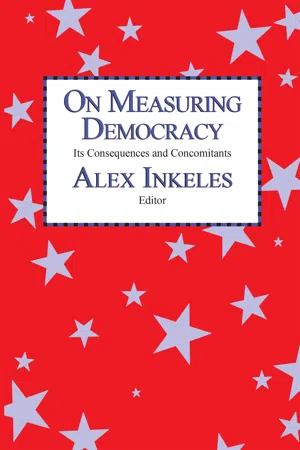
On Measuring Democracy
Its Consequences and Concomitants: Conference Papers
- 244 pages
- English
- ePUB (mobile friendly)
- Available on iOS & Android
eBook - ePub
On Measuring Democracy
Its Consequences and Concomitants: Conference Papers
About this book
This book focuses on measuring democratic political systems as such, and is concerned more with the consequences and concomitants of political democracy in cross-national research. It examines the sequences and dynamics of political change between 1800 and 1986.
Information
Subtopic
Political EconomyI
Measuring Democratic Political Systems
1
Political Democracy: Conceptual and Measurement Traps
Kenneth A. Bollen
Kenneth A. Bollen is a professor of sociology at the University of North Carolina at Chapel Hill. His major research interests are in international development and statistics. He is the author of Structural Equations with Latent Variables (1989), published in John Wiley’s Series in Probability and Mathematical Statistics.
The movement toward democratic political systems in many nations in the 1980s has renewed interest in measurement of political democracy. This paper calls attention to the problems that surround both the definition and measurement of political democracy. The main conceptual problems are the failure to develop an adequate theoretical definition of this concept, the confounding of the concept with others, and treating democracy as a binary rather than a continuous concept. Four problems of measurement are: invalid indicators, subjective indicators, ordinal or dichotomous measures, and the failure to test reliability or validity. The paper offers several suggestions to improve measurement as well as a warning about the danger of repeating past errors.
In the late 1950s and early 1960s a record number of countries became independent. A surprisingly large group began with relatively democratic political systems (e.g., Somalia, Sierra Leone, and Jamaica). Accompanying this were the first major efforts at developing cross-national measures of national political democracy. Lerner (1958), Lipset (1959), Coleman (1960), Cutright (1963), and Banks and Textor (1963) are only a few of the many who provided indices or indicators of democracy. As democracies collapsed and authoritarian régimes rose, the 1970s saw a decline in social science interest in measuring democracy. Important work was done during this period (e.g., Banks 1971; Dahl 1971; Gastil 1978), but the volume of studies declined. And much of this work developed cross-national measures of political democracy for the 1960s rather than the 1970s.1 Political democracy indicators received some attention in the early 1980s (e.g., Bollen 1980) but here again the indices often referred to the 1960s.
Redemocratization in the 1980s in Argentina, Brazil, the Philippines, and else-where has sparked renewed interest in empirical measures. I suspect that we will see at least as much attention to measuring democracy in the 1990s as we saw during the 1960s and certainly more than has been true during most of the 1970s and the early 1980s.
The measurement of political democracy in cross-national research is the focus of this article. An examination of the efforts to quantify political democracy does not reveal a smooth evolution toward clear theoretical definitions and finely calibrated instruments. Instead, we see advances as well as backsliding. Consider the theoretical definitions that should accompany the presentation of new measures. Studies such as Dahl’s (1971) are exemplary in the attention they give to defining political democracy while others, even recent work, do not provide a definition or do not have a sharp line separating their theoretical from their operational definitions. Nor is a trend toward improved calibration of measures evident. Ironically, some of the early studies by Lerner (1958) and Cutright (1963) have measures with more precise gradations than do several more recent studies that classify political democracy as “present” or “absent” in each year (e.g., Hewitt 1977; Muller 1988). Another sign of measurement advancement is understanding the boundaries of a concept and using measures that do not confuse one concept with another. Here, too, progress is not obvious. Voter turnout and political stability are two examples of concepts that are confounded with political democracy. This occurs in early works (e.g., Lerner 1958; Cutright 1963) as well as in recent studies (e.g., Hewitt 1977; Muller 1988).
The history of research in this area suggests that the renewed interest in measuring political democracy is no guarantee that we will escape the errors made in earlier measurement efforts. Those researchers new to this area may dismiss this warning, believing that virtually all social science data contain errors and that such errors have a trivial impact. I do not doubt that measurement error is present in most variables, but this ignores the degree of measurement error and whether it is systematic or random. It is my contention that, indicators of political democracy contain both types of error and the proportion of error is sizable.
Does it matter? Yes. Consider the monitoring of the worldwide trends in political democracy. The U.S. State Department, Amnesty International, and many other organizations and scholars are committed to assessing human rights in countries. An important sector of human rights are political rights and liberties that are closely tied to political democracy. If we were to follow the conventions established with some measures of political democracy, these monitoring efforts would be undermined. For instance, Lerner (1958) used voter turnout to gauge degrees of political democracy and this practice has continued (e.g., Smith 1969; Coulter 1975; Vanhanen 1979). Yet, when we contemplate that in some countries voters are legally obligated to vote, that high turnouts can occur in elections with no choice or under conditions of fraud, and that turnout is affected by many things, ranging from voter satisfaction or apathy to whether it rains on the election day, we see that voter turnout reflects factors that have little to do with measuring political democracy. Monitoring efforts relying on voter turnout are seriously compromised. Add to this that policy decisions ranging from foreign aid and investments to the imposition of sanctions on foreign governments are influenced by human rights reports and measures, and it is easy to see that flawed measures have potentially serious policy repercussions.
Academic research has not escaped the negative consequences of faulty political democracy measures. An example is the research on the relation between political democracy and income inequality. For more than two decades quantitative cross-national studies have presented conflicting evidence on the impact of political democracy on income inequality (e.g., Cutright 1967; Jackman 1974; Bollen and Jackman 1985; Muller 1988). At the center of the controversy is the measurement of political democracy (Bollen and Jackman 1985; 1989). Thus, measurement error in indicators matters for monitoring trends in political democracy, for policy decisions, and for scholarly research.
To call attention to common problems that surround the definition and measurement of political democracy, I will draw upon my earlier research (Bollen 1980; Bollen and Grandjean 1981; Bollen 1986; Bollen and Jackman 1989), providing new illustrations of points made in these studies and elaborating definitional issues growing out of this work. A consideration of the definitional and conceptual issues, and of measurement problems besetting political democracy is followed by recommendations for future research.
Conceptual Issues
The starting point in evaluating the validity of political democracy measures is the theoretical definition of the concept. Clearly, providing a definition of political democracy that everyone accepts is impossible. I will settle for the less ambitious goal of providing a working definition of political democracy and contrasting it with other definitions.
I define political democracy as the extent to which the political power of the elites is minimized and that of the nonelites is maximized (Bollen 1980:372). By political power I am referring to the ability to control the national governing system. The elites are those members of a society who hold a disproportionate amount of the political power. These include the members of the executive, judicial, and legislative branches of the government as well as leaders of political parties, local governments, businesses, labor unions, professional associations, or religious bodies. Like Mosca (1939), Michels (1962), Mills (1956), and many others, I recognize the existence of elites. However, unlike them, I do not conclude that the presence of elites means that their relative power compared to the nonelites is everywhere the same. Indeed, it is the relative balance of power between elites and nonelites that determines the degree of political democracy. Where the nonelites have little control over the elites, political democracy is low. When the elites are accountable to the nonelites, political democracy is higher.
The minimization of elite political power and the maximization of nonelite power remain fairly abstract ideas. How do we determine the elites and nonelites in each society. Even if we can determine these groups, how do we measure their relative political power? Until someone finds a direct measure of political power, these goals remain elusive. However, we can indirectly gauge the relative political power of elites and nonelites. As I have argued elsewhere (Bollen 1980; 1986), political rights and political liberties reflect the political power of these two groups. Political rights and liberties are two dimensions of political democracy:2
Political rights exist to the extent that the national government is accountable to the general population and each individual is entitled to participate in the government directly or through representatives. Political liberties exist to the extent that the people of a country have the freedom to express any political opinions in any media and the freedom to form or to participate in any political group. (Bollen 1986:568)
Political rights are typically assessed by examining characteristics of the electoral system. Leaders selected by elections, equal weighting of votes, the extent of the franchise, the openness of the candidate selection process, the fairness of elections, the representativeness of office holders, and the timeliness of elections, are specific examples of political rights. The higher the level of political democracy in a country, the more we expect these rights to be present.
Political liberties refer to the freedom that the population has in the political system. Here I refer to characteristics such as the freedom of the media, the freedom of individuals or political groups to oppose government policies or officials, and the absence of political censorship.
Differences in political rights and liberties correspond to differences in the relative political power of the elites versus the nonelites. If a country’s standing on political rights or liberties is low, this suggests that the elites in that society have greater political power over the nonelites than in a society where these rights and liberties are high. Hence, political rights and political liberties provide evidence on political democracy.
How does this definition compare to others? These two dimensions encompass many of the more specific characteristics of political democracy laid out by others. To illustrate this I will consider Dahl’s (1971) definition. He (1971:3) proposed that political democracies must have eight “institutional guarantees”: (1) freedom to join and form organizations, (2) freedom of expression, (3) right to vote, (4) eligibility for public office, (5) right of political leaders to compete for support and votes, (6) alternative sources of information, (7) free and fair elections, and (8) institutions for making government policies depend on votes and other expressions of preference. Table 1 classifies Dahl’s eight “requirements for a democracy” under either the political rights or political liberties dimension, demonstrating that Dahl’s requirements are encompassed by my definition.
Interestingly, Dahl (1974:4) also argued that two dimensions run through these items, but his dimensions differ from mine. Instead he sees these as public contestation and inclusiveness (participation). Public contestation is “the extent to which the eight institutional conditions are openly available, publicly employed, and ful...
Table of contents
- Cover Page
- Half Title
- Title
- Copyright
- I Measuring Democratic Political Systems
- II Measuring Consequences and Concomitants
Trusted by 375,005 students
Access to over 1.5 million titles for a fair monthly price.
Study more efficiently using our study tools.
Frequently asked questions
Yes, you can cancel anytime from the Subscription tab in your account settings on the Perlego website. Your subscription will stay active until the end of your current billing period. Learn how to cancel your subscription
No, books cannot be downloaded as external files, such as PDFs, for use outside of Perlego. However, you can download books within the Perlego app for offline reading on mobile or tablet. Learn how to download books offline
We are an online textbook subscription service, where you can get access to an entire online library for less than the price of a single book per month. With over 1.5 million books across 990+ topics, we’ve got you covered! Learn about our mission
Look out for the read-aloud symbol on your next book to see if you can listen to it. The read-aloud tool reads text aloud for you, highlighting the text as it is being read. You can pause it, speed it up and slow it down. Learn more about Read Aloud
Yes! You can use the Perlego app on both iOS and Android devices to read anytime, anywhere — even offline. Perfect for commutes or when you’re on the go.
Please note we cannot support devices running on iOS 13 and Android 7 or earlier. Learn more about using the app
Please note we cannot support devices running on iOS 13 and Android 7 or earlier. Learn more about using the app
Yes, you can access On Measuring Democracy by Alex Inkeles,Herman Kahn, Alex Inkeles in PDF and/or ePUB format, as well as other popular books in Politics & International Relations & Political Economy. We have over 1.5 million books available in our catalogue for you to explore.