The Lean Brain Theory
eBook - ePub

The Lean Brain Theory

Complex Networked Lean Strategic Organizational Design

  1. 159 pages
  2. English
  3. ePUB (mobile friendly)
  4. Available on iOS & Android
eBook - ePub

The Lean Brain Theory

Complex Networked Lean Strategic Organizational Design

About this book

The most complex organization known in the universe is inside of our heads: our brain. Because organizations are formed by human beings, The Lean Brain Theory aims to mimic human brain structure and functionality so as to enable the emergence of brain-like organizations in which the 'neurons' are the human-beings and the 'axons' ought to be Lean Management oriented behavioral and communication patterns. These networks ought to evolve towards brain-like configurations that display thinking-like processes and ultimately organizational consciousness. The Lean Brain Theory offers a quantifiable holistic framework to strategically design any organization as a human brain. By embedding complexity into the Strategic Organizational Design (SOD) and combining this with Lean Management and neuropsychological state of the art knowledge, The Lean Brain Theory ends up with the Brain-Organization metaphor and makes it possible.

This idea of embedding complexity into organizational design is a follow up to the book The Hoshin Kanri Forest. That book dealt with the methodology of creating 'forest-like' topologies. The Lean Brain Theory aims to set the ground for Lean organizations of the future that embrace both Business Intelligence and Complex Networked Lean Strategic Organizational Design. The organization as a super-network evolves towards 'intelligent' Human-Brain-like entity. The Lean Brain Theory ultimately seeks to integrate an anthropomorphic organizational paradigm with future tendencies of technological advances. In this way, the brain-like organization emerging from it can be regarded as bionic.

Frequently asked questions

Yes, you can cancel anytime from the Subscription tab in your account settings on the Perlego website. Your subscription will stay active until the end of your current billing period. Learn how to cancel your subscription.
No, books cannot be downloaded as external files, such as PDFs, for use outside of Perlego. However, you can download books within the Perlego app for offline reading on mobile or tablet. Learn more here.
Perlego offers two plans: Essential and Complete
  • Essential is ideal for learners and professionals who enjoy exploring a wide range of subjects. Access the Essential Library with 800,000+ trusted titles and best-sellers across business, personal growth, and the humanities. Includes unlimited reading time and Standard Read Aloud voice.
  • Complete: Perfect for advanced learners and researchers needing full, unrestricted access. Unlock 1.4M+ books across hundreds of subjects, including academic and specialized titles. The Complete Plan also includes advanced features like Premium Read Aloud and Research Assistant.
Both plans are available with monthly, semester, or annual billing cycles.
We are an online textbook subscription service, where you can get access to an entire online library for less than the price of a single book per month. With over 1 million books across 1000+ topics, we’ve got you covered! Learn more here.
Look out for the read-aloud symbol on your next book to see if you can listen to it. The read-aloud tool reads text aloud for you, highlighting the text as it is being read. You can pause it, speed it up and slow it down. Learn more here.
Yes! You can use the Perlego app on both iOS or Android devices to read anytime, anywhere — even offline. Perfect for commutes or when you’re on the go.
Please note we cannot support devices running on iOS 13 and Android 7 or earlier. Learn more about using the app.
Yes, you can access The Lean Brain Theory by Javier Villalba-Diez, PhD in PDF and/or ePUB format, as well as other popular books in Business & Business General. We have over one million books available in our catalogue for you to explore.

Information

Section III
The Theory
4
The Lean Brain Theory
“The Lean Brain Theory” by Dr. H4.
Paraphrasing Immanuel Kant, a science is not a Science until there is a relation to mathematics. Although this characterization is provocative, and nowadays few would frame a discussion in such absolute terms, the main implicit question remains valid: can we find mathematical expressions that explain Lean as predictive and quantitative?“The Lean Brain Theory” by Dr. H4.
Or shall Lean practitioners keep on letting the consultant industry tell the tale? Can this scientific approach help Lean practitioners stop following Toyota and its soft narrators (Rother and Aulinger, 2017; Liker, 2004) and start leading their own way 道 with quantifiable metrics?
Can Lean become a Science that explains phenomena in complex socio-technical interdependent systems such as organizations and help Lean practitioners understand their own specific situations?
This chapter aims to contribute to this direction by introducing certain mathematical characterizations of complex networked Lean strategic organizational design configurations.
We will start by analyzing complex networks and their degree exponent, then we will follow by presenting the conditions for complex networked Lean strategic organizational design configurations to emerge, and we will finalize the chapter by providing a quantifiable explanation of how behavioral spreading phenomena can be analytically described in such organizational design architectures.
4.1ANALYTIC CHARACTERIZATION OF DEGREE EXPONENT
As seen before, complex networks present generally a degree distribution that has a power-law tail p(k )~ k–γ where γ is called degree exponent. The degree exponent γ is a parameter whose value has been experimentally shown to be in the range 2 < γ < 5 (Barabási, 2016).
How the evolution of the structural network has behaved in the past can be determined by understanding three time-dependent parameters (Albert and Barabási, 2000):
p(t), or the quote of new (CPD)nA links created within already activated process owners
q(t), or the quote of re-wired (CPD)nA linked to already existing process owners
m(t), the growth rate of the complex organizational network or the number of new activated (CPD)nAs in the complex networked organizational design configuration
Albert and Barabási (2000) showed that the exponent γ can be expressed by Equation 4.1 at any point in time:
γ ( t ) = 2 m ( t ) ( 1 q ( t ) ) + 1 p ( t ) q ( t ) m ( t ) + 1
(4.1)
where time is discrete t = 1,…,n and is typically measured on a weekly or monthly basis
4.1.1Management Implications
It is important for organizational leaders to track the degree exponent as a vital parameter to avoid deviations in the desired development of the organizational design configuration.
This KPI becomes then a measurable relevant strategic KPI describing the organizational design architecture. The desired values of such KPIs are those that lie in the scale-free range 2 < γ < 3.
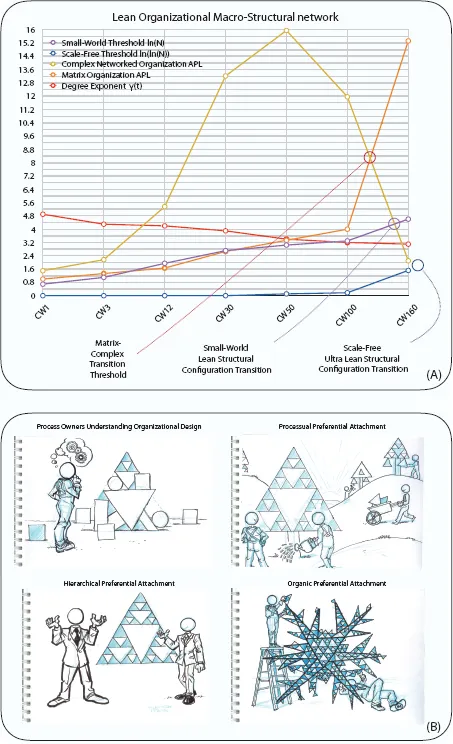
The degree exponent of the real case study shown in the previous chapter that was depicted in Figure 4.1A has been calculated with Equation 4.1.
FIGURE 4.1
Lean Brain Theory.
It can be observed how the threshold γ = 3 is approached by the curve when the small-world condition is reached APL~ln(N) and is expected to attain a value 2 < γ < 3 when the scale-free condition is reached APL~ln(ln(N)).
But how can the analytic description of the emergence of such a scale-free complex networked organizational design configuration be described?
4.2ANALYTIC CONDITIONS FOR EMERGENCE OF SCALE-FREE Complex NETWORKED ORGANIZATIONAL CONFIGURATIONS
Under the organizational network paradigm, there are two conditions for complex organizational evolving networks to adopt a scale-free network structure (Albert and Barábasi, 2000):
Continuous growth
Preferential attachment
The need to analytically describe an evolutional process of continuous growth and preferential attachment that describes such organizational design configurations is vital to understand and guide the emergent dynamics toward desired organizational configuration states.
4.2.1Continuous Growth Dynamics
Organizational networks are not static systems. They expand or con...
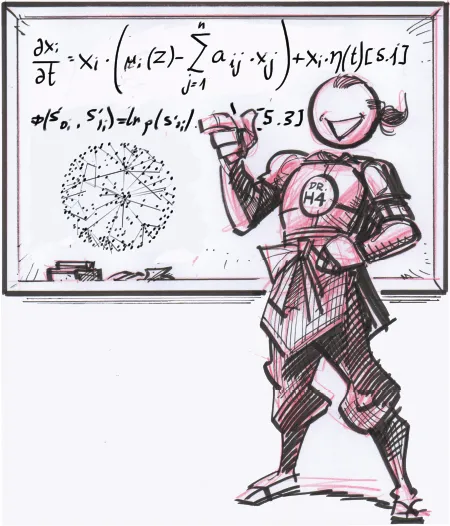
Table of contents

  1. Cover
  2. Half-Title
  3. Series
  4. Title
  5. Copyright
  6. Dedication1
  7. Dedication2
  8. Contents
  9. Preface and Acknowledgments
  10. About the Author
  11. Introduction
  12. SECTION I The Metaphor
  13. SECTION II The Method
  14. SECTION III The Theory
  15. SECTION IV Applications
  16. References
  17. Appendix
  18. Index