![]()
1 Introduction
Kim is six years old and has one-to-one support due to her aggressive behaviour. The teaching assistant in Kim’s class reports that she is a pleasure to work with and that, when she is on her own, Kim is polite and co-operative. But when she is with her peers Kim is pushy and aggressive unless she is getting her own way.
It is not uncommon for children who face emotional and behavioural difficulties to behave well in a one-to-one situation with an adult. It is when they are in a group with their peers that their behaviour deteriorates dramatically. More and more today we refer to the difficulties of such children as being social, emotional and behavioural, rather than just emotional and behavioural. Yet, while most of us work with children in groups, little formal training in the understanding of group dynamics is provided. The more we understand the nature, purpose and function of groups then the better equipped we will be to support children who find such skills as turn-taking and sharing difficult to master or achieve.
In this chapter we will:
• define key terms
• consider the importance of groups
• explore why groups are difficult for children with social, emotional and behavioural difficulties.
What is a group?
While there is no hard and firm definition of what constitutes a group the following features are central. A group comprises members who:
• relate to each other
• can influence each other
• have an identity
• communicate with each other
• have some form of hierarchy.
This leads us to the next key term:
Group dynamics
When social psychologists were beginning to study groups, a key figure was Kurt Lewin who was carrying out research in the 1930s. He emphasised that groups are dynamic in that their members influence each other. Groups give identity to members and can pressure them to conform. Since Lewin’s time our understanding of group dynamics has increased significantly. In fact, to many people, all psychology is essentially group psychology as that is where we live our lives – in a range of different groups. This includes the family as well as the class in school that a child belongs to.
What purpose do groups serve for young people?
We are all social animals. When we were children we depended on our carers to survive. Our personal identity is developed through our relationship to others, both within our family and outside. For example, I am a husband to a wife, a father to children, a son to a mother, a colleague at work. We are never without any links to one or other group.
As human beings we have many needs. We all need food, shelter and warmth. But after these basic needs are met other needs emerge that relate to social groups. Groups provide us with the following three core human needs:
1 The need to belong: being positively attached to other people
2 The need for power: influencing the goals and actions of others
3 The need for success: the enhancement of self-worth through achieving socially valued goals.
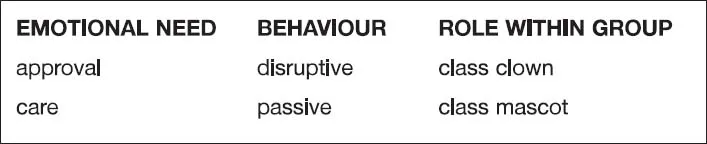
When these three needs coexist in a positive way then pupils will be ideal learners. Learners can enjoy belonging to their class, value the projects they are working on and enjoy the success of achieving set goals. These emotional needs are instrumental in driving pupils’ behaviour and lead them to take up those roles within the group that help them meet their needs (see Figure 1).
FIGURE 1. Group roles
Awareness of these driving needs helps us to appreciate why we can only ever understand a child’s behaviour if we look at the social context in which it takes place. To look at the child in isolation is to look at only half the answer. A pupil’s behaviour is seeking to meet an emotional need within a group context. This leads us on to the third key question.
Why do so many children find it difficult to behave appropriately within class?
This is not a simple question – classroom behaviour is very complex and there are many interrelating factors that need to be understood to make sense of it. (If we fully understood it, then managing challenging behaviour in our classrooms would not be the problem that it clearly is in most schools.)
Some key factors
Ideally, before they even start attending school, most children will learn a number of social skills at home within the family group that match school expectations:
• ho...