eBook - ePub
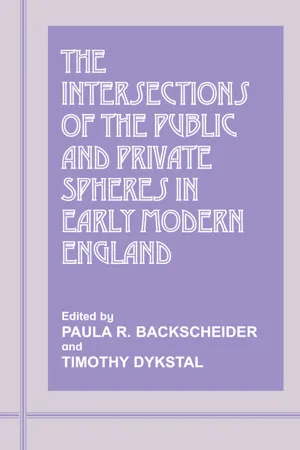
The Intersections of the Public and Private Spheres in Early Modern England
- 280 pages
- English
- ePUB (mobile friendly)
- Available on iOS & Android
eBook - ePub
The Intersections of the Public and Private Spheres in Early Modern England
About this book
The public and private spheres are conceived to be separate and complementary, useful in understanding human experience and social phenomena, gendered and perhaps "natural". Taking the usefulness of this model as a focus, these essays ask how the spheres interpenetrate.
“Completing the Union”: Critical Ennui, the Politics of Narrative, and the Reformation of Irish Cultural Identity1
“… the extended and well-merited fame of Miss Edgeworth, whose Irish characters have gone so far to make the English familiar with the character of their gay and kind-hearted neighbours of Ireland, that she may be truly said to have done more towards completing the Union than perhaps all the legislative enactments by which it has been followed up.” Sir Walter Scott, 1829 General Preface, Waverley (1814)2
“[A]s Scott is the authority for Scotch character, Maria Edgeworth is the authority for Irish; … her three stories of Ormond [1817], Ennui [1809], and The Absentee [1812] contain more essential truths about Ireland than can be learned from any other sources whatsoever.” John Ruskin, 18863
How do – or can – women represent revolution? “Represent” suggests, of course, a double meaning: how are revolutionary events incorporated in female-authored fiction, and also how does “woman” herself as a cultural symbol stand for or usher in new ways of thinking about the family, culture, and national identity, a domestic counterpart to the Napoleonic era’s great wars on land and sea? Not so many years ago, conventional wisdom thought Jane Austen never mentioned the French Revolution. We know better now, but too much archival and revisionary work remains to be done for us to pronounce what the revolutionary years meant for women writers quite yet. In France, a plethora of bicentenary symposia and special issues suggest that the news from the battle front was bad, that if, as a pioneering article in women’s history once argued, women had no Renaissance, they had no French Revolution either. They are mostly absent from male historians’ accounts, and when they have been noticed they have been depicted – most forcefully by Joan Landes – as systematically excluded from the revolutionary rhetoric of the public sphere, a space Republican men defined as essentially masculine.4 Landes’s disheartening interpretation has been ably challenged by the recent work of Dena Goodman and other French Enlightenment scholars, and the conventional British caricature of the Anti-Jacobin writer, scared into reactionary propaganda by wicked Wollstonecraft and Pitt’s repressive policies, has also been turned upside down, Nancy Armstrong, among others, claiming that it is not man who epitomizes the new citizen of the new state but woman, that domestic love (literally) engenders middle-class authority.5
What has only recently begun to be noticed is how much these fresh if contradictory readings of woman’s relation to revolutionary cultural change destabilize the explanatory model on which they (and just about everything else written on women since the last wave of feminism began) seem to be grounded: the venerable paradigm of separate public and private spheres, feeling domestic woman and thinking public man. Late-eighteenth-century conduct book writers cannot stop talking about domestic ideology and woman’s place, and although modern feminist theorists may be showing that women did not corset their lives to accord with conduct books, most historians and literary critics still shape their arguments via the familiar sphere model.6 It demarcates and organizes things tidily, so that even though feminist revisionism knows that spheres could not be truly separate, we are still stuck with an orthodoxy of public and private realms, with women as domestic persons – bodies discussed most fashionably at the moment (like supermarket chicken) as all white breast – and with men as public actors. We tend to forget that men are culturally gendered too, that patriarchy is not ahistorical, that most masculine life is not particularly public.
The hegemonic imaginative constructs I have sketched are doubtless one reason why Maria Edgeworth’s “Irish” fiction has received so little recent feminist attention. (Luckily, there is at least a diseased breast, a bad mother, and a hermaphroditic Amazon to discuss in Belinda, her “English” woman-centered novel of 1801).7 Edgeworth creates lots of strong women, but her main adult Irish protagonists are male, her concerns are often frankly political, and her treatment of the obligatory courtship plot is frequently ironized. Yet if Edgeworth is too Irish and insufficiently “feminine” to be packaged as domestic fiction, she does not fit tidily within nationalist critical categories either, since she is an Anglo-Irish author. Maria Edgeworth (1768–1849) was Britain’s reigning woman of letters in the first decade of the nineteenth century. Not coincidentally, the most productive period of her long literary career coincides with the revolutionary nineties and the Napoleonic Wars; her formative years and creative output are interwoven with the contemporary crises of her class, country, and gender. Born in England and schooled there, she had spent only two years of very early life in Ireland before she came back for good in 1782, an auspicious moment for the Anglo-Irish ascendancy, marking the birth of Grattan’s independent Parliament. She was fourteen, and her reforming landlord father, Richard Lovell Edgeworth, was returning with his third wife and burgeoning family to take up permanent residence on the family estate in County Longford.8 In 1800, the year of the legislative union between England and Ireland, she published Castle Rackrent, memorializing the “Manners of the Irish Squires, Before the Year 1782,” the “Hibernian” tale of degenerate old Ireland for which she is still best known.9 Literary history thus situates Edgeworth as the founder of Anglo-Irish literature, simultaneously the first of the “Big House” novelists and the creator of the sympathetically realized, possibly subversive vernacular narrator, Thady M’Quirk. Tricksy and ambiguous, Castle Rackrent’s dialectic of irresistible native voice and enlightened editorial apparatus provokes critical hetero-glossia as well: the book’s ironies elude interpretive consensus as nimbly as they evoke admiration.
Maria Edgeworth’s first fiction for adults still monopolizes discussion of her achievement because it so neatly epitomizes the dualities which structure modern Irish literary study: English and Irish, settler and native, landlord and peasant, colonist and colonized, colon and colonisé – urbane Enlightenment versus local attachments and lore. Castle Rackrent is often read as a sport, its double-voicedness literally a “quirk,” an aberration, in the straightforwardly utilitarian career of its rationalist author, who is most often taken to exemplify, in P.F. Sheeran’s phrase, the colonizer who accepts, the daughter who just ventriloquizes the ruling father’s views.10 Marginalized in mainstream literary history as “regional fiction,” Maria Edgeworth’s Irish work is also marginalized within Irish criticism, which is much preoccupied with what it means to be Irish. Within this framework, Edgeworth can be read as exemplifying the “ascendancy mind,” an ambiguous catch-all phrase which turns up with depressing regularity to label an extraordinarily wide range of Anglo-Irish writers and thinkers over a long time span. No matter how brillantly she renders the sociological details she observes and the linguistic variations she hears, Edgeworth is suspect for her landlord heroes, her Anglocentricity, and her enlightened view of history as civilizing process. She stands for the “Unionist” writer unsympathetic to the Gaelic past, the rationalistic antithesis of the romantic nationalism that, celebrated or deplored, still plays so large a part in Irish cultural and literary history.11
Although, as the epigraphs from Scott and Ruskin indicate, Edgeworth’s later Irish novels contributed hugely to her contemporary fame, they have only recently begun to be reprinted.12 Her fiction of the 1798 Irish Rebellion, Ennui, the first of the three-volume Tales of Fashionable Life (1809) – it was joined by another three-volume set in 1812 – was long thought by many, including her father, to be her strongest work.13 Yet it has probably received the least critical attention, and most of that little has been puzzled by the relationship between the lackadaisical Earl of Glenthorn and the stirring events around him, vexed by the fiction’s outrageous plot which turns on babies switched at birth, or put off by the voluble and assertive Lady Geraldine, one of those witty Edgeworth women who has always rubbed some male critics the wrong way.14 Most typically, Edgeworth’s odd story has been read as a fictionalized version of the father’s improving landlord politics, though of course Ennui comes out looking very different depending on whether the interpreter is a male Irish historian preoccupied with the themes of land tenure and colonial repossession (as is Tom Dunne) or an American feminist concerned to show how the father’s class locale shapes the daughter’s gendered perspective (as is Beth Kowaleski-Wallace).15 Intent on subversive Gaelic servants, the former notices Joe Kelly, the United Irishman with designs on Glenthorn’s life and property, whereas Ellinor, Glenthorn’s supposed foster nurse and real mother, is the character most available for a feminist indictment of Edgeworth’s alleged repudiation of savage Gaelic maternity: Ellinor and the hog of her favorite song conflated as the “grotesque.”16 In neither case is narrative qua narrative to the fore, nor does either critic consider how the revolutionary events which generated the tale are portrayed within the story. Although Maria Edgeworth as tale-teller has conventionally been depicted as an efficient apparatus for transforming sociological fact and/or paternal educational notion into edifying fiction, the “what” of her stories cannot be sifted from the “how.” The Rebellion narrative of a writer who is far more than the naive rationalist or transparent realist that her reputation concedes, Ennui is, among other things, a metafictional reflection about imagining, representing, and symbolically resolving the “romance of real life” that is Irish history.17
Mary Wollstonecraft had to travel to Paris to be shocked at streets bloodied by the guillotine; Ennui was authored by a woman who had to flee for her life when war arrived on her very doorstep.18 Yet literary histories usually dispose of the tale without even noticing that it is a narrative about revolution, much less a woman’s narrative which audaciously appropriates history to change history and translates fictional clichés into surreal Irish political truths. Rather, the paternal paratext through which the reader approaches the book determines what it means.19 Richard Lovell Edgeworth’s general preface to the 1809 Tales of Fashionable Life has been recurrently quoted as a sufficient explanation of what the story is about and how it works. Ennui, he tells us, is educational, part of the family enterprise to promote the “progress of education, from the cradle to the grave” which “we have laid before the public in more didactic works,” a wide-ranging reformist enterprise which now directs its attention toward the “circles of fashion,” pointing out “errors to which the higher classes of society are disposed.” More specifically, Ennui exemplifies “the causes, curses, and cure” of the titular ailment, “I hope, in such a manner, as not to make the remedy worse than the disease” (v-vi).20 If the awkward jocularity is odd for a father who long rated this the very best of his daughter’s tales, the omission of any reference to Irish politics is odder yet for a man who had just lived through a stirring decade of agrarian unrest, French invasion, and internecine warfare, who had fled from the pikes of a “green” rebel army, only to be stoned by an ultra-Protestant “Orange” mob. The father’s preface does indeed provide “paternal protection,” camouflage for a writing woman’s political narrative that is ambitious, iconoclastic, and, ultimately, profoundly cynical about the workings of the “masculine” public sphere (v). But since the preface does so at the price of occluding the tale’s topicality, its allusive technique, and its pervasive personal and cultural referentiality, paternal protection has its price.
Moreover, Richard Lovell’s seeming generalities, like his daughter’s fiction, solicit a double reading, for the family’s sensationalist educational philosophy subtends both the story’s unsentimental cultural determinism and its hopeful utopian fantasy of a regenerated Ireland. Our reading of radical pedagogy as boring didacticism says more about us than about history. Recent work on French revolutionary culture helps us feel again the political resonance of the Helvétian dictum that “Education is capable of effecting every thing” and to recognize pedagogy’s ecumenical symbolism in a divided Ireland.21 If, as the Edgeworths argue, “what we feel, and see, and hear, and read, affects our conduct from the moment when we begin, till the moment when we cease to think,” then three corollaries for a reformist political fiction follow (v). Because, not in spite of, her previous immersion in writing for children and in observing how persons are shaped by their environing culture, Edgeworth could become the first novelist to represent individual characters subjugated to social forces and to do so with graphic sociological realism.22 Secondly, she could find in “education” thus broadly conceived not just a way of representing social formation effectively, but also a strategy for reforming Irish realities. The memoirs of the Earl of Glenthorn detail his fashionable “ennui” and debunk the aristocratic drone, while simultaneously providing a purchase on how the immiseration of the “lower Irish” can – with hard work and good luck – be reversed. Ennui is, thirdly, a woman’s political fiction which brilliantly portrays, deflates, and ironizes masculine posturing and public life; at the levels of both theme and narrative structure, Edgeworth’s tale demonstrates that the state politics which really matter are grounded in domestic education and affective consensus.23 When we configure the revolutionary text as masculinist public oratory, we risk missing women’s revolutionary appropriation of the family unit and the educational story. It is only with hindsight, of course, that Edgeworth’s new-model national tales can be read back out of the paternal preface, but we should not let a father’s purposeful blandness mandated by troubled early-nineteenth-century politics obscure what the daring representational strategies of the daughter’s rebellion narrative are really accomplishing. If we no longer need be embarrassed by interventionist fiction doing cultural work, we also need to move away from outmoded notions of Edgeworth as a naive realist whose fiction is the vehicle for her father’s truths. It is important to remember that generously conceived “educational” aims do inform the daughter’s writing. But it is more important to notice now that they do so through and by means of a wonderfully witty and ironic narrative, for Edgeworth foregrounds women’s storying and allusive traditions as the keys to the Irish historical dilemma.
At the start of this century, Irish historians demanded a new nationalist narrative to replace the “ascendancy” story, which they read as depicting Irish history “enslaved in the chains of the Moral Tale – the good man (English) who prospered, and the bad man (Irish) who came to a shocking end.”24 No longer so simple as Anglo versus Gael, Irish historiography is as contentious as ever, with revisionist criticizing revisionist. Most current thinking emphasizes the multiplicity of cultures within Ireland – Gaelic (with its varied strands), “old English” (the descendants of the Anglo-Normans against whom Edmund Spenser and Sir John Davies inveigh more fiercely than against the “meer” Irish), the “new English” of later settlement, the Scotch element (eighteenth-century enlightened shading into Protestant ultra-Orange) – and their mutual jostling against an English presence.25 Ironically, the outmoded formula rejected by nationalist historians and their revisionist successors alike still configures discussion of “ascendancy” fiction, for example in depictions of Castle Rackrent’s dialogic structure as a struggle between editor and oral memoirist for control of the narrative. But Edgeworth’s first adult tale eludes easy oppositions, since Thady is of multiple minds and so is the compiler: the Gaelic voice is not unitary, nor is that of the editor in the multiple layers of apparatus – preface, footnotes, conclusion, and glossary.26
In Ennui, this heteroglossia is both the subject and the method: how does the reader hear more than the voice of the male ascendancy narrator, the supposed Earl of Glenthorn? What kind of narratives have constructed Irish political and cultural life and what kind of fictional narrative can reconstruct it? How can the story’s politics of representation model (in Benedict Anderson’s phrase) an “imagined community”? Edgeworth’s sociological and linguistic accuracies have established her credentials as the founder of the realistic Anglo-Irish novel. But her metarepresentational inquiry into Irish identity formation also situates her as a stylistic innovator within a larger body of intertexts, w...
Table of contents
- Cover
- Half Title
- Title Page
- Copyright Page
- Table of Contents
- Introduction
- Introduction
- “Completing the Union”: Critical Ennui, the Politics of Narrative, and the Reformation of Irish Cultural Identity
- “As Easy as a Chimney Pot to Blacken”: Catharine Macaulay “the Celebrated Female Historian”
- Publicizing Private History: Mary Carleton’s Case in Court and in Print
- Eroticizing the Subject, or Royals in Drag: Reading the Memoirs of Anne, Lady Halkett
- Swift’s Sermons, “Public Conscience,” and the Privatization of Religion
- The Construction of the Public Interest in the Debates over Fox’s India Bills
- William Godwin and the Pathological Public Sphere: Theorizing Communicative Action in the 1790s
- Public Loathing, Private Thoughts: Historical Representation in Helen Maria Williams’ Letters from France
- Vices, Benefits, and Civil Society: Mandeville, Habermas, and the Distinction between Public and Private
- Notes on Contributors
Trusted by 375,005 students
Access to over 1.5 million titles for a fair monthly price.
Study more efficiently using our study tools.
Frequently asked questions
Yes, you can cancel anytime from the Subscription tab in your account settings on the Perlego website. Your subscription will stay active until the end of your current billing period. Learn how to cancel your subscription
No, books cannot be downloaded as external files, such as PDFs, for use outside of Perlego. However, you can download books within the Perlego app for offline reading on mobile or tablet. Learn how to download books offline
Perlego offers two plans: Essential and Complete
- Essential is ideal for learners and professionals who enjoy exploring a wide range of subjects. Access the Essential Library with 800,000+ trusted titles and best-sellers across business, personal growth, and the humanities. Includes unlimited reading time and Standard Read Aloud voice.
- Complete: Perfect for advanced learners and researchers needing full, unrestricted access. Unlock 1.5M+ books across hundreds of subjects, including academic and specialized titles. The Complete Plan also includes advanced features like Premium Read Aloud and Research Assistant.
We are an online textbook subscription service, where you can get access to an entire online library for less than the price of a single book per month. With over 1.5 million books across 990+ topics, we’ve got you covered! Learn about our mission
Look out for the read-aloud symbol on your next book to see if you can listen to it. The read-aloud tool reads text aloud for you, highlighting the text as it is being read. You can pause it, speed it up and slow it down. Learn more about Read Aloud
Yes! You can use the Perlego app on both iOS and Android devices to read anytime, anywhere — even offline. Perfect for commutes or when you’re on the go.
Please note we cannot support devices running on iOS 13 and Android 7 or earlier. Learn more about using the app
Please note we cannot support devices running on iOS 13 and Android 7 or earlier. Learn more about using the app
Yes, you can access The Intersections of the Public and Private Spheres in Early Modern England by Paula R. Backscheider, Timothy Dykstal, Paula R. Backscheider,Timothy Dykstal in PDF and/or ePUB format, as well as other popular books in History & Early Modern History. We have over 1.5 million books available in our catalogue for you to explore.