The Routledge Handbook of Chinese Language Teaching defines Chinese language teaching in a pedagogical, historical, and contemporary context. Throughout the volume, teaching methods are discussed, including the traditional China-based approach, and Western methods such as communicative teaching and the immersion program.
The Handbook also presents a pedagogical model covering pronunciation, tones, characters, vocabulary, grammar, and the teaching of listening, speaking, reading, and writing. The remaining chapters explore topics of language assessment, technology enhanced instruction, teaching materials and resources, Chinese for specific purposes, classroom implementation, social contexts of language teaching and language teaching policies, and pragmatics and culture.
Ideal for scholars and researchers of Chinese language teaching, the Handbook will benefit educators and teacher training programs. This is the first comprehensive volume exploring the growing area of Chinese language pedagogy.
This chapter focuses on the issue of Chinese language education in mainland China, especially how Chinese is taught as a first language (L1) in primary schools. The discussion is not confined to China but is extended to Mandarin education in Taiwan as the region implements a very different system. This study is mainly based on a comprehensive survey of language education (语文教育) literature published in China, and some comparisons between US/UK-China and China-Taiwan language education curricula. Additionally, some differences between Traditional Chinese and Simplified Chinese as used in China and Taiwan respectively are also discussed with implications for future Chinese language education reforms.
In this chapter, I first carry out a scientometric analysis using CiteSpace (Chen 2016) to reveal the main research strands of first-language education conducted in China, especially on Mandarin teaching in primary schools. The keywords identified are, for example, ‘emotional education’ (情感教育), ‘Chinese character teaching’ (汉字教学), ‘children’s literature’ (儿童文学) and so on. Several themes of research strands are identified from the one hundred or so keywords extracted by the meta-analysis tool. Each strand is then investigated by zooming in on some representative papers published in China’s leading academic journals. The selected keywords and their elaborations in the form of literature review provide the background information necessary for understanding the current status of L1 education in China.
Having had a brief look at the research outputs of L1 education in China and the topics they usually cover, we move on to examine the curriculum of mother tongue education in China and compare it with a British one, before reviewing a US-China comparative study, so that the similarities and differences of first-language education policies can be teased out between China and the West. A subsequent section then compares the language varieties and curricular differences between China and Taiwan, hoping to reveal the heterogeneous nature of the official Chinese language (namely the differences between Traditional and Simplified Chinese and their residing cultures and respective usages) and its implication on L1 education in different Chinese regions. Towards the end of the discussion, some speculations on the implications of the findings to teaching Chinese as L2 will be offered to conclude the chapter.
First-Language Education Research in China
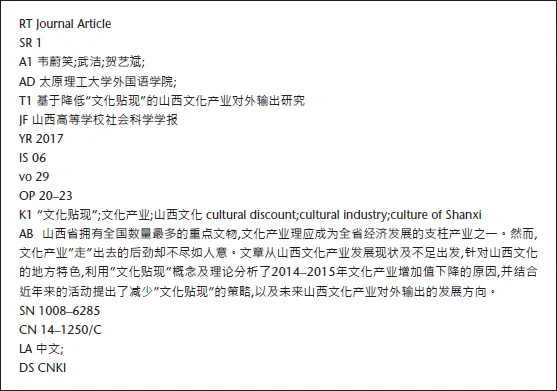
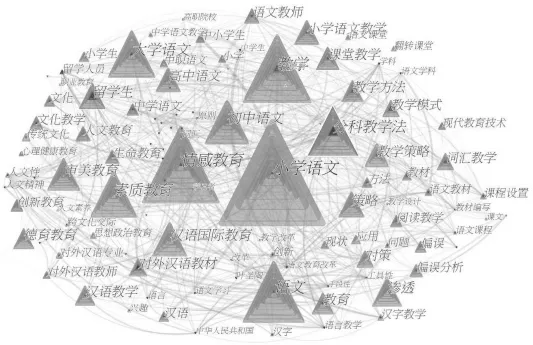
CNKI (China National Knowledge Infrastructure, 中国知网) is a comprehensive knowledge database that includes many academic journal resources. To generate a list of keywords from research works published in China regarding L1 education, I keyed in 语文教育 (‘language education’) as the search phrase in the topic category and the system returned 25,223 journal papers published between 1980 and August 2018. I then used the export function of the CNKI database to generate a list of reference notes consisting of the title, author, keywords, and abstract of the first 6,000 journal articles. A bibliographic note downloaded from CNKI looks like that in Figure 1.1, where the title of the paper, the keywords, and the abstract are all preserved along with the author names. These bibliography notes are then processed using CiteSpace (see Chen 2016) to generate a keyword visualization image as shown in Figure 1.2. In this visualization, the more frequent the keyword, the larger the triangle representing it in the reference collection.
While Figure 1.2 gives a visually appealing image of the keywords identified by CiteSpace from China’s L1 (first language) education research, Table 1.1, on the other hand, gives a list of 40 keywords selected and believed by the author to represent prominent concepts in the L1 research field in China. Among this group of top 40 keywords extracted from the 6,000 reference works, five strands of research can roughly be identified (see Table 1.1 for original keywords in Chinese):
School level: ‘primary school Chinese’, ‘junior high school Chinese’, ‘high school Chinese’
Collateral aims: ‘emotional education’, ‘quality education’, ‘aesthetic education’, ‘moral education’, ‘innovative education’, ‘ideological and political education’
Components of teaching: ‘vocabulary teaching’, ‘teaching reading’, ‘Chinese character teaching’, ‘spoken language teaching’, ‘grammar teaching’, ‘phonetic teaching’
Material and curriculum: ‘curriculum planning’, ‘language teaching material’, ‘language curriculum standards’
Related concepts and names: ‘traditional culture’, ‘children’s literature’, ‘humanity’, ‘instrumental’, ‘Ye Shengtao’
Figure 1.1 A bibliography note exported from CNKI knowledge database in Refworks format
Figure 1.2 Visualization of keywords generated from 25,223 references with search phrase 语文教育
Most research papers published in China’s academic journals regarding L1 education, as downloaded from CNKI, are written by practitioners (i.e. primary schoolteachers) who are not required by the profession to have serious research background. The majority of papers are short essays one or two pages in length, often written on the basis of personal experience and expressing subjective views, somewhat similar to newspaper editorials or columns. Full-length papers like that seen in international journals are relatively rare in China’s current L1 research field. These short papers often give a list of references at the end of the work without referring to them in the main text, which is a relatively old-fashioned academic writing practice.
When speaking of mother tongue education, the academics in China are well-informed to focus more on primary school language (小学语文, 578) than on schools at higher levels, such as junior high school (初中语文, 243) and high school (高中语文, 149), as this is the time when the commonly assumed critical period of first-language acquisition falls (i.e. sometime between age 5 and puberty). This also reflects Chinese society’s recognition of the crucial importance of literacy education and its association with primary schools. The high frequency of the term ‘primary school language’ predicts more papers and discussions on all aspects of L1 education in primary schools than those on other school levels.
Table 1.1 Forty selected keywords from the top list generated by CiteSpace out of 25,223 references
Frequency count
Keyword/phrase
Frequency count
Keyword/phrase
578
小学语文
(primary school Chinese)
81
创新教育
(innovative education)
420
情感教育
(emotional education)
72
课程设置
(curriculum planning)
277
素质教育
(quality education)
71
教材
(teaching material)
243
初中语文
(junior high school Chinese)
61
汉字教学
(Chinese character teaching)
188
审美教育
(aesthetic education)
60
语文教材
(language teaching material)
173
渗透
(infiltrate)
56
人文性
(humanity)
164
课堂教学
(classroom teaching)
54
传统文化
(traditional Culture)
157
教学策略
(teaching strategy)
51
现代教育技术
(modern educational technology)
149
高中语文
(high school Chinese)
39
思想政治教育
(ideological and political education)
147
教学方法
(teaching method)
35
翻转课堂
(flipped classroom)
135
汉语教学
(Chinese teaching)
24
教学改革
(teaching reform)
135
德育教育
(moral education)
24
工具性
(instrumental)
125
词汇教学
(vocabulary teaching)
23
叶圣陶
(Yie Shengtao)
115
教学模式
(teaching model)
19
口语教学
(spoken language teaching)
110
语文教师
(language teacher)
16
语文课程标准
(language curriculum standards)
105
文化教学
(culture teaching)
15
语法教学
(grammar teaching)
99
人文教育
(humanities education)
14
文化导入
(cultural introduction)
94
生命教育
(life education)
12
语音教学
(phonetic teaching)
90
偏误分析
(error analysis)
11
任务型教学法
(task-based approach)
81
阅读教学
(teaching reading)
10
儿童文学
(children's literature)
From the many collateral aims explored under the rubric of language education, we can suspect that L1 education in China is not solely considered in its own right but is often conceptualized as a tool to achieve other educational aims, such as ‘emotional education’ (420), ‘quality education’ (277), ‘aesthetic education’ (188), ‘moral education’ (135), ‘ideological and political education’ (39), and so on. For a start, one may wonder about the nature of ‘emotional education’ and what it has to do with language teaching. Leng (2018) gives a possible definition:
所谓情感教育,就是指教师针对某一特定的人或物展开相应的一系列情感教育活动, 从而促进学生产生新的感情。(p. 44) (So-called emotional education means for the teacher to implement a series of emotional teaching activities against a certain person or object in order to generate new emotions on the part of the students.)
The reasoning behind this approach is that there are always plenty of emotions residing in the literary material used for teaching Chinese language. The teacher should not only teach the linguistic knowledge embedded in these literary works but also stimulate and guide student emotions towards desirable outcomes such as ‘promoting the development of student physical and mental health’ (促进学生的身心健康发展) (Leng 2018), ‘enriching the emotional experience of students’ (丰富学生的情感体验), ‘inspiring students’ enthusiasm for learning’ (激发学生的学习热情), and ‘helping students to perfect their independent characters’ (帮助学生健全独立的个性) (G. Gao 2018). Liu (2018) even goes so far as to claim:
情感是语文教学的生命线,没有情感的语文课堂将会毫无生机与活力。(p. 140) (Emotion is the lifeline of language teaching. A language classroom without emotion will be lacking in energy and vitality.)
Emotional education is also often associated with love for country. For example, Liu suggested that a topic for writing such as ‘Motherland, I love you’ (祖国, 我爱你) can prompt students to appreciate the magnificent rivers and mountains of the motherland and thereby cultivate children’s patriotic sentiments. In addition, the theoretical foundation for embedding collateral aims in L1 education is often traced back to wise sayings in well-known historical works. For example, Liu (2018) quotes the phrase 披文以入情 (‘understanding the author’s feelings through reading the text’) from the historical book 文心雕龙 (‘Carving Dragon at the Core of Literature’) to support his view that emotion in the text should be extracted to permeate the learning environment and eventually be internalized by the students. Thus, emotional education in China seems to play a pivotal role in connecting language education to patriotism and the nation’s history.
Regarding the components of teaching, the most frequently mentioned areas in Chinese as L1 research are vocabulary teaching (125), reading (81), and Chinese character teaching (61); other areas such as spoken language (19), grammar (15), and phonetics (12) are much less mentioned. V...
Table of contents
Cover
Half Title
Title
Copyright
Contents
List of Figures
List of Tables
List of Contributors
Introduction: Relationships and Motivation in Chinese Language Teaching
Part I Overview
Part II Chinese Language Pedagogy
Part III Teaching Chinese Pronunciation and Characters
Part IV Teaching Chinese Words and Grammar
Part V Materials and Curricula
Part VI Instructional Media and Resources
Part VII Teaching Context and Policy
Index
Trusted by 375,005 students
Access to over 1.5 million titles for a fair monthly price.
Study more efficiently using our study tools.
Frequently asked questions
Yes, you can cancel anytime from the Subscription tab in your account settings on the Perlego website. Your subscription will stay active until the end of your current billing period. Learn how to cancel your subscription
No, books cannot be downloaded as external files, such as PDFs, for use outside of Perlego. However, you can download books within the Perlego app for offline reading on mobile or tablet. Learn how to download books offline
We are an online textbook subscription service, where you can get access to an entire online library for less than the price of a single book per month. With over 1.5 million books across 990+ topics, we’ve got you covered! Learn about our mission
Look out for the read-aloud symbol on your next book to see if you can listen to it. The read-aloud tool reads text aloud for you, highlighting the text as it is being read. You can pause it, speed it up and slow it down. Learn more about Read Aloud
Yes! You can use the Perlego app on both iOS and Android devices to read anytime, anywhere — even offline. Perfect for commutes or when you’re on the go. Please note we cannot support devices running on iOS 13 and Android 7 or earlier. Learn more about using the app
Yes, you can access The Routledge Handbook of Chinese Language Teaching by Chris Shei,Monica McLellan Zikpi,Der-Lin Chao,Monica E McLellan Zikpi in PDF and/or ePUB format, as well as other popular books in Pedagogía & Tecnología educativa. We have over 1.5 million books available in our catalogue for you to explore.