- 666 pages
- English
- ePUB (mobile friendly)
- Available on iOS & Android
eBook - ePub
About this book
First Published in 2005. This is the most complete and detailed account of the traditional domestic and daily life of the Chinese in the mid-nineteenth century. Writing in the 1860's, Doolittle concentrates on social and religious customs, revealing the people through their practices and material culture which he observed for over fourteen years. Colourful, exotic and compelling, this is a more telling portrait than any history or encyclopedia, an innovative tour de force of popular culture, and a classic ahead of its time. Doolittle lived midway between Shanghai and Canton, the origin of the overseas Chinese diaspora. The world he describes here may have vanished in mainland China, but endures in Chinatowns and Chinese homes around the world.
Chapter I.
Agricultural and Domestic Matters.
THE Chinese at Fuhchau are shorter than the generality of foreigners, mild in character, and timid in appearance. They are not as turbulent, bloodthirsty, and daring as are the Chinese of some of the more southern sections of the empire. They indulge oftentimes in angry scolding and violent quarrelling in the streets, but seldom come to earnest blows. They are proud and self-relying, and look with disdain, as do other Chinese, on foreigners. They are in the habit of applying diminutive and derogatory expressions to them: none so bad, however, as “fanqui”—4‘foreign devil”—formerly used so constantly at Canton. The most common epithet applied at Fuhchau to foreigners is “Huang kiang”—“foreign children.” They, almost without exception, have black hair and eyes; and, noticing the fact that most foreigners have hair and eyes not of the same colour, frequently express this difference by calling them red-haired and blue-eyed, though their hair may be white and eyes grey. Foreigners all belong to the kingdom of red-haired people, while the Chinese style themselves men of the “black-haired race.”
The houses of the Chinese are usually one story high, and built of wood. Few substantial brick dwelling-houses are seen. The covering is earthen tiles burned in kilns. The flooring of most houses among the poorer classes is made of a cement composed of clay, sand, and lime, and is hard and smooth when properly prepared, or it is simply the earth pounded down. The wooden floors, even in the better kind of houses, are very poor, uneven, and unplaned. No carpets are used, and seldom is matting spread upon the flooring. Oftentimes there is no ceiling overhead, the room extending to the roof. A large number of families live in boats, about twenty or twenty-five feet long, and about six or eight feet wide. Here children are born, brought up, marry, and die.
Dwelling-houses usually have wooden windows, no glass being used even in wealthy families. Sometimes windows having a kind of semi-transparent shell ingeniously arranged in rows are found. When light is needed, the wooden windows are opened either partially or wholly. They are also opened for purposes of ventilation in the summer season.
The houses have no fireplaces, furnaces, or stoves. The doors and windows are poorly adapted to cold weather, not being fitted tightly. The Chinese at Fuhchau simply put on more garments than usual in the winter, the number being graduated by the intensity of the cold. In the absence of artificial means for heating their rooms, the people frequently carry around with them a portable furnace, containing embers of coals, with which they warm themselves from time to time.
At Fuhchau ice is very rarely seen, even as thin as a knife-blade. Frosty mornings seldom occur. Snow-storms are exceedingly uncommon. In February 1864, snow fell two or three inches deep, and remained on the surrounding hills for several days,—an event which had not taken place before, it was said, for thirty-eight years. Hail-storms are not so uncommon as snow-storms. The heat in the shade, in the hottest months of summer, seldom exceeds 96° Fahrenheit. August and September are oftentimes felt to be the most oppressive months, on account of the long-continued heat previously experienced. Rain falls in all seasons of the year, though more falls in the spring than the fall. Usually in April or May there is a freshet, covering the rice-fields in the vicinity, and flooding the ground on which many Houses are built. When it comes late in the season, it is apt to damage or destroy the rice crop, causing much suffering among the poor.
The soil of the valley of the Min is very fertile, and is kept’ in a state of excellent tillage. Night-soil is hoarded in the city and suburbs by the Chinese with the greatest care. It is sold to persons who transport it into the surrounding country for use as manure. On some low lands two crops of rice and one of wheat are annually produced. From many gardens at least six or eight crops of vegetables are grown year after year. Two crops of the Irish or foreign potato, on the same land, can be cultivated, one coming to maturity in December, and’ the other in April.
Rice, of which there are several varieties, wheat, and sweet potatoes, are the most common crops. Barley, tobacco, and beans are produced in considerable quantities. A kind of sugar-cane, propagated by slips, and making inferior brown sugar, is also grown extensively.*
Fruits are plenty during all the year, but they are picked before ripe, very frequently when quite green, so that, as a general remark, they are not well flavoured. At the close of the season for each species, ripe fruits are found in market. They are often brought on men’s shoulders a great distance in baskets, and if picked only when ripe they would spoil, or be very badly damaged, before they could reach the market. There are no railroads by which ripe fruit and other produce can be transported without injury and with speed; nor are steamers available for transporting fruit, &c. except between a very few places along the sea-coast. Junks and sailing vessels are usually too slow and uncertain a mode of conveyance for fruit, unless picked before fully ripe. Peaches, plums, pears, and several varieties of the orange, abound in their season. One kind of orange, which is called the Mandarin orange, has a loose jacket or skin, and the inside is divided into ten or twelve lobes. There are no lemons, cherries, or currants raised at Fuhchau, and no berries of any kind, as strawberry, gooseberry, whortleberry, blackberry, raspberry, &c. The pine-apple, plantain, cocoa-nut, mango, and a fine variety of pumelo, are brought from Formosa or Amoy. Native pumelos, shaddocks, pomegranates, the arbutus, the guava, persimmon, grapes of an inferior quality, the pipi, lichi, the lungan, or the dragon’s eyes, are abundant, but no good apples. Large quantities of oranges, ginger, and various kinds of fruit and vegetables are preserved in sugar, and exported to other parts of China. Bamboo-shoots for food are also cured and sent away. Water-melons, squashes, onions and garlics, turnips, carrots, cabbages, lettuce, cucumbers, and a variety of vegetables not cultivated in the United States or in Great Britain, are produced in large quantities, and sold at reasonable prices; but no musk-melon, nor beets, nor tomatoes of a large species. A very small kind of tomato, about the size of a small cherry, called “snake’s eggs,” not used as food by the Chinese, is found growing wild. Ground-nuts, or pea-nuts, are extensively cultivated. The art of grafting is considerably practised, but fruit is not cultivated as carefully as in the West.
The Chinese at Fuhchau live principally on rice, fish, and vegetables. They never use bread at their meals. Wheat-Hour is used for making various kinds of luncheon cakes. The most common meats are pork, the flesh of the mountain goat, and the flesh of the domesticated buffalo or water-ox, and the cow; ducks, geese, chickens, and fish from salt and from fresh water. There is never any veal or mutton in market. They never salt down beef or pork. Fuhchau bacon and hams are celebrated in Eastern and Southern Asia. It is considered a hardship, and a mark of excessive poverty, to eat potatoes except as luncheon. Immense quantities of the sweet potato are grated into coarse slips and dried in the sun for use as food among the poor in case rice cannot be procured. This dried potato is called potato-rice. Oysters abound in the winter, and are very cheap, the usual price of clear oysters being between five and six cents per pound. Shrimps, crabs, and clams are plentiful. Little wild game can be obtained at any season of the year, In the winter, pheasants, in small numbers, are brought from the country to sell, having been shot or entrapped upon the hills.
The Chinese at their meals usually have several small dishes of vegetables, fish, &c. prepared, besides a large quantity of boiled or steamed rice put in a vessel by itself. Each person helps himself to the rice, putting some, by means of a ladle or large spoon, into a bowl. The bowl, held in the left hand, is brought near the chin, whence, by the use of a pair of chopsticks, taken between the thumb and fore and middle fingers, the rice is shovelled or pushed into the mouth from time to time. Whenever any vegetable or fish, &c. is desired, a morsel is taken, by a dexterous use of the chopsticks, from the common dish which contains the article, and conveyed to the mouth. The chopsticks are not used separately, one in each hand. An earthen spoon is sometimes used to dip out the gravy or liquor from the dish of vegetables or fish, but knives and forks are never used at mealtime.
Husband and wife and adult children oftentimes eat at the same table and at the same time, if there are no strangers or guests present; in such a case, females do not appear at the table with males. On festive occasions, when friends are invited to dinner, the men eat by themselves, and the women by themselves. Ladies and gentlemen, if unacquainted, are not formally introduced to each other when invited to a feast at the same house, nor do they converse or promenade together. The ladies keep by themselves in the inner apartments, while the gentlemen remain in the reception-room, or public hall, or library. Persons of different sex, even those who are acquainted or related, are not allowed to mingle together on public or festive occasions. Husband and wife never walk side by side or arm in arm in the streets. Sometimes a small-footed woman is seen walking in public leaning on the shoulder of her son. Dancing is unknown.
The common beverage of the Chinese is a weak decoction of black tea—according to common fame they never use green tea. At Fuhchau, the use of cold water as a drink is regarded by the natives as decidedly unhealthy, and most would prefer to thirst for a long time rather than drink it, though they might venture to rinse their mouth or wet their lips with water. A drink of hot or warm water would be greatly preferred to a drink of cold water. The poorest of the poor must have their tea, regarding it not so much a luxury as a necessity. They never use milk or sugar, but always take it clear, and as hot as they can drink it. They prepare it, not by steeping, but by pouring boiling water, or water which has boiled, upon the tea, letting it stand a few minutes, usually covered over. It is considered essential, on receiving a call from a friend or stranger, to offer him some hot tea as soon after he enters as possible, and usually he is also invited to smoke a whiff of tobacco. Unless the tea should be forthcoming, the host would be regarded as destitute of good manners, and unaccustomed to the usages of polite society.
The tea-shrub resembles, in some respects, the low species of whortleberry, being allowed to grow usually only about a foot and a half high. Some compare the tea-shrub to the currant-bush; but the currant grows too high and is too bushy to justify the comparison, according to our observation. The tea-shrub would grow much higher than what we saw, if allowed to do so. It was kept low by picking the higher leaves and breaking off the highest branches. A high shrub would be in danger of damage from the heavy storms of wind, which, are quite common amid the hills, and, besides, the leaves would not be as valuable as the leaves of a small shrub.
The tea-seeds should be planted in the tenth. Chinese month (corresponding to November), and the plants are then ready for transplanting by the following autumn. They are transplanted from three to five together, in rows from three to five feet apart each way, in much the same manner as Indian corn is planted in America. In about four years the plants are large enough to spare some of their leaves without serious detriment. The plantations are not manured, but are kept free from weeds. The plant blossoms about the tenth month, producing a white flower, in appearance and size much like the flower of the orange. The seeds form in a pod, each pod containing three tea-seeds about as large as a small bean.
We were informed that only two kinds of tea, Congou and Oolong, were usually made from these tea plantations, differing from each other only in consequence of being manufactured in different ways.*
The leaves of a medium size are carefully plucked, principally by women and children. The largest leaves are usually left on the shrub, in order to catch the dew. If all were picked at once, there would be danger of killing or of greatly injuring the shrub. A thrifty clump will annually furnish from three to five ounces of leaves, and a smart picker can gather in a day eight or ten pounds of green leaves. There are three seasons for picking the leaves, viz. in the third, fifth, and eighth Chinese months, when each shrub is picked over, at intervals of ten or fifteen days, two or three times or more, according to its thriftiness, and the demand in market for the dried leaf. If there is no prospect of selling the tea at a profit, the leaf is not picked. A pound of green leaves makes only about three or four ounces of tea. The first picking is the best, and commands the highest price.
The following, we were informed, is the method of preparing Congou:—
1. The leaves are exposed in the sun or in an airy place. The object of this is not to dry them, but only to wilt them slowly and thoroughly.
2. A quantity of the leaves thus wilted are put into a shallow vessel, usually made of the splints of the bamboo, and trodden down together for a considerable time, until all the fibres and stems of the leaves are broken. The object is simply to break the stiff parts or fibres. Men, barefooted, are employed to do this work, because the Chinese do not appear to have found out a more convenient, expeditious, and effective method of attaining the object in view.
3. These leaves are then rolled in a particular manner by the hands of the operator. The object is solely to cause them to take a round or spiral form. If not rolled in this way, they would remain fiat, a shape not adapted to the foreign market. While lying on the vessel, the hands, spread out, are passed around for some time in a circular manner, parallel to the bottom of the vessel, lightly touching the leaves.
4. They are now placed in a heap to heat for half an hour or longer, until they become of a reddish appearance.
5. The leaves are then spread out in the sun, or in a light and airy place, and left to dry. They must be thoroughly dried, else they would mould, and become unfit for the foreign market.
6. The leaf is next sold to the agents of foreigners or to native dealers, who take it away and expend a great deal of labour upon it before it is shipped to foreign countries. It is sifted in coarse sieves, and picked over several times, in order to separate the different qualities, to remove the stems, the large or flat leaves, &c. The large leaves are put by themselves, and the small by themselves. It is dried several times over slow fires in iron pans, in order to prevent its spoiling through moisture, according to circumstances, as the weather, length of time on hand, &c. seem to require.
The process of preparing Oolong tea differs in some particulars from the method of preparing Congou.
The fresh leaves are dried for a short time only, not until they are wilted, but only until all the dew, or water, or external dampness, is gone.
Instead of being dried in the sun, they are dried in an iron vessel over a small, steady fire. They are kept in motion by the hand to prevent any scorching, or crisping, or burning. They are not perfectly, but only about half dried.
They are trodden by barefooted men, rolled with the hand, and dried in the sun or air, and afterwards sifted, sorted, and fired in iron pans, as the leaf for making Congou was served.
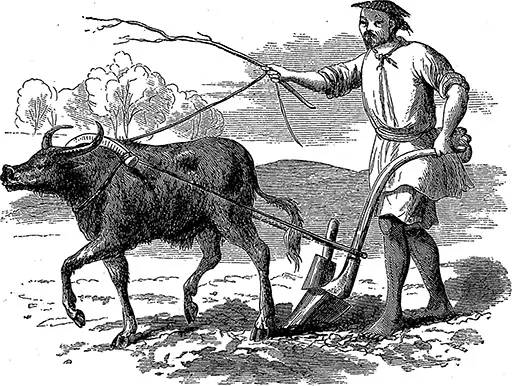
Ploughing with the Domesticated Buffalo.
In the suburbs of Fuhchau there are many establishments where large numbers of young men, women, and children are industriously employed during the tea season in sifting and sorting the leaves. Women and children earn from three to six cents per day, according to their skill and celerity, boarding themselves; while the young men receive from five to eight cents, besides their board, per day.
These facts, and others which might be added, show that tea can never be cultivated in Western or European countries to advantage. The high rate of wages in the United States, even if it would grow in the southern part of the country, would forbid the extensive and profitable cultivation of the tea-shrub. The same amount of capital, industry, and labour, employed in any of the common trades and occupations in that land, would be far more lucrative. Tea could not be offorred, if raised in America, at less than four or five times the cost per pound at which it can be offorred obtained from China.
The fields are cultivated by means of the plough and the harrow, drawn by the water-ox or domesticated buffalo, and by the hoe and light pickaxe. The use of the spade and the wheelbarrow is unknown, Women of the large or natural-footed class and men work at farming together. Such women also carry burdens in the same manner as men. Only one beast, guided by a rope tied to a ring in its nose, is used in ploughing. The common plough is simple and light, turning a narrow and shallow furrow. Rice, wheat, &c. are always reaped by the sickle or bill-hook. There are no cradles or machines for cutting grain, nor are there any machines used for threshing grain.
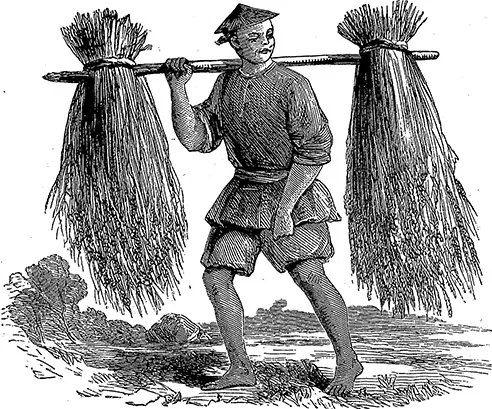
Carrying Bundles of Grain.
When it is necessary to transport the bundles from one part of the field to another for any purpose, they are carried in the usual manner of carrying other articles, by a pole laid across the shoulder, never on carts or wagons. Rice and wheat are usually threshed by beating on a frame of slats; sometimes by flails on the hard ground. A man takes a small quantity of the unthreshed grain in both hands, and strikes it f...
Table of contents
- Cover
- Title
- Copyright
- PREFACE.
- CONTENTS.
- LIST OF ILLUSTRATIONS.
- EXPLANATION OF TERMS.
- Introduction.—Chinese Life in Fuhchau
- Chapter I.—Agricultural and Domestic Matters
- Chapter II.—Betrothal and Marriage
- Chapter III.—Betrothal and Marriage—continued
- Chapter IV.—Married Life and Children
- Chapter V.—Superstitious Treatment of Disease
- Chapter VI.—Death, Mourning, and Burial
- Chapter VII.—Death, Mourning, and Burial—continued
- Chapter VIII.—Ancestral Tablets and Ancestral Halls
- Chapter IX.—Priests of the Three Religions
- Chapter X.—Popular Gods and Goddesses
- Chapter XI.—Popular Gods and Goddesses—continued
- Chapter XII.—Mandarins and their Subordinates
- Chapter XIII.—Mandarins and their Subordinates—continued
- Chapter XIV.—The State Religion
- Chapter XV.—Competitive Literary Examinations
- Chapter XVI.—Competitive Literary Examinations—continued
- Chapter XVII.—Competitive Literary Examinations—continued
- Chapter XVIII.—Chinese Anecdotes
- Chapter XIX.—Established Annual Customs and Festivals
- Chapter XX.—Established Annual Customs and Festivals—continued
- Chapter XXI.—Established Annual Customs and Festivals—continued
- Chapter XXII.—Singular and Popular Superstitions
- Chapter XXIII.—Business Customs
- Chapter XXIV.—Meritorious or Charitable Practices
- Chapter XXV.—Meritorious or Charitable Practices—continued
- Chapter XXVI.—Social Customs
- Chapter XXVII.—Social Customs—continued
- Chapter XXVIII.—Social Customs—continued
- Chapter XXIX.—Miscellaneous Opinions and Practices
- Chapter XXX.—Miscellaneous Opinions and Practices—continued
- Chapter XXXI.—Charms and Omens
- Chapter XXXII.—Fortune-Telling
- Chapter XXXIII.—Opium and Opium-Smoking
- Chapter XXXIV.—Missionary Topics
- Chapter XXXV.—Missionary Topics—continued
- Chapter XXXVI.—Interior View of Peking
- INDEX.
Trusted by 375,005 students
Access to over 1.5 million titles for a fair monthly price.
Study more efficiently using our study tools.
Frequently asked questions
Yes, you can cancel anytime from the Subscription tab in your account settings on the Perlego website. Your subscription will stay active until the end of your current billing period. Learn how to cancel your subscription
No, books cannot be downloaded as external files, such as PDFs, for use outside of Perlego. However, you can download books within the Perlego app for offline reading on mobile or tablet. Learn how to download books offline
Perlego offers two plans: Essential and Complete
- Essential is ideal for learners and professionals who enjoy exploring a wide range of subjects. Access the Essential Library with 800,000+ trusted titles and best-sellers across business, personal growth, and the humanities. Includes unlimited reading time and Standard Read Aloud voice.
- Complete: Perfect for advanced learners and researchers needing full, unrestricted access. Unlock 1.5M+ books across hundreds of subjects, including academic and specialized titles. The Complete Plan also includes advanced features like Premium Read Aloud and Research Assistant.
We are an online textbook subscription service, where you can get access to an entire online library for less than the price of a single book per month. With over 1.5 million books across 990+ topics, we’ve got you covered! Learn about our mission
Look out for the read-aloud symbol on your next book to see if you can listen to it. The read-aloud tool reads text aloud for you, highlighting the text as it is being read. You can pause it, speed it up and slow it down. Learn more about Read Aloud
Yes! You can use the Perlego app on both iOS and Android devices to read anytime, anywhere — even offline. Perfect for commutes or when you’re on the go.
Please note we cannot support devices running on iOS 13 and Android 7 or earlier. Learn more about using the app
Please note we cannot support devices running on iOS 13 and Android 7 or earlier. Learn more about using the app
Yes, you can access Social Life Of The Chinese by Justus Doolittle,Doolittle in PDF and/or ePUB format, as well as other popular books in History & Chinese History. We have over 1.5 million books available in our catalogue for you to explore.