This book draws together two domains of psychological theory, Vygotsky's cultural-historical theory of cognition and narrative theories of identity, to offer a way of rethinking the human subject as embodied, relational and temporal. A dialogue between these two ostensibly disparate and contested theoretical trajectories provides a new vantage point from which to explore questions of personal and political change.
In a world of deepening inequalities and increasing economic precarity, the demand for free, decolonised quality education as articulated by the South African Student Movement and in many other contexts around the world, is disrupting established institutional practices and reinvigorating possibilities for change. This context provokes new lines of hopeful thought and critical reflection on (dis)continuities across historical time, theories of (social and psychological) developmental processes and the practices of intergenerational life, particularly in the domain of education, for the making of emancipatory futures.
This is essential reading for academics and students interested in Vygotskian and narrative theory and critical psychology, as well as those interested in the politics and praxis of higher education.
Vygotsky’s subject is a storytelling animal. Reframing Vygotsky’s subject (in both senses, his subject of study, but also his conceptualisation of the human “subject”) in narrative terms is premised on the pivotal role of language in his theory that not only serves to carry cultural history and thus construct the social subject, but is also a natural, universal human capacity. The internalisation of the contents of social talk, the cultural baggage (or capital) of history is well recognised as constituting the “social subject”, or reformulates Vygotsky’s position as “society in mind”. Storytelling or narration enables us to become quite other than our natural selves, quite different in kind than even our nearest animal relatives, not only in our capacity to tell stories, but also through our narration of life. However, this social subject constituted in the world of language and meaning remains entirely natural, embodied in the material world. There is nothing more “natural” to human life than the use of signs and the telling of stories: it is intrinsic to the kind of animal that human beings are. This first chapter will draw together the resources of Vygotskian theory and narrative psychology for rethinking personhood as embodied, temporal and relational. Several themes that will run throughout the text will be introduced, in particular, highlighting the role of language in the formation of psychosocial life through internal conversations, dialogue and the narration of the self.
Both Vygotskian theory and narrative psychology are approaches more properly described as theory-methods or innovative ways of thinking about persons in terms of dynamic processes rather than as circumscribed entities. In outlining Vygotsky’s “enabling theory-method”, Shotter (2000, p. 234) emphasises the “responsivity of growing and living forms, both to each and to the otherness in their surroundings, and on their own particular and unique ways of coming-into-Being”. Narrative psychology emphasises the temporal quality of human life that biologically unfolds inexorably forwards but in psychological terms is constituted through perpetual oscillations back and forth in time in which each fleeting present moment is infused with memories of the past and tenuously connected by intention and imagination to projected futures. This emphasis on the living processes of changing subjects requires a very different conceptual and methodological approach to aspirations to science and the taxonomically descriptive language that characterises much of psychology’s history. Vygotsky’s theory-method attempts to trace the origins and course of development of psychosocial functions. His focus is not on the “fossilised” products of human behaviour in finished current forms but on “the very process of genesis or establishment of the higher form caught in a living aspect” (Vygotsky, 1997, p. 71, emphasis added). This conceptualisation of history does not refer to a static archive but to a flow of activity in which present forms of life participate: “It is here that the past and the present are fused and the present is seen in the light of history” (Shotter, 2000, p. 236).
These sociohistorical processes are woven through intergenerational narratives that both constrain and enable possibilities for change. While history and culture shape both the contents and forms of our narratives, it is because we are storytelling creatures that history and culture are possible at all. The subjects of psychology, human beings, are both subject to and subjects of change, but we have been slow to recognise the methodological implications of this understanding, amusingly captured in the injunction from Harré and Secord (1972, p. 84): “for scientific purposes, treat people as if they were human beings”.1
Vygotsky’s theory: society in mind
Vygotskian theory is typically understood as an account of the powerful sociohistorical and cultural effects on the formation of human mind, and his concepts of mediation and the zone of proximal development are now established received wisdoms in psychological theory and educational applications. However, as important as this contribution is in deepening our understanding of children’s development in context, the more thoroughly radical and transformative implications of Vygotskian theory are often eclipsed or erased: minds are always “in society” (or social contexts) but critically, they are also always infused with the social; society is “in mind”. Thus, Vygotsky provides us with a developmental account of human consciousness as articulated in and through sociohistorical processes. Vygotsky’s approach, in similar vein to other stage theorists such as Freud, Erikson and Piaget,2 focuses on ontogenetic development as a route to explaining the processes of psychological life.
While Vygotsky and Piaget are often understood as providing antithetical theories of cognitive development, the two theories provide divergent but complementary, rather than opposing, explanatory accounts of the human mind. Piaget explains human consciousness as constructed in and through the mental operations of mind in transaction with the material world. His purpose is to neutralise the effects of culture or the malleable historical elements of human life, which he acknowledged as necessary but insufficient for cognitive development.3 In this way, his theoretical project is to abstract ontogenetic, species-specific universals from multiple empirical studies of children’s engagement with cognitive tasks. By contrast, Vygotsky acknowledges the necessity of the material fabric of both individual mental life and collective social life, but focuses on how these resources are insufficient to either effect or explain development or change.
Collective histories inform our current individual modes of being and the traces of the past create the contours of present life, and constrain our imaginative future projections. To put this idea into the psychological language of development, into Vygotskian language, the world is always mediated. Unlike the Piagetian baby who crawls and grasps towards the object desired, the mother of Vygotsky’s baby inserts herself between the baby’s grasping action and the object, interpreting her baby’s action and providing the desired object. By conferring meaning on the grasping action, it is transformed into a gesture of desire, pointing, that is a meaningful gesture of communication with another person, directing her attention to the object and “requesting” assistance. In this way, Vygotsky argues, the “[t]he path from the object to the child and from the child to the object, passes through another person” (1978, p. 30), prism-like, radically altering its quality and the form of experience.
The focus on ontogenetic development is thus a theory-method for Vygotsky, a vehicle for exploring and accounting for the dynamic historical development of cultural life and the intellectual actions of persons in the making of human history. Marx’s visceral image of the intertwining of the past and present resonates:
Men make their own history, but they do not make it as they please; they do not make it under self-selected circumstances, but under circumstances existing already, given and transmitted from the past. The traditions of all dead generations weighs like a nightmare on the brains of the living.
(Marx, 1852)
The theoretical lenses of sociohistorical psychology enable us to engage with the (im)possibilities of changing our worlds and selves in the landscape of this living nightmare by recognising that social and psychological phenomena are intertwined rather than oppositional. Thinking about change entails attending to both social structure and individual agency, adopting a stance that Michelle Fine (2018) calls “critical bifocality”. This requires a willingness to learn new ways of seeing, shifting our focus from persons to the social world and back again. But these alternations in focus are an analytic necessity rather than a reflection of the phenomenon of change. The domain that is currently in sharp focus (whether social or individual) remains intertwined with the blurry zone that has temporarily receded beyond our immediate attention. The key to active developmental processes of change, and to a “bifocal” vision of these processes, both within and beyond mind, is language.
Language for thought: conceptualising the world
First, I want to emphasise, following Vygotsky, that human language is conceptual not just expressive or communicative, although of course this is its most obvious function, in common with the languages of other social animals.
When we meet what is called a cow and say “this is a cow,” we add the act of thinking to the act of perception, bringing the given perception under a general concept. A child who first calls things by their names is making genuine discoveries. I do not see that this is a cow, for this cannot be seen. I see something big, black, moving, lowing, etc., and understand that this is a cow. And this act is an act of classification, of assigning a singular phenomenon to the class of similar phenomena, of systematizing the experience, etc.
(Vygotsky, 1987, pp. 249–250)
This abstraction from life is what makes it possible for us to “see” multiple objects from multiple angles which are, in simple visual or perceptual terms, very different indeed, as “cows”. As Vygotsky argues, we can detach the word from the world (the specific object referent) and indeed, further, detach the meaning from the word. Generalisation, systematisation and classification thus underpin all language. In other words, a kind of thinking is entailed in all language, allowing for the creation of complex systems and relations of meaning and enabling us to establish new relations between ourselves and the world. (These complex relations are extended in formal instruction, writing and other forms of symbolic representation.)
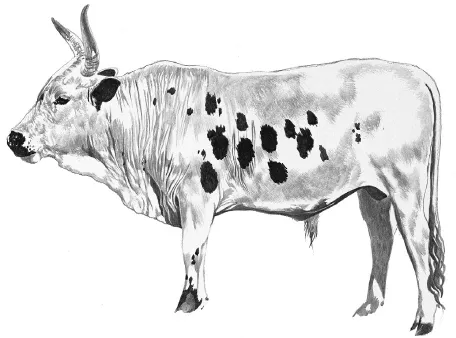
I am from a part of South Africa called KwaZulu-Natal and from there comes the beautiful book Abundant Herds: A Celebration of the Nguni Cattle of the Zulu People by Marguerita Poland and David Hammond-Tooke (2003). The following images of Nguni cattle from the book are by Leigh Voigt (see Figures 1.1 and 1.2).
FIGURE 1.1 Abundance
Reproduced by kind permission of the artist, Leigh Voigt
FIGURE 1.2 Houses
Reproduced by kind permission of the artist, Leigh Voigt
These images offer a glimpse of an intricate story about culture and symbolic naming of the world. Cows are, throughout the world, concrete material objects of great utilitarian value for their milk and meat and skins. Moreover, in Zulu culture, as in many other African cultures, cattle are units of exchange for lobola (often crudely and inaccurately translated as “bride price” in English) and other practices (such as the payment of “damages” to repair breaches in relationships or as offerings to ancestors). In other words, cattle are central to both economic and social relations. Beyond this, the naming of these individual cows for the visual patterns of their hides speaks to questions of aesthetics and meaning and cultural history. Children in these cultural worlds encounter far more than “something big, black, moving, lowing” and also, far more than simply the synthesis of these material elements into the abstract category of “cow”. Tracing a simple dialogical exchange between a 7-year-old child in the Eastern Cape of South Africa and a documentary interviewer in the BBC Seven-Up series (1992), provides us with a vivid instantiation of this insertion into language and meaningful histories.
INTERVIEWER: How many cattle are there at your place?
LINDA4: 19.
INTERVIEWER: Do you know them all?
LINDA: Yes.
INTERVIEWER: Which are your favourites? Tell me their names.
LINDA: Tamblain and Holland.
INTERVIEWER: Who names them?
LINDA: When I was born, they were already here, so I don’t know who named them.
INTERVIEWER: So they were here. Don’t the small ones have names?
LINDA: Yes.
INTERVIEWER: What?
LINDA: One is Wazibula. The others are calves.
INTERVIEWER: Who named them?
LINDA: Elder brother.
INTERVIEWER: Did you name any?
LINDA: No.
INTERVIEWER: Why not?
LINDA: Elder brother says little boys give cattle bad names.
INTERVIEWER: Why?
LINDA: They don’t sound right.
This little boy makes two pertinent observations about the naming of cows: first, he resists the interviewer’s question about the naming of his favourite cattle as “they were here before me”. We, each one of us, always arrive into a social world already structured, in which meaning is already sedimented, a world already named in language. We are inserted into relations of kinship and culture, into the flows and prejudices of what Gadamer (1975) calls “tradition” or Merleau-Ponty (2013) calls “sedimentation”. Second, he repeats his older brother’s observation that “little boys give cows bad names”. This disciplining of young subjects is ubiquitous; we socialise the young into our ways of doing and being and through their engagement with others (and the cultural artefacts of the social world) children are enculturated. However, we always have the capacity for becoming what Judith Butler (1997) calls “bad subjects” and perhaps this potential is most evident in the young; each successive generation is simultaneously trapped and yet escapes the “prison house” (Jameson, 1975) of language. This is possible because language is internalised not as an inert set of “instructions” or even a set of potential meanings that must simply then be articulated anew in the appropriate circumstances. Rather, language is internalised as dialogue, enabling us to talk to ourselves and, in Vygotskian terms, to self-regulate.
Mediation: narrating action and dialogical selves
By focusing on the developmental stage of egocentric speech in young children, catching speech on its route inward, Vygotsky was able to delineate the functions of inner speech. A famous story from Vygotsky illustrates how talking to oneself enables new relations with the world and transforms thought and action. A little girl is observed solving a problem of great importance to any small child: how to obtain sweets that are beyond the reach of her short arms!
(Stands on a stool, quietly looking, feeling along a shelf with stick)
“On the stool.” (glances at the experimenter. Puts stick in other hand.)
“Is that really the candy?” (Hesitates)
“I can get it from that other stool, stand and get it.” (Gets second stool.)
“No, that doesn’t get it. I could use the stick.” (Takes stick, knocks at the candy.)
“It will move now.” (Knocks candy.)
“It moved, I couldn’t get it with the stool, but the, but the stick worked”.
(Vygotsky, 1978, p. 25)
This story demonstrates the way in which, as Vygotsky (1999, p. 50) says, “children solve problems not just with their hands and eyes but with their speech as well”. The little girl comments on her actions, plans what to do next, co-ordinates and re-organises objects and, finally, concludes with a model of successful action that might be usefully deployed in future to solve similar problems: “I couldn’t get it with the stool, but the, but the stick worked.” Language thus enables decontextualisation, the restructuring of the perceptual field, the imagining of alternatives, the possibility of memory, and the transferability of understanding to new situations.
While each successive generation is born into a pre-existing (social) world and cannot escape history or stand outside of culture, the very nature of language ...
SECTION 2: Conceptual tools from the south: changing the subject of psychology
SECTION 3: Intergenerational subjects in changing worlds
Bibliography
Index
Trusted by 375,005 students
Access to over 1.5 million titles for a fair monthly price.
Study more efficiently using our study tools.
Frequently asked questions
Yes, you can cancel anytime from the Subscription tab in your account settings on the Perlego website. Your subscription will stay active until the end of your current billing period. Learn how to cancel your subscription
No, books cannot be downloaded as external files, such as PDFs, for use outside of Perlego. However, you can download books within the Perlego app for offline reading on mobile or tablet. Learn how to download books offline
Perlego offers two plans: Essential and Complete
Essential is ideal for learners and professionals who enjoy exploring a wide range of subjects. Access the Essential Library with 800,000+ trusted titles and best-sellers across business, personal growth, and the humanities. Includes unlimited reading time and Standard Read Aloud voice.
Complete: Perfect for advanced learners and researchers needing full, unrestricted access. Unlock 1.5M+ books across hundreds of subjects, including academic and specialized titles. The Complete Plan also includes advanced features like Premium Read Aloud and Research Assistant.
Both plans are available with monthly, semester, or annual billing cycles.
We are an online textbook subscription service, where you can get access to an entire online library for less than the price of a single book per month. With over 1.5 million books across 990+ topics, we’ve got you covered! Learn about our mission
Look out for the read-aloud symbol on your next book to see if you can listen to it. The read-aloud tool reads text aloud for you, highlighting the text as it is being read. You can pause it, speed it up and slow it down. Learn more about Read Aloud
Yes! You can use the Perlego app on both iOS and Android devices to read anytime, anywhere — even offline. Perfect for commutes or when you’re on the go. Please note we cannot support devices running on iOS 13 and Android 7 or earlier. Learn more about using the app
Yes, you can access Narrative Psychology and Vygotsky in Dialogue by Jill Bradbury in PDF and/or ePUB format, as well as other popular books in Psychology & History & Theory in Psychology. We have over 1.5 million books available in our catalogue for you to explore.