![]()
1
Being a Logical Thinker
Understanding yourself
Do you tend to work things out logically? Are you systematic in the way you approach tasks and solve problems? Ever wondered why some people don’t seem to understand what you mean and others just don’t make any sense at all? Do others tell you to make the ‘right choice’ without being clear what they perceive the ‘right choice’ to be? Do you ever wonder if there is something different about you, or them?
It may well be that you simply are a logical thinker, and see the world in a different way to others. This book is about considering about whether you observe, analyse and engage in tasks, conversations and relationships in a logical way and it attempts to offer an explanation of different ways of thinking as well as some practical tools to help you negotiate the minefield of social interaction and communication.
Let’s start with the admission that we are human, and so this book, as it has been written by a human, is not necessarily factual, and in fact, there may be many aspects you do not think are like you and other things that you can relate with.
This is OK.
Being human means we are complex.
We have our own thoughts, feelings and ideas and have experienced life in different ways to others. As much we might wish we could predict others’ behaviour and that their actions always made sense; beings which can be programmed to produce predictable results, the human element means this is not always possible.
This is not a book about how to change yourself or please other people. It is a book to further your understanding, generate questions and develop ideas on social communication and interaction.
This book offers guidelines and information about some areas of social communication and interaction that may interest you. The activities are there for you to try out and see if they give you better understanding of human behaviour. If you are happier or more OK in social situations afterwards, this is great.
It does not mean you should change who you are, although developing ourselves and learning new ways to behave could be a good thing.
It is extremely important that you learn to be happy with who you are as a person. The way you think is important and what you do and how you do it is important too. This book may help you find ways to relate and communicate with others, if that is what you want.
Types of thinker
Professor Simon Baron-Cohen has done research on how we think and behave as people and he has written books and research papers over many years. Here is one of the ways he believes we can think about differences:
There are different ways that we process information and understand the world.
| Empathizing | Systemizing |
| 'Empathizing is the drive to identify another person's emotions and thoughts, and to respond to them with an appropriate emotion' (Baron-Cohen, 2004, p.2). | 'Systemizing is the drive to analyze, explore, and construct a system. The systemizer intuitively figures out how things work, or extracts the underlying rules that govern the behavior of a system. This is done in order to understand and predict the system, or to invent a new one' (Baron-Cohen, 2004, p.3). |
| It is the ability to understand and relate to other people's feelings, thoughts and attitudes. People who are highly empathic will be able to understand why others behave in particular ways and can instinctively feel what another person may be feeling. | People who are good systemizers can instinctively recognize and interpret systems and are able to identify and apply rules. |
| They may be able to predict how someone may react in particular circumstances. | Once rules are understood, a good systemizer can use them to predict things that will occur in that system. |
| So, a highly empathic person may be able to feel that someone is upset when their pet dies and responds by offering words of comfort. | So, for example someone who is a systematic thinker may be able to use the calendar system to predict which day of the week 24th January will be on in 20 years' time. |
Professor Simon Baron-Cohen writes about how some people tend to be better at empathizing and others are more systematic in their approach to the world. He does not say one way is better than the other, just that there are differences.
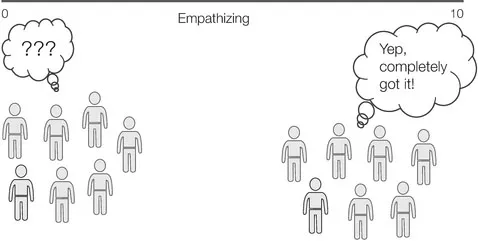
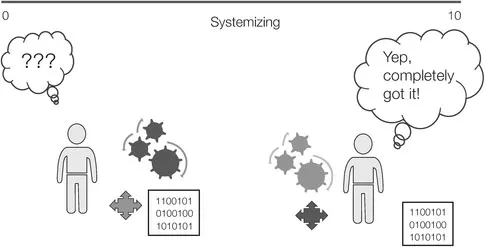
Let’s use these ideas and put them on scales where 10 = extremely good and 0 = not good at all:
So if everyone put themselves on the scales, we would see some are better at systemizing, some are better at empathizing while others may be particularly good at both.
This means that some of us relate more to the empathic way of thinking and processing, and respond to people and situations better whilst others apply more logic to the world as we see it.
Intelligently different
Professor Howard Gardner is someone else who has researched people and how we work. He doesn’t see intelligence as a single scale, or number but as types. So, it is not ‘How intelligent are you?’ that we should ask, but ‘In what ways are you intelligent?’
Gardner believes we are all intelligent in different ways and that one way is not superior or inferior to the others. Each way of being intelligent represents how we process information. Below are some of the ways he thinks we are intelligent.
Linguistic intelligence
An ability to analyze information and create products involving oral and written language such as speeches, books, and memos.
Logical-mathematical intelligence
An ability to develop equations and proofs, make calculations, and solve abstract problems.
Spatial intelligence
An ability to recognize and manipulate large-scale and fine-grained spatial images.
Musical intelligence
An ability to produce, remember, and make meaning of different patterns of sound.
Naturalist intelligence
An ability to identify and distinguish among different types of plants, animals, and weather formations that are found in the natural world.
Bodily-kinaesthetic intelligence
An ability to use one’s own body to create products or solve problems.
Interpersonal intelligence
An ability to recognize and understand other peopl...